

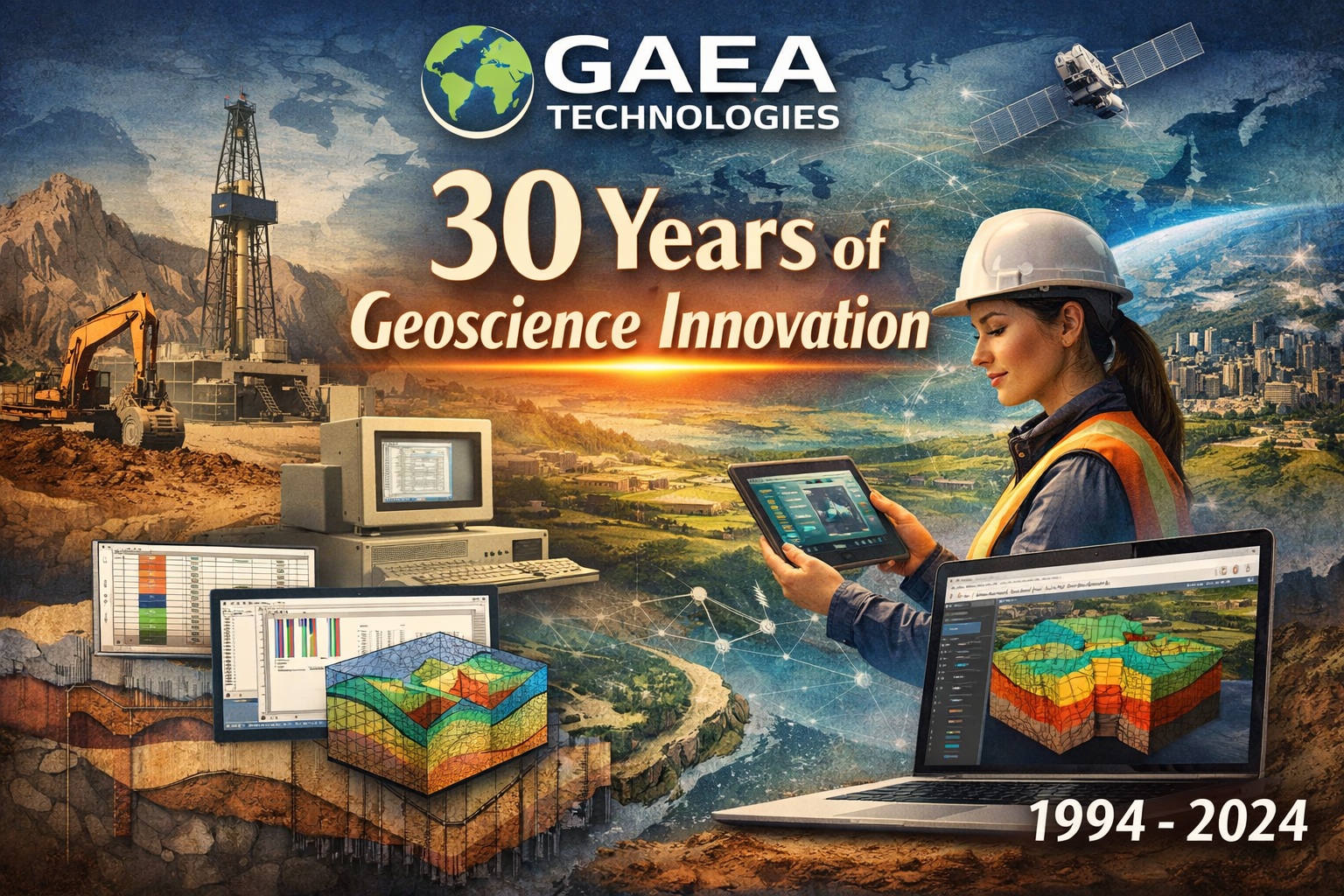
Introduction
For over three decades, GAEA Technologies Ltd. has quietly shaped the evolution of geoscience and engineering workflows across the globe. From its early beginnings in the mid-1990s to its present-day role as a provider of integrated geotechnical, environmental, and geological software solutions, the company’s journey reflects a broader transformation within the geoscience industry itself.
Founded in 1994 and headquartered in Cambridge, Ontario, GAEA Technologies emerged at a time when digital transformation in geoscience was still in its infancy. Over the years, its tools have been adopted by thousands of organizations in more than 80 countries, helping professionals manage, visualize, and interpret complex subsurface data.
This is the story of how GAEA Technologies evolved—from a niche software developer into a long-standing innovator—by staying true to a simple philosophy: build tools for geoscientists, by geoscientists.
The Early Years: A Vision Takes Shape (1990s)
The early 1990s were a turning point for geoscience. Personal computing was becoming more accessible, but most geological and geotechnical workflows remained manual, fragmented, and inefficient. Data was often stored in spreadsheets, handwritten logs, or disparate systems that made collaboration difficult.
It was within this environment that GAEA Technologies was founded.
From the outset, the company focused on solving real-world problems faced by engineers and geoscientists. Rather than building generic software, GAEA took a highly specialized approach—developing tools tailored specifically to subsurface investigations, environmental assessments, and resource evaluation.
This focus would become a defining characteristic of the company.
The founding vision was clear:
- Bridge the gap between field data and digital analysis
- Improve accuracy and efficiency in subsurface interpretation
- Create intuitive tools that reflect real geoscience workflows
By embedding domain expertise directly into software design, GAEA distinguished itself early from general-purpose software vendors.
Building the Foundation: Specialized Tools for a Growing Industry
As the geoscience industry expanded in the late 1990s and early 2000s, so did the demand for better data management and visualization tools. Infrastructure development, environmental regulations, and resource exploration all required more sophisticated analysis of subsurface conditions.
GAEA responded by developing a suite of purpose-built applications, including:
- WinLoG – for borehole and well log visualization
- WinFence – for cross-sections and fence diagrams
- POLLUTEv8 – for contaminant transport modeling
- EDMS – for environmental data management
- GDMS – for geotechnical data management
- GaeaSynergy – for integrated geoscience workflows
These tools addressed specific pain points within the industry—turning raw field data into actionable insights.
What set GAEA apart was not just the functionality of its software, but its usability. The company prioritized intuitive interfaces and workflows that mirrored how geoscientists actually work. This reduced training time and increased adoption across organizations.
As a result, GAEA’s solutions began to gain traction internationally, eventually reaching thousands of users worldwide. ()
A Philosophy That Endured: Built by Experts, for Experts
One of the most consistent themes throughout GAEA’s history is its commitment to domain-driven development.
Unlike many software companies that rely solely on developers, GAEA’s products have been shaped by geoscientists and engineers themselves. ()
This approach ensured that:
- Features addressed real-world challenges
- Interfaces aligned with industry workflows
- Outputs met regulatory and reporting standards
It also allowed the company to maintain close relationships with its users. Feedback from practitioners directly influenced product evolution, creating a continuous cycle of improvement.
This philosophy became especially important as the complexity of geoscience projects increased.
Adapting to Industry Transformation (2000s–2010s)
The 2000s and 2010s brought significant changes to the geoscience landscape:
- Increased environmental regulations
- Growth in infrastructure and urban development
- Expansion of global resource exploration
- Rising demand for data integration and visualization
At the same time, technology was advancing rapidly. Geographic Information Systems (GIS), 3D modeling, and cloud computing began to reshape how data was managed and interpreted.
GAEA Technologies adapted by evolving its software ecosystem.
Key Developments
1. Integration of Multiple Data Types
Instead of treating datasets in isolation, GAEA began integrating geological, geotechnical, and environmental data into unified platforms.
2. Enhanced Visualization
Tools like cross-sections, 3D views, and interactive maps became central to decision-making.
3. Scalable Data Management
With the introduction of systems like EDMS, organizations could manage large volumes of environmental data more efficiently.
4. Improved Collaboration
As projects became more complex, GAEA’s tools supported collaboration across teams and disciplines.
These advancements positioned the company as more than just a software provider—it became a workflow enabler.
The Rise of Integrated Platforms: Enter GaeaSynergy
One of the most significant milestones in GAEA’s evolution was the development of GaeaSynergy.
Rather than offering standalone tools, GaeaSynergy represents a unified platform that brings together:
- Data management
- Visualization
- Reporting
- Collaboration
This shift reflected a broader industry trend toward integration.
Geoscience projects increasingly require:
- Real-time data access
- Cross-disciplinary coordination
- Centralized project management
GaeaSynergy addresses these needs by providing a cohesive environment where all project data can be accessed and analyzed in one place.
Recent enhancements—such as advanced dashboards, license monitoring, and project visualization tools—demonstrate the platform’s continued evolution in response to user needs.
Global Reach, Local Expertise
Although headquartered in Cambridge, Ontario, GAEA Technologies has achieved a global presence.
Its software is used by organizations in more than 120 countries, spanning industries such as:
- Environmental consulting
- Geotechnical engineering
- Oil and gas
- Mining
- Infrastructure development
Despite this global reach, the company has maintained a strong connection to its local roots.
Being based in Canada—particularly in a region known for engineering and environmental expertise—has allowed GAEA to stay closely aligned with industry standards and regulatory frameworks.
This balance between global scalability and local expertise has been key to its long-term success.
Leadership and Longevity
Sustaining innovation over 30 years requires consistent leadership and a clear vision.
Since its founding, GAEA Technologies has been led by experienced professionals with deep roots in geoscience and engineering. Leadership continuity has helped the company maintain strategic focus while adapting to industry changes.
This stability has enabled GAEA to:
- Invest in long-term product development
- Build lasting relationships with clients
- Maintain a strong reputation within the industry
In an era where many tech companies prioritize rapid growth over sustainability, GAEA’s steady approach stands out.
Innovation Through Practical Problem-Solving
GAEA’s innovation has never been about chasing trends—it has always been about solving real problems.
Some of the key challenges the company has addressed include:
- Managing fragmented subsurface data
- Visualizing complex geological conditions
- Ensuring compliance with environmental regulations
- Improving efficiency in field-to-office workflows
By focusing on practical solutions, GAEA has built tools that deliver measurable value.
This approach has also allowed the company to remain relevant across decades of technological change.
The Digital Transformation of Geoscience
Today, the geoscience industry is undergoing another major transformation—driven by digital technologies such as:
- Cloud computing
- Big data analytics
- Artificial intelligence
- Digital twins
GAEA Technologies is well-positioned within this evolving landscape.
Its long-standing expertise in data management and visualization provides a strong foundation for adopting new technologies.
Platforms like GaeaSynergy are already moving toward more connected, data-driven workflows—enabling organizations to make faster and more informed decisions.
Challenges and Opportunities Ahead
Like any long-standing company, GAEA faces both challenges and opportunities.
Challenges
- Keeping pace with rapid technological change
- Meeting evolving regulatory requirements
- Competing with larger software providers
Opportunities
- Expanding cloud-based solutions
- Integrating AI-driven analytics
- Enhancing real-time collaboration tools
- Supporting sustainability and environmental initiatives
The company’s history suggests that it is well-equipped to navigate these challenges.
Looking Forward: The Next Chapter
As GAEA Technologies enters its fourth decade, its mission remains as relevant as ever.
The need for accurate, efficient, and integrated geoscience tools continues to grow—driven by global challenges such as:
- Climate change
- Urbanization
- Resource management
- Environmental protection
By continuing to innovate while staying grounded in real-world applications, GAEA is poised to play a key role in the future of geoscience.
Conclusion
The story of GAEA Technologies is not just about software—it is about the evolution of an industry.
From its beginnings in 1994 to its current role as a global provider of geoscience solutions, the company has consistently focused on one goal: empowering professionals with better tools to understand the subsurface world.
Over 30 years, this commitment has resulted in:
- Widely adopted software solutions
- Long-term client relationships
- Continuous innovation in geoscience workflows
As the industry continues to evolve, GAEA Technologies stands as a testament to what can be achieved through expertise, focus, and a deep understanding of user needs.
Its journey is far from over—but its impact is already firmly established.