

Introduction
In the world of geotechnical engineering, environmental consulting, and geological analysis, software has traditionally been built around data structures, not people. Tables, schemas, and databases often take center stage, while the real users—engineers and geoscientists—are left adapting their workflows to fit rigid systems.
At GAEA Technologies, we saw this disconnect firsthand.
Engineers weren’t struggling because they lacked data. They were struggling because the tools they used didn’t reflect how they actually think, work, or make decisions.
That realization became the foundation for GaeaSynergy.
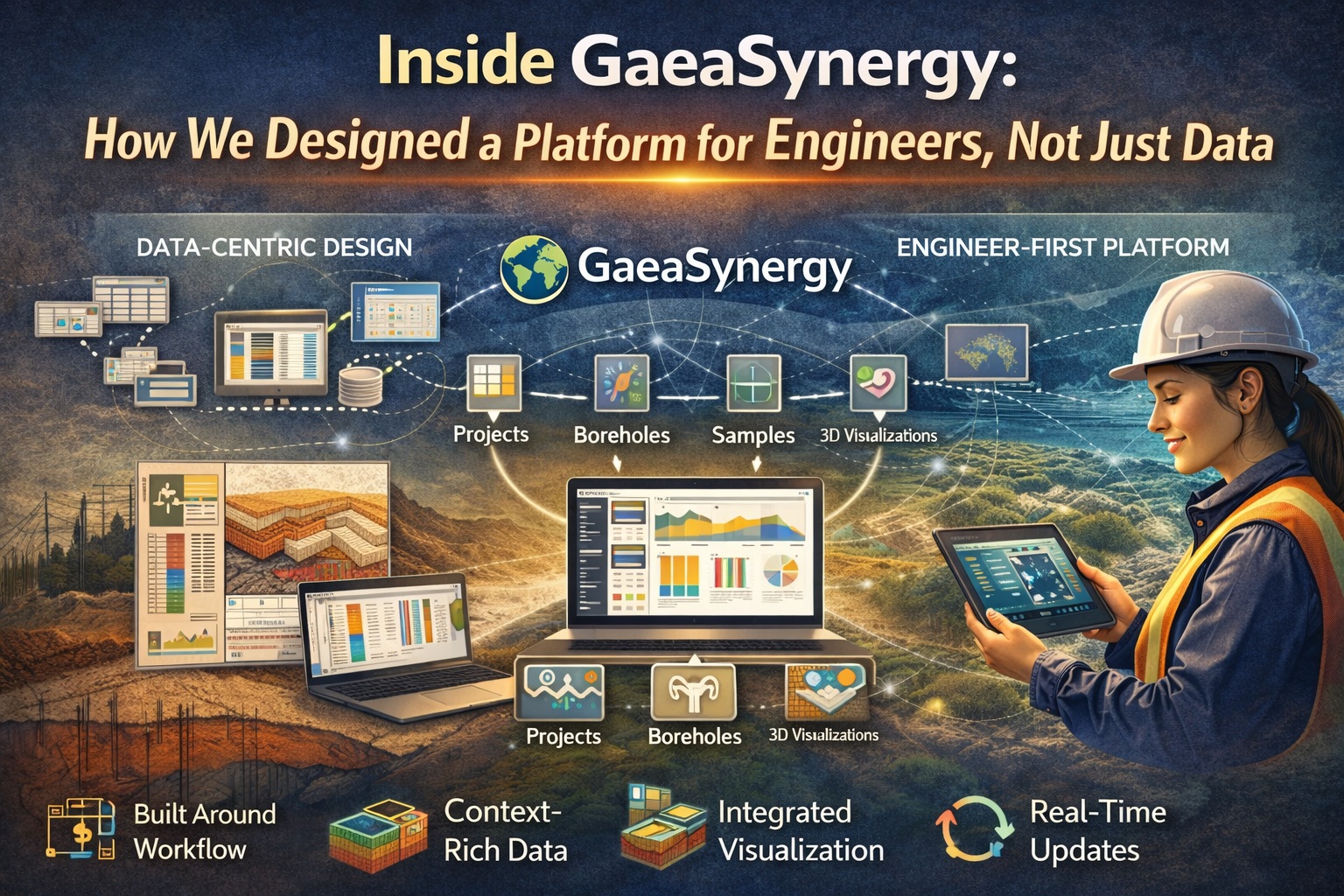
We didn’t set out to build another data platform. We set out to build a system designed around engineers’ workflows, geoscience logic, and real-world project demands.
This is an inside look at how GaeaSynergy was designed—not just as a data management system, but as a platform built for engineers from the ground up.
The Problem with Data-Centric Software
Most traditional systems in the geoscience space are built with a data-first mindset:
- Structured databases define everything
- Interfaces mirror backend schemas
- Users must adapt to system constraints
While this approach ensures data consistency, it often comes at a cost.
Where Data-Centric Design Falls Short
Engineers don’t think in rows and columns—they think in:
- Boreholes and stratigraphy
- Cross-sections and spatial relationships
- Field observations and site conditions
When software forces users into rigid data structures:
- Workflows become fragmented
- Tasks take longer than necessary
- Context is lost between steps
In short, the software becomes a barrier instead of a tool.
A Different Approach: Engineer-First Design
When we began developing GaeaSynergy, we flipped the traditional model.
Instead of asking:
“How should we structure the data?”
We asked:
“How do engineers actually work?”
This shift led to a fundamentally different design philosophy:
Build Around Workflows, Not Tables
Rather than exposing users to raw data structures, GaeaSynergy organizes functionality around:
- Projects
- Sites
- Boreholes
- Samples
- Visualizations
- Reports
Each element reflects how engineers naturally approach their work.
Understanding Real-World Workflows
To design effectively, we needed to understand the full lifecycle of a geoscience project.
From Field to Final Report
A typical workflow includes:
- Data Collection
- Borehole drilling
- Sampling
- Field logging
- Data Processing
- Lab analysis
- Data entry and validation
- Interpretation
- Cross-sections
- Geological modeling
- Reporting
- Figures and charts
- Final deliverables
Most systems treat these steps as separate processes.
GaeaSynergy connects them into a continuous flow.
Designing Around Context, Not Just Content
One of the most important design decisions was to preserve context.
Why Context Matters
Data without context is just numbers.
Engineers need to understand:
- Where data came from
- How it relates to other data
- What it means in a spatial and geological sense
How GaeaSynergy Maintains Context
- Borehole data is linked to location and stratigraphy
- Samples are connected to depth and source
- Lab results are tied directly to field data
- Visualizations reflect real-time data relationships
This ensures that users never lose sight of the bigger picture.
The Power of Visual Thinking
Engineers and geoscientists are highly visual thinkers.
They rely on:
- Maps
- Cross-sections
- 3D models
Yet many systems treat visualization as an afterthought.
Visualization as a Core Feature
In GaeaSynergy, visualization is not separate from data—it is part of it.
- Cross-sections update automatically as data changes
- Maps are directly linked to datasets
- 3D views provide deeper insight into subsurface conditions
This allows users to move seamlessly between data and interpretation.
Simplifying Complexity Without Losing Power
Geoscience data is inherently complex.
The challenge is not to remove that complexity—but to manage it effectively.
Avoiding Over-Simplification
Some systems try to simplify by limiting functionality.
We took a different approach:
- Preserve full data depth
- Provide intuitive ways to interact with it
Layered Interfaces
GaeaSynergy uses layered design:
- High-level views for quick insights
- Detailed views for in-depth analysis
Users can zoom in and out—both visually and conceptually.
Real-Time Integration: Eliminating Workflow Gaps
One of the biggest frustrations in traditional systems is the gap between steps.
- Data is exported
- Re-imported into another tool
- Manually updated
This breaks the workflow.
A Continuous Data Flow
GaeaSynergy eliminates these gaps:
- Data flows seamlessly between modules
- Updates occur in real time
- Outputs always reflect the latest information
This creates a truly connected environment.
Designing for Collaboration
Engineering projects are rarely solo efforts.
They involve teams of:
- Engineers
- Geologists
- Environmental scientists
- Project managers
The Challenge of Team-Based Work
In fragmented systems:
- Data is shared through files
- Communication is manual
- Version control becomes a problem
Built-In Collaboration
GaeaSynergy is designed for team environments:
- Shared access to centralized data
- Real-time updates across users
- Consistent information for all stakeholders
This reduces friction and improves coordination.
Flexibility Without Chaos
Engineers need flexibility—but too much flexibility can lead to inconsistency.
Striking the Balance
GaeaSynergy provides:
- Structured data models
- Standardized workflows
While still allowing:
- Custom project configurations
- Adaptation to different project types
This ensures both consistency and adaptability.
Performance Matters
Large datasets are common in geoscience.
- Thousands of boreholes
- Extensive lab results
- Complex spatial data
Designing for Scale
GaeaSynergy is built to handle:
- High data volumes
- Complex relationships
- Real-time processing
Without compromising performance.
Learning Curve: Reducing Friction
A powerful system is only useful if people can actually use it.
Common Pitfalls
Many platforms suffer from:
- Steep learning curves
- Complex interfaces
- Extensive training requirements
Intuitive Design
By aligning the platform with real workflows:
- Users recognize familiar concepts
- Navigation feels natural
- Training time is reduced
This accelerates adoption across teams.
Feedback-Driven Development
GaeaSynergy wasn’t built in isolation.
It evolved through continuous feedback from:
- Engineers
- Consultants
- Industry professionals
Iterative Improvement
User feedback influenced:
- Feature development
- Interface design
- Workflow optimization
This ensures the platform remains aligned with real needs.
Security and Reliability
With centralized data comes responsibility.
Protecting Critical Information
GaeaSynergy is designed with:
- Secure data storage
- Controlled access permissions
- Reliable backup systems
Ensuring data integrity at all times.
Beyond Data: Supporting Decision-Making
Ultimately, the goal of any engineering platform is not just to manage data—but to support decisions.
From Data to Insight
By integrating data, visualization, and workflows:
- Patterns become clearer
- Risks are easier to identify
- Decisions are more informed
The Bigger Picture: A Shift in Software Design
GaeaSynergy represents a broader shift in how software is built.
From:
- Data-centric systems
To:
- User-centric platforms
Why This Matters
As projects become more complex and data volumes grow:
- Engineers need better tools
- Workflows need to be more efficient
- Insights need to be faster
Platforms designed for users—not just data—will define the future.
Conclusion
Designing GaeaSynergy was not about building another database.
It was about rethinking how geoscience software should work.
By focusing on:
- Real workflows
- Contextual data
- Visual understanding
- Seamless integration
We created a platform that supports engineers in the way they actually work.
Because at the end of the day:
It’s not just about managing data.
It’s about empowering the people who use it.