

Introduction
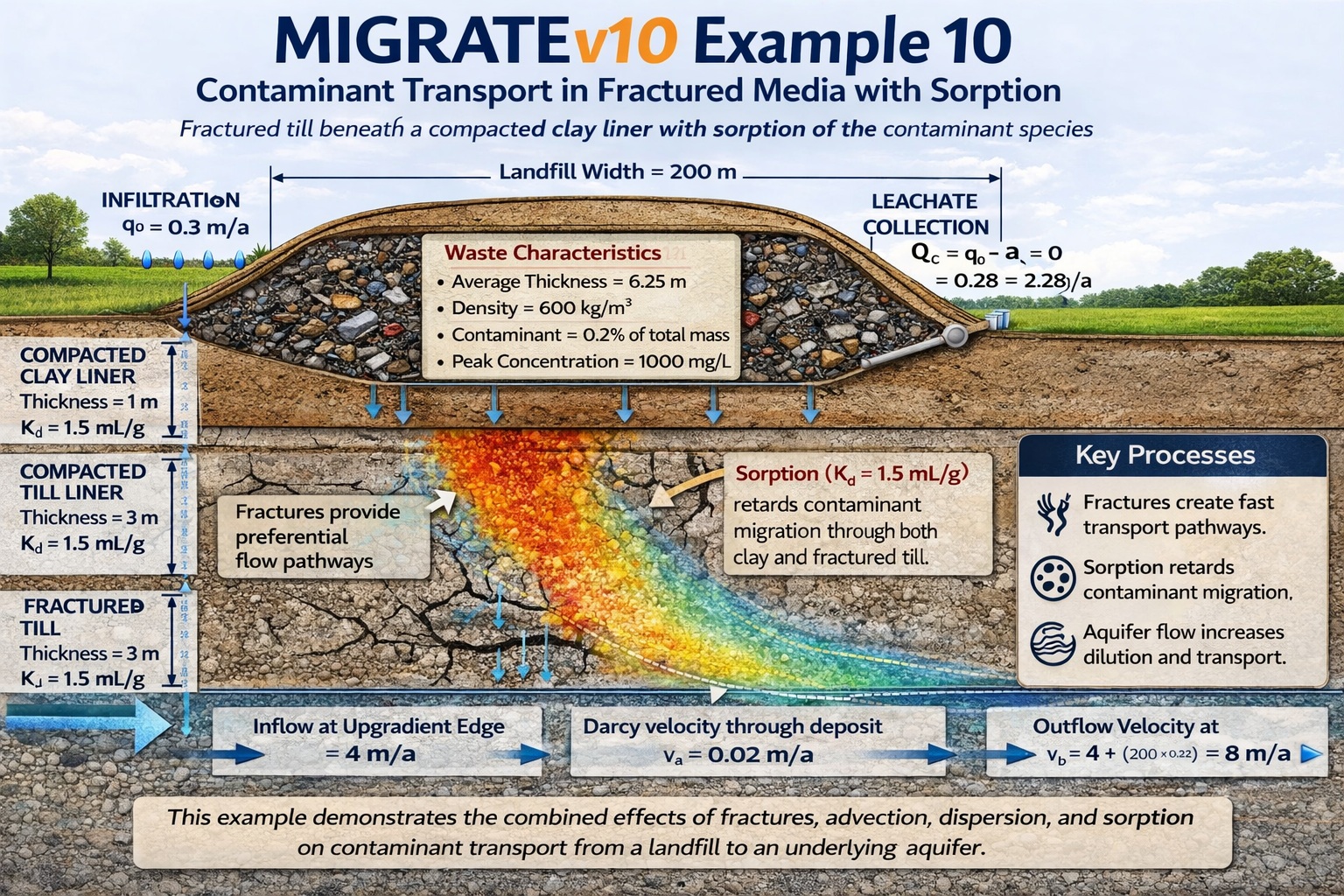
MIGRATEv10 Example 10 introduces a more advanced and realistic scenario by incorporating:
- Fractured media flow
- Sorption of contaminants
This example builds on earlier cases by modeling contaminant migration through a landfill barrier system that includes both compacted clay and a fractured till layer, while accounting for retardation due to sorption.
It also serves as the 2-D extension of a similar case presented in POLLUTEv6 (Example 6), providing greater spatial detail and realism.
Conceptual Model Overview
The modeled system consists of:
- A landfill source
- A 1 m compacted clay liner
- A 3 m fractured till layer
- An underlying 1 m aquifer
Key Modeling Objective
This example aims to:
- Simulate contaminant transport through fractured porous media
- Evaluate the effect of sorption on contaminant migration
- Demonstrate how fracture flow influences plume behavior
Barrier System Description
1. Compacted Clay Layer
| Property | Value |
|---|---|
| Thickness | 1 m |
| Function | Primary barrier |
| Sorption (Kd) | 1.5 mL/g |
2. Fractured Till Layer
| Property | Value |
| Thickness | 3 m |
| Function | Secondary transport layer |
| Sorption (Kd) | 1.5 mL/g |
👉 The fractured structure allows faster transport pathways, while sorption slows contaminant movement.
Source Characteristics
| Parameter | Value |
| Waste Thickness | 6.25 m |
| Density | 600 kg/m³ |
| Contaminant Fraction | 0.2% |
| Peak Concentration | 1000 mg/L |
| Landfill Width | 200 m |
The contaminant is assumed to reach peak concentration early and then migrate downward.
Flow and Leachate Generation
Leachate Collection Rate
Qc = qo – va = 0.3 – 0.02 = 0.28 m/a
Where:
- ( qo ) = infiltration through cover = 0.3 m/a
- ( va ) = downward Darcy velocity = 0.02 m/a
Aquifer Properties
| Parameter | Value |
| Thickness | 1 m |
| Porosity | 0.35 |
| Inflow Velocity | 4 m/a |
Base Outflow Velocity
vb = 4 + (200 \times 0.02) = 8 0 m/a
This reflects the combined effect of:
- Natural groundwater flow
- Additional inflow from the landfill
Modeling Approach in MIGRATEv10
Step 1: Define Layered System
- Clay liner (1 m)
- Fractured till (3 m)
- Aquifer (1 m)
Step 2: Assign Sorption Properties
- Set distribution coefficient (Kd = 1.5 mL/g) for both layers
Step 3: Define Source Conditions
- Peak concentration: 1000 mg/L
- Finite mass source
Step 4: Apply Flow Conditions
- Darcy velocity through deposit
- Infiltration rate
- Base outflow velocity
Step 5: Run Simulation
- Evaluate plume migration
- Analyze concentration profiles
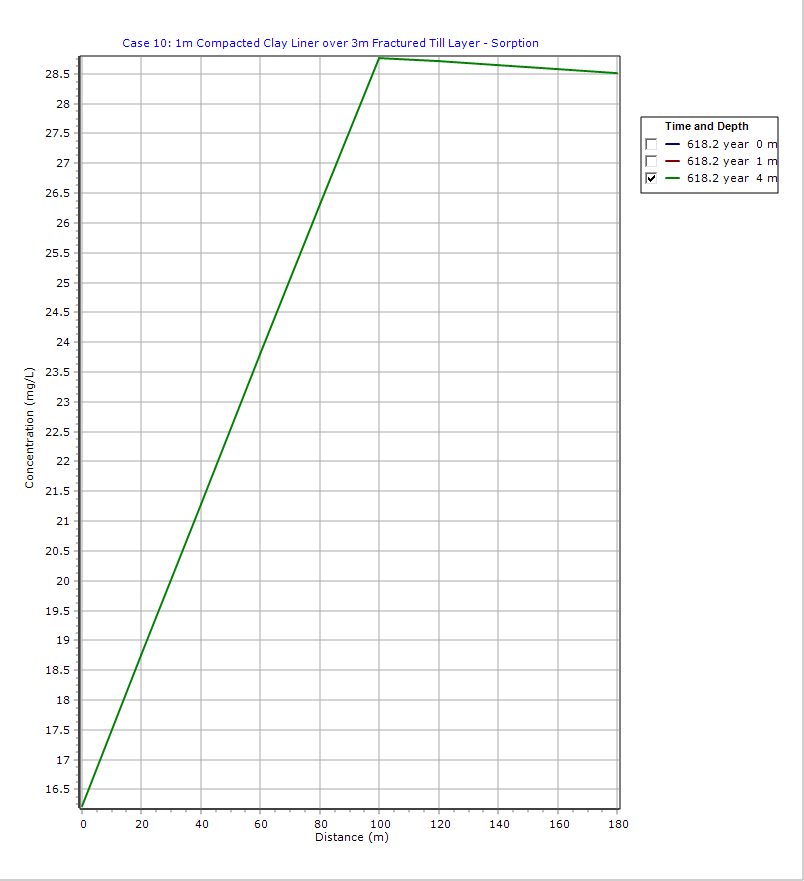
Graphical Output: Concentration vs Distance
PDF Report
 Loading…

 Reload document
  Open in new tab
 Interpretation of Results
1. Effect of Fractured Media
- Fractures provide preferential pathways
- Faster contaminant movement compared to homogeneous media
2. Role of Sorption
- Sorption slows contaminant migration
- Reduces peak concentrations
- Increases travel time
3. Combined Effect
- Fractures accelerate transport
- Sorption retards transport
👉 The resulting plume reflects a balance between these competing processes
4. Aquifer Impact
- Increased base velocity enhances dilution
- Contaminant concentrations depend on:
- Flow rate
- Sorption
- Fracture connectivity
Key Insights
- Fractured media significantly alters contaminant pathways
- Sorption is critical for predicting realistic transport rates
- Ignoring either process can lead to misleading results
- MIGRATEv10 can simulate complex coupled processes effectively
Key Takeaways
- Fractures increase transport speed
- Sorption decreases contaminant mobility
- Combined processes produce realistic plume behavior
- Accurate modeling requires:
- Proper parameter selection
- Understanding of subsurface conditions
Final Thoughts
MIGRATEv10 Example 10 demonstrates how real-world complexity can be incorporated into contaminant transport modeling. By including both fractured flow and sorption, this example provides a more accurate representation of subsurface conditions commonly encountered in landfill environments.
This example is especially relevant for:
- Fractured tills and bedrock systems
- Long-term contaminant migration studies
- Environmental risk assessments
Learn more about our Contaminant Transport Modeling Solutions
MIGRATE Examples
- MIGRATEv10 Example 1: Modeling a RCRA Subtitle D Landfill with a Composite Liner
- MIGRATEv10 Example 2: Composite Liner System with Primary & Secondary Leachate Collection
- MIGRATEv10 Example 3: Pure Diffusion of a Conservative Contaminant
- MIGRATEv10 Example 4: Finite Mass Source and Aquifer Mixing with Base Outflow
- MIGRATEv10 Example 5: Understanding Integration, Accuracy, and the Role of Engineering Judgment
- MIGRATEv10 Example 6: Eliminating Negative Concentrations Through Improved Integration
- MIGRATEv10 Example 7: Improving Accuracy with User-Selected Fourier Integration
- MIGRATEv10 Example 8: Evaluating Contaminant Migration at Multiple Lateral Positions
- MIGRATEv10 Example 9: Comparison with the TDAST Analytical Solution
- MIGRATEv10 Example 11: Contaminant Migration from Two Adjacent Landfill Cells
- MIGRATEv10 Example 12: Modeling Time-Dependent Source Histories for Multiple Landfill Cells
- MIGRATEv10 Example 13: Termination of Primary Leachate Collection System
Comparison between POLLUTE and MIGRATE
- MIGRATEv10 vs POLLUTEv10: Pure Diffusion Comparison
- MIGRATEv10 vs POLLUTEv10: Advective–Diffusive Transport Comparison
- MIGRATEv10 vs POLLUTEv10: Finite Mass Source Comparison
- MIGRATEv10 vs POLLUTEv10: Hydraulic Trap (Finite Mass Source) Comparison
- MIGRATEv10 vs POLLUTEv10: Fractured Layer with Sorption Comparison