

Validating Fracture Transport Modeling with Analytical Benchmarks
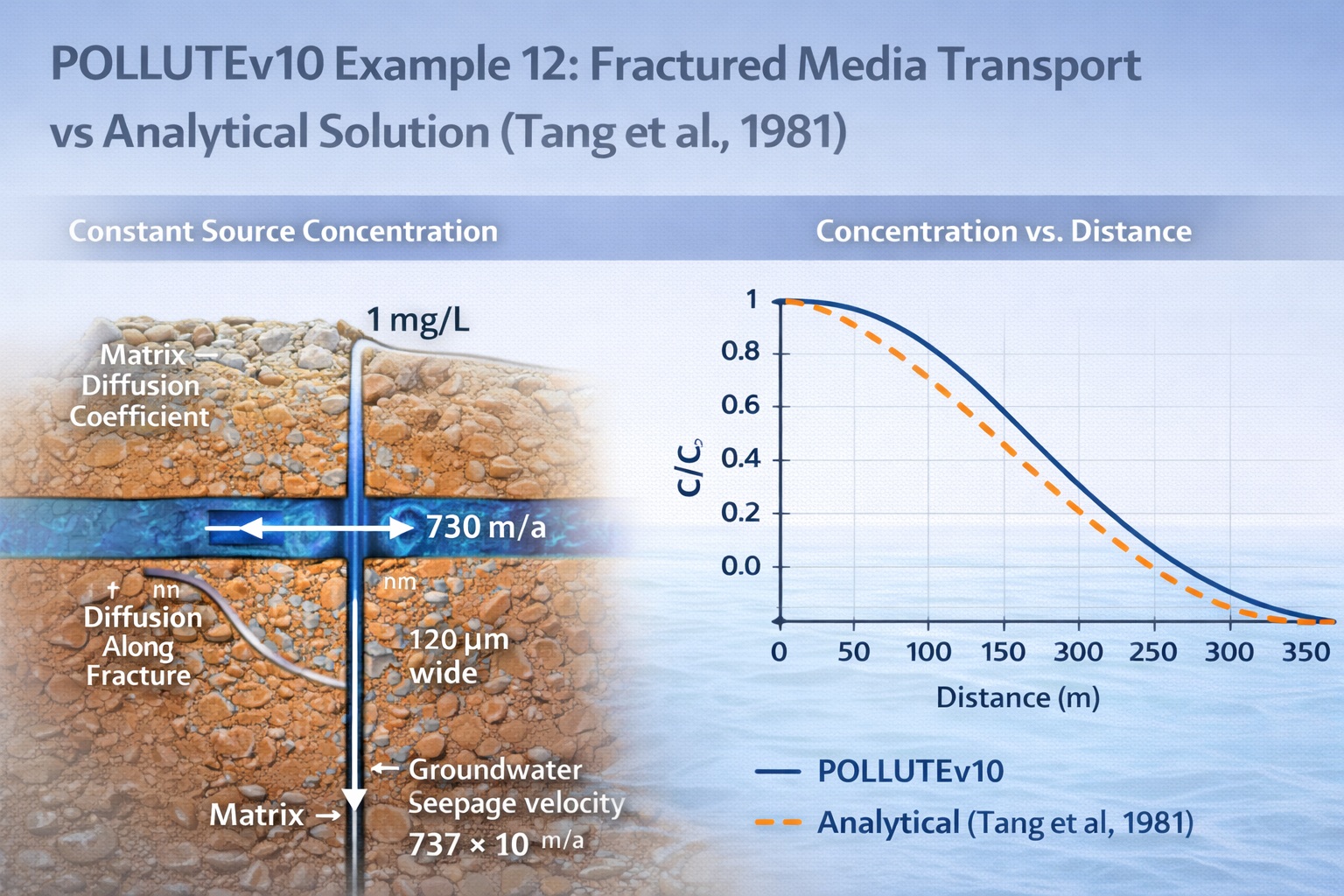
POLLUTEv10 Example 12 is a benchmark validation case that compares numerical results from POLLUTEv10 with an analytical solution developed by Tang et al..
This example focuses on transport in fractured porous media, where contaminant migration occurs rapidly along fractures and slowly into the surrounding rock matrix.
Problem Overview
The model simulates:
- A single fracture system
- A conservative contaminant (no sorption in fracture)
- Advection and diffusion along fractures
- Diffusion into the surrounding matrix
- A constant source concentration
Key Conditions
- Source concentration (co) = 1.0 mg/L
- Fracture spacing = 1 m
- Fracture aperture = 10 μm
- High groundwater velocity along fractures
Conceptual Model
The system consists of:
- Discrete fractures acting as fast-flow pathways
- A low-permeability rock matrix surrounding fractures
- Diffusion from fracture → matrix
Key Insight
Because matrix diffusion is extremely small:
There is effectively no interaction between adjacent fractures
Thus:
- Results are independent of fracture spacing over the time scale considered
Key Calculations
Darcy Velocity in Fractures
Mix Diffusion Coefficient
Input Parameters
| Property | Value | Units |
|---|---|---|
| Darcy Velocity (va) | 0.73E-2 | m/a |
| Soil Thickness (H) | 400.0 | m |
| Sub-layers | 4 | – |
| Fracture Spacing | 1.0 | m |
| Fracture Opening | 10E-6 | m |
| Fracture Diffusion Coefficient | 0.077 | m²/a |
| Fracture Distribution Coef. | 0.0 | cm³/g |
| Matrix Diffusion Coefficient | 7.57E-6 | m²/a |
| Matrix Distribution Coef. | 1.0 | cm³/g |
| Matrix Porosity (nm) | 0.05 | – |
| Dry Density (Matrix) | 0.0 | g/cm³ |
| Source Concentration | 1.0 | mg/L |
Transport Mechanisms
1. Advection in Fractures
- Rapid contaminant movement
- Dominant transport pathway
2. Diffusion Along Fractures
- Spreads contaminant longitudinally
- Controlled by Df = 0.077 m²/a
3. Matrix Diffusion
- Very slow transfer into surrounding rock
- Controlled by low tortuosity
4. No Dispersion
- Dispersivity = 0
- Simplifies comparison with analytical solution
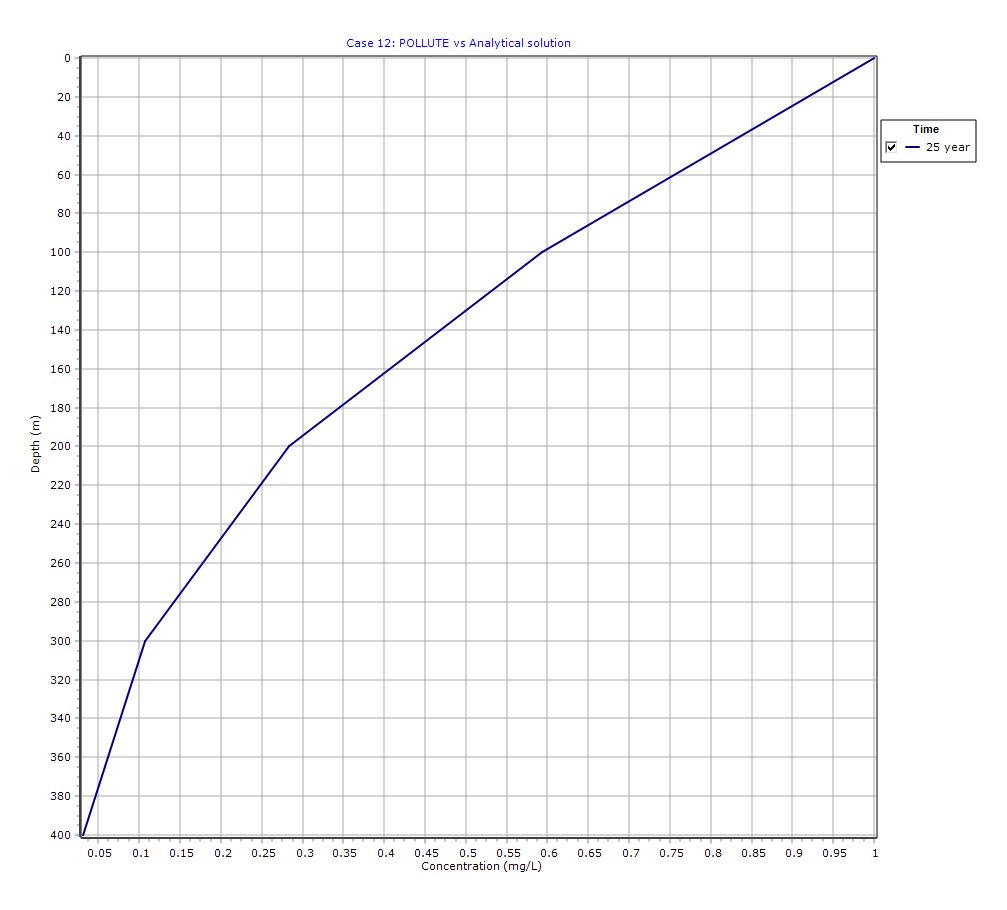
Graphical Output: Depth vs Concentration
PDF Report
 Loading…

 Reload document
  Open in new tab
 Key Insights
- Fractures dominate contaminant transport in rock
- Matrix diffusion can be negligible depending on tortuosity
- Analytical solutions are valuable for model validation
- POLLUTEv10 accurately simulates dual-porosity systems
Importance of Model Setup
Even though only 4 sub-layers are used:
- Large domain (400 m) simplifies gradients
- Low matrix interaction reduces complexity
However:
More layers may be required for higher precision or stronger matrix interaction
Practical Applications
This example is critical for:
- Fractured rock aquifer analysis
- Nuclear waste repository studies
- Contaminant transport in bedrock
- Model verification and calibration
Conclusion
POLLUTEv10 Example 12 demonstrates the model’s ability to accurately simulate fracture–matrix transport systems and match established analytical solutions.
Key takeaways:
- Fracture flow controls transport speed
- Matrix diffusion may be minimal in some systems
- Analytical comparisons are essential for validation
This example builds confidence in using POLLUTEv10 for complex fractured media problems.
Learn more about our Contaminant Transport Modeling Solutions
POLLUTE Examples
- POLLUTEv10 Example 1: Modeling a U.S. RCRA Subtitle D Landfill
- POLLUTEv10 Example 2: Pure Diffusion in a Soil Layer (No Sorption)
- POLLUTEv10 Example 3: Advection + Diffusion with Aquifer Mixing
- POLLUTEv10 Example 4: Finite Mass Source with Leachate Collection System
- POLLUTEv10 Example 5: Hydraulic Trap (Upward Flow into the Landfill)
- POLLUTEv10 Example 6: Fractured Layer with Sorption and Reactive Transport
- POLLUTEv10 Example 7: Lateral Migration of a Radioactive Contaminant in Fractured Rock
- POLLUTEv10 Example 8: Laboratory Diffusion of Potassium in Clay
- POLLUTEv10 Example 9: Diffusion with Freundlich Non-Linear Sorption (Phenol in Clay)
- POLLUTEv10 Example 10: Time-Varying Advective–Dispersive Transport from a Landfill
- POLLUTEv10 Example 11: Time-Varying Source Concentration with Diffusion (Chloride in Clay)
- POLLUTEv10 Example 13: 2D Plane Dispersion vs Analytical Solution (TDAST)
- POLLUTEv10 Example 14: Modeling a Landfill with Primary and Secondary Leachate Collection Using Passive Sink
- POLLUTEv10 Example 15: Modeling Leachate Collection System Failure Using Variable Properties and Passive Sink
- POLLUTEv10 Example 16: Monte Carlo Simulation of Leachate Collection System Failure Timing
- POLLUTEv10 Example 17: Modeling a Landfill with Composite Liners and Dual Leachate Collection Systems
- POLLUTEv10 Example 18: Modeling Phase Change in a Secondary Leachate Collection System
- POLLUTEv10 Example 19: Multiphase Diffusion of Toluene Through a Geomembrane System
- POLLUTEv10 Example 20: Sensitivity Analysis of Primary Leachate Collection System Failure
Comparison between POLLUTE and MIGRATE
- MIGRATEv10 vs POLLUTEv10: Pure Diffusion Comparison
- MIGRATEv10 vs POLLUTEv10: Advective–Diffusive Transport Comparison
- MIGRATEv10 vs POLLUTEv10: Finite Mass Source Comparison
- MIGRATEv10 vs POLLUTEv10: Hydraulic Trap (Finite Mass Source) Comparison
- MIGRATEv10 vs POLLUTEv10: Fractured Layer with Sorption Comparison