


Introduction
POLLUTEv10 Example 19 models a multiphase diffusion experiment originally conducted by Buss et al. (1995). This example is particularly useful for understanding how volatile organic compounds (VOCs), such as toluene, migrate through engineered barrier systems that include geomembranes, airspaces, and aqueous reservoirs.
The simulation demonstrates how POLLUTEv10 can accurately reproduce laboratory-scale results by incorporating diffusion coefficients, phase partitioning, and layered transport mechanisms across multiple media.
Background of the Experiment
The experimental setup consists of three primary components:
- HDPE geomembrane (barrier layer)
- Air-filled void space
- Well-mixed water reservoir (receptor)
Toluene migrates from a constant concentration source, diffusing sequentially through each medium before reaching the receptor.
Conceptual Model Overview
The modeled system includes:
- A constant source of toluene
- A 0.1 cm thick HDPE geomembrane
- An 18.2 cm thick airspace
- A 12.3 cm water reservoir, assumed to be fully mixed
This layered configuration allows simulation of multiphase transport, where contaminant movement is governed by both diffusion and partitioning between phases.
Key Input Parameters
1. Geomembrane Properties (HDPE)
| Parameter | Value |
|---|---|
| Thickness | 0.1 cm |
| Diffusion Coefficient | 6 × 10⁻⁸ cm²/s |
| Phase Coefficient | 43.8 |
The high phase coefficient reflects strong partitioning of toluene into the geomembrane material.
2. Airspace Properties
| Parameter | Value |
| Thickness | 18.2 cm |
| Diffusion Coefficient | 0.088 cm²/s |
| Phase Coefficient | 0.27 |
The airspace provides relatively rapid diffusion compared to the geomembrane, acting as a transport pathway between layers.
3. Water Reservoir (Receptor)
| Parameter | Value |
| Thickness | 12.3 cm |
| Mixing Condition | Well-mixed |
The assumption of a well-mixed reservoir simplifies the model by treating the receptor concentration as uniform at any given time.
Modeling Assumptions
- Constant concentration source of toluene
- Diffusion-dominated transport (no advection)
- Phase equilibrium at layer interfaces
- Well-mixed receptor boundary
- No degradation or reaction processes considered
These assumptions align with the controlled laboratory conditions of the original experiment.
Simulation Setup in POLLUTEv10
Step 1: Define Layer Geometry
- Layer 1: HDPE geomembrane (0.1 cm)
- Layer 2: Airspace (18.2 cm)
- Layer 3: Water reservoir (12.3 cm)
Step 2: Assign Material Properties
- Input diffusion coefficients and phase coefficients for each layer
- Ensure units are consistent (cm²/s)
Step 3: Configure Boundary Conditions
- Apply a constant concentration source
- Define the receptor as a well-mixed boundary
Step 4: Set Simulation Time
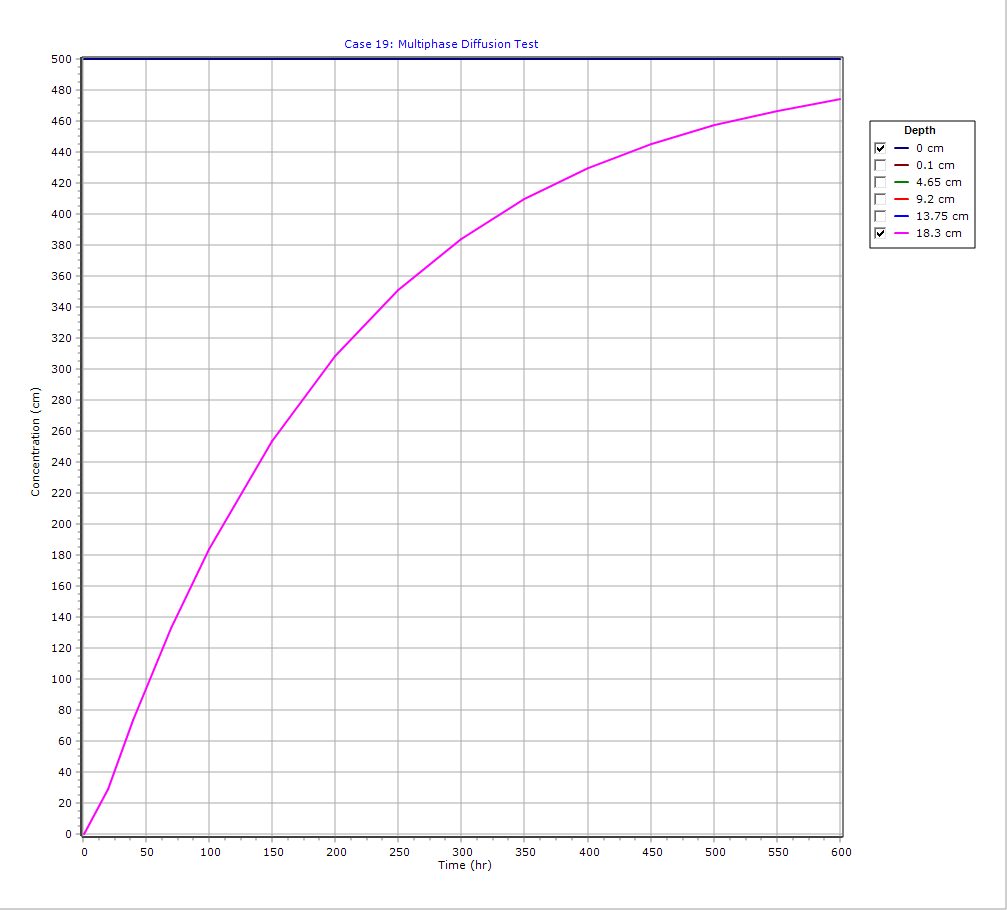
- Total simulation duration: 600 hours
Step 5: Run Model
- Track concentration breakthrough in the water reservoir
- Compare simulated results with observed data
Graphical Output: Concentration vs Time
PDF Report
 Loading…

 Reload document
  Open in new tab
 Interpretation of Multiphase Diffusion
This example highlights several important concepts:
1. Barrier Performance of HDPE
The very low diffusion coefficient demonstrates the effectiveness of geomembranes in limiting contaminant migration.
2. Role of Phase Partitioning
The high phase coefficient in the geomembrane indicates strong sorption, which slows transport.
3. Rapid Transport in Air
Diffusion in air is orders of magnitude faster than in solids, making the airspace a critical pathway.
4. Importance of Interface Conditions
Accurate modeling of phase equilibrium at interfaces is essential for realistic results.
Key Takeaways
- POLLUTEv10 can effectively simulate multiphase diffusion systems
- Geomembranes play a critical role in contaminant containment
- Phase coefficients are just as important as diffusion coefficients
- Laboratory validation strengthens confidence in model predictions
- This example bridges experimental data and numerical modeling
Final Thoughts
Example 19 provides a strong foundation for modeling VOC transport through engineered barrier systems, particularly in landfill and containment applications. By reproducing a controlled laboratory experiment, it demonstrates the reliability of POLLUTEv10 in handling complex, multi-layer, multiphase diffusion problems.
However, real-world applications require careful consideration of:
- Temperature effects
- Material variability
- Field-scale heterogeneity
As always, site-specific calibration and expert judgment are essential.
Learn more about our Contaminant Transport Modeling Solutions
POLLUTE Examples
- POLLUTEv10 Example 1: Modeling a U.S. RCRA Subtitle D Landfill
- POLLUTEv10 Example 2: Pure Diffusion in a Soil Layer (No Sorption)
- POLLUTEv10 Example 3: Advection + Diffusion with Aquifer Mixing
- POLLUTEv10 Example 4: Finite Mass Source with Leachate Collection System
- POLLUTEv10 Example 5: Hydraulic Trap (Upward Flow into the Landfill)
- POLLUTEv10 Example 6: Fractured Layer with Sorption and Reactive Transport
- POLLUTEv10 Example 7: Lateral Migration of a Radioactive Contaminant in Fractured Rock
- POLLUTEv10 Example 8: Laboratory Diffusion of Potassium in Clay
- POLLUTEv10 Example 9: Diffusion with Freundlich Non-Linear Sorption (Phenol in Clay)
- POLLUTEv10 Example 10: Time-Varying Advective–Dispersive Transport from a Landfill
- POLLUTEv10 Example 11: Time-Varying Source Concentration with Diffusion (Chloride in Clay)
- POLLUTEv10 Example 12: Fractured Media Transport vs Analytical Solution (Tang et al., 1981)
- POLLUTEv10 Example 13: 2D Plane Dispersion vs Analytical Solution (TDAST)
- POLLUTEv10 Example 14: Modeling a Landfill with Primary and Secondary Leachate Collection Using Passive Sink
- POLLUTEv10 Example 15: Modeling Leachate Collection System Failure Using Variable Properties and Passive Sink
- POLLUTEv10 Example 16: Monte Carlo Simulation of Leachate Collection System Failure Timing
- POLLUTEv10 Example 17: Modeling a Landfill with Composite Liners and Dual Leachate Collection Systems
- POLLUTEv10 Example 18: Modeling Phase Change in a Secondary Leachate Collection System
- POLLUTEv10 Example 20: Sensitivity Analysis of Primary Leachate Collection System Failure
Comparison between POLLUTE and MIGRATE
- MIGRATEv10 vs POLLUTEv10: Pure Diffusion Comparison
- MIGRATEv10 vs POLLUTEv10: Advective–Diffusive Transport Comparison
- MIGRATEv10 vs POLLUTEv10: Finite Mass Source Comparison
- MIGRATEv10 vs POLLUTEv10: Hydraulic Trap (Finite Mass Source) Comparison
- MIGRATEv10 vs POLLUTEv10: Fractured Layer with Sorption Comparison