

Introduction
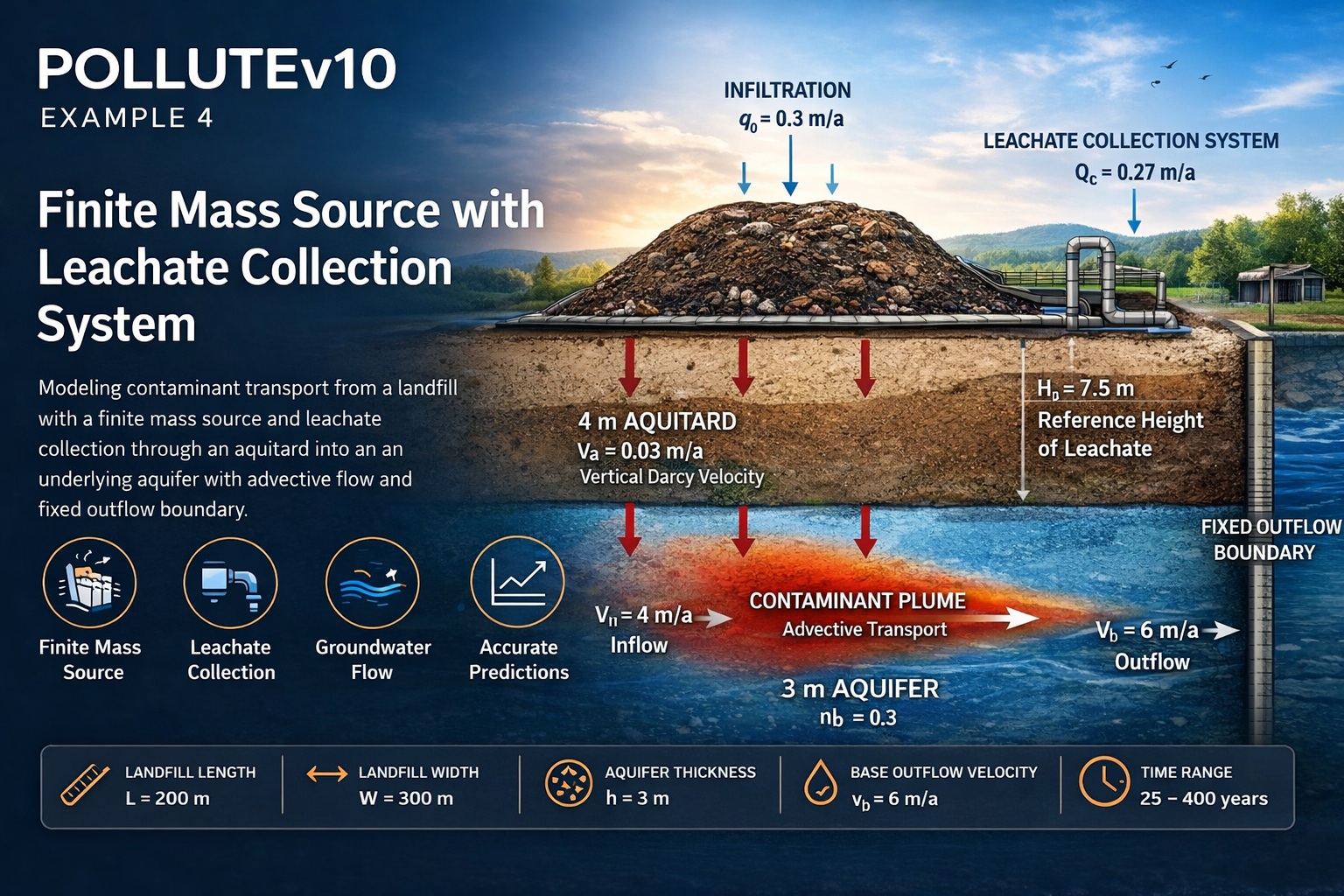
This example builds directly on the conceptual and numerical framework established in Case 3, introducing a more realistic landfill condition: a finite mass contaminant source combined with an active leachate collection system. This scenario better reflects modern engineered landfills, where contaminant release is limited by waste mass and partially controlled through collection infrastructure.
The model simulates contaminant migration from a landfill through a low-permeability layer into an underlying aquifer, while accounting for declining source mass and reduced leachate flux due to collection.
Conceptual Model Overview
The hydrogeological system remains consistent with Case 3, with the following structure:
- A 4 m thick upper soil layer (aquitard)
- A finite mass contaminant source at the surface (landfill)
- A 3 m thick aquifer beneath
- A fixed outflow boundary at the downgradient edge
Key Enhancements in Example 4:
- Finite contaminant mass instead of constant concentration
- Inclusion of a leachate collection system
- Adjusted groundwater velocities
- Time-dependent source behavior (though constant in this case due to assumptions)
Landfill Geometry and Hydrogeology
| Parameter | Symbol | Value | Units |
|---|---|---|---|
| Landfill Length | L | 200 | m |
| Landfill Width | W | 300 | m |
| Aquifer Thickness | h | 3 | m |
| Aquifer Porosity | nb | 0.3 | – |
| Base Outflow Velocity | vb | 6 | m/a |
| Time Range | t | 25–400 | years |
Important Note:
The landfill width (W) is perpendicular to groundwater flow and does not influence results in this 2D model.
Finite Mass Source Calculation
Unlike previous examples, the contaminant source is defined by a finite mass of chloride within the waste.
Step 1: Total Chloride Mass per Unit Area
Where:
- Chloride fraction = 0.2% (0.002)
- Waste density = 600 kg/m³
- Waste thickness = 6.25 m
Result:
Step 2: Reference Height of Leachate (Hr)
Where:
Result:
Step 3: Rate of Increase in Concentration (Cr)
Because peak concentration is reached early:
- Cr = 0 mg/L/a
This simplifies the model by eliminating time-dependent concentration buildup.
Leachate Collection System
A key addition in this example is the leachate collection system, which reduces contaminant loading to the subsurface.
Leachate Collection Rate
Where:
- (infiltration through cover)
- (vertical Darcy velocity)
Result:
This indicates that most infiltrating water is captured, significantly reducing contaminant migration.
Groundwater Flow Conditions
Upgradient Inflow Velocity:
Downgradient Outflow Velocity:
Substituting values:
This ensures mass balance across the system.
Transport Parameters
| Property | Symbol | Value | Units |
|---|---|---|---|
| Vertical Darcy Velocity | va | 0.03 | m/a |
| Diffusion Coefficient | D | 0.01 | m²/a |
| Distribution Coefficient | Kd | 0 | cm³/g |
| Soil Porosity | n | 0.4 | – |
| Dry Density | ρd | 1.5 | g/cm³ |
| Soil Thickness | H | 4 | m |
| Sub-layers | – | 4 | – |
| Source Concentration | co | 1000 | mg/L |
| Rate of Increase | cr | 0 | mg/L/a |
| Ref. Height | Hr | 7.5 | m |
| Leachate Collected | Qc | 0.27 | m/a |
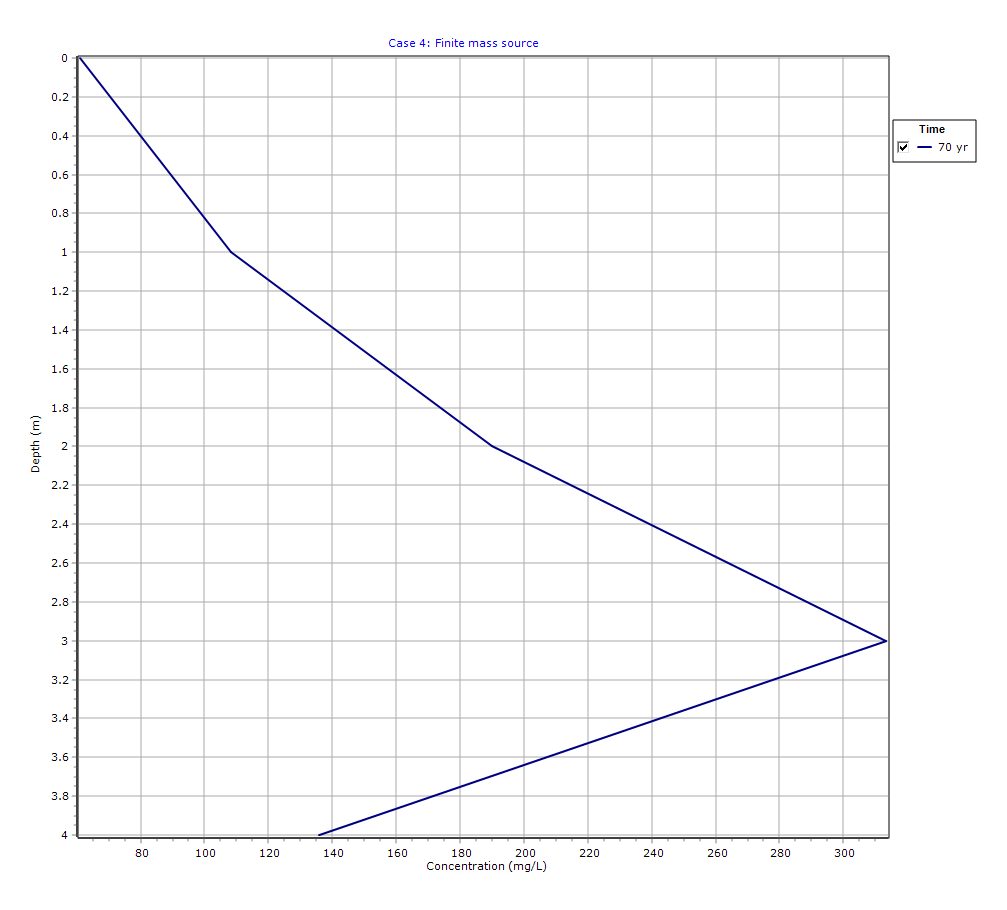
Graphical Output: Depth vs Concentration
PDF Report
 Loading…

 Reload document
  Open in new tab
 Interpretation of Results
This example highlights several important hydrogeological and modeling insights:
1. Finite Source Behavior
Unlike constant concentration models, the finite mass source:
- Limits total contaminant release
- Results in eventual depletion of the source
- Produces more realistic long-term predictions
2. Impact of Leachate Collection
The collection system:
- Reduces downward contaminant flux
- Decreases plume concentration and extent
- Represents modern landfill engineering controls
3. Advective Transport Dominance
With:
- Horizontal velocity = 4 m/a
- Vertical velocity = 0.03 m/a
Transport is strongly horizontal in the aquifer, leading to plume elongation downgradient.
Practical Applications
This modeling scenario is particularly relevant for:
- Landfill design and risk assessment
- Regulatory compliance modeling
- Evaluation of leachate collection efficiency
- Long-term contaminant fate predictions
- Phase II Environmental Site Assessments (ESA)
Key Takeaways
- Finite mass sources provide realistic contaminant release behavior
- Leachate collection significantly reduces environmental impact
- Proper velocity balancing ensures accurate groundwater modeling
- POLLUTEv10 can simulate complex engineered landfill systems
Learn more about our Contaminant Transport Modeling Solutions
POLLUTE Examples
- POLLUTEv10 Example 1: Modeling a U.S. RCRA Subtitle D Landfill
- POLLUTEv10 Example 2: Pure Diffusion in a Soil Layer (No Sorption)
- POLLUTEv10 Example 3: Advection + Diffusion with Aquifer Mixing
- POLLUTEv10 Example 5: Hydraulic Trap (Upward Flow into the Landfill)
- POLLUTEv10 Example 6: Fractured Layer with Sorption and Reactive Transport
- POLLUTEv10 Example 7: Lateral Migration of a Radioactive Contaminant in Fractured Rock
- POLLUTEv10 Example 8: Laboratory Diffusion of Potassium in Clay
- POLLUTEv10 Example 9: Diffusion with Freundlich Non-Linear Sorption (Phenol in Clay)
- POLLUTEv10 Example 10: Time-Varying Advective–Dispersive Transport from a Landfill
- POLLUTEv10 Example 11: Time-Varying Source Concentration with Diffusion (Chloride in Clay)
- POLLUTEv10 Example 12: Fractured Media Transport vs Analytical Solution (Tang et al., 1981)
- POLLUTEv10 Example 13: 2D Plane Dispersion vs Analytical Solution (TDAST)
- POLLUTEv10 Example 14: Modeling a Landfill with Primary and Secondary Leachate Collection Using Passive Sink
- POLLUTEv10 Example 15: Modeling Leachate Collection System Failure Using Variable Properties and Passive Sink
- POLLUTEv10 Example 16: Monte Carlo Simulation of Leachate Collection System Failure Timing
- POLLUTEv10 Example 17: Modeling a Landfill with Composite Liners and Dual Leachate Collection Systems
- POLLUTEv10 Example 18: Modeling Phase Change in a Secondary Leachate Collection System
- POLLUTEv10 Example 19: Multiphase Diffusion of Toluene Through a Geomembrane System
- POLLUTEv10 Example 20: Sensitivity Analysis of Primary Leachate Collection System Failure