

Modeling Hydraulic Gradient Reversal with Variable Properties
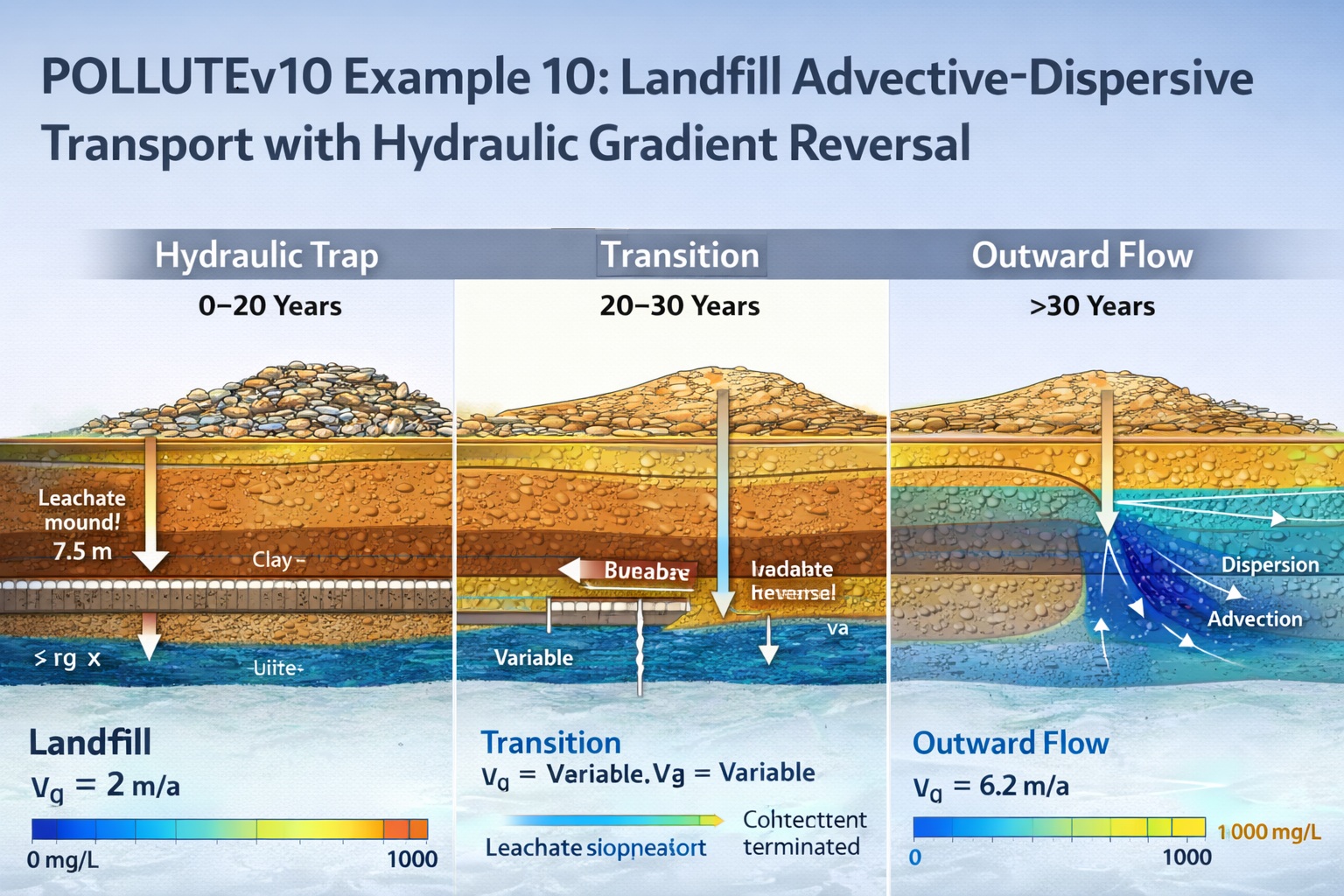
POLLUTEv10 Example 10 demonstrates one of the most powerful capabilities of the model: simulating time-varying transport conditions using the Variable Properties feature.
This scenario captures a realistic landfill lifecycle where:
- Early operation creates a hydraulic trap (inward gradient)
- Later conditions cause a gradient reversal
- Contaminant transport shifts from contained → released
Problem Overview
This example models:
- A landfill with finite contaminant mass
- A conservative species (no sorption, Kd = 0)
- A leachate collection system that is later discontinued
- A clay liner overlying an aquifer
Key Phases
- 0–20 years
- Leachate collection active
- Inward gradient → hydraulic trap
- No contaminant escape
- 20–30 years
- Collection stops
- Leachate mound builds
- Gradient begins to reverse
- >30 years
- Outward flow established
- Contaminant begins migrating into aquifer
Conceptual Model
The system includes:
- A 4 m thick clay layer beneath the landfill
- An underlying aquifer
- A finite contaminant source within the landfill
- Time-dependent Darcy velocities (va and vb)
The most critical behavior is the reversal of hydraulic gradient, which fundamentally changes transport direction.
Key Equations
Hydrodynamic Dispersion
Where:
- D = hydrodynamic dispersion coefficient
- Dm = molecular diffusion coefficient
- α = dispersivity
- va = Darcy velocity
- n = porosity
Outflow Velocity Relationship
- At 30 years,
Input Parameters
| Property | Value | Units |
|---|---|---|
| Darcy Velocity (va) | Variable | m/a |
| Diffusion Coefficient (Dm) | 0.02 | m²/a |
| Distribution Coefficient | 0.0 | cm³/g |
| Dispersivity (va < 0) | 0.0 | m |
| Dispersivity (va > 0) | 0.4 | m |
| Soil Porosity (n) | 0.4 | – |
| Dry Density | 1.5 | g/cm³ |
| Soil Thickness | 4.0 | m |
| Sub-layers | 12 | – |
| Source Concentration | 1000 | mg/L |
| Leachate Height (Hr) | 7.5 | m |
Aquifer Properties
| Property | Value | Units |
|---|---|---|
| Length (L) | 200 | m |
| Width (W) | 1 | m |
| Thickness (h) | 1 | m |
| Porosity (nb) | 0.3 | – |
| Outflow Velocity | Variable | m/a |
Finite Mass Source Calculation
The contaminant mass per unit area:
This yields the reference leachate height:
This ensures the model represents a finite, depleting contaminant source.
Time-Varying Flow Conditions
Infiltration & Collection
Where:
- qo = 0.3 m/a (infiltration through cover)
- va = exfiltration through base
Variable Dispersivity Behavior
A key feature of this example:
- va < 0 (inward flow):
- Dispersivity = 0
- Transport = diffusion only
- va > 0 (outward flow):
- Dispersivity = 0.4 m
- Transport = advection + dispersion
This reflects real-world physics:
- No plume spreading during containment
- Significant plume spreading after release
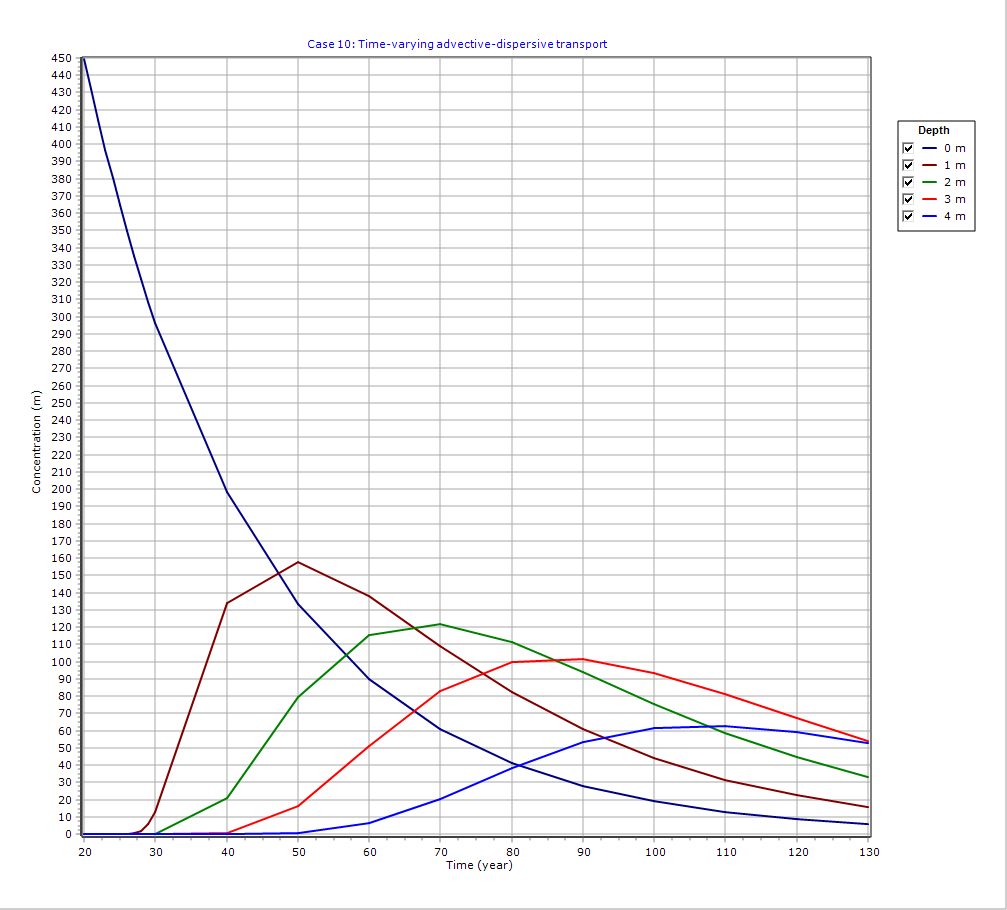
Graphical Output: Concentration vs Time
PDF Report
 Loading…

 Reload document
  Open in new tab
 Key Insights
- Hydraulic traps are temporary if conditions change
- Leachate collection systems are critical for containment
- Gradient reversal can trigger sudden contaminant release
- Dispersion becomes significant only during outward flow
Importance of Sub-Layer Resolution
Accuracy depends on the number of sub-layers when using Variable Properties.
Why?
- Time-dependent parameters require fine numerical resolution
- Velocity reversals create sharp transitions
- Coarse meshes may miss key behaviors
Best Practice
- Use ≥ 12 sub-layers (minimum)
- Increase for sensitivity analysis
Practical Applications
This example is highly relevant for:
- Landfill design and risk assessment
- Long-term contaminant migration modeling
- Leachate collection system evaluation
- Regulatory compliance studies
Conclusion
POLLUTEv10 Example 10 highlights the complexity of time-dependent transport systems, demonstrating that:
- Flow conditions can change dramatically over time
- Containment strategies must consider future scenarios
- Variable properties modeling is essential for realistic predictions
This example is a powerful tool for understanding how engineering controls and hydrogeology interact to influence contaminant fate.
Learn more about our Contaminant Transport Modeling Solutions
POLLUTE Examples
- POLLUTEv10 Example 1: Modeling a U.S. RCRA Subtitle D Landfill
- POLLUTEv10 Example 2: Pure Diffusion in a Soil Layer (No Sorption)
- POLLUTEv10 Example 3: Advection + Diffusion with Aquifer Mixing
- POLLUTEv10 Example 4: Finite Mass Source with Leachate Collection System
- POLLUTEv10 Example 5: Hydraulic Trap (Upward Flow into the Landfill)
- POLLUTEv10 Example 6: Fractured Layer with Sorption and Reactive Transport
- POLLUTEv10 Example 7: Lateral Migration of a Radioactive Contaminant in Fractured Rock
- POLLUTEv10 Example 8: Laboratory Diffusion of Potassium in Clay
- POLLUTEv10 Example 9: Diffusion with Freundlich Non-Linear Sorption (Phenol in Clay)
- POLLUTEv10 Example 10: Time-Varying Advective–Dispersive Transport from a Landfill
- POLLUTEv10 Example 12: Fractured Media Transport vs Analytical Solution (Tang et al., 1981)
- POLLUTEv10 Example 13: 2D Plane Dispersion vs Analytical Solution (TDAST)
- POLLUTEv10 Example 14: Modeling a Landfill with Primary and Secondary Leachate Collection Using Passive Sink
- POLLUTEv10 Example 15: Modeling Leachate Collection System Failure Using Variable Properties and Passive Sink
- POLLUTEv10 Example 16: Monte Carlo Simulation of Leachate Collection System Failure Timing
- POLLUTEv10 Example 17: Modeling a Landfill with Composite Liners and Dual Leachate Collection Systems
- POLLUTEv10 Example 18: Modeling Phase Change in a Secondary Leachate Collection System
- POLLUTEv10 Example 19: Multiphase Diffusion of Toluene Through a Geomembrane System
- POLLUTEv10 Example 20: Sensitivity Analysis of Primary Leachate Collection System Failure
Comparison between POLLUTE and MIGRATE
- MIGRATEv10 vs POLLUTEv10: Pure Diffusion Comparison
- MIGRATEv10 vs POLLUTEv10: Advective–Diffusive Transport Comparison
- MIGRATEv10 vs POLLUTEv10: Finite Mass Source Comparison
- MIGRATEv10 vs POLLUTEv10: Hydraulic Trap (Finite Mass Source) Comparison
- MIGRATEv10 vs POLLUTEv10: Fractured Layer with Sorption Comparison