


Introduction
POLLUTEv10 Example 18 demonstrates the application of the Phase Change special feature to simulate contaminant transport within a landfill system that includes a secondary leachate collection system (SLCS). This example is particularly valuable for environmental engineers and hydrogeologists interested in modeling multi-phase contaminant behavior across unsaturated and saturated zones.
The scenario focuses on the migration of dichloromethane (DCM) under conditions where phase partitioning occurs, influenced by Henry’s Law in the unsaturated zone. The model incorporates biological decay, layered hydrogeology, and controlled flow conditions to illustrate how phase change affects contaminant transport.
⚠️ Important Note: This example is hypothetical and intended for instructional purposes only. It should not be used as a direct template for real-world landfill modeling without proper hydrogeologic expertise.
Conceptual Model Overview
The modeled system consists of:
- A landfill containing a constant concentration source of DCM
- A primary liner
- A secondary leachate collection system (SLCS) with distinct unsaturated and saturated zones
- A secondary liner
- An underlying 1-meter thick aquifer
Key Feature: Phase Change
A phase change occurs at the interface between:
- Unsaturated zone (0.2 m thick)
- Saturated zone (0.1 m thick)
This interface governs how DCM transitions between vapor and dissolved phases, significantly impacting transport behavior.
Hydrogeologic and Transport Assumptions
1. Layered Structure of the SLCS
The secondary leachate collection system is divided into two conceptual layers:
| Layer | Zone Type | Thickness |
|---|---|---|
| Layer 1 | Unsaturated Zone | 0.2 m |
| Layer 2 | Saturated Zone | 0.1 m |
This layered approach allows POLLUTE to simulate phase-dependent transport properties.
2. Contaminant Properties (DCM)
- Constant concentration source in the landfill
- Subject to biological decay
- Exhibits phase partitioning in the unsaturated zone
Biological Decay Rates
| Zone | Half-Life |
| Landfill | 10 years |
| Primary liner | 40 years |
| Secondary liner | 40 years |
| Aquifer | 40 years |
| Secondary leachate system | No decay |
3. Diffusion Coefficients
Diffusion varies significantly between zones:
| Zone Type | Diffusion Coefficient |
| Unsaturated Zone | 300 m²/year |
| Saturated Zone | 100 m²/year |
The higher diffusion in the unsaturated zone reflects enhanced vapor-phase mobility, while the saturated zone value represents increased mixing conditions.
4. Phase Change Parameter
The phase behavior of DCM in the unsaturated zone is governed by:
- Henry’s Constant = 0.1
This parameter controls the equilibrium between dissolved and vapor phases, making it critical for accurately simulating contaminant partitioning.
5. Flow Conditions
- Darcy velocity through primary liner: 0.003 m/year
- Darcy velocity through secondary liner: 0 m/year
This creates a controlled system where flow is limited to the primary liner and lateral movement occurs within the saturated portion of the SLCS.
Modeling Approach in POLLUTEv10
To implement this example in POLLUTEv10:
Step 1: Define Layered Geometry
- Input two layers for the SLCS:
- Unsaturated (0.2 m)
- Saturated (0.1 m)
Step 2: Assign Transport Properties
- Set diffusion coefficients for each layer
- Define Darcy velocities for liners
Step 3: Enable Phase Change Feature
- Activate the Phase Change option
- Input Henry’s Constant (0.1) for the unsaturated zone
Step 4: Apply Decay Parameters
- Assign appropriate half-lives to each domain
- Ensure no decay is assigned to the SLCS
Step 5: Define Source Conditions
- Use a constant concentration boundary at the landfill base
Step 6: Run Simulation
- Analyze concentration profiles across layers
- Evaluate the impact of phase change on transport
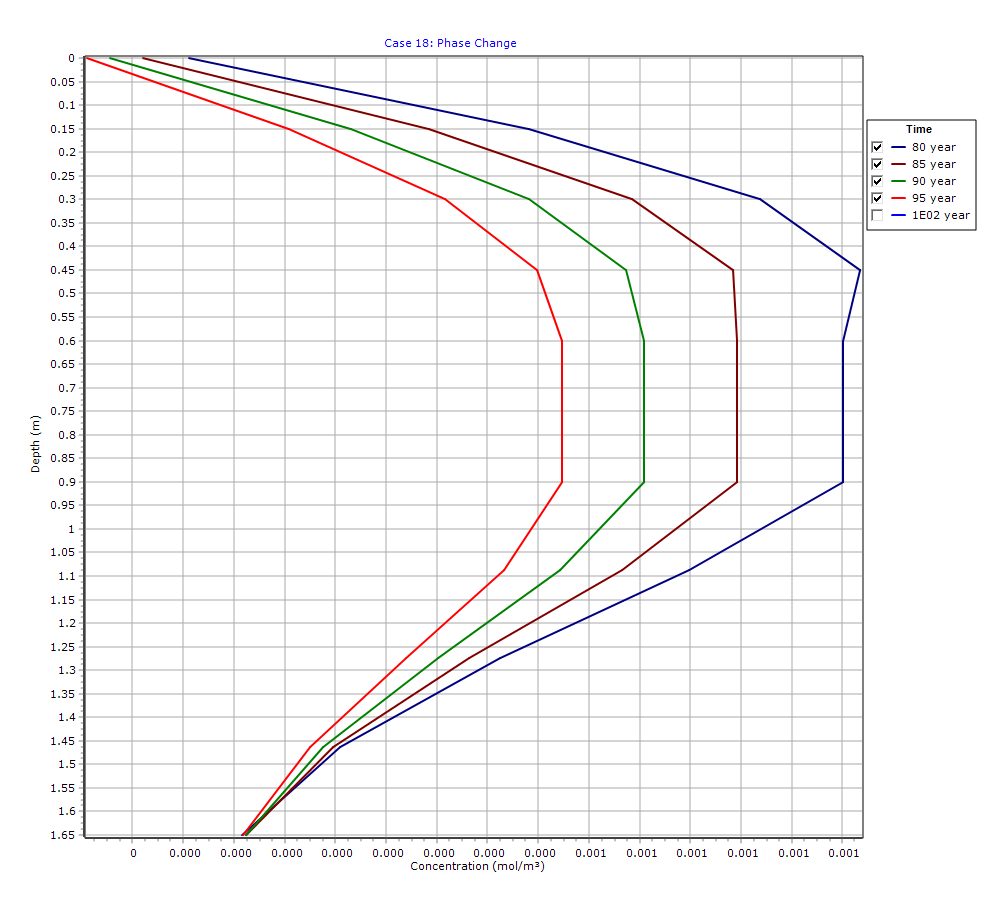
Graphical Output: Depth vs Concentration
PDF Report
 Loading…

 Reload document
  Open in new tab
 Interpretation of Results
This example highlights several important behaviors:
1. Enhanced Transport in Unsaturated Zone
Due to higher diffusion and vapor-phase mobility, DCM can migrate more rapidly in the unsaturated portion.
2. Mixing-Dominated Saturated Zone
The lower diffusion coefficient still reflects significant mixing, leading to lateral spreading within the SLCS.
3. Impact of Phase Partitioning
Henry’s Constant controls how much DCM transitions into vapor form, influencing:
- Vertical flux
- Concentration gradients
- Breakthrough timing
4. Role of Biological Decay
Decay reduces concentrations over time, particularly in the landfill and underlying aquifer, but not within the SLCS.
Key Takeaways
- The Phase Change feature in POLLUTEv10 is essential for modeling contaminants that partition between phases.
- Accurate representation of unsaturated vs. saturated conditions is critical.
- Henry’s Law plays a central role in volatile contaminant transport.
- Layered modeling allows for realistic simulation of landfill systems.
- This example reinforces the importance of site-specific parameterization.
Final Thoughts
Example 18 provides a powerful demonstration of how POLLUTEv10 can simulate complex environmental processes involving multi-phase transport and layered hydrogeology. While simplified, it introduces key concepts necessary for advanced contaminant migration modeling.
However, real-world applications require:
- Detailed site characterization
- Calibration against field data
- Expert interpretation of results
The Phase Change option should only be used when the user fully understands the physical processes and assumptions involved.
Learn more about our Contaminant Transport Modeling Solutions
POLLUTE Examples
- POLLUTEv10 Example 1: Modeling a U.S. RCRA Subtitle D Landfill
- POLLUTEv10 Example 2: Pure Diffusion in a Soil Layer (No Sorption)
- POLLUTEv10 Example 3: Advection + Diffusion with Aquifer Mixing
- POLLUTEv10 Example 4: Finite Mass Source with Leachate Collection System
- POLLUTEv10 Example 5: Hydraulic Trap (Upward Flow into the Landfill)
- POLLUTEv10 Example 6: Fractured Layer with Sorption and Reactive Transport
- POLLUTEv10 Example 7: Lateral Migration of a Radioactive Contaminant in Fractured Rock
- POLLUTEv10 Example 8: Laboratory Diffusion of Potassium in Clay
- POLLUTEv10 Example 9: Diffusion with Freundlich Non-Linear Sorption (Phenol in Clay)
- POLLUTEv10 Example 10: Time-Varying Advective–Dispersive Transport from a Landfill
- POLLUTEv10 Example 11: Time-Varying Source Concentration with Diffusion (Chloride in Clay)
- POLLUTEv10 Example 12: Fractured Media Transport vs Analytical Solution (Tang et al., 1981)
- POLLUTEv10 Example 13: 2D Plane Dispersion vs Analytical Solution (TDAST)
- POLLUTEv10 Example 14: Modeling a Landfill with Primary and Secondary Leachate Collection Using Passive Sink
- POLLUTEv10 Example 15: Modeling Leachate Collection System Failure Using Variable Properties and Passive Sink
- POLLUTEv10 Example 17: Modeling a Landfill with Composite Liners and Dual Leachate Collection Systems
- POLLUTEv10 Example 18: Modeling Phase Change in a Secondary Leachate Collection System
- POLLUTEv10 Example 19: Multiphase Diffusion of Toluene Through a Geomembrane System
- POLLUTEv10 Example 20: Sensitivity Analysis of Primary Leachate Collection System Failure
Comparison between POLLUTE and MIGRATE
- MIGRATEv10 vs POLLUTEv10: Pure Diffusion Comparison
- MIGRATEv10 vs POLLUTEv10: Advective–Diffusive Transport Comparison
- MIGRATEv10 vs POLLUTEv10: Finite Mass Source Comparison
- MIGRATEv10 vs POLLUTEv10: Hydraulic Trap (Finite Mass Source) Comparison
- MIGRATEv10 vs POLLUTEv10: Fractured Layer with Sorption Comparison