

Introduction
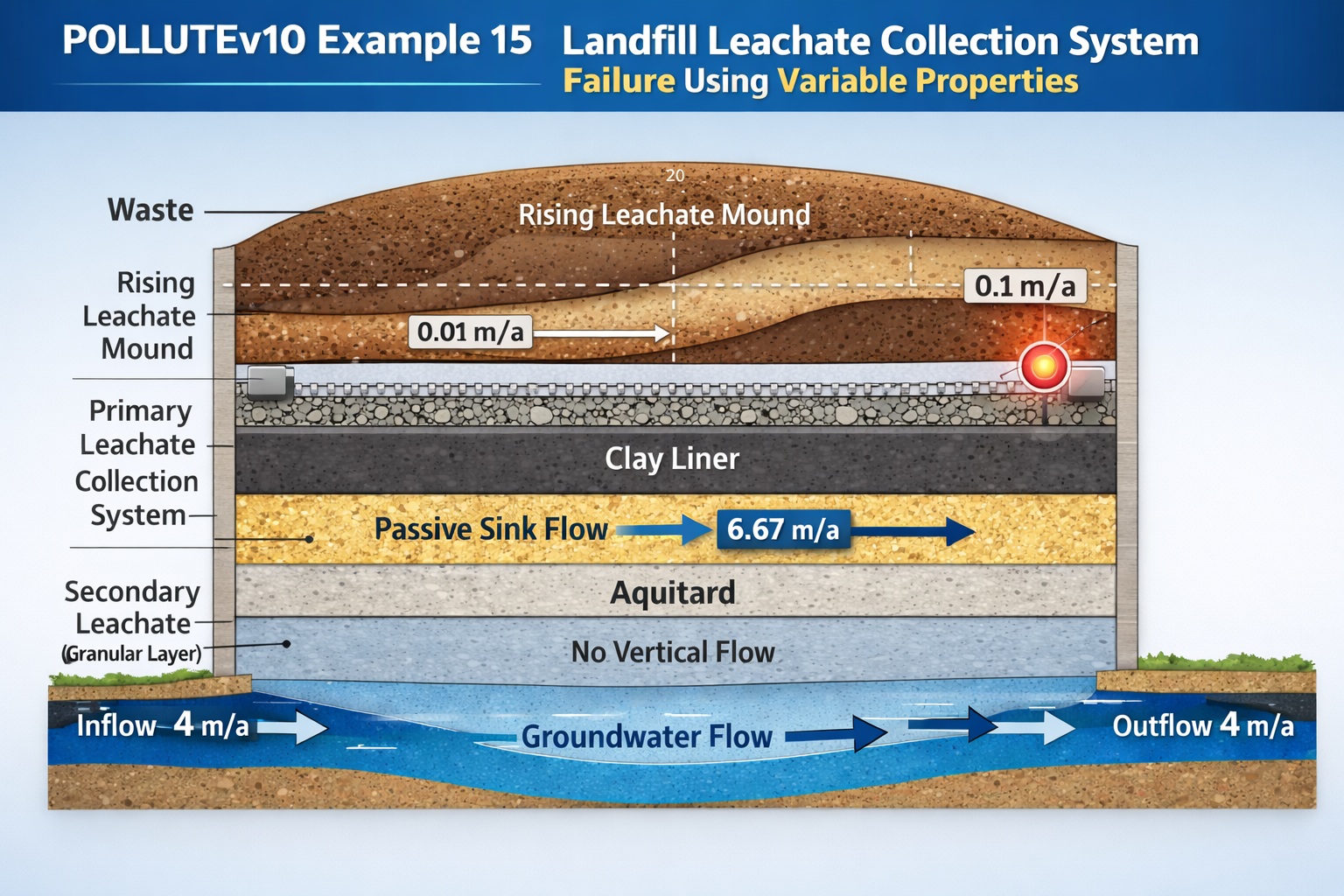
POLLUTEv10 Example 15 builds directly on Example 14 by introducing a critical real-world scenario: failure of the primary leachate collection system (LCS). This example demonstrates how to simulate time-dependent changes in hydraulic conditions using the Variable Properties feature in combination with the Passive Sink option.
The result is a more realistic representation of landfill performance over time, particularly as engineered systems degrade.
Conceptual Model Overview
This model represents:
- A landfill with finite contaminant mass
- A failing primary leachate collection system
- A secondary leachate collection system (passive sink)
- An underlying aquifer with fixed outflow
Key Difference from Example 14
- Darcy velocity between landfill and secondary system is time-dependent
- Represents progressive failure of the primary LCS
Time-Dependent Hydraulic Behavior
The defining feature of this example is the variation in Darcy velocity (va) over time:
| Time Period | Darcy Velocity (va) |
|---|---|
| 0–20 years | 0.01 m/a |
| 20–30 years | Linear increase |
| >30 years | 0.1 m/a |
Interpretation
- 0–20 years: System functioning normally
- 20–30 years: Gradual failure, leachate mound rises
- After 30 years: Complete failure, increased leakage
This increase in Darcy velocity reflects greater downward migration of contaminants.
Source Term and Initial Conditions
As in Example 14:
- Peak concentration: 1000 mg/L
- Reference height of leachate:
- Rate of concentration increase:
The contaminant source is finite and conservative, meaning no decay or sorption occurs.
Leachate Generation
The water balance equation becomes:
Where:
- (infiltration)
- va varies with time
Key Insight
As the primary system fails:
- va increases
- Qc (collected leachate) decreases
- More leachate escapes downward into the subsurface
Passive Sink Layer Configuration
The system is divided into three layers:
Layer 1 – Clay Layer
- Variable vertical flow (time-dependent)
- No horizontal flow
Layer 2 – Secondary LCS (Granular Layer)
- Horizontal flow defined as:
- Acts as a passive sink, intercepting leachate
Layer 3 – Aquitard
- No advective flow
- Diffusion-dominated transport
Coupling Variable Properties and Passive Sink
A critical modeling detail:
- POLLUTE multiplies Darcy velocities from both features
- Recommended approach:
- Set Darcy velocity = 1.0 in one feature
- Input actual values in the other
In This Example
- Variable Properties → 1.0
- Passive Sink → actual time-dependent velocities
This avoids unintended scaling errors.
Dispersivity Consideration
Using Variable Properties allows inclusion of dispersivity:
- Dispersivity = 0.4 m
This reflects enhanced spreading of contaminants due to outward flow conditions.
Model Parameters
| Property | Symbol | Value | Units |
|---|---|---|---|
| Darcy Velocity | va | Variable | m/a |
| Sink Velocity | vs | Variable | m/a |
| Diffusion Coefficient | D | 0.02 | m²/a |
| Dispersivity | α | 0.4 | m |
| Distribution Coefficient | Kd | 0.0 | cm³/g |
| Soil Porosity | n | 0.4 | – |
| Granular Porosity | n | 0.3 | – |
| Dry Density | ρd | 1.5 | g/cm³ |
| Layer Thicknesses | H | 1 / 0.3 / 2 | m |
| Source Concentration | c₀ | 1000 | mg/L |
| Reference Height | Hr | 7.5 | m |
| Leachate Collected | Qc | Variable | m/a |
| Landfill Length | L | 200 | m |
| Aquifer Velocity | vb | 4 | m/a |
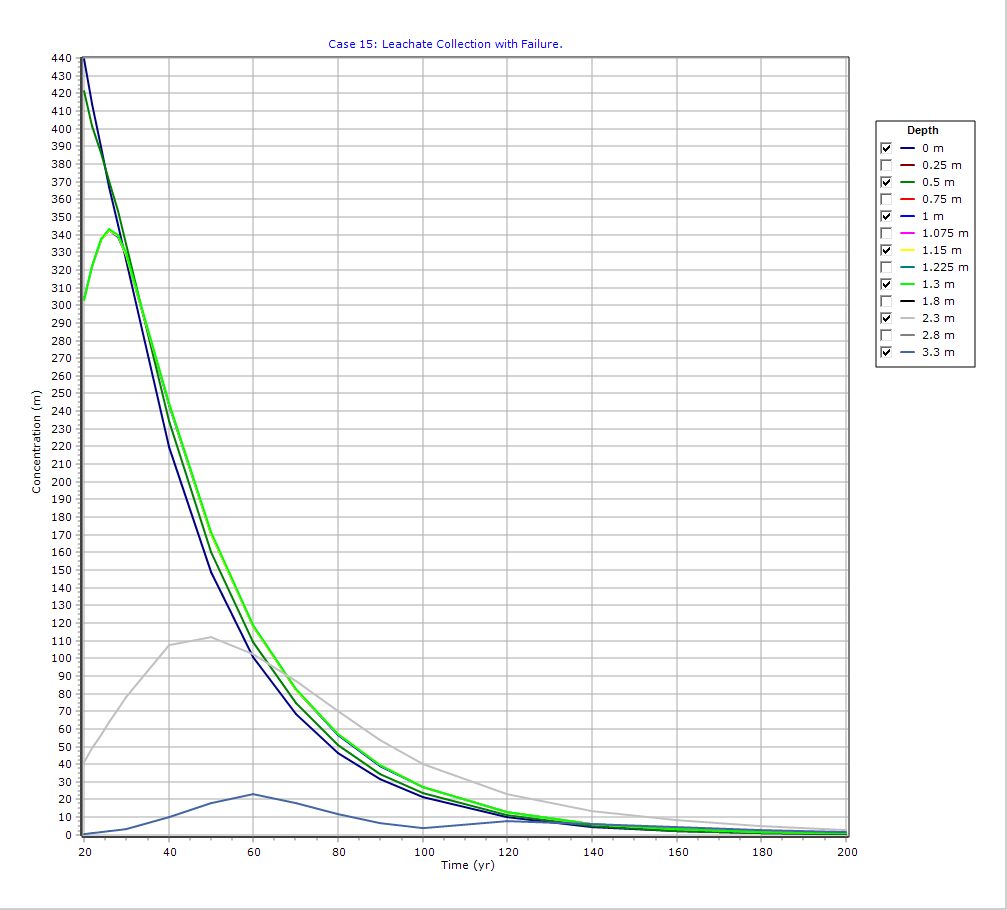
Graphical Output: Concentration vs Time
PDF Report
 Loading…

 Reload document
  Open in new tab
 Key Insights
- System failure dramatically increases contaminant migration risk
- Passive sink helps mitigate but not eliminate impacts
- Time-dependent modeling is essential for:
- Long-term landfill performance
- Risk assessment
- Decreasing leachate collection efficiency leads to:
- Increased downward flux
- Greater reliance on natural attenuation
Numerical Considerations
When using Variable Properties:
- Accuracy depends on number of sublayers
- More sublayers = better resolution of time-dependent changes
- Important for capturing gradual system failure
Practical Implications
This example highlights:
- The importance of redundancy in landfill design
- Risks associated with aging infrastructure
- Need for long-term monitoring and maintenance
Important Disclaimer
⚠️ This example is hypothetical and intended for demonstration purposes only.
- Not a design guideline
- Not universally applicable
- Requires expert interpretation
These modeling approaches should only be applied by professionals with expertise in:
- Hydrogeology
- Contaminant transport
- Landfill engineering
Conclusion
POLLUTEv10 Example 15 provides a powerful demonstration of how system failure can be incorporated into contaminant transport modeling. By combining Variable Properties with the Passive Sink feature, the model captures the dynamic behavior of landfill systems over time—offering valuable insight into long-term environmental risk.
Learn more about our Contaminant Transport Modeling Solutions
POLLUTE Examples
- POLLUTEv10 Example 1: Modeling a U.S. RCRA Subtitle D Landfill
- POLLUTEv10 Example 2: Pure Diffusion in a Soil Layer (No Sorption)
- POLLUTEv10 Example 3: Advection + Diffusion with Aquifer Mixing
- POLLUTEv10 Example 4: Finite Mass Source with Leachate Collection System
- POLLUTEv10 Example 5: Hydraulic Trap (Upward Flow into the Landfill)
- POLLUTEv10 Example 6: Fractured Layer with Sorption and Reactive Transport
- POLLUTEv10 Example 7: Lateral Migration of a Radioactive Contaminant in Fractured Rock
- POLLUTEv10 Example 8: Laboratory Diffusion of Potassium in Clay
- POLLUTEv10 Example 9: Diffusion with Freundlich Non-Linear Sorption (Phenol in Clay)
- POLLUTEv10 Example 10: Time-Varying Advective–Dispersive Transport from a Landfill
- POLLUTEv10 Example 11: Time-Varying Source Concentration with Diffusion (Chloride in Clay)
- POLLUTEv10 Example 12: Fractured Media Transport vs Analytical Solution (Tang et al., 1981)
- POLLUTEv10 Example 13: 2D Plane Dispersion vs Analytical Solution (TDAST)
- POLLUTEv10 Example 14: Modeling a Landfill with Primary and Secondary Leachate Collection Using Passive Sink
- POLLUTEv10 Example 16: Monte Carlo Simulation of Leachate Collection System Failure Timing
- POLLUTEv10 Example 17: Modeling a Landfill with Composite Liners and Dual Leachate Collection Systems
- POLLUTEv10 Example 18: Modeling Phase Change in a Secondary Leachate Collection System
- POLLUTEv10 Example 19: Multiphase Diffusion of Toluene Through a Geomembrane System
- POLLUTEv10 Example 20: Sensitivity Analysis of Primary Leachate Collection System Failure
Comparison between POLLUTE and MIGRATE
- MIGRATEv10 vs POLLUTEv10: Pure Diffusion Comparison
- MIGRATEv10 vs POLLUTEv10: Advective–Diffusive Transport Comparison
- MIGRATEv10 vs POLLUTEv10: Finite Mass Source Comparison
- MIGRATEv10 vs POLLUTEv10: Hydraulic Trap (Finite Mass Source) Comparison
- MIGRATEv10 vs POLLUTEv10: Fractured Layer with Sorption Comparison