

Introduction
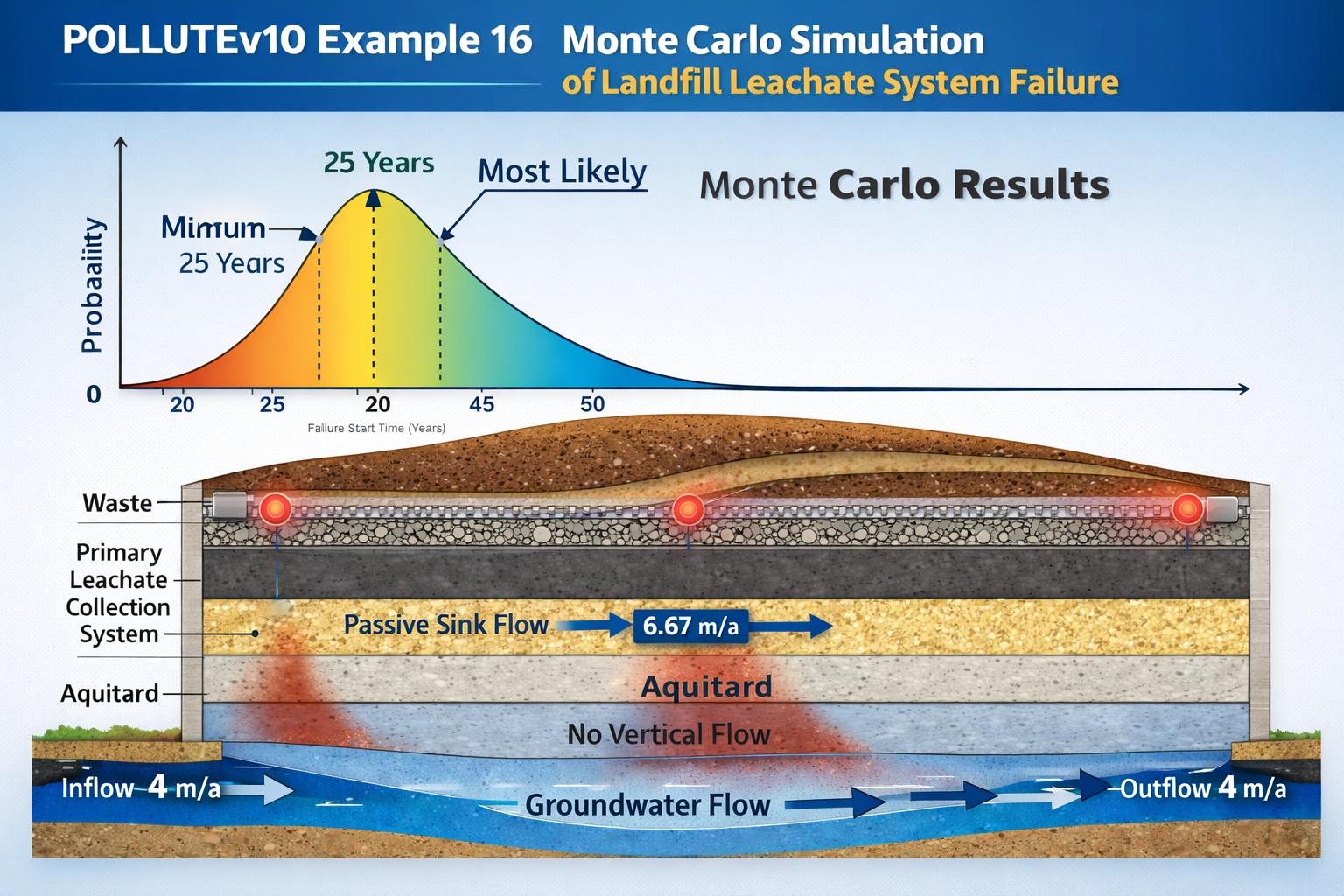
POLLUTEv10 Example 16 introduces probabilistic modeling into landfill contaminant transport analysis using Monte Carlo simulation. Building on Example 15, this case evaluates how uncertainty in the timing of primary leachate collection system (LCS) failure affects contaminant migration.
Rather than assuming a single failure time, this example models a range of possible failure scenarios, providing a more realistic assessment of long-term environmental risk.
Conceptual Model Overview
This model is identical to Example 15 except for one key enhancement:
👉 The onset of primary LCS failure is uncertain
Key Features
- Finite contaminant source
- Passive Sink for secondary leachate collection
- Variable Properties for time-dependent flow
- Monte Carlo simulation for uncertainty analysis
Modeling Uncertainty in System Failure
Instead of a fixed failure time, the model uses a triangular probability distribution:
| Parameter | Value |
|---|---|
| Minimum failure time | 20 years |
| Most likely (mode) | 25 years |
| Maximum failure time | 50 years |
Interpretation
- Some simulations show early failure (20 years)
- Most cluster around 25 years
- Others extend to late failure (up to 50 years)
This approach captures the natural variability and uncertainty in landfill system performance.
Monte Carlo Simulation Approach
Monte Carlo simulation works by:
- Randomly sampling a failure time from the triangular distribution
- Running the POLLUTE model for that scenario
- Repeating the process many times
- Analyzing the distribution of results
Output
Instead of a single deterministic result, you obtain:
- Range of contaminant concentrations
- Probability distributions
- Risk-based insights
Hydraulic Behavior with Variable Failure Timing
As in Example 15:
- Initial Darcy velocity: 0.01 m/a
- After failure: 0.1 m/a
However, the timing of this transition varies per simulation.
Implications
- Earlier failure → greater contaminant migration
- Later failure → reduced long-term impact
- Results reflect uncertainty envelope, not a single prediction
Passive Sink and Variable Properties Integration
The modeling framework remains consistent:
Passive Sink
- Represents secondary leachate collection system
- Provides lateral drainage
Variable Properties
- Controls time-dependent Darcy velocity
- Now linked to random failure timing
Important Note
- Darcy velocities from both features are multiplied internally
- Best practice:
- Set one feature to 1.0
- Input actual values in the other
Model Parameters
All parameters are identical to Example 15, with the addition of Monte Carlo inputs:
| Property | Value | Units |
|---|---|---|
| Diffusion Coefficient | 0.02 | m²/a |
| Dispersivity | 0.4 | m |
| Porosity (soil) | 0.4 | – |
| Porosity (granular) | 0.3 | – |
| Source Concentration | 1000 | mg/L |
| Reference Height | 7.5 | m |
| Landfill Length | 200 | m |
| Aquifer Velocity | 4 | m/a |
Monte Carlo Parameters
| Parameter | Value |
|---|---|
| Minimum failure time | 20 years |
| Mode | 25 years |
| Maximum | 50 years |
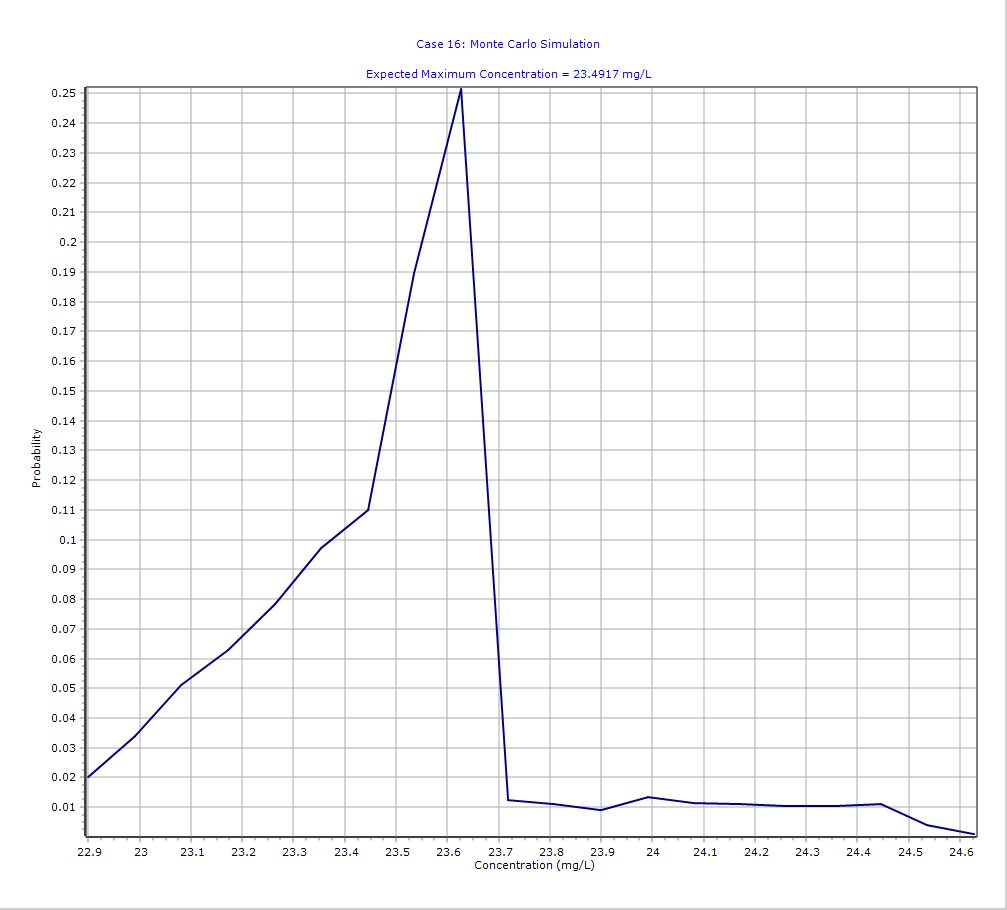
Graphical Output: Probability vs Concentration
PDF Report
 Loading…

 Reload document
  Open in new tab
 Key Insights
- Uncertainty significantly affects predicted contaminant migration
- Deterministic models may underestimate or overestimate risk
- Monte Carlo simulation provides:
- Probability-based outcomes
- Better support for decision-making
- Early failure scenarios dominate worst-case risk
Practical Applications
This type of analysis is valuable for:
- Risk assessments
- Landfill design optimization
- Regulatory submissions
- Long-term monitoring strategies
It helps answer questions like:
👉 “What is the probability that contamination reaches the aquifer within 50 years?”
Numerical and Modeling Considerations
- Results depend on number of Monte Carlo realizations
- More simulations → smoother probability distributions
- Computational demand increases with:
- Number of realizations
- Model complexity
Important Disclaimer
⚠️ This example is for demonstration purposes only.
- Not a design guideline
- Not suitable for direct application without expert review
Use of Monte Carlo simulation with Variable Properties requires:
- Advanced understanding of POLLUTEv10
- Strong background in hydrogeology and risk modeling
- Consultation with program developers for critical applications
Conclusion
POLLUTEv10 Example 16 elevates contaminant transport modeling by incorporating uncertainty into system performance. Through Monte Carlo simulation, it provides a more realistic and robust framework for evaluating landfill risks over time.
This approach reflects real-world conditions—where system failure is not a fixed event, but a probabilistic process—making it a powerful tool for modern environmental engineering.
Learn more about our Contaminant Transport Modeling Solutions
POLLUTE Examples
- POLLUTEv10 Example 1: Modeling a U.S. RCRA Subtitle D Landfill
- POLLUTEv10 Example 2: Pure Diffusion in a Soil Layer (No Sorption)
- POLLUTEv10 Example 3: Advection + Diffusion with Aquifer Mixing
- POLLUTEv10 Example 4: Finite Mass Source with Leachate Collection System
- POLLUTEv10 Example 5: Hydraulic Trap (Upward Flow into the Landfill)
- POLLUTEv10 Example 6: Fractured Layer with Sorption and Reactive Transport
- POLLUTEv10 Example 7: Lateral Migration of a Radioactive Contaminant in Fractured Rock
- POLLUTEv10 Example 8: Laboratory Diffusion of Potassium in Clay
- POLLUTEv10 Example 9: Diffusion with Freundlich Non-Linear Sorption (Phenol in Clay)
- POLLUTEv10 Example 10: Time-Varying Advective–Dispersive Transport from a Landfill
- POLLUTEv10 Example 11: Time-Varying Source Concentration with Diffusion (Chloride in Clay)
- POLLUTEv10 Example 12: Fractured Media Transport vs Analytical Solution (Tang et al., 1981)
- POLLUTEv10 Example 13: 2D Plane Dispersion vs Analytical Solution (TDAST)
- POLLUTEv10 Example 14: Modeling a Landfill with Primary and Secondary Leachate Collection Using Passive Sink
- POLLUTEv10 Example 15: Modeling Leachate Collection System Failure Using Variable Properties and Passive Sink
- POLLUTEv10 Example 17: Modeling a Landfill with Composite Liners and Dual Leachate Collection Systems
- POLLUTEv10 Example 18: Modeling Phase Change in a Secondary Leachate Collection System
- POLLUTEv10 Example 19: Multiphase Diffusion of Toluene Through a Geomembrane System
- POLLUTEv10 Example 20: Sensitivity Analysis of Primary Leachate Collection System Failure
Comparison between POLLUTE and MIGRATE
- MIGRATEv10 vs POLLUTEv10: Pure Diffusion Comparison
- MIGRATEv10 vs POLLUTEv10: Advective–Diffusive Transport Comparison
- MIGRATEv10 vs POLLUTEv10: Finite Mass Source Comparison
- MIGRATEv10 vs POLLUTEv10: Hydraulic Trap (Finite Mass Source) Comparison
- MIGRATEv10 vs POLLUTEv10: Fractured Layer with Sorption Comparison