

Introduction
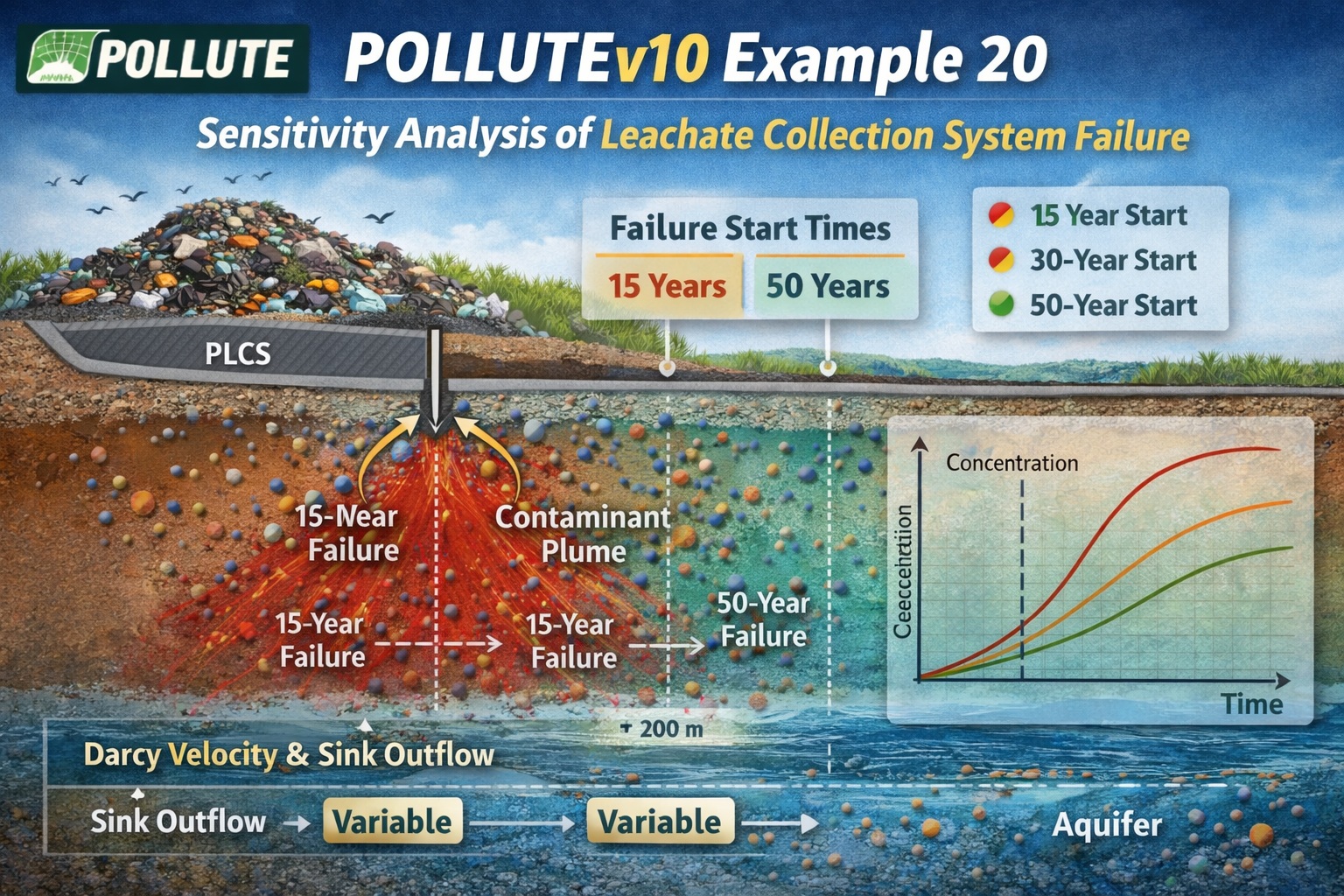
POLLUTEv10 Example 20 introduces Sensitivity Analysis as a powerful tool to evaluate how uncertainty in system performance impacts contaminant transport. In this case, the focus is on the service life of a Primary Leachate Collection System (PLCS) and how variations in its failure timing influence contaminant migration.
Building on the framework established in Examples 15 and 16, this model incorporates both:
- Variable Properties
- Passive Sink
to simulate changing hydraulic conditions as the leachate collection system degrades over time.
⚠️ Important Note: This is a hypothetical example intended for instructional purposes only. It should not be used directly for real-world landfill design or risk assessment without expert guidance.
Conceptual Model Overview
The modeled system consists of:
- A landfill source with constant contaminant concentration
- A Primary Leachate Collection System (PLCS) subject to failure over time
- Multiple subsurface layers
- An underlying aquifer system
The key variable is the time at which the PLCS begins to fail, which directly affects flow and contaminant migration.
Objective of the Sensitivity Analysis
The purpose of this example is to evaluate how uncertainty in PLCS failure timing impacts:
- Contaminant breakthrough timing
- Concentration levels in the aquifer
- Long-term system performance
Failure Time Range
- Minimum failure start time: 15 years
- Maximum failure start time: 50 years
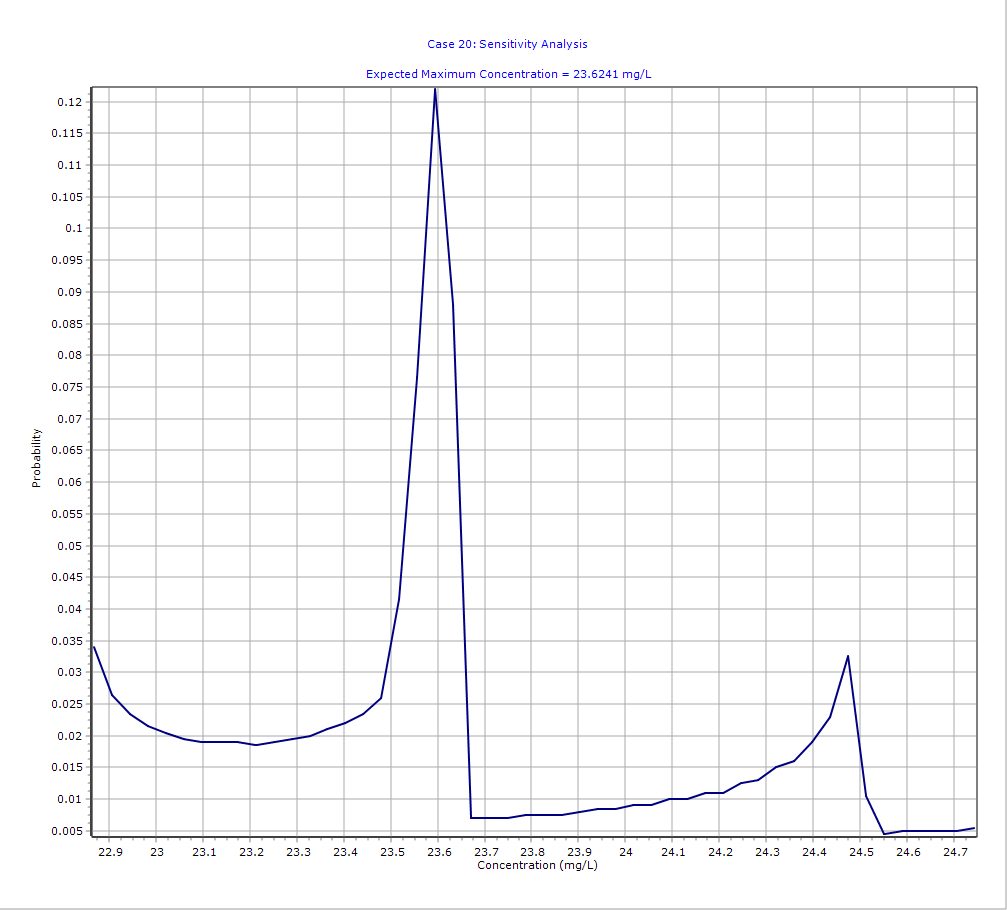
By varying this parameter, the model generates a range of possible outcomes, helping quantify risk and uncertainty.
Key Input Parameters
The model uses the same parameters as Example 15, with the addition of sensitivity analysis variables.
Transport and Material Properties
| Property | Symbol | Value | Units |
|---|---|---|---|
| Diffusion Coefficient | D | 0.02 | m²/a |
| Dispersivity | α | 0.4 | m |
| Distribution Coefficient | K | 0 | cm³/g |
| Soil Porosity | n | 0.3 | – |
| Granular Layer Porosity | n | 0.3 | – |
| Dry Density | ρd | 1.5 | g/cm³ |
Geometric Parameters
| Layer | Thickness |
| Layer 1 | 1 m |
| Layer 2 | 0.3 m |
| Layer 3 | 2 m |
| Aquifer Thickness | 1 m |
Source and System Properties
| Parameter | Symbol | Value |
| Source Concentration | c₀ | 1000 mg/L |
| Reference Height of Leachate | Hr | 7.5 cm³/g |
| Landfill Length | L | 200 m |
| Landfill Width | W | 1 m |
Flow Parameters (Variable)
| Parameter | Symbol | Description |
| Darcy Velocity | va | Varies with PLCS performance |
| Sink Outflow Velocity | vs | Varies with system degradation |
| Leachate Collection Rate | Qc | Variable |
Aquifer Properties
| Parameter | Symbol | Value |
| Aquifer Porosity | nb | 0.3 |
| Aquifer Velocity | vb | 4 m/a |
Modeling Approach in POLLUTEv10
Step 1: Base Model Setup
- Use the configuration from Example 15
- Ensure Variable Properties and Passive Sink features are enabled
Step 2: Define Sensitivity Parameter
- Set failure start time as the variable parameter
- Define range: 15 to 50 years
Step 3: Link Failure to System Behavior
- Adjust:
- Darcy velocity (va)
- Sink outflow velocity (vs)
- Leachate collection rate (Qc)
These parameters evolve as the PLCS degrades.
Step 4: Run Multiple Simulations
- POLLUTE automatically evaluates scenarios across the defined range
- Results represent a spectrum of possible outcomes
Graphical Output: Probability vs Concentration
PDF Report
 Loading…

 Reload document
  Open in new tab
 Why Sensitivity Analysis Matters
Sensitivity analysis is critical in environmental modeling because:
- Real-world systems involve uncertainty
- Material degradation is time-dependent
- Field conditions are rarely uniform
This approach helps:
- Identify critical parameters
- Quantify risk ranges
- Support decision-making and design optimization
Key Takeaways
- The service life of leachate systems is a critical control on contaminant migration
- POLLUTEv10 enables robust uncertainty analysis through sensitivity tools
- Combining Variable Properties and Passive Sink features allows realistic system degradation modeling
- Sensitivity analysis provides insight into best-case and worst-case scenarios
Final Thoughts
Example 20 highlights the importance of moving beyond single deterministic simulations toward probabilistic and sensitivity-based approaches. By evaluating a range of failure scenarios, engineers can better understand the risk envelope associated with landfill performance.
However, applying these tools in practice requires:
- Strong hydrogeologic understanding
- Careful parameter selection
- Validation against field or monitoring data
These advanced features should only be used by qualified professionals, particularly for projects with regulatory or environmental significance.
Learn more about our Contaminant Transport Modeling Solutions
.
POLLUTE Examples
POLLUTEv10 Example 20: Sensitivity Analysis of Primary Leachate Collection System Failure
POLLUTEv10 Example 1: Modeling a U.S. RCRA Subtitle D Landfill
POLLUTEv10 Example 2: Pure Diffusion in a Soil Layer (No Sorption)
POLLUTEv10 Example 3: Advection + Diffusion with Aquifer Mixing
POLLUTEv10 Example 4: Finite Mass Source with Leachate Collection System
POLLUTEv10 Example 5: Hydraulic Trap (Upward Flow into the Landfill)
POLLUTEv10 Example 6: Fractured Layer with Sorption and Reactive Transport
POLLUTEv10 Example 7: Lateral Migration of a Radioactive Contaminant in Fractured Rock
POLLUTEv10 Example 8: Laboratory Diffusion of Potassium in Clay
POLLUTEv10 Example 9: Diffusion with Freundlich Non-Linear Sorption (Phenol in Clay)
POLLUTEv10 Example 10: Time-Varying Advective–Dispersive Transport from a Landfill
POLLUTEv10 Example 11: Time-Varying Source Concentration with Diffusion (Chloride in Clay)
POLLUTEv10 Example 12: Fractured Media Transport vs Analytical Solution (Tang et al., 1981)
POLLUTEv10 Example 13: 2D Plane Dispersion vs Analytical Solution (TDAST)
POLLUTEv10 Example 16: Monte Carlo Simulation of Leachate Collection System Failure Timing
POLLUTEv10 Example 18: Modeling Phase Change in a Secondary Leachate Collection System
POLLUTEv10 Example 19: Multiphase Diffusion of Toluene Through a Geomembrane System
Comparison between POLLUTE and MIGRATE
- MIGRATEv10 vs POLLUTEv10: Pure Diffusion Comparison
- MIGRATEv10 vs POLLUTEv10: Advective–Diffusive Transport Comparison
- MIGRATEv10 vs POLLUTEv10: Finite Mass Source Comparison
- MIGRATEv10 vs POLLUTEv10: Hydraulic Trap (Finite Mass Source) Comparison
- MIGRATEv10 vs POLLUTEv10: Fractured Layer with Sorption Comparison