

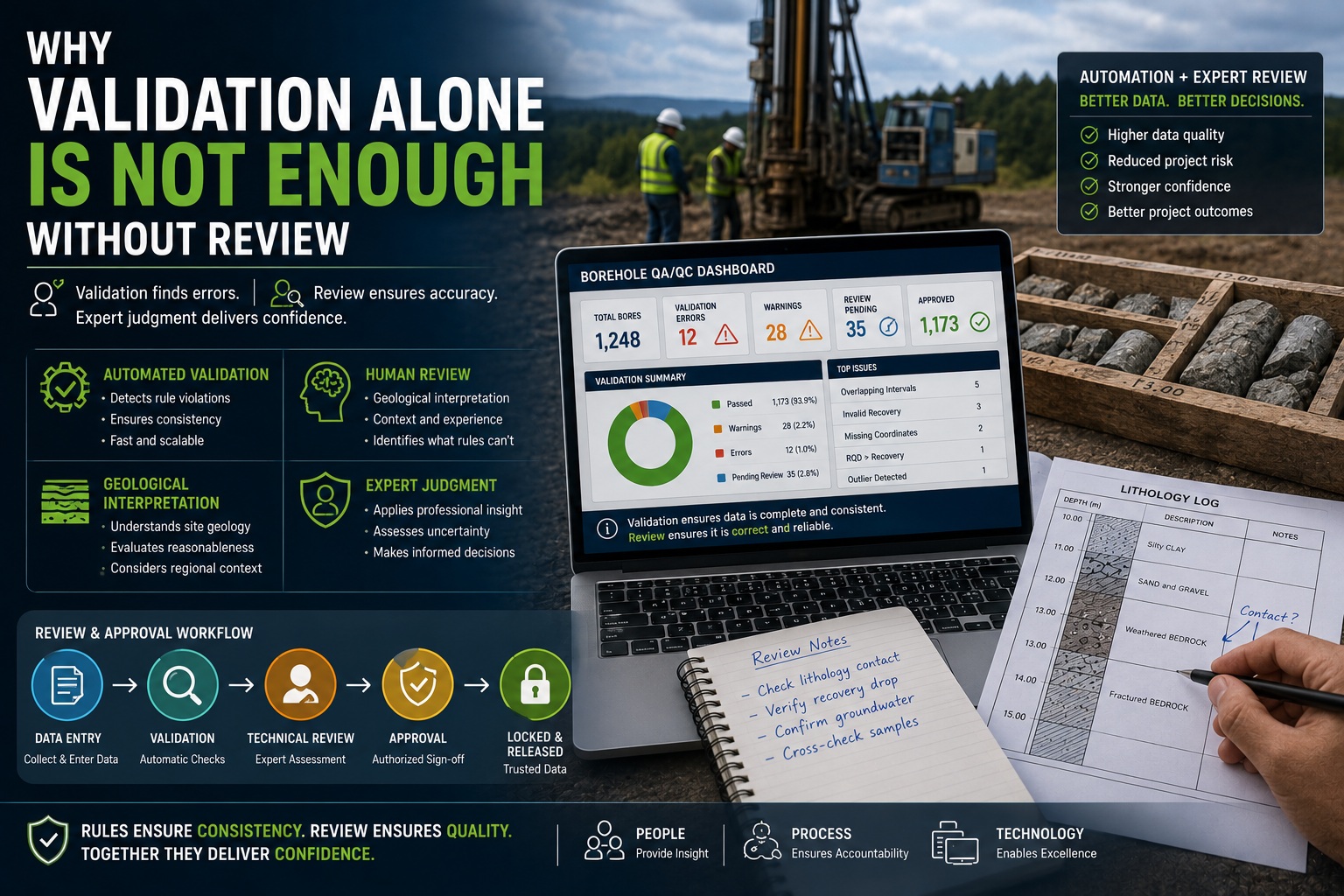
The Critical Role of Human Expertise in Borehole Data Quality
Modern geological and geotechnical database systems have become increasingly sophisticated. Automated validation engines can identify missing fields, overlapping intervals, invalid coordinates, impossible recovery values, and hundreds of other data quality issues within seconds. These systems dramatically improve efficiency and help organizations maintain consistent quality standards across large projects.
However, despite the power of automated validation, one fundamental truth remains unchanged:
Validation does not replace review.
A borehole can pass every validation rule in a database and still contain significant geological, geotechnical, or interpretive errors. Automated systems excel at identifying data that violates predefined rules, but they cannot fully understand geological context, site history, drilling conditions, or the professional judgment required to interpret subsurface conditions.
This is why successful organizations combine automated validation with structured review and approval workflows. Validation ensures data is technically consistent, while review ensures it is scientifically and professionally correct.
This article explores why validation alone is insufficient, the importance of human oversight, the role of geological interpretation, the purpose of review stages, approval workflows, and the continuing importance of expert judgment.
What Validation Does Well
Automated validation is one of the most valuable tools available for modern borehole data management.
Validation systems can automatically identify:
- Missing required fields
- Invalid depth intervals
- Overlapping records
- Recovery greater than run length
- RQD exceeding recovery
- Duplicate sample numbers
- Invalid coordinate formats
- Missing survey data
- Statistical outliers
These checks improve consistency and significantly reduce manual review effort.
For example:
| Value | Validation Result |
|---|---|
| Recovery = 105% | Error |
| From Depth > To Depth | Error |
| Missing Borehole ID | Error |
Such issues are objective and can be detected reliably by software.
Validation is excellent at identifying what is clearly wrong.
What Validation Cannot Do
The challenge is that many geological decisions are not objective.
Consider the following example:
A geologist logs:
| Depth | Lithology |
| 0–5 m | Clay |
| 5–12 m | Sand |
| 12–20 m | Till |
Every interval is complete.
No overlaps exist.
No gaps exist.
The borehole passes validation.
However, a senior geologist reviewing nearby boreholes notices that no sand unit exists anywhere else on the site.
The “sand” interval was actually misclassified silty till.
The data is valid from a database perspective but incorrect from a geological perspective.
No validation rule can reliably detect this type of interpretive mistake.
Human Oversight Remains Essential
Automated systems evaluate rules.
Humans evaluate meaning.
This distinction is critical.
A reviewer considers factors such as:
- Local geology
- Project objectives
- Historical drilling data
- Regional stratigraphy
- Site conditions
- Engineering implications
These factors often cannot be represented through simple validation rules.
For example, a coordinate may fall within project boundaries and pass validation.
A reviewer may still recognize that the location is inconsistent with field survey records.
Similarly, recovery values may be mathematically valid while being geologically suspicious.
Human oversight provides context that software alone cannot replicate.
Geological Interpretation Requires Expertise
One of the most important limitations of automated validation is its inability to perform geological interpretation.
Geological logging involves judgment.
Two experienced geologists may interpret the same interval differently.
Examples include:
- Weathering grades
- Fracture frequency
- Lithological contacts
- Structural features
- Core recovery assessments
- Stratigraphic boundaries
These interpretations require professional expertise.
Example: Lithological Boundaries
Suppose a geologist records:
| Depth | Lithology |
| 0–4.5 m | Clay |
| 4.5–8.0 m | Sand |
| 8.0–12.0 m | Clay |
The intervals are technically valid.
However, review of neighboring boreholes suggests the sand layer should begin at approximately 6 m.
The interval may require reconsideration.
The database cannot determine whether the interpretation is geologically reasonable.
An experienced reviewer can.
Example: Rock Quality Assessment
Recovery and RQD may pass all validation checks.
Example:
| Recovery | RQD |
| 95 | 85 |
The values are valid.
However, if photographs show heavily fractured core, the reviewer may question the RQD calculation.
Validation confirms consistency.
Review confirms correctness.
Both are necessary.
The Purpose of Review Stages
A structured review process acts as a second line of defense against data quality issues.
Rather than relying solely on automated validation, organizations typically implement multiple review stages.
Each stage focuses on different aspects of quality.
Stage 1: Data Entry Review
The first review occurs shortly after data entry.
Objectives include:
- Checking completeness
- Confirming coding standards
- Verifying imported records
- Reviewing validation warnings
This stage focuses primarily on data integrity.
Stage 2: Technical Review
The second stage evaluates technical correctness.
Reviewers assess:
- Geological interpretations
- Stratigraphic consistency
- Sampling procedures
- Laboratory results
- Drilling records
This stage often identifies issues that automated validation cannot detect.
Stage 3: Senior Review
Senior reviewers evaluate broader project consistency.
Examples include:
- Regional geological trends
- Modeling implications
- Resource impacts
- Engineering significance
This review ensures the data supports project objectives.
Approval Workflows Create Accountability
Review alone is valuable, but formal approval workflows create accountability.
Approval workflows establish clear responsibility for data quality.
A typical workflow might include:
Draft
Data is being entered.
In Review
Validation completed and assigned for review.
Reviewed
Technical review completed.
Approved
Final sign-off completed.
Locked
Changes prevented without authorization.
This progression ensures that data receives appropriate scrutiny before becoming part of the permanent project record.
Why Approval Is Different From Validation
Validation asks:
“Does the data violate any rules?”
Approval asks:
“Can this data be trusted for decision-making?”
These are fundamentally different questions.
A borehole may pass every validation rule and still require revision before approval.
Approval confirms that qualified personnel accept responsibility for the data.
This is particularly important for:
- Regulatory submissions
- Engineering designs
- Environmental reports
- Resource calculations
- Construction projects
Expert Judgment Cannot Be Automated
Artificial intelligence and advanced analytics continue to improve, but expert judgment remains irreplaceable.
Experienced geologists recognize patterns that software may not detect.
Examples include:
- Unusual depositional environments
- Structural complexity
- Drilling artifacts
- Logging inconsistencies
- Historical site knowledge
Experts often identify issues based on intuition developed through years of experience.
This intuition is difficult to encode into automated rules.
Recognizing Geological Context
A recovery value of 40% may be alarming in competent granite.
The same recovery may be completely normal within a fault zone.
An automated system may flag both records.
An experienced reviewer understands the context.
This ability to incorporate geological knowledge remains one of the greatest strengths of human review.
The Risk of Over-Reliance on Automation
Organizations sometimes assume that a borehole passing validation is automatically ready for approval.
This assumption can create significant risk.
Potential consequences include:
- Incorrect geological models
- Faulty engineering recommendations
- Regulatory compliance issues
- Costly redesigns
- Reduced confidence in data
Automation should support reviewers, not replace them.
The most successful organizations view validation as an aid to decision-making rather than a substitute for professional judgment.
Building an Effective Validation and Review Process
The strongest QA/QC systems combine automation with expert oversight.
Recommended practices include:
Automate Objective Checks
Use validation rules for:
- Completeness
- Consistency
- Formatting
- Mathematical relationships
- Cross-dataset validation
Require Technical Review
Ensure qualified personnel review:
- Geological interpretations
- Core logging
- Sampling decisions
- Laboratory results
Implement Formal Approval
Require documented approval before:
- Reporting
- Modeling
- Regulatory submission
- Engineering use
Maintain Audit Trails
Track:
- Validation status
- Reviewer comments
- Approval history
- Revision records
This provides transparency and accountability.
Validation and Review Work Together
The relationship between validation and review is not competitive.
They serve different purposes.
| Validation | Review |
| Automated | Human |
| Rule-based | Experience-based |
| Objective | Interpretive |
| Fast | Analytical |
| Consistency-focused | Quality-focused |
Neither process is sufficient on its own.
Together they create a comprehensive quality assurance framework.
Conclusion
Automated validation has transformed borehole data management by detecting errors faster, improving consistency, and reducing manual effort. However, validation alone cannot replace the expertise required to evaluate geological interpretations, assess data reasonableness, and make professional decisions. Human oversight, structured review stages, formal approval workflows, and expert judgment remain essential components of any effective QA/QC program. The highest-quality geological databases are not created through automation alone but through the combination of intelligent validation systems and experienced professionals who understand the geological context behind the data. When validation and review work together, organizations achieve greater confidence, better decision-making, and more reliable project outcomes.