

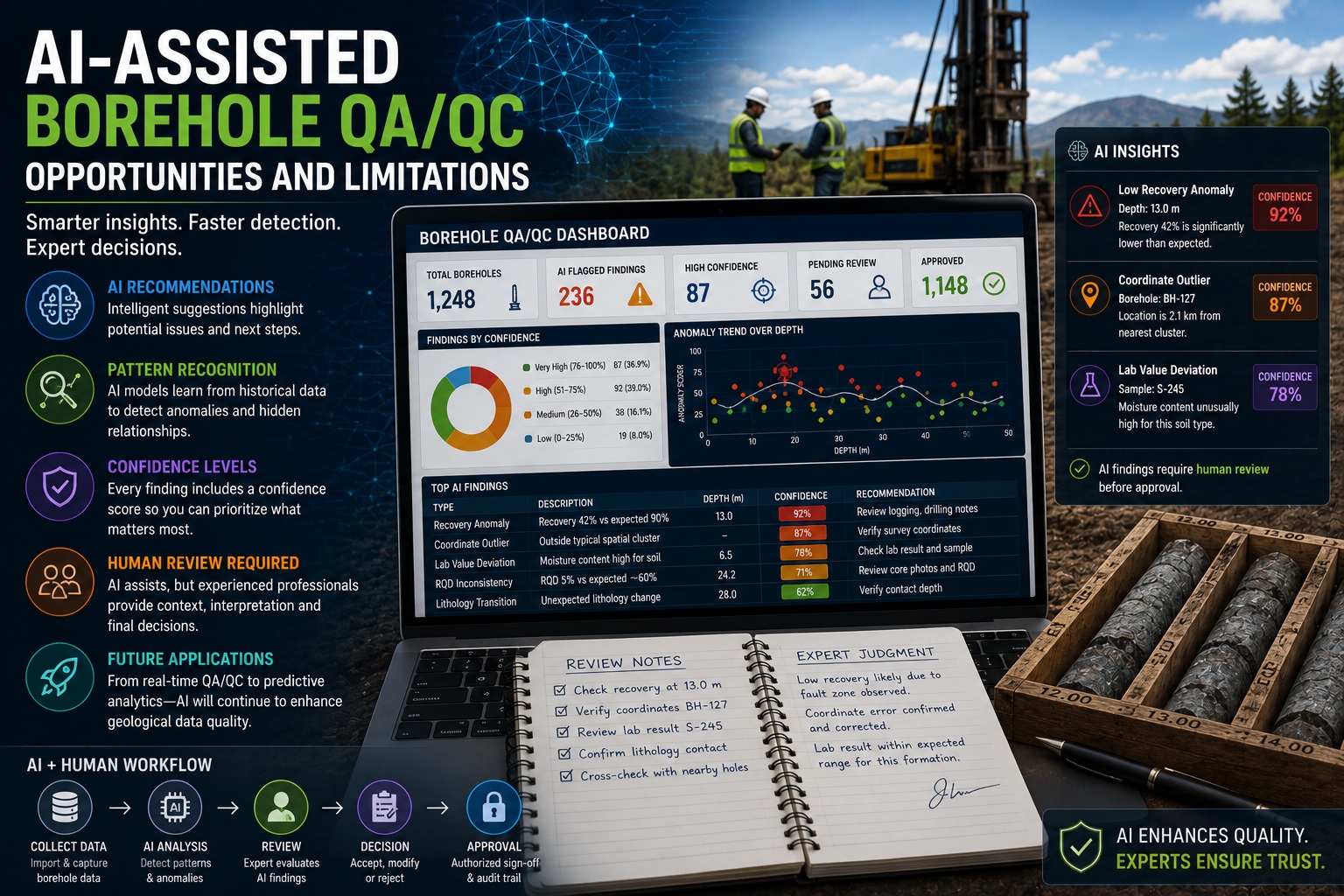
How Artificial Intelligence Is Transforming Geological Data Quality Management
The volume of geological and geotechnical data being collected today is growing at an unprecedented rate. Modern drilling programs can generate thousands of boreholes, millions of records, and numerous interconnected datasets that include lithology logs, recovery measurements, Rock Quality Designation (RQD), laboratory results, geotechnical testing, groundwater monitoring, and spatial information.
Traditional QA/QC processes rely heavily on validation rules and expert review. While these methods remain essential, many organizations are beginning to explore how artificial intelligence (AI) can enhance data quality management by identifying patterns, detecting anomalies, and providing intelligent recommendations.
AI has the potential to dramatically improve the speed and effectiveness of borehole QA/QC. However, it is equally important to understand its limitations. AI can assist experts, but it cannot replace geological knowledge, professional judgment, or formal review processes.
This article explores the opportunities and limitations of AI-assisted borehole QA/QC, including AI recommendations, pattern recognition, confidence levels, human review requirements, and future applications.
What Is AI-Assisted Borehole QA/QC?
AI-assisted QA/QC uses machine learning, statistical modeling, and pattern recognition techniques to identify potential data quality issues automatically.
Unlike traditional validation rules that check predefined conditions, AI systems learn from historical data and identify situations that appear unusual or inconsistent.
Traditional rule:
RQD <= RecoveryAI-based assessment:
Recovery is unusually low compared to nearby intervals in similar rock units.The difference is significant.
Rule-based systems identify known errors.
AI systems identify suspicious patterns.
Together they create a more comprehensive quality assurance framework.
Why AI Is Becoming Important
Several trends are driving interest in AI-assisted validation.
Growing Data Volumes
Large projects may contain:
- Thousands of boreholes
- Millions of intervals
- Multiple datasets
- Decades of historical information
Manual review becomes increasingly difficult as data volumes expand.
Complex Data Relationships
Geological data contains numerous interdependencies.
Examples include:
- Recovery versus RQD
- Lithology versus laboratory results
- SPT values versus soil type
- Well construction versus geology
- Coordinates versus project boundaries
AI can evaluate many variables simultaneously.
Need for Faster QA/QC
Organizations want to identify problems as early as possible.
AI can analyze data continuously and provide near real-time feedback during:
- Data entry
- Import operations
- Review processes
- Reporting workflows
This allows teams to focus attention where it is most needed.
AI Recommendations
One of the most practical applications of AI in QA/QC is the generation of recommendations.
Rather than simply reporting errors, AI systems can suggest likely causes and possible actions.
Example: Recovery Anomaly
Suppose a borehole contains:
| Depth | Recovery |
|---|---|
| 10 m | 92% |
| 11 m | 95% |
| 12 m | 94% |
| 13 m | 42% |
| 14 m | 93% |
Traditional validation may not identify a problem because 42% recovery is technically possible.
An AI system may recognize that:
- Nearby intervals average 93%
- Similar lithologies average 90%
- Historical boreholes show consistent recovery
Recommendation:
“Recovery value at 13 m differs significantly from surrounding intervals. Review logging records and drilling notes.”
The AI does not claim the value is wrong.
It recommends further investigation.
Example: Coordinate Validation
An AI system may detect that:
- Most boreholes cluster within a project area
- One borehole is located 2 km away
Recommendation:
“Coordinate appears inconsistent with project spatial distribution. Verify survey information.”
This type of intelligent guidance helps reviewers prioritize their efforts.
Pattern Recognition
Pattern recognition is one of the most powerful capabilities of AI.
Unlike traditional validation rules, AI can identify complex relationships that may not be obvious to users.
Geological Patterns
Machine learning models can recognize:
- Stratigraphic sequences
- Typical lithological transitions
- Recovery trends
- Geotechnical property relationships
- Regional geological characteristics
For example, an AI system may learn that:
- Dense sand typically exhibits high SPT values
- Fresh granite generally has high recovery
- Certain formations exhibit characteristic weathering profiles
When new data deviates substantially from these patterns, the system can flag the record for review.
Multi-Dataset Analysis
Traditional validation often evaluates datasets independently.
AI can analyze relationships across multiple datasets simultaneously.
Examples:
Recovery vs RQD
AI may detect:
- Consistent relationships throughout the project
- A single interval that behaves differently
Lithology vs Laboratory Results
AI may identify:
- Density values inconsistent with soil type
- Moisture contents unusual for a given formation
Spatial Relationships
AI can compare:
- Nearby boreholes
- Geological continuity
- Structural trends
This level of analysis would be difficult to implement using conventional validation rules alone.
Confidence Levels
AI systems rarely provide absolute answers.
Instead, they generate confidence levels that indicate how strongly the system believes a record requires attention.
What Is a Confidence Score?
A confidence score represents the probability that a detected anomaly is meaningful.
Typical scale:
| Confidence | Interpretation |
| 0–25 | Low concern |
| 26–50 | Moderate concern |
| 51–75 | High concern |
| 76–100 | Very high concern |
Higher values suggest greater likelihood that the record deserves review.
Example
Suppose an AI model evaluates an RQD value.
Scenario A
- Slightly unusual
- Similar values nearby
Confidence: 35
Review if convenient.
Scenario B
- Highly unusual
- No supporting geological evidence
Confidence: 92
Immediate review recommended.
Confidence scores help reviewers prioritize large numbers of validation findings.
Workflow Benefits
Confidence levels allow organizations to:
- Rank issues by importance
- Reduce review effort
- Focus on high-risk records
- Improve productivity
Instead of reviewing thousands of warnings, teams can concentrate on the most significant anomalies.
Human Review Requirements
Despite the capabilities of AI, human review remains essential.
This is perhaps the most important principle of AI-assisted QA/QC.
AI is a tool.
It is not a replacement for professional expertise.
Geological Interpretation Cannot Be Fully Automated
AI can identify patterns.
It cannot fully understand geological context.
For example:
A low recovery interval may represent:
- Logging error
- Fault zone
- Sheared rock
- Weathered contact
An experienced geologist can evaluate supporting evidence and determine the most likely explanation.
AI cannot reliably make that decision.
Context Matters
Consider a gold exploration project.
An AI system flags an unusually high assay value.
Possible explanations include:
- Laboratory error
- Sample contamination
- Significant mineralization
Only a qualified professional can determine which interpretation is appropriate.
This is why AI findings should generally be treated as recommendations rather than conclusions.
Regulatory Accountability
Many industries require professional sign-off.
Examples include:
- Environmental reports
- Geotechnical investigations
- Resource estimates
- Engineering studies
Regulatory agencies expect qualified experts to review and approve data.
AI cannot assume legal or professional responsibility.
Human reviewers remain accountable.
Limitations of AI in Borehole QA/QC
While AI offers substantial benefits, organizations must recognize its limitations.
Dependence on Training Data
AI models learn from historical information.
Poor-quality historical data can produce poor-quality recommendations.
If a database contains systematic errors, the model may learn incorrect patterns.
False Positives
AI systems may identify valid geological conditions as anomalies.
Examples:
- Fault zones
- Ore bodies
- Karst features
- Unique depositional environments
These conditions may be unusual but completely legitimate.
Excessive false positives can frustrate users and reduce trust in the system.
Lack of Geological Understanding
AI identifies statistical relationships.
It does not truly understand geology.
It cannot:
- Visit a drill site
- Examine core
- Observe drilling conditions
- Apply professional experience
Its conclusions are based entirely on available data.
Black Box Concerns
Some machine learning models are difficult to explain.
Users may struggle to understand:
- Why an anomaly was flagged
- Which variables contributed
- How confidence was calculated
Organizations should prioritize transparent and explainable AI systems whenever possible.
Future Applications
AI capabilities continue to evolve rapidly.
Future applications may include:
Automated Data Classification
AI-assisted lithology coding and standardization.
Intelligent Data Import
Automatic detection of mapping errors during data imports.
Real-Time Drilling QA/QC
Continuous monitoring of drilling and logging operations.
Predictive Validation
Forecasting potential data quality issues before they occur.
Geological Knowledge Graphs
Linking boreholes, laboratory data, models, and reports to identify hidden relationships.
Digital Review Assistants
AI systems that help reviewers navigate complex datasets and prioritize findings.
These technologies have the potential to significantly improve efficiency while maintaining high-quality standards.
Best Practices for Implementing AI-Assisted QA/QC
Organizations adopting AI should follow several key principles.
Use AI as an Assistant
AI should support decision-making, not replace it.
Maintain Traditional Validation Rules
Rule-based validation remains essential for detecting objective errors.
Require Human Review
All significant AI findings should be reviewed by qualified personnel.
Provide Confidence Scores
Users should understand how strongly the system believes a finding is important.
Maintain Audit Trails
Record:
- AI recommendations
- Confidence levels
- Reviewer decisions
- Resolution history
This improves transparency and accountability.
Conclusion
AI-assisted borehole QA/QC represents one of the most promising developments in geological data management. By combining pattern recognition, anomaly detection, confidence scoring, and intelligent recommendations, AI can help organizations identify data quality issues faster and more effectively than traditional methods alone. However, AI also has important limitations. It cannot replace geological interpretation, professional judgment, regulatory accountability, or expert review. The most effective approach is a hybrid model in which automated validation, artificial intelligence, and experienced professionals work together. In this environment, AI becomes a powerful assistant that enhances productivity, improves data quality, and supports better decision-making while ensuring that final responsibility remains with qualified experts.