

Borehole data is one of the most valuable assets in environmental, geotechnical, mining, hydrogeological, and geological projects. The quality of this data directly affects engineering decisions, regulatory compliance, risk assessments, and project outcomes. While data validation tools can identify many errors, an effective borehole quality assurance and quality control (QA/QC) process requires much more than automated checks.
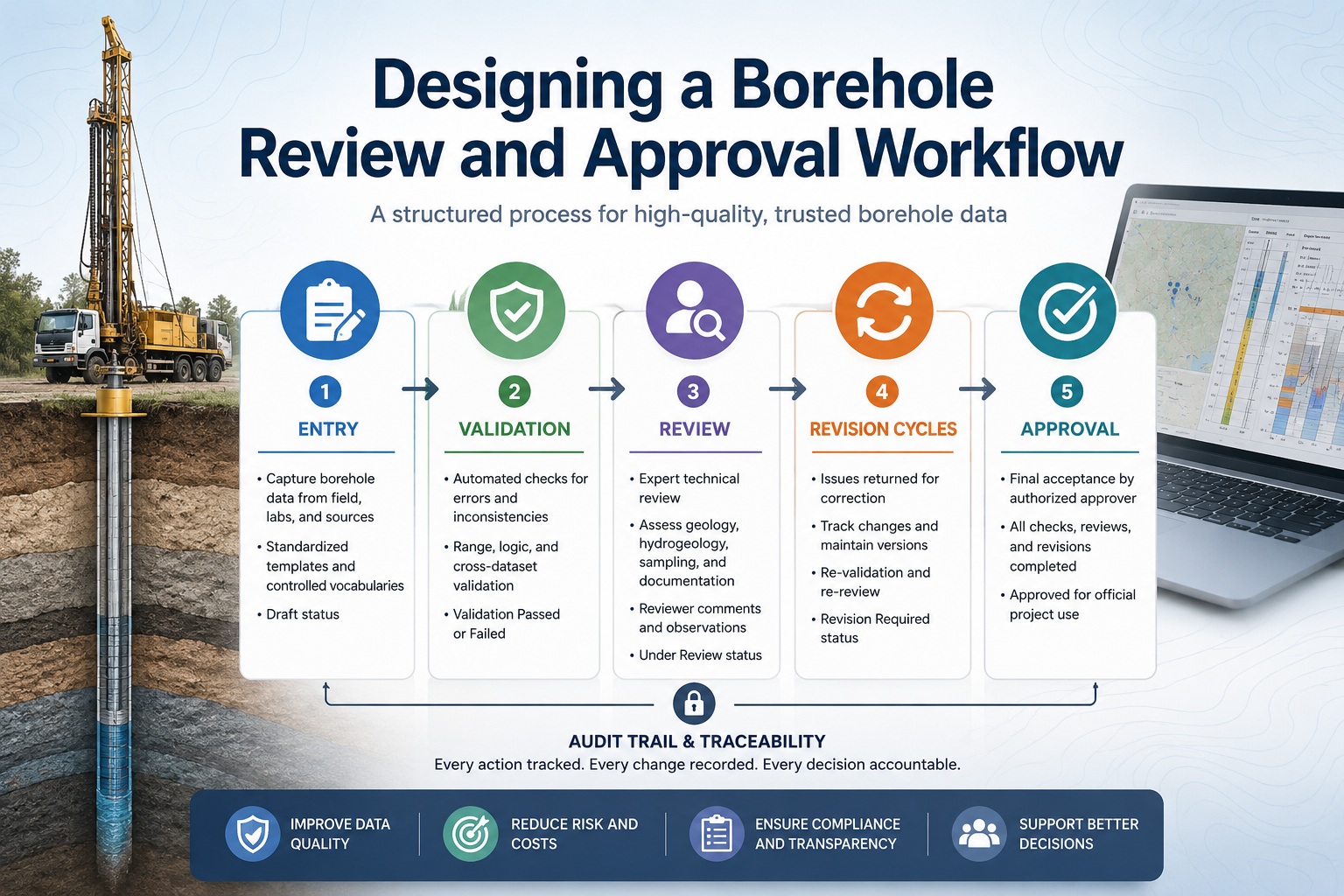
A well-designed borehole review and approval workflow ensures that data progresses through structured stages before it becomes part of the official project record. By implementing clear entry, validation, review, approval, and revision processes, organizations can improve data quality, increase accountability, and reduce project risk.
This article explores the key components of a robust borehole review and approval workflow and provides guidance for designing a process that supports both efficiency and data integrity.
Why a Formal Workflow Matters
Many organizations still rely on informal review processes involving spreadsheets, email exchanges, and manual sign-offs. While these approaches may work for small projects, they become increasingly difficult to manage as project complexity grows.
Without a formal workflow, common problems include:
- Inconsistent data quality
- Missing review records
- Unclear ownership and responsibility
- Duplicate corrections
- Regulatory compliance risks
- Delays in reporting and project delivery
A structured workflow creates transparency and ensures every borehole record follows the same quality control path before being used in analyses, models, reports, or regulatory submissions.
Stage 1: Data Entry
The workflow begins with data entry.
Borehole information may originate from various sources, including:
- Field logging software
- Drilling contractors
- Laboratory reports
- Historical databases
- Geological logging systems
- Manual data entry forms
At this stage, the primary objective is to capture data accurately and completely.
Typical information entered includes:
- Borehole identifiers
- Coordinates and elevations
- Drilling methods
- Lithology descriptions
- Sample intervals
- Groundwater measurements
- Laboratory results
- Construction details
- Monitoring well information
Best Practices for Data Entry
Organizations should establish standardized templates and controlled vocabularies to reduce inconsistencies.
Examples include:
- Standard lithology codes
- Consistent unit systems
- Dropdown lists for classifications
- Mandatory fields
- Controlled terminology
Data entry systems should also track:
- Entry date
- User information
- Data source
- Project association
Maintaining this metadata creates an audit trail that supports future reviews and investigations.
Workflow Status: Draft
Newly entered records should initially receive a Draft status.
Draft records are not yet considered verified and should not be used in official reports or analyses until they progress through subsequent workflow stages.
Stage 2: Automated Validation
Once data has been entered, the next step is automated validation.
Validation identifies errors, omissions, and inconsistencies before human reviewers spend time examining records.
Automated validation rules can evaluate:
Required Fields
Examples:
- Missing borehole ID
- Missing coordinates
- Missing ground elevation
- Missing drilling dates
Range Checks
Examples:
- Negative depths
- Invalid elevations
- Impossible groundwater levels
- Laboratory values outside expected limits
Logical Consistency Checks
Examples:
- Total depth less than sample depth
- Screen interval below borehole depth
- End date before start date
- Sample interval overlap
Cross-Dataset Validation
Examples:
- Laboratory sample IDs not matching field samples
- Water levels inconsistent with borehole construction
- Coordinates outside project boundaries
- Lithology intervals containing gaps
Validation Severity Levels
Many organizations categorize validation results according to severity:
Error
- Must be corrected before proceeding.
Warning
- Potential issue requiring review.
Information
- Unusual condition that may be acceptable.
This distinction helps reviewers focus on issues that present the greatest risk.
Workflow Status: Validation Failed or Validation Passed
Records containing critical errors remain in a Validation Failed state until corrections are made.
Records passing validation advance to the review stage.
Automated validation significantly reduces reviewer workload by catching routine issues early in the workflow.
Stage 3: Technical Review
Validation identifies rule-based issues, but it cannot replace professional judgment.
The review stage introduces expert evaluation by qualified personnel.
Reviewers may include:
- Geologists
- Hydrogeologists
- Environmental scientists
- Geotechnical engineers
- Senior data managers
The purpose of review is to assess whether the data makes technical and contextual sense.
Review Activities
Reviewers commonly evaluate:
Geological Consistency
Examples:
- Stratigraphy follows expected regional patterns.
- Lithologic transitions appear reasonable.
- Rock descriptions match core observations.
Hydrogeological Interpretation
Examples:
- Water levels are realistic.
- Hydraulic test results are reasonable.
- Aquifer interpretations are supported by evidence.
Sampling Completeness
Examples:
- Required samples were collected.
- Laboratory results are complete.
- Quality control samples are present.
Documentation Quality
Examples:
- Comments are adequate.
- Supporting attachments exist.
- Field notes are available.
Reviewer Comments
An effective workflow allows reviewers to document observations and concerns.
Comments should include:
- Issue description
- Recommended correction
- Reviewer identity
- Date and time
Maintaining these records provides accountability and historical traceability.
Workflow Status: Under Review
During review, records should be locked from unauthorized modification while still allowing reviewers to document findings.
This prevents changes from occurring simultaneously with the review process.
Stage 4: Revision Cycles
Few borehole datasets pass review without requiring some level of correction.
The revision cycle is a critical component of any workflow.
When issues are identified, records should be returned to the responsible individual for correction.
Common Revision Requests
Examples include:
- Correcting coordinates
- Updating lithology descriptions
- Adding missing intervals
- Resolving validation warnings
- Clarifying groundwater measurements
- Uploading missing documentation
Controlled Revisions
A robust system should:
- Track every revision
- Preserve previous versions
- Record who made changes
- Capture timestamps
- Maintain reviewer comments
Version control is essential because it allows organizations to reconstruct the history of a record and demonstrate compliance during audits or regulatory reviews.
Iterative Improvement
Multiple review and revision cycles may occur before approval.
The workflow should support:
- Review
- Revision
- Re-validation
- Re-review
- Approval
This iterative process gradually improves data quality while maintaining a complete audit trail.
Workflow Status: Revision Required
Records returned for correction should receive a Revision Required status.
This clearly communicates that additional work is needed before approval can occur.
Stage 5: Final Approval
Approval represents the formal acceptance of a borehole record.
At this stage, the organization confirms that:
- Validation checks have passed
- Technical reviews are complete
- Required corrections have been addressed
- Supporting documentation exists
- Quality standards have been met
Approval Authority
Approval should be performed by designated personnel such as:
- Senior geologists
- Project managers
- Data managers
- Technical leads
- Regulatory coordinators
The approving individual assumes responsibility for confirming that the data is suitable for project use.
Approval Records
Approval actions should capture:
- Approver name
- Approval date
- Approval comments
- Workflow status
- Version number
These records become part of the permanent project history.
Workflow Status: Approved
Once approved, records become official project data.
Organizations often restrict editing of approved records to prevent accidental modifications.
If changes are required later, a formal revision process should reopen the workflow rather than allowing direct edits.
Recommended Borehole Workflow Lifecycle
A typical borehole workflow may follow the following progression:
- Draft
- Validation Pending
- Validation Failed
- Validation Passed
- Under Review
- Revision Required
- Re-Submitted
- Approved
- Archived
This structure provides clear visibility into the current status of every borehole within a project.
Key Features of an Effective Workflow System
When implementing a borehole review and approval workflow, organizations should consider features such as:
Role-Based Permissions
Different users should have different responsibilities.
Examples:
- Data Entry Personnel
- Reviewers
- Approvers
- Administrators
Audit Trails
Every action should be recorded, including:
- Data changes
- Workflow transitions
- Review comments
- Approval actions
Automated Notifications
Notifications can inform users when:
- Validation fails
- Reviews are assigned
- Revisions are requested
- Approvals are completed
Dashboard Reporting
Project dashboards can display:
- Boreholes awaiting review
- Validation error counts
- Approval progress
- Data completeness metrics
- Workflow bottlenecks
These metrics help project managers monitor quality and schedule performance.
Conclusion
A borehole review and approval workflow provides the framework needed to transform raw field data into trusted project information. By combining structured data entry, automated validation, expert review, controlled revision cycles, and formal approval processes, organizations can significantly improve data quality while maintaining complete traceability.
As regulatory requirements grow and projects become increasingly data-driven, a documented and repeatable workflow is no longer optional. It is a fundamental component of modern borehole QA/QC programs. Organizations that invest in robust review and approval processes reduce risk, improve confidence in their datasets, and establish a solid foundation for better technical and business decisions.