

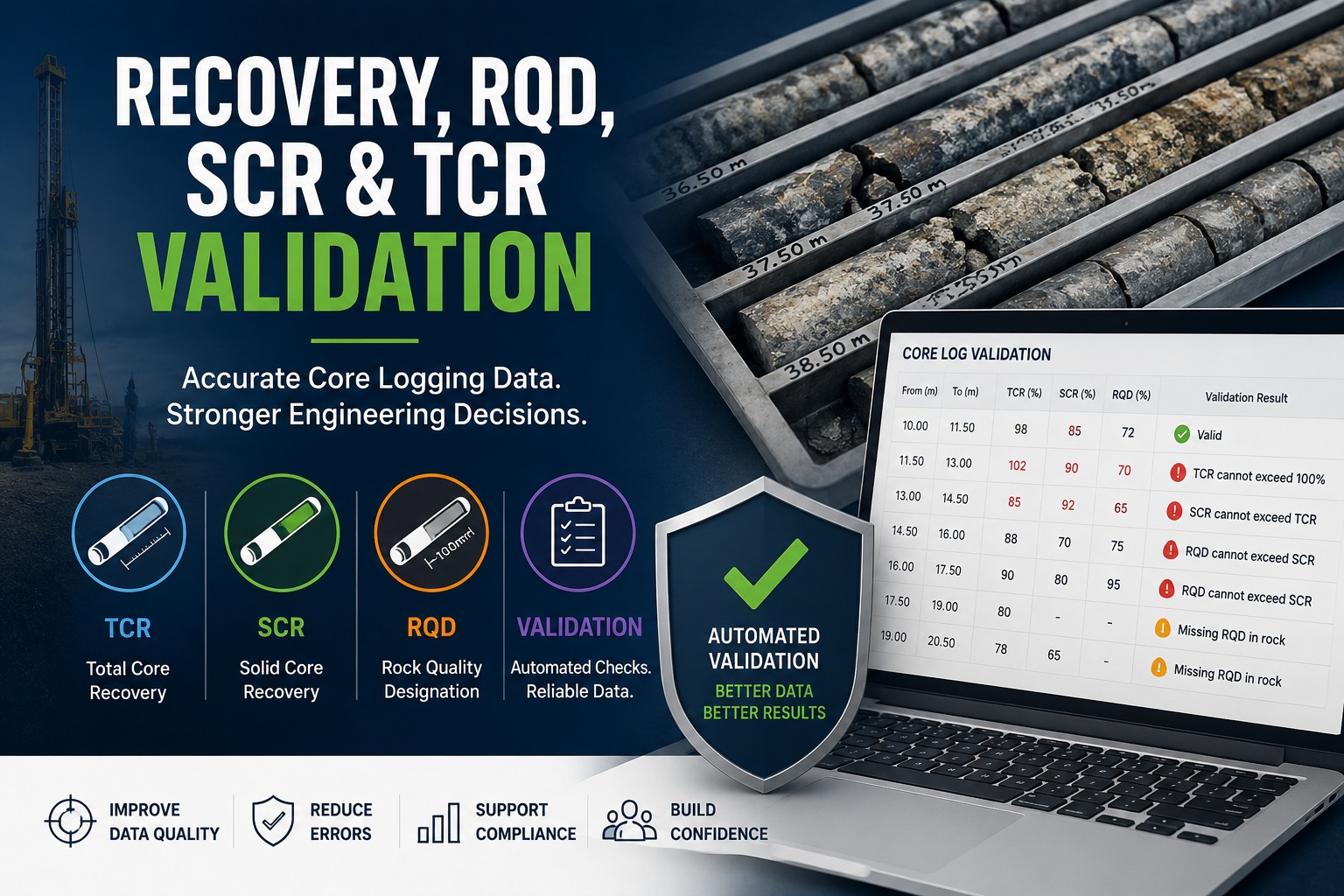
Core drilling provides some of the most valuable information used in geotechnical engineering, mining, hydrogeology, and environmental investigations. However, the value of that information depends entirely on the quality and consistency of the recorded data. Among the most important measurements collected during core logging are Core Recovery, Rock Quality Designation (RQD), Solid Core Recovery (SCR), and Total Core Recovery (TCR).
These measurements influence everything from foundation design and slope stability assessments to tunneling, mine planning, and resource estimation. Unfortunately, they are also among the most commonly miscalculated or inconsistently recorded values found in borehole databases.
Modern borehole management systems such as WinLoG can automatically validate these values during data entry and project review, detecting impossible combinations, calculation errors, missing information, and inconsistencies before reports are issued.
This article explains what Recovery, RQD, SCR, and TCR represent, why validation is essential, and how automated QA/QC significantly improves the reliability of geological data.
Why Core Recovery Validation Matters
Core recovery measurements provide an indication of the condition of the rock mass encountered during drilling. Engineers often rely heavily on these values when evaluating:
- Rock competency
- Fracture frequency
- Excavation methods
- Foundation suitability
- Tunnel stability
- Mine planning
- Ground support requirements
Even relatively small errors can significantly affect engineering interpretations. An incorrect RQD value may cause rock quality to appear substantially better—or worse—than it actually is.
Manual review of hundreds or thousands of boreholes is both time-consuming and prone to error. Automated validation ensures that every interval is checked consistently using predefined engineering rules.
Understanding the Four Measurements
Total Core Recovery (TCR)
Total Core Recovery represents the percentage of the drilled interval recovered, regardless of whether the pieces are intact or broken.
It is calculated as:
Total recovered core length ÷ drilled interval × 100
TCR indicates drilling success but does not necessarily reflect rock quality.
For example:
- Drill interval: 1.5 m
- Core recovered: 1.47 m
TCR =
1.47 ÷ 1.50 × 100 = 98%
Solid Core Recovery (SCR)
SCR measures only the solid, competent pieces of recovered core while excluding heavily fractured material.
SCR is typically lower than TCR because broken fragments are excluded.
SCR provides a better indication of intact rock quality than TCR alone.
Rock Quality Designation (RQD)
RQD measures the percentage of core pieces longer than 100 mm within the drill run.
Only intact pieces longer than 100 mm contribute to the calculation.
Typical interpretation:
| RQD | Rock Quality |
|---|---|
| 90–100% | Excellent |
| 75–90% | Good |
| 50–75% | Fair |
| 25–50% | Poor |
| <25% | Very Poor |
RQD is one of the most widely used rock mass classification parameters.
Core Recovery
Some organizations use “Recovery” as a synonym for TCR, while others calculate recovery differently depending on drilling procedures.
Regardless of terminology, validation ensures that recovery values remain internally consistent with the recorded measurements.
Common Data Quality Problems
Automated validation frequently discovers issues such as:
- Recovery exceeding 100%
- SCR greater than TCR
- RQD greater than SCR
- Missing recovery values
- Missing RQD in rock intervals
- RQD reported for soil
- Copy-and-paste errors
- Unit conversion mistakes
- Incorrect interval lengths
- Decimal point errors
- Data entry transcription mistakes
Many of these errors can remain undetected without automated QA/QC.
Engineering Relationships That Should Always Hold
Several logical relationships should always exist.
Rule 1: Recovery Cannot Exceed 100%
Since recovery represents recovered length divided by drilled length, values above 100% are impossible.
Valid
- Recovery = 96%
Invalid
- Recovery = 118%
Possible causes include:
- Incorrect interval length
- Typographical errors
- Wrong units
- Duplicate measurements
Rule 2: SCR Cannot Exceed TCR
Because SCR measures only intact core, it must always be less than or equal to total recovered core.
Correct:
- TCR = 95%
- SCR = 82%
Incorrect:
- TCR = 88%
- SCR = 94%
This is one of the simplest—and most important—validation rules.
Rule 3: RQD Cannot Exceed SCR
RQD counts only intact pieces longer than 100 mm.
SCR includes all solid core.
Therefore:
RQD ≤ SCR
Example:
Correct
- SCR = 85%
- RQD = 71%
Incorrect
- SCR = 70%
- RQD = 89%
Such inconsistencies usually indicate calculation errors.
Rule 4: RQD Should Not Exceed Recovery
Since RQD is calculated using recovered core, it cannot exceed total recovery.
Example:
Recovery = 82%
RQD = 90%
Impossible.
Detecting Missing RQD Values
Many organizations require RQD whenever competent rock is encountered.
Automated validation can identify intervals where:
- Lithology indicates bedrock
- Rock descriptions exist
- Recovery measurements are present
but
- RQD is missing.
Rather than discovering these omissions during report preparation, the software identifies them immediately.
Preventing Soil/Rock Confusion
RQD is intended only for rock.
Sometimes boreholes contain entries such as:
- Clay
- Silt
- Sand
- Peat
with an RQD value.
This usually results from:
- Copying previous intervals
- Incorrect templates
- Data import errors
Automated rules immediately flag these inconsistencies.
Cross-Checking Multiple Measurements
One advantage of modern validation systems is the ability to compare multiple datasets simultaneously.
Instead of validating each field independently, the software evaluates relationships between:
- Lithology
- Recovery
- SCR
- TCR
- RQD
- Weathering
- Rock strength
- Fracture frequency
- Core photographs
- Geophysical logs
Cross-dataset validation detects errors that would otherwise appear perfectly reasonable when viewed individually.
Detecting Suspicious Engineering Values
Not every unusual value is incorrect.
However, certain combinations deserve review.
Examples include:
Very high recovery with extremely poor RQD
Example:
- Recovery = 99%
- RQD = 8%
Possible explanations:
- Highly fractured rock
- Incorrect RQD calculation
- Logging inconsistency
Automated validation flags these for engineering review rather than automatically marking them as errors.
Interval Consistency Checks
Adjacent intervals should generally transition logically.
Validation can identify abrupt changes such as:
| Depth | RQD |
|---|---|
| 10–11 m | 95% |
| 11–12 m | 6% |
| 12–13 m | 94% |
While possible, such dramatic changes often indicate data entry mistakes.
These intervals can be highlighted for further review.
Automated Validation Rules
Typical QA/QC systems include rules such as:
| Rule | Purpose |
|---|---|
| Recovery ≤ 100% | Prevent impossible recovery values |
| SCR ≤ TCR | Ensure logical recovery hierarchy |
| RQD ≤ SCR | Validate RQD calculations |
| RQD ≤ Recovery | Prevent impossible relationships |
| Missing RQD | Detect incomplete logging |
| RQD in soil | Prevent invalid use |
| Recovery missing | Detect incomplete records |
| Duplicate values | Identify copy/paste errors |
| Extreme value changes | Highlight unusual transitions |
| Interval overlap | Detect logging inconsistencies |
These rules can execute automatically whenever data are entered or imported.
Batch Validation Across Entire Projects
One major advantage of automated QA/QC is the ability to validate every borehole in an entire project within seconds.
Instead of reviewing individual logs manually, engineers can validate:
- Hundreds of boreholes
- Thousands of intervals
- Multiple drilling campaigns
- Historical databases
- Imported AGS or DIGGS datasets
The resulting validation report highlights only those intervals requiring attention.
Benefits During Data Migration
Many organizations are migrating decades of borehole information from legacy systems such as gINT or spreadsheets.
During migration, common problems include:
- Missing RQD values
- Incorrect recovery calculations
- Truncated decimal values
- Unit conversion errors
- Field mapping mistakes
- Duplicate intervals
Running automated validation immediately after import provides confidence that migrated data remain technically sound before they are relied upon for new projects.
Supporting Regulatory Compliance
Government agencies, infrastructure owners, mining companies, and transportation authorities increasingly expect digital data to be accurate, complete, and auditable.
Automated validation supports these requirements by providing:
- Consistent rule enforcement
- Repeatable QA/QC procedures
- Documented validation results
- Audit trails
- Project-wide quality metrics
- Defensible engineering records
This is particularly valuable when projects undergo independent technical review or regulatory submission.
Integrating Validation into Daily Workflows
The most effective QA/QC systems perform validation throughout the project lifecycle rather than waiting until report generation.
Typical workflow:
- Validate during data entry.
- Revalidate after edits.
- Validate imported datasets.
- Run project-wide QA/QC before review.
- Correct flagged issues.
- Revalidate to confirm resolution.
- Approve and issue the finalized records.
This continuous validation approach minimizes rework and reduces the likelihood of errors reaching final reports.
WinLoG Automated Core Logging Validation
WinLoG includes an advanced validation engine designed specifically for borehole and geological data. Rather than relying on generic database checks, it applies engineering-specific rules to evaluate the relationships between Recovery, RQD, SCR, TCR, lithology, sampling data, groundwater observations, laboratory results, and other borehole information.
Validation can be performed during data entry, after imports, or across entire projects. Results are categorized by severity, linked directly to the affected interval, and accompanied by explanations that help users understand both the issue and the recommended corrective action. Organizations can also extend the validation framework with company-specific or agency-specific rule sets to reflect their own standards and workflows.
By automatically identifying inconsistent recovery measurements, impossible RQD values, missing data, and other common logging issues, WinLoG helps improve data quality before reports are finalized, supporting more reliable engineering decisions and better long-term management of borehole information.
Conclusion
Recovery, SCR, TCR, and RQD form the foundation of rock mass characterization. Their accuracy directly affects engineering analyses, construction decisions, mining operations, and geological interpretations.
Unfortunately, these values are also susceptible to calculation errors, transcription mistakes, inconsistent logging practices, and data migration problems. Manual reviews can catch some issues, but they are rarely practical for large projects.
Automated QA/QC transforms core logging validation by checking every interval against engineering rules in seconds. By enforcing logical relationships, detecting missing or impossible values, and identifying unusual patterns that warrant review, modern validation systems help ensure that borehole data are complete, consistent, and technically defensible.
As organizations continue to digitize historical records and adopt more data-driven engineering workflows, automated validation of Recovery, RQD, SCR, and TCR is becoming an essential component of reliable subsurface data management.