

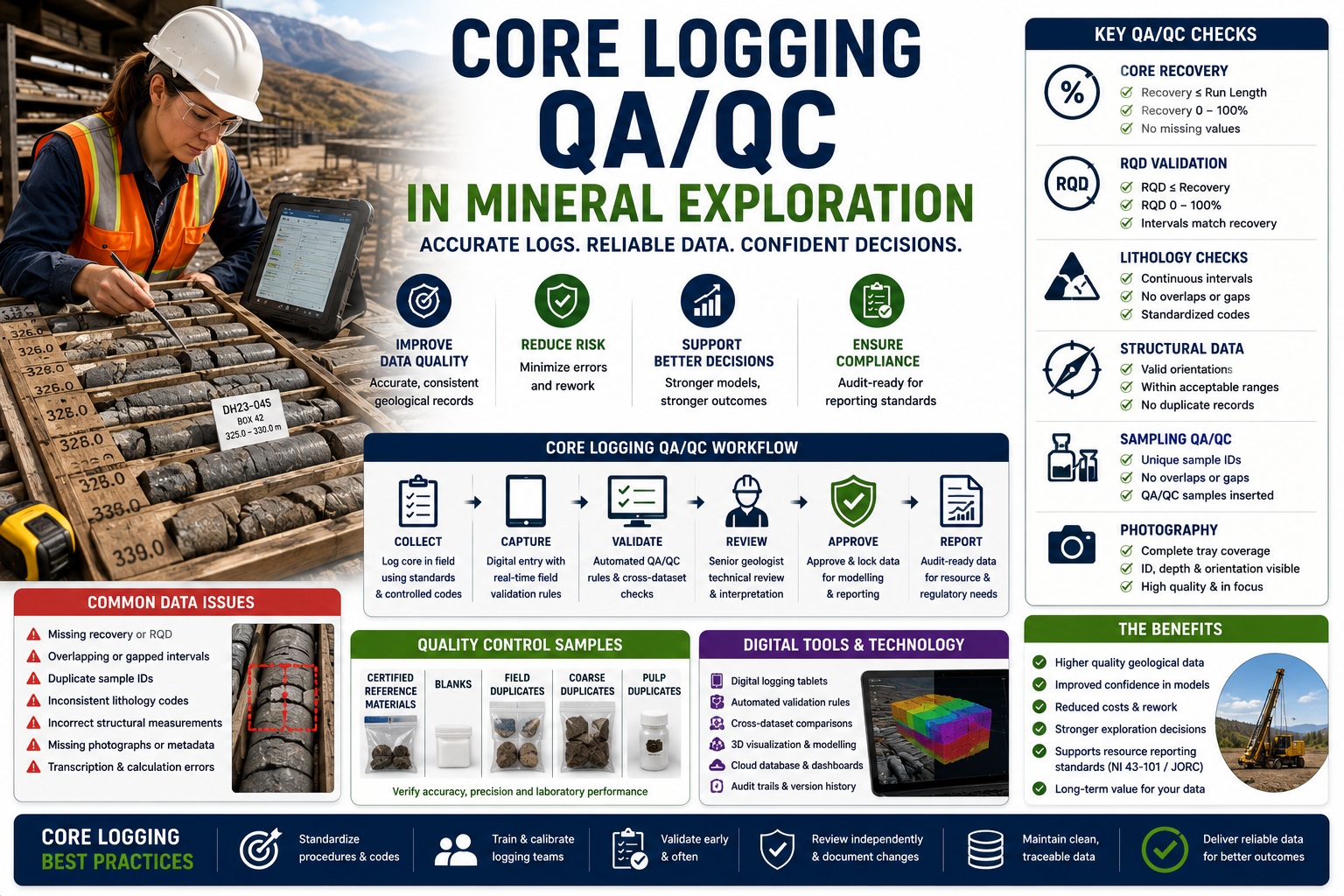
Best Practices for Producing Accurate, Consistent, and Defensible Geological Core Data
Diamond drilling is one of the largest investments made during a mineral exploration program. Every metre of core recovered represents significant drilling costs and provides valuable geological information that may influence exploration strategy, resource estimation, mine planning, and investment decisions. Because of this, the quality of core logging is fundamental to the success of any exploration project.
Core logging is far more than simply describing rock. It captures lithology, alteration, mineralization, structures, weathering, core recovery, Rock Quality Designation (RQD), geotechnical measurements, geochemistry sampling, photography, and numerous geological observations that collectively form the foundation of exploration databases.
Poor-quality core logging can have serious consequences. Inconsistent lithology coding, incorrect recovery calculations, inaccurate structural measurements, or poorly documented sampling intervals can affect resource models, reduce investor confidence, delay permitting, and increase exploration costs. In publicly traded mining companies, inaccurate geological data may also have regulatory implications under reporting standards such as NI 43-101, JORC, and other international resource reporting codes.
A comprehensive Quality Assurance and Quality Control (QA/QC) program helps ensure that geological core data remains accurate, consistent, traceable, and suitable for long-term decision-making.
This article examines best practices for QA/QC in mineral exploration core logging, covering field procedures, digital data capture, validation rules, review workflows, and data governance.
Why Core Logging QA/QC Matters
Core logging influences virtually every stage of mineral exploration.
Reliable core data supports:
- Geological interpretation
- Structural modelling
- Resource estimation
- Grade control
- Geotechnical analysis
- Hydrogeological studies
- Mine planning
- Environmental assessments
Errors introduced during logging often propagate through downstream models, making them increasingly difficult and expensive to correct.
High-quality QA/QC reduces these risks while improving confidence in exploration results.
Establish Standard Logging Procedures
Consistency begins with standardized logging protocols.
Every geologist should follow documented procedures covering:
- Lithology descriptions
- Alteration logging
- Mineralization logging
- Structural measurements
- Recovery calculations
- RQD measurements
- Weathering classifications
- Sample selection
Without standardized procedures, different geologists may record identical geology in different ways.
Controlled Geological Coding
Free-text descriptions create inconsistency.
For example:
- Granite
- GRANITE
- Granitic
- Granite (pink)
- Biotite Granite
While geologically meaningful, inconsistent terminology complicates searching, reporting, and modelling.
Organizations should implement:
- Controlled lithology codes
- Standard alteration codes
- Mineralization codes
- Weathering classifications
- Structure classifications
Controlled vocabularies improve consistency across projects and logging teams.
Core Recovery QA/QC
Core recovery is one of the most important geotechnical measurements recorded during drilling.
Recovery influences:
- Rock quality
- Structural interpretation
- Geotechnical assessments
- Resource confidence
Validation Rules
Recovery should be checked automatically.
Examples include:
- Recovery ≤ run length
- Recovery ≥ 0%
- Recovery does not exceed 100%
- Missing recovery values identified
Automated validation prevents many common calculation errors.
Rock Quality Designation (RQD)
RQD remains one of the most widely used measures of rock quality.
Because RQD depends on accurate measurement of core pieces greater than 100 mm, consistent procedures are essential.
QA/QC Checks
Validation should verify:
- RQD ≤ Recovery
- RQD ≤ 100%
- RQD intervals match recovery intervals
- Missing RQD where competent rock exists
Cross-validation between RQD and recovery improves data quality.
Lithology Logging
Lithology forms the foundation of geological interpretation.
QA procedures should verify:
- Continuous intervals
- No overlapping intervals
- No unexplained gaps
- Standardized codes
- Complete descriptions
Automated interval validation greatly reduces transcription errors.
Alteration Logging
Alteration often controls mineralization.
Consistent recording improves:
- Target generation
- Resource interpretation
- Deposit modelling
Standardized intensity scales and alteration codes reduce subjectivity.
Structural Data QA/QC
Structural measurements frequently influence resource models and mine design.
Examples include:
- Fractures
- Faults
- Veins
- Bedding
- Foliation
- Joint orientation
Validation should evaluate:
- Valid orientation ranges
- Missing measurements
- Duplicate records
- Impossible dip values
Digital capture significantly reduces manual errors.
Sampling QA/QC
Geochemical sampling requires strict quality control.
Sampling errors cannot be corrected later.
Sample Interval Validation
Validation should verify:
- Samples cover intended intervals.
- No overlaps occur.
- No unintended gaps exist.
- Sample IDs remain unique.
Sample Numbering
Duplicate sample identifiers create major database problems.
Modern databases should automatically reject duplicate IDs.
QA/QC Samples
Exploration programs should routinely include:
- Certified reference materials
- Blanks
- Field duplicates
- Coarse duplicates
- Pulp duplicates
These samples evaluate analytical performance and laboratory consistency.
Core Photography
High-quality core photography provides permanent documentation.
QA procedures should verify:
- Correct orientation
- Complete coverage
- Proper lighting
- Scale visibility
- Sample tags visible
- Tray identification
Photographs become valuable references during future reviews and audits.
Digital Logging
Many exploration companies now use digital logging systems instead of paper forms.
Digital logging improves:
- Data consistency
- Validation
- Searchability
- Reporting
- Integration with resource models
Field validation reduces transcription errors before information reaches the database.
Automated Validation Rules
Modern geological databases can automatically evaluate hundreds of rules.
Examples include:
Domain Validation
Approved lithology codes only.
Range Validation
Recovery and RQD within acceptable limits.
Cross-Dataset Validation
Compare related datasets.
Examples:
- Recovery vs RQD
- Sample depth vs lithology interval
- Core photographs vs logged intervals
Completeness Validation
Identify missing fields before approval.
Automation dramatically reduces manual QA effort.
Cross-Dataset Validation
Relationships between datasets should always be verified.
Examples include:
| Dataset Comparison | Validation |
|---|---|
| Recovery vs RQD | RQD ≤ Recovery |
| Sample interval vs lithology | Interval exists |
| Core tray vs photograph | Complete documentation |
| Structural data vs lithology | Correct interval |
| Assays vs sample IDs | Valid relationship |
Cross-validation often detects errors that individual dataset reviews miss.
Metadata Management
Metadata preserves important context.
Examples include:
- Logger
- Logging date
- Drill rig
- Drill contractor
- Core diameter
- Orientation method
- Coordinate system
- Photography date
Metadata improves long-term traceability.
Review Workflows
Validation alone cannot guarantee geological quality.
Experienced geologists should review:
- Geological interpretation
- Stratigraphic consistency
- Structural interpretation
- Alteration zoning
- Sampling strategy
Independent review remains an essential QA component.
Approval Workflows
Core logs should follow structured workflows.
Example:
Draft
Initial logging completed.
↓
Validation
Automated QA/QC executed.
↓
Technical Review
Senior geologist review.
↓
Approval
Record locked for resource modelling.
↓
Revision (if required)
Controlled reopening workflow.
Structured workflows improve accountability and consistency.
Audit Trails
Every modification should be recorded.
Audit trails should capture:
- User
- Date
- Time
- Modified field
- Previous value
- New value
- Reason for change
Audit trails support both technical review and regulatory compliance.
Data Governance
Successful QA/QC depends upon clear governance.
Organizations should define:
- Data ownership
- Logging standards
- User permissions
- Review responsibilities
- Approval authority
- Revision procedures
- Retention policies
Governance ensures consistency throughout the exploration program.
Common Core Logging Errors
Frequently encountered issues include:
- Missing recovery values
- Incorrect RQD calculations
- Duplicate sample IDs
- Overlapping lithology intervals
- Missing photographs
- Inconsistent lithology codes
- Incorrect structural measurements
- Unvalidated alterations
- Missing metadata
Most can be identified automatically before data approval.
Preparing for Resource Estimation
Before geological information enters resource modelling, organizations should confirm:
✓ Validation complete
✓ Technical review completed
✓ Sampling verified
✓ QA/QC samples reviewed
✓ Lithology complete
✓ Recovery validated
✓ RQD validated
✓ Structural data reviewed
✓ Photographs archived
✓ Audit trail complete
Only validated information should be used for resource estimation.
Regulatory Reporting Considerations
Publicly reported exploration results must be supported by reliable geological data.
Well-documented QA/QC procedures help demonstrate that exploration information has been collected, reviewed, and managed using recognized professional practices.
Comprehensive validation, documented review workflows, audit trails, and traceable sampling records strengthen confidence in exploration data and support preparation of technical reports prepared under applicable reporting frameworks.
Emerging Technologies
Core logging continues to evolve rapidly.
Modern systems increasingly incorporate:
- Digital core logging tablets
- AI-assisted lithology recognition
- Automated core photography
- Machine vision fracture analysis
- Cloud-based geological databases
- Real-time validation
- Barcode sample tracking
- Integration with 3D geological modelling
These technologies improve efficiency while maintaining high-quality QA/QC standards.
Best Practices Summary
Organizations can improve core logging quality by:
- Standardizing geological logging procedures.
- Using controlled geological vocabularies.
- Capturing data digitally whenever possible.
- Validating recovery and RQD automatically.
- Cross-checking related datasets.
- Including certified QA/QC samples.
- Maintaining complete metadata.
- Requiring independent geological review.
- Preserving audit trails and version history.
- Implementing structured approval workflows.
Conclusion
Core logging is one of the most important sources of information in mineral exploration, and its quality directly affects geological interpretation, resource estimation, mine planning, and investment decisions. A comprehensive QA/QC program should encompass standardized logging procedures, controlled geological coding, automated validation, cross-dataset verification, structured review workflows, audit trails, and robust data governance. By combining modern digital logging systems with experienced geological oversight, exploration companies can significantly improve the accuracy, consistency, and defensibility of their geological databases. As mineral exploration becomes increasingly data-driven, organizations that invest in rigorous core logging QA/QC will be better positioned to make confident exploration decisions, support transparent resource reporting, and maximize the long-term value of their geological information.
Best Practices for Producing Accurate, Consistent, and Defensible Geological Core Data
Diamond drilling is one of the largest investments made during a mineral exploration program. Every metre of core recovered represents significant drilling costs and provides valuable geological information that may influence exploration strategy, resource estimation, mine planning, and investment decisions. Because of this, the quality of core logging is fundamental to the success of any exploration project.
Core logging is far more than simply describing rock. It captures lithology, alteration, mineralization, structures, weathering, core recovery, Rock Quality Designation (RQD), geotechnical measurements, geochemistry sampling, photography, and numerous geological observations that collectively form the foundation of exploration databases.
Poor-quality core logging can have serious consequences. Inconsistent lithology coding, incorrect recovery calculations, inaccurate structural measurements, or poorly documented sampling intervals can affect resource models, reduce investor confidence, delay permitting, and increase exploration costs. In publicly traded mining companies, inaccurate geological data may also have regulatory implications under reporting standards such as NI 43-101, JORC, and other international resource reporting codes.
A comprehensive Quality Assurance and Quality Control (QA/QC) program helps ensure that geological core data remains accurate, consistent, traceable, and suitable for long-term decision-making.
This article examines best practices for QA/QC in mineral exploration core logging, covering field procedures, digital data capture, validation rules, review workflows, and data governance.
Why Core Logging QA/QC Matters
Core logging influences virtually every stage of mineral exploration.
Reliable core data supports:
- Geological interpretation
- Structural modelling
- Resource estimation
- Grade control
- Geotechnical analysis
- Hydrogeological studies
- Mine planning
- Environmental assessments
Errors introduced during logging often propagate through downstream models, making them increasingly difficult and expensive to correct.
High-quality QA/QC reduces these risks while improving confidence in exploration results.
Establish Standard Logging Procedures
Consistency begins with standardized logging protocols.
Every geologist should follow documented procedures covering:
- Lithology descriptions
- Alteration logging
- Mineralization logging
- Structural measurements
- Recovery calculations
- RQD measurements
- Weathering classifications
- Sample selection
Without standardized procedures, different geologists may record identical geology in different ways.
Controlled Geological Coding
Free-text descriptions create inconsistency.
For example:
- Granite
- GRANITE
- Granitic
- Granite (pink)
- Biotite Granite
While geologically meaningful, inconsistent terminology complicates searching, reporting, and modelling.
Organizations should implement:
- Controlled lithology codes
- Standard alteration codes
- Mineralization codes
- Weathering classifications
- Structure classifications
Controlled vocabularies improve consistency across projects and logging teams.
Core Recovery QA/QC
Core recovery is one of the most important geotechnical measurements recorded during drilling.
Recovery influences:
- Rock quality
- Structural interpretation
- Geotechnical assessments
- Resource confidence
Validation Rules
Recovery should be checked automatically.
Examples include:
- Recovery ≤ run length
- Recovery ≥ 0%
- Recovery does not exceed 100%
- Missing recovery values identified
Automated validation prevents many common calculation errors.
Rock Quality Designation (RQD)
RQD remains one of the most widely used measures of rock quality.
Because RQD depends on accurate measurement of core pieces greater than 100 mm, consistent procedures are essential.
QA/QC Checks
Validation should verify:
- RQD ≤ Recovery
- RQD ≤ 100%
- RQD intervals match recovery intervals
- Missing RQD where competent rock exists
Cross-validation between RQD and recovery improves data quality.
Lithology Logging
Lithology forms the foundation of geological interpretation.
QA procedures should verify:
- Continuous intervals
- No overlapping intervals
- No unexplained gaps
- Standardized codes
- Complete descriptions
Automated interval validation greatly reduces transcription errors.
Alteration Logging
Alteration often controls mineralization.
Consistent recording improves:
- Target generation
- Resource interpretation
- Deposit modelling
Standardized intensity scales and alteration codes reduce subjectivity.
Structural Data QA/QC
Structural measurements frequently influence resource models and mine design.
Examples include:
- Fractures
- Faults
- Veins
- Bedding
- Foliation
- Joint orientation
Validation should evaluate:
- Valid orientation ranges
- Missing measurements
- Duplicate records
- Impossible dip values
Digital capture significantly reduces manual errors.
Sampling QA/QC
Geochemical sampling requires strict quality control.
Sampling errors cannot be corrected later.
Sample Interval Validation
Validation should verify:
- Samples cover intended intervals.
- No overlaps occur.
- No unintended gaps exist.
- Sample IDs remain unique.
Sample Numbering
Duplicate sample identifiers create major database problems.
Modern databases should automatically reject duplicate IDs.
QA/QC Samples
Exploration programs should routinely include:
- Certified reference materials
- Blanks
- Field duplicates
- Coarse duplicates
- Pulp duplicates
These samples evaluate analytical performance and laboratory consistency.
Core Photography
High-quality core photography provides permanent documentation.
QA procedures should verify:
- Correct orientation
- Complete coverage
- Proper lighting
- Scale visibility
- Sample tags visible
- Tray identification
Photographs become valuable references during future reviews and audits.
Digital Logging
Many exploration companies now use digital logging systems instead of paper forms.
Digital logging improves:
- Data consistency
- Validation
- Searchability
- Reporting
- Integration with resource models
Field validation reduces transcription errors before information reaches the database.
Automated Validation Rules
Modern geological databases can automatically evaluate hundreds of rules.
Examples include:
Domain Validation
Approved lithology codes only.
Range Validation
Recovery and RQD within acceptable limits.
Cross-Dataset Validation
Compare related datasets.
Examples:
- Recovery vs RQD
- Sample depth vs lithology interval
- Core photographs vs logged intervals
Completeness Validation
Identify missing fields before approval.
Automation dramatically reduces manual QA effort.
Cross-Dataset Validation
Relationships between datasets should always be verified.
Examples include:
| Dataset Comparison | Validation |
|---|---|
| Recovery vs RQD | RQD ≤ Recovery |
| Sample interval vs lithology | Interval exists |
| Core tray vs photograph | Complete documentation |
| Structural data vs lithology | Correct interval |
| Assays vs sample IDs | Valid relationship |
Cross-validation often detects errors that individual dataset reviews miss.
Metadata Management
Metadata preserves important context.
Examples include:
- Logger
- Logging date
- Drill rig
- Drill contractor
- Core diameter
- Orientation method
- Coordinate system
- Photography date
Metadata improves long-term traceability.
Review Workflows
Validation alone cannot guarantee geological quality.
Experienced geologists should review:
- Geological interpretation
- Stratigraphic consistency
- Structural interpretation
- Alteration zoning
- Sampling strategy
Independent review remains an essential QA component.
Approval Workflows
Core logs should follow structured workflows.
Example:
Draft
Initial logging completed.
↓
Validation
Automated QA/QC executed.
↓
Technical Review
Senior geologist review.
↓
Approval
Record locked for resource modelling.
↓
Revision (if required)
Controlled reopening workflow.
Structured workflows improve accountability and consistency.
Audit Trails
Every modification should be recorded.
Audit trails should capture:
- User
- Date
- Time
- Modified field
- Previous value
- New value
- Reason for change
Audit trails support both technical review and regulatory compliance.
Data Governance
Successful QA/QC depends upon clear governance.
Organizations should define:
- Data ownership
- Logging standards
- User permissions
- Review responsibilities
- Approval authority
- Revision procedures
- Retention policies
Governance ensures consistency throughout the exploration program.
Common Core Logging Errors
Frequently encountered issues include:
- Missing recovery values
- Incorrect RQD calculations
- Duplicate sample IDs
- Overlapping lithology intervals
- Missing photographs
- Inconsistent lithology codes
- Incorrect structural measurements
- Unvalidated alterations
- Missing metadata
Most can be identified automatically before data approval.
Preparing for Resource Estimation
Before geological information enters resource modelling, organizations should confirm:
✓ Validation complete
✓ Technical review completed
✓ Sampling verified
✓ QA/QC samples reviewed
✓ Lithology complete
✓ Recovery validated
✓ RQD validated
✓ Structural data reviewed
✓ Photographs archived
✓ Audit trail complete
Only validated information should be used for resource estimation.
Regulatory Reporting Considerations
Publicly reported exploration results must be supported by reliable geological data.
Well-documented QA/QC procedures help demonstrate that exploration information has been collected, reviewed, and managed using recognized professional practices.
Comprehensive validation, documented review workflows, audit trails, and traceable sampling records strengthen confidence in exploration data and support preparation of technical reports prepared under applicable reporting frameworks.
Emerging Technologies
Core logging continues to evolve rapidly.
Modern systems increasingly incorporate:
- Digital core logging tablets
- AI-assisted lithology recognition
- Automated core photography
- Machine vision fracture analysis
- Cloud-based geological databases
- Real-time validation
- Barcode sample tracking
- Integration with 3D geological modelling
These technologies improve efficiency while maintaining high-quality QA/QC standards.
Best Practices Summary
Organizations can improve core logging quality by:
- Standardizing geological logging procedures.
- Using controlled geological vocabularies.
- Capturing data digitally whenever possible.
- Validating recovery and RQD automatically.
- Cross-checking related datasets.
- Including certified QA/QC samples.
- Maintaining complete metadata.
- Requiring independent geological review.
- Preserving audit trails and version history.
- Implementing structured approval workflows.
Conclusion
Core logging is one of the most important sources of information in mineral exploration, and its quality directly affects geological interpretation, resource estimation, mine planning, and investment decisions. A comprehensive QA/QC program should encompass standardized logging procedures, controlled geological coding, automated validation, cross-dataset verification, structured review workflows, audit trails, and robust data governance. By combining modern digital logging systems with experienced geological oversight, exploration companies can significantly improve the accuracy, consistency, and defensibility of their geological databases. As mineral exploration becomes increasingly data-driven, organizations that invest in rigorous core logging QA/QC will be better positioned to make confident exploration decisions, support transparent resource reporting, and maximize the long-term value of their geological information.