

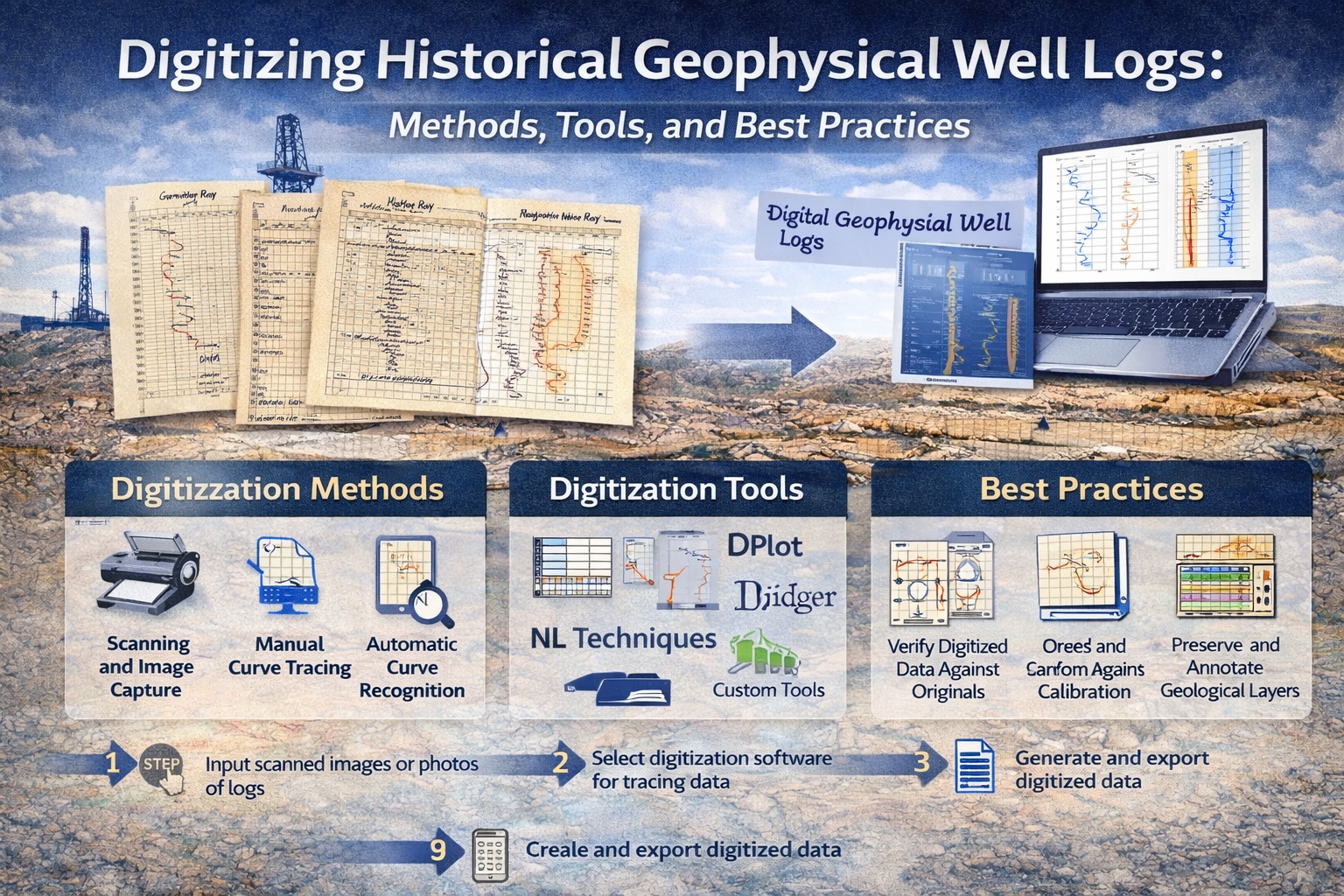
Introduction
Across the energy, environmental, mining, and geothermal sectors, historical geophysical well logs represent one of the most valuable yet underutilized subsurface datasets. For decades, oil and gas companies, government geological surveys, environmental consultancies, and exploration firms generated millions of well logs documenting the physical properties of the subsurface.
However, a large portion of these logs still exist only as paper prints, microfilm records, or scanned images stored in archives. Without digitization, these datasets remain inaccessible to modern interpretation workflows, machine learning tools, and integrated geoscience platforms.
Digitizing historical geophysical well logs transforms static archival records into structured digital datasets that can support reservoir modeling, geothermal exploration, carbon capture site evaluation, environmental assessment, and subsurface engineering.
In this article, we explore:
- Why historical well logs are valuable
- The challenges of legacy log archives
- Key digitization methods
- Software and tools used for log digitization
- Best practices for building reliable digital well log datasets
Why Historical Well Logs Still Matter
Many organizations underestimate the value stored in historical well log archives. These records often contain decades of geological and geophysical information that would be extremely expensive—or impossible—to reproduce today.
Historical well logs commonly include measurements such as:
- Gamma ray
- Resistivity
- Spontaneous potential (SP)
- Density
- Neutron porosity
- Sonic velocity
- Caliper logs
- Lithology descriptions
These logs provide direct insight into rock properties, formation boundaries, and reservoir characteristics across entire basins.
Digitizing these records unlocks numerous modern applications, including:
Reservoir Characterization
Legacy logs allow geoscientists to map formations, identify productive zones, and refine reservoir models.
Carbon Capture and Storage (CCS)
Historical logs help evaluate porosity, permeability, and cap rock integrity, which are critical parameters for CO₂ storage.
Geothermal Exploration
Old oil and gas wells frequently provide temperature gradients and formation properties useful for geothermal development.
Environmental Site Assessments
Well logs support groundwater modeling, contaminant transport studies, and subsurface risk evaluation.
Machine Learning Applications
Digitized logs provide structured datasets that can be used to train AI-driven subsurface interpretation models.
In short, digitizing legacy well logs converts dormant archives into valuable digital assets for modern subsurface analysis.
Challenges of Historical Well Log Archives
Despite their value, historical well logs present several significant challenges.
Paper-Based Storage
Many logs were originally printed on large paper sheets or continuous plot rolls, making them difficult to store, retrieve, and analyze.
These physical documents are vulnerable to:
- Paper deterioration
- Fading ink
- Physical damage
- Environmental degradation
Inconsistent Log Formats
Different logging service companies historically used different standards and formats. Logs may vary in:
- Scale
- Track layout
- Curve labeling
- Measurement units
This inconsistency makes automated interpretation difficult.
Limited Metadata
Older logs often lack critical metadata such as:
- Well coordinates
- Logging dates
- Tool calibration information
- Depth references
Without proper metadata, integrating logs into modern databases becomes challenging.
Non-Digital Data
Even when scanned, many logs exist only as image files rather than structured datasets.
Images cannot be directly used for:
- Petrophysical analysis
- Reservoir modeling
- Machine learning workflows
Digitization converts these images into machine-readable data.
The Well Log Digitization Workflow
Digitizing historical well logs typically involves several key stages.
1. Log Scanning
The first step is converting paper logs into high-resolution digital images.
Large-format scanners are used to capture detailed images while preserving:
- Curve clarity
- Grid lines
- Depth markers
- Annotations
Typical scanning resolutions range from 300 to 600 DPI.
This stage produces raster images such as:
- TIFF
- PNG
- JPEG
These images serve as the foundation for digitization.
2. Image Preprocessing
Before digitizing the curves, scanned images must be prepared for analysis.
Common preprocessing tasks include:
Image Alignment
Old logs may be scanned at slight angles. Alignment ensures depth scales remain vertical.
Contrast Enhancement
Improving contrast makes curves easier to detect.
Noise Removal
Artifacts such as dust, fold marks, and stains may need to be removed.
Track Identification
Well logs typically contain multiple tracks for different measurements.
Each track must be identified before digitization.
3. Curve Digitization
The most critical step is extracting numerical data from the curves.
Digitization can be performed using:
Manual Digitization
A technician traces curves using specialized software.
Advantages:
- High accuracy
- Good for complex logs
Disadvantages:
- Time-consuming
- Labor intensive
Semi-Automated Digitization
Advanced software automatically detects curves while allowing manual correction.
Advantages:
- Faster processing
- Maintains quality control
This approach is commonly used in large digitization projects.
Automated AI-Based Digitization
Machine learning tools can automatically detect curves and extract data.
Advantages:
- High speed
- Scalable for large archives
However, manual validation is usually required to ensure accuracy.
Tools Used for Well Log Digitization
Several types of software are used during the digitization process.
Log Digitization Software
These tools allow technicians to trace and extract curves from scanned images.
Features typically include:
- Automatic curve detection
- Depth calibration
- Track segmentation
- Curve smoothing
- Data export
Outputs often include digital log formats such as:
- LAS
- CSV
- ASCII
Image Processing Software
Image editing tools help prepare scanned logs for digitization by improving image clarity.
These tools may include:
- Noise reduction
- Contrast adjustment
- Image cropping
- Alignment correction
Geological Interpretation Software
After digitization, logs are imported into interpretation platforms used by geoscientists.
These tools enable:
- Petrophysical analysis
- Formation evaluation
- Cross-well correlation
- Reservoir modeling
Common Output Formats for Digitized Logs
Once digitized, well logs are typically stored in standardized formats.
LAS (Log ASCII Standard)
LAS is the most widely used format for digital well logs.
Advantages include:
- Simple ASCII structure
- Easy data exchange
- Broad software compatibility
LAS files contain sections such as:
- Well information
- Curve definitions
- ASCII data
DLIS (Digital Log Interchange Standard)
DLIS is a more complex binary format used by logging service companies.
It supports:
- Multiple frames
- Tool calibration data
- Advanced metadata
CSV and Database Formats
For machine learning and analytics applications, logs may also be stored in:
- CSV files
- SQL databases
- Data lake systems
These formats support large-scale data processing.
Quality Control in Well Log Digitization
Quality control is essential to ensure digitized logs accurately represent the original records.
Several validation steps are typically performed.
Depth Calibration
Digitized data must match the original depth scale.
This ensures accurate correlation between wells.
Curve Verification
Extracted curves are visually compared against the scanned image.
Technicians check for:
- Missing segments
- Curve overlap
- Noise artifacts
Data Smoothing
Digitization may introduce small fluctuations.
Smoothing algorithms help produce realistic curves.
Cross-Log Validation
When multiple logs exist for the same well, curves can be compared to confirm consistency.
Best Practices for Digitizing Well Log Archives
Organizations planning digitization projects should follow several best practices.
Prioritize High-Value Wells
Digitization projects should begin with wells that have the highest strategic value.
Examples include:
- Key exploration wells
- Reservoir discovery wells
- Deep geothermal wells
- CCS evaluation wells
Preserve Original Scans
Always archive original scanned images alongside digitized data.
This ensures traceability and allows future reprocessing.
Standardize Naming Conventions
Consistent file naming improves data management.
For example:
WellName_LogType_Year_Format
Capture Metadata
Digitization should include metadata such as:
- Well coordinates
- Logging company
- Tool type
- Logging date
- Depth reference
This information improves future analysis.
Implement Centralized Data Storage
Digitized logs should be stored in centralized repositories.
Examples include:
- Enterprise subsurface databases
- Cloud data platforms
- Geological data management systems
Centralized storage improves collaboration.
The Role of Digitized Logs in Modern Subsurface Workflows
Once digitized, well logs become powerful inputs for modern geoscience workflows.
3D Geological Modeling
Digitized logs provide formation boundaries and lithology data used to construct 3D subsurface models.
Machine Learning Interpretation
AI models can analyze digitized logs to identify:
- Formation tops
- Reservoir intervals
- Lithology patterns
Basin Analysis
Large log datasets allow geoscientists to evaluate basin-wide trends in:
- Formation thickness
- Rock properties
- Thermal maturity
Integrated Data Platforms
Digitized logs can be integrated with:
- Seismic data
- Core samples
- Production data
- Geological maps
This integrated approach improves subsurface understanding.
Future Trends in Well Log Digitization
The digitization of geoscience archives is accelerating due to several emerging technologies.
AI-Based Curve Extraction
Machine learning algorithms are improving the speed and accuracy of curve digitization.
Automated Metadata Extraction
Natural language processing can extract information from log headers and annotations.
Cloud-Based Data Platforms
Digitized logs are increasingly stored in cloud-based geoscience data environments.
These platforms support:
- Real-time collaboration
- Large-scale analytics
- integrated workflows
Digital Twin Applications
Digitized well logs contribute to digital twin models of reservoirs and subsurface systems.
These models help organizations simulate and optimize operations.
Conclusion
Historical geophysical well logs represent a vast reservoir of subsurface knowledge that remains locked inside paper archives across the world.
Digitizing these records transforms static images into structured digital datasets that power modern geoscience workflows.
Through careful scanning, curve extraction, quality control, and data management, organizations can convert legacy well logs into valuable digital assets that support:
- Exploration
- Reservoir characterization
- Carbon capture
- Geothermal development
- Environmental analysis
As energy transition projects expand and machine learning becomes increasingly important in subsurface analysis, digitized well logs will continue to play a critical role in unlocking insights from historical geoscience data.
For organizations seeking to maximize the value of their subsurface archives, well log digitization is not simply a preservation exercise—it is a strategic investment in the future of geoscience.
Learn more about our Data Solutions
- Geophysical and well log digitization
- Seismic section digitization
- Map digitization
- Core photo splicing
- Scout ticket digitization