

Introduction
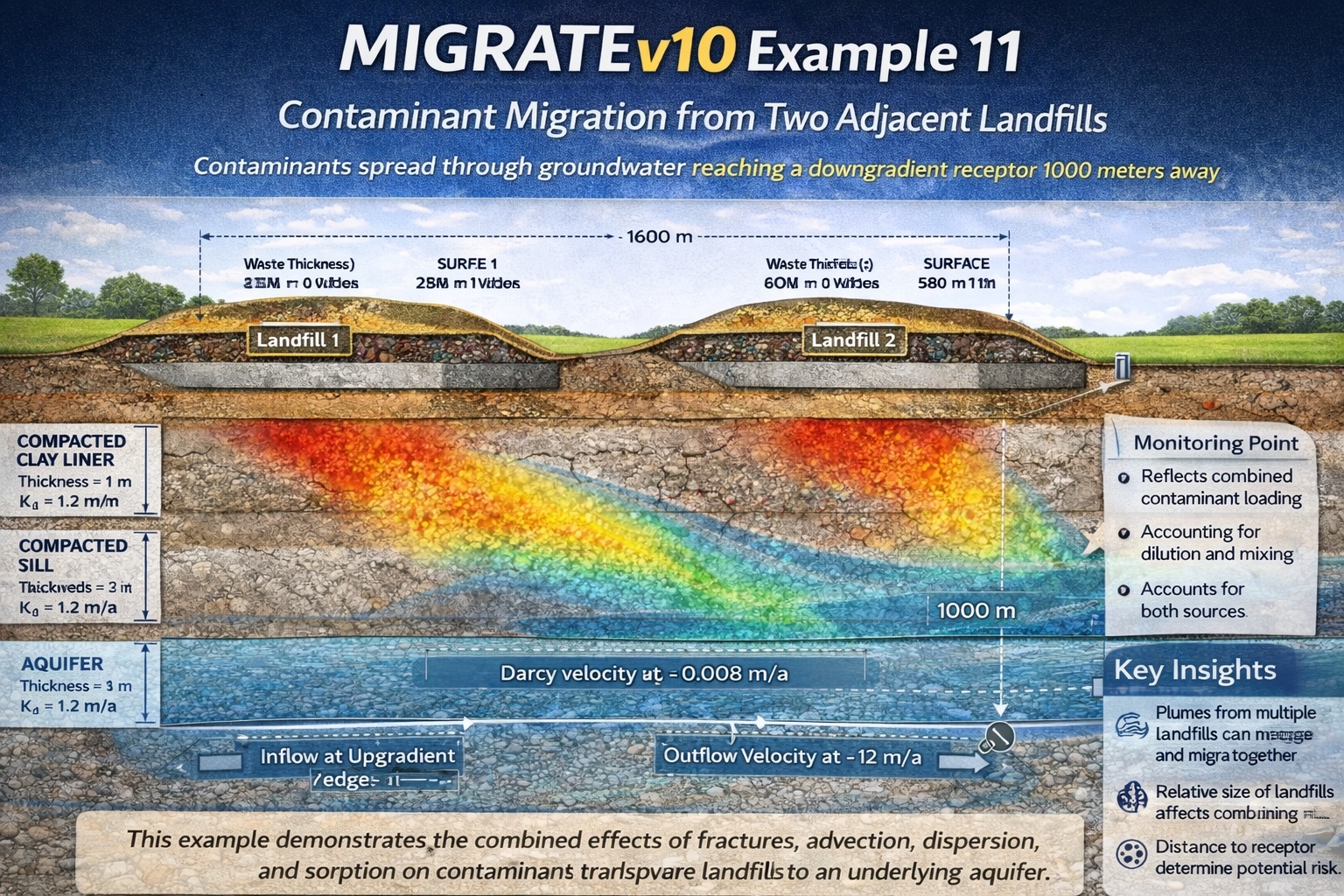
MIGRATEv10 Example 11 expands the modeling complexity by simulating contaminant migration from two adjacent landfill cell sites. This scenario is particularly important for real-world applications where multiple sources may contribute to groundwater contamination.
The key objective is to evaluate the combined impact of both landfill cells and determine contaminant concentrations at a down-gradient receptor located 1000 m away.
Conceptual Model Overview
The modeled system consists of:
- Two adjacent landfill cells
- A layered barrier system:
- 1 m compacted clay
- 2 m silt
- An underlying 2 m thick aquifer
- A down-gradient receptor point (1000 m away)
Key Modeling Objective
This example aims to:
- Evaluate combined contaminant loading from two sources
- Simulate plume interaction and overlap
- Calculate concentration at a down-gradient compliance point
Landfill Geometry and Properties
Landfill Cell 1
| Property | Value |
|---|---|
| Waste Thickness | 15 m |
| Surface Width | 300 m |
| Base Width | 280 m |
Landfill Cell 2
| Property | Value |
| Waste Thickness | 25 m |
| Surface Width | 600 m |
| Base Width | 580 m |
👉 The second landfill cell is both larger and thicker, contributing a greater contaminant load.
Source Characteristics
| Parameter | Value |
| Waste Density | 600 kg/m³ |
| Contaminant Fraction | 0.2% |
| Peak Concentration | 1500 mg/L |
Both landfills are assumed to have identical contaminant properties but differ in size and geometry.
Barrier System
| Layer | Thickness |
| Compacted Clay | 1 m |
| Silt | 2 m |
| Aquifer | 2 m |
Hydraulic Conductivities
- Clay: ( 2-10 m/s )
- Silt: ( 1-7 m/s )
These values influence the rate of contaminant migration through the subsurface.
Flow and Leachate Conditions
| Parameter | Value |
| Darcy Velocity (va) | 0.008 m/a |
| Leachate Collection (Qc) | 0.05 m/a |
The Darcy velocity is based on:
- A leachate mound of 0.3 m
- Hydraulic conductivity of underlying layers
Aquifer Properties
| Parameter | Value |
| Thickness | 2 m |
| Porosity | 0.35 |
| Outflow Velocity (vb) | 12 m/a |
The aquifer acts as the transport medium and receptor system.
Modeling Approach in MIGRATEv10
Step 1: Define Geometry
- Input both landfill ve;; profiles
- Include spacing and relative positioning
Step 2: Assign Layer Properties
- Clay, silt, and aquifer properties
- Hydraulic conductivities
Step 3: Define Source Terms
- Assign contaminant concentrations
- Account for differing landfill cell sizes
Step 4: Apply Flow Conditions
- Darcy velocity through deposits
- Aquifer flow velocity
Step 5: Set Observation Point
- Location: 1000 m downgradient
Step 6: Run Simulation
- Track concentration over time at receptor point
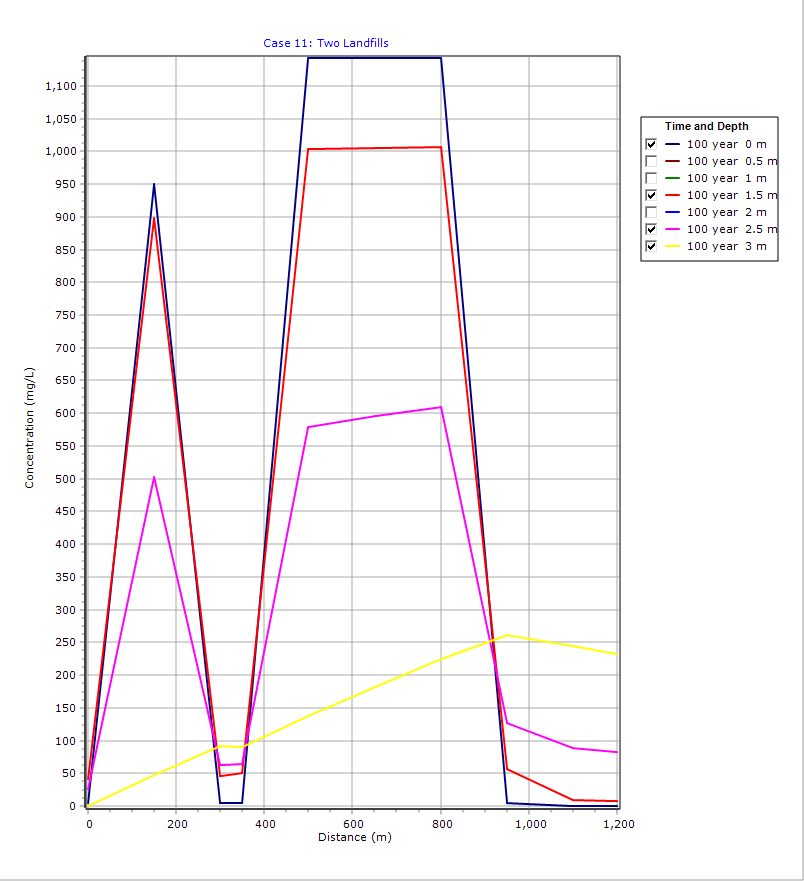
Graphical Output: Concentration vs Distance
PDF Report
 Loading…

 Reload document
  Open in new tab
 Interpretation of Results
1. Plume Interaction
- Contaminant plumes from both landfill cells merge
- Combined plume shows:
- Increased width
- Higher total mass
2. Relative Contribution
- The second landfill cell dominates due to:
- Greater thickness
- Larger footprint
3. Down-Gradient Impact
- Concentration at 1000 m reflects:
- Combined loading
- Aquifer dilution
- Travel time
4. Temporal Behavior
- Early time: influence from closer/smaller landfill cell
- Later time: dominant contribution from larger landfill cell
Key Insights
- Multiple sources can significantly increase contaminant concentrations
- Plume interaction is critical in:
- Site assessment
- Regulatory compliance
- Larger landfill cells contribute disproportionately higher impacts
Practical Applications
This type of modeling is essential for:
- Regional groundwater assessments
- Multi-source contamination scenarios
- Environmental impact studies
- Designing monitoring programs
Key Takeaways
- Contaminant plumes from adjacent landfill cells can merge and amplify impacts
- Geometry and size strongly influence contaminant loading
- MIGRATEv10 can simulate complex multi-source systems
- Down-gradient concentrations depend on:
- Source strength
- Flow conditions
- Aquifer properties
Final Thoughts
MIGRATEv10 Example 11 demonstrates the importance of considering multiple contaminant sources in groundwater modeling. In real-world scenarios, contamination rarely originates from a single location, and understanding plume interaction is essential for accurate prediction and risk assessment.
This example highlights the need for:
- Comprehensive site characterization
- Multi-source modeling
- Careful interpretation of cumulative effects
Learn more about our Contaminant Transport Modeling Solutions
MIGRATE Examples
- MIGRATEv10 Example 1: Modeling a RCRA Subtitle D Landfill with a Composite Liner
- MIGRATEv10 Example 2: Composite Liner System with Primary & Secondary Leachate Collection
- MIGRATEv10 Example 3: Pure Diffusion of a Conservative Contaminant
- MIGRATEv10 Example 4: Finite Mass Source and Aquifer Mixing with Base Outflow
- MIGRATEv10 Example 5: Understanding Integration, Accuracy, and the Role of Engineering Judgment
- MIGRATEv10 Example 6: Eliminating Negative Concentrations Through Improved Integration
- MIGRATEv10 Example 7: Improving Accuracy with User-Selected Fourier Integration
- MIGRATEv10 Example 8: Evaluating Contaminant Migration at Multiple Lateral Positions
- MIGRATEv10 Example 9: Comparison with the TDAST Analytical Solution
- MIGRATEv10 Example 10: Contaminant Transport in Fractured Media with Sorption
- MIGRATEv10 Example 12: Modeling Time-Dependent Source Histories for Multiple Landfill Cells
- MIGRATEv10 Example 13: Termination of Primary Leachate Collection System
Comparison between POLLUTE and MIGRATE
- MIGRATEv10 vs POLLUTEv10: Pure Diffusion Comparison
- MIGRATEv10 vs POLLUTEv10: Advective–Diffusive Transport Comparison
- MIGRATEv10 vs POLLUTEv10: Finite Mass Source Comparison
- MIGRATEv10 vs POLLUTEv10: Hydraulic Trap (Finite Mass Source) Comparison
- MIGRATEv10 vs POLLUTEv10: Fractured Layer with Sorption Comparison