

Introduction
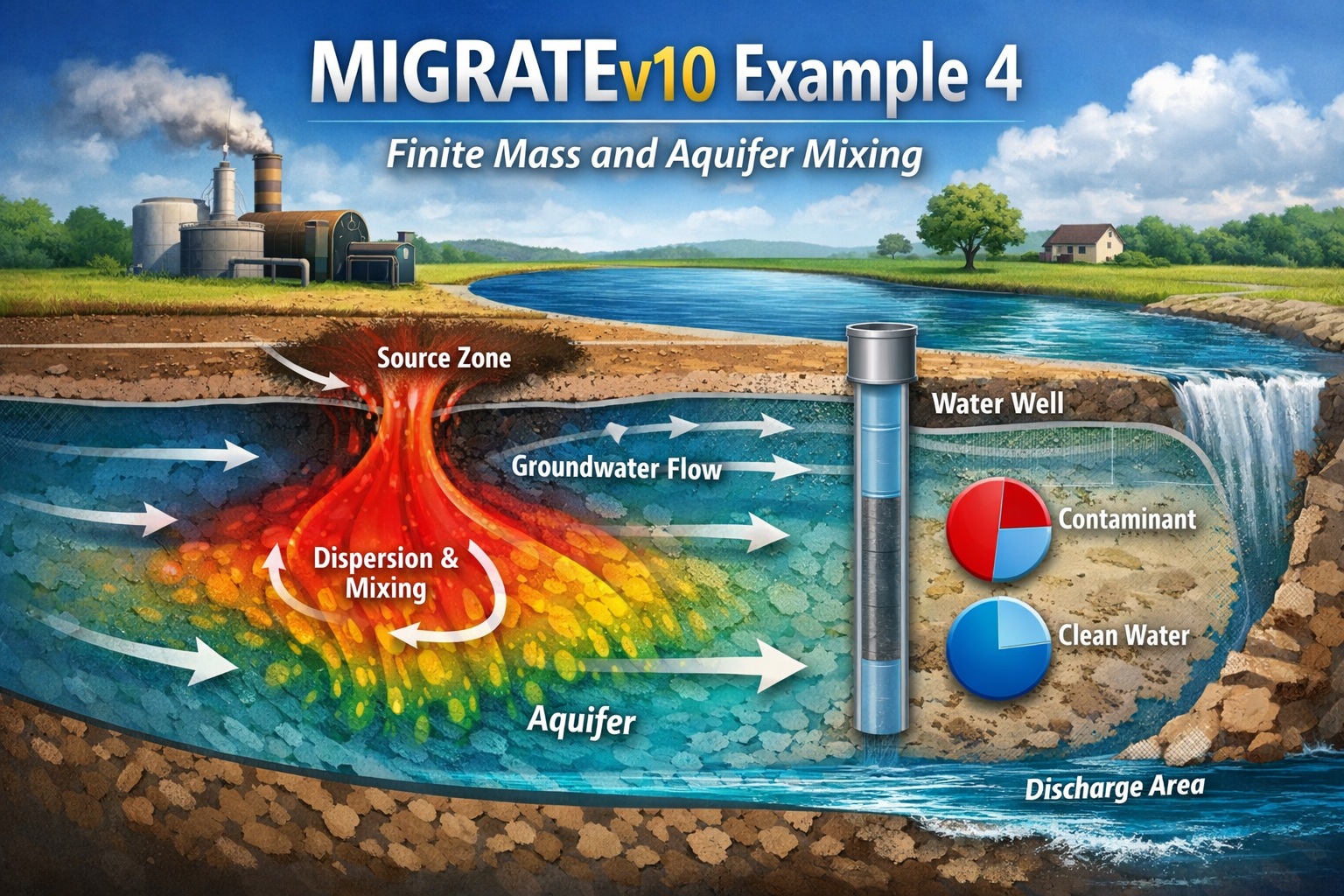
MIGRATEv10 Example 4 builds directly on Example 3 by introducing two critical real-world complexities:
- A finite mass source (instead of constant concentration)
- An explicit aquifer boundary with flow and mixing (base outflow)
This example provides a more realistic representation of landfill behavior by simulating how a limited contaminant mass evolves over time and how it is diluted within a flowing aquifer.
⚠️ Important: This example highlights key hydrogeologic assumptions. Proper application requires expert judgment and site-specific data.
Conceptual Model Overview
The modeled system consists of:
- A finite mass contaminant source at the top
- A 4 m thick aquitard (low permeability layer)
- A 20 m thick aquifer (only partially modeled for mixing)
Key Modeling Objective
This example aims to:
- Simulate mass-limited contaminant release
- Evaluate leachate generation and migration
- Quantify dilution in the aquifer
- Demonstrate how to calculate and apply base outflow velocity (vb)
Source Term: Finite Mass of Waste
Unlike previous examples, the source is not infinite.
Waste Properties
| Parameter | Value |
|---|---|
| Waste Thickness | 6.25 m |
| Density | 600 kg/m³ |
| Chloride Fraction | 0.2% |
| Peak Concentration (c₀) | 1000 mg/L |
- The analysis begins when peak concentration is reached
- Chloride is treated as a conservative contaminant
Leachate Generation
Leachate collection is defined as:
Qc = qo – va = 0.3 – 0.03 = 0.27 m/a
Where:
- ( qo ) = infiltration through cover = 0.3 m/a
- ( va ) = exfiltration through base = 0.03 m/a
This represents the net leachate collected by the system.
Aquifer Representation
Although the aquifer is 20 m thick, only the upper 3 m is modeled.
Why?
- Full-depth mixing is unrealistic
- Mixing depends on:
- Monitoring screen depth
- Hydrogeologic conditions
- Regulatory requirements
👉 Therefore:
- Modeled aquifer thickness (h) = 3 m
- Output concentration at 4 m depth represents average concentration in top 3 m
Flow in the Aquifer
1. Inflow to Aquifer
q{in} = v * h * L = 4 * 3 * 300 = 3600 m3/a
2. Flow from Landfill
qa = va * L * W = 0.03 * 300 * 200 = 1800 m3/a
3. Total Outflow
q{out} = q{in} + qa = 3600 + 1800 = 5400 m3/a
4. Base Outflow Velocity
vb = q{out} / (W * h) = 5400 / (300 * 3) = 6 m/a
This parameter is critical because it defines how quickly contaminants are transported away in the aquifer.
Modeling Approach in MIGRATEv10
Step 1: Modify Example 3 Input File
- Replace constant source with finite mass source
Step 2: Define Geometry
- Aquitard thickness: 4 m
- Aquifer thickness (modeled): 3 m
Step 3: Input Source Properties
- Peak concentration: 1000 mg/L
- Define waste mass and composition
Step 4: Apply Flow Parameters
- Infiltration and exfiltration rates
- Leachate collection rate (Qc)
- Base outflow velocity (vb = 6 m/a)
Step 5: Configure Boundary Conditions
- Aquifer represented as a mixing boundary
Step 6: Run Simulation
- Track concentration over time
- Evaluate depletion of source mass
- Analyze aquifer concentrations
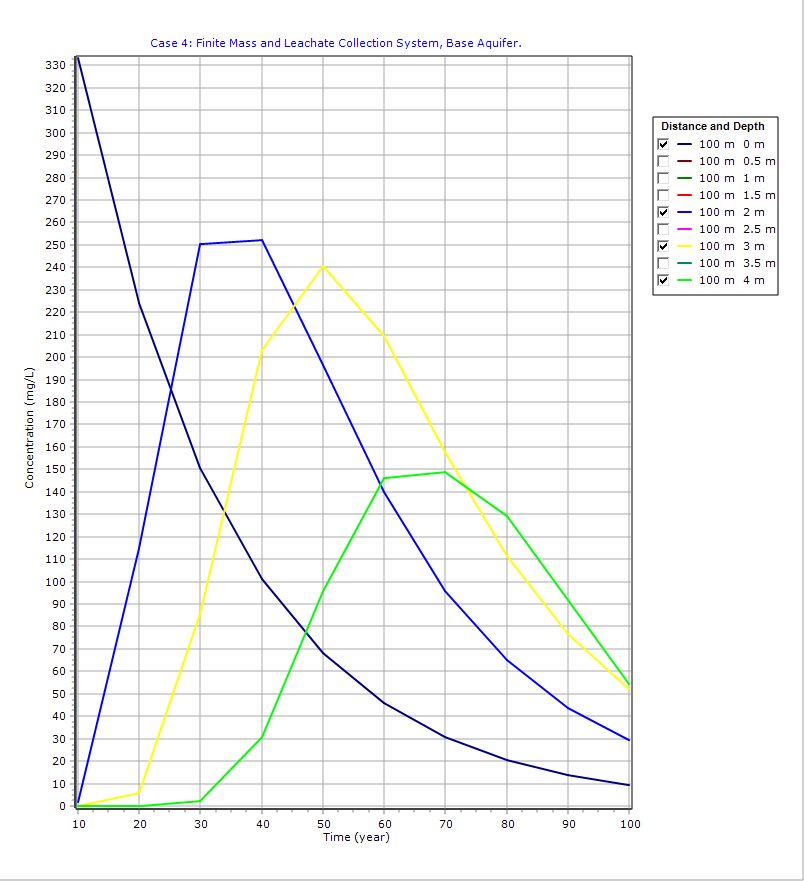
Graphical Output: Concentration vs Time
PDF Report
 Loading…

 Reload document
  Open in new tab
 Interpretation of Results
1. Finite Source Behavior
- Concentrations decline over time as mass is depleted
- Unlike constant source cases, long-term impact is limited
2. Aquifer Dilution
- Concentration depends strongly on:
- Mixing depth (h)
- Base flow velocity (vb)
3. Sensitivity to Aquifer Thickness
- Increasing modeled thickness → lower concentrations
- Demonstrates importance of realistic assumptions
4. Role of Base Velocity
- Higher vb → faster contaminant removal
- Lower vb → greater accumulation
Key Takeaways
- Finite mass sources produce time-dependent contaminant release
- Aquifer mixing assumptions significantly affect results
- Base outflow velocity is a critical modeling parameter
- MIGRATEv10 allows realistic representation of mass balance and flow continuity
Important Warning
The calculation of base flow velocity (vb) is highly sensitive to:
- Site hydrogeology
- Landfill geometry
- Flow system changes after construction
👉 This parameter must be determined by a qualified hydrogeologist or engineer. Incorrect assumptions can lead to significant errors in predicted concentrations.
Final Thoughts
MIGRATEv10 Example 4 represents a major step toward realistic landfill modeling, incorporating:
- Finite contaminant mass
- Dynamic leachate generation
- Aquifer dilution and flow
This example highlights the importance of mass balance, flow continuity, and hydrogeologic context in environmental modeling.
Learn more about our Contaminant Transport Modeling Solutions
MIGRATE Examples
- MIGRATEv10 Example 1: Modeling a RCRA Subtitle D Landfill with a Composite Liner
- MIGRATEv10 Example 2: Composite Liner System with Primary & Secondary Leachate Collection
- MIGRATEv10 Example 3: Pure Diffusion of a Conservative Contaminant
- MIGRATEv10 Example 5: Understanding Integration, Accuracy, and the Role of Engineering Judgment
- MIGRATEv10 Example 6: Eliminating Negative Concentrations Through Improved Integration
- MIGRATEv10 Example 7: Improving Accuracy with User-Selected Fourier Integration
- MIGRATEv10 Example 8: Evaluating Contaminant Migration at Multiple Lateral Positions
- MIGRATEv10 Example 9: Comparison with the TDAST Analytical Solution
- MIGRATEv10 Example 10: Contaminant Transport in Fractured Media with Sorption
- MIGRATEv10 Example 11: Contaminant Migration from Two Adjacent Landfill Cells
- MIGRATEv10 Example 12: Modeling Time-Dependent Source Histories for Multiple Landfill Cells
- MIGRATEv10 Example 13: Termination of Primary Leachate Collection System