

Introduction
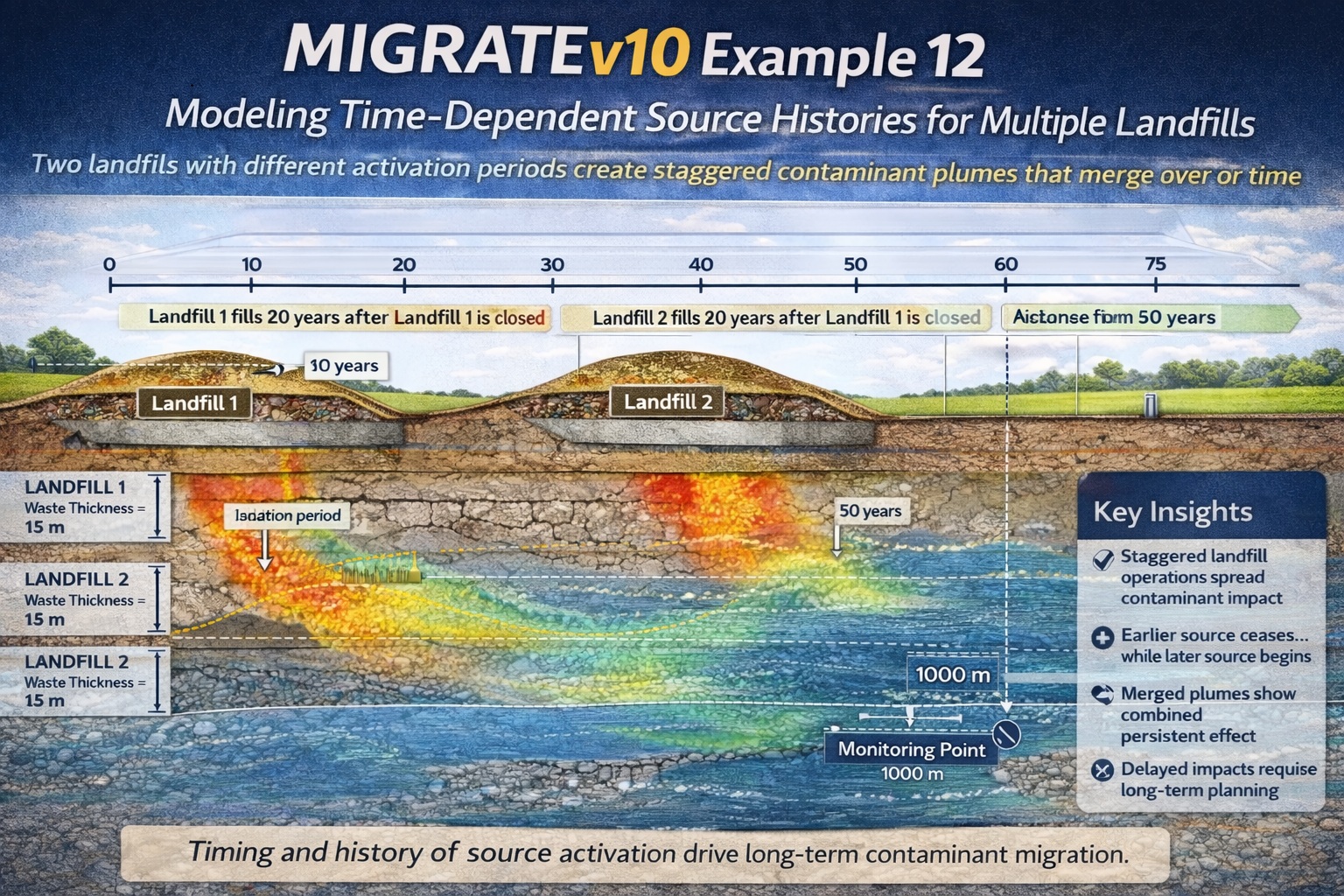
MIGRATEv10 Example 12 builds on Example 11 by introducing a critical real-world factor:
👉 Different source histories for multiple landfill cells
Rather than assuming constant or identical source conditions, this example models how staggered construction, filling, and closure timelines affect contaminant migration.
This is a major step toward realistic modeling, where timing is just as important as geometry and hydrogeology.
Conceptual Model Overview
The system includes:
- Two adjacent landfill cells (same as Example 11)
- Identical hydrogeologic conditions
- Different operational timelines and source concentrations
Key Modeling Objective
This example aims to:
- Evaluate how time-varying source concentrations affect plume development
- Understand delayed impacts from secondary sources
- Assess concentration at a down-gradient receptor over time
Source History: Landfill Cell 1 (Smaller, Earlier)
Filling Phase
- Duration: 0 to 10 years
- Concentration increases linearly as waste accumulates
👉 In the model, this linear increase is approximated using two step increases
Peak Concentration
- Occurs at: 10 years
- Peak value determined by source assumptions
Post-Closure Behavior
- After 10 years:
- Landfill is closed
- Concentration decreases over time
- Represents mass depletion
Source History: Landfill Cell 2 (Larger, Delayed)
Delayed Construction
- Begins: 20 years after closure of Landfill Cell 1
- Filling occurs between:
- 30 to 50 years
Filling Phase
- Duration: 20 years
- Concentration increases linearly
Peak Concentration
- Reached at: 50 years
- Peak value: 2500 mg/L
Post-Closure Behavior
- After 50 years:
- Landfill is closed
- Concentration begins to decline
Key Difference from Example 11
| Feature | Example 11 | Example 12 |
|---|---|---|
| Source Type | Constant / simultaneous | Time-dependent |
| Landfill Timing | Same | Staggered |
| Concentration Behavior | Static | Dynamic |
👉 Example 12 introduces temporal complexity
Modeling Approach in MIGRATEv10
Step 1: Use Geometry from Example 11
- Same landfill cell dimensions
- Same hydrogeologic layers
Step 2: Define Time-Dependent Sources
Landfill Cell 1:
- Stepwise increase (0–10 years)
- Decline after closure
Landfill Cell 2:
- No contribution until ~30 years
- Stepwise increase (30–50 years)
- Decline after closure
Step 3: Assign Concentration Functions
- Approximate linear trends using step inputs
- Ensure continuity between phases
Step 4: Run Simulation
- Track concentration at:
- Down-gradient receptor
- Evaluate over full time range
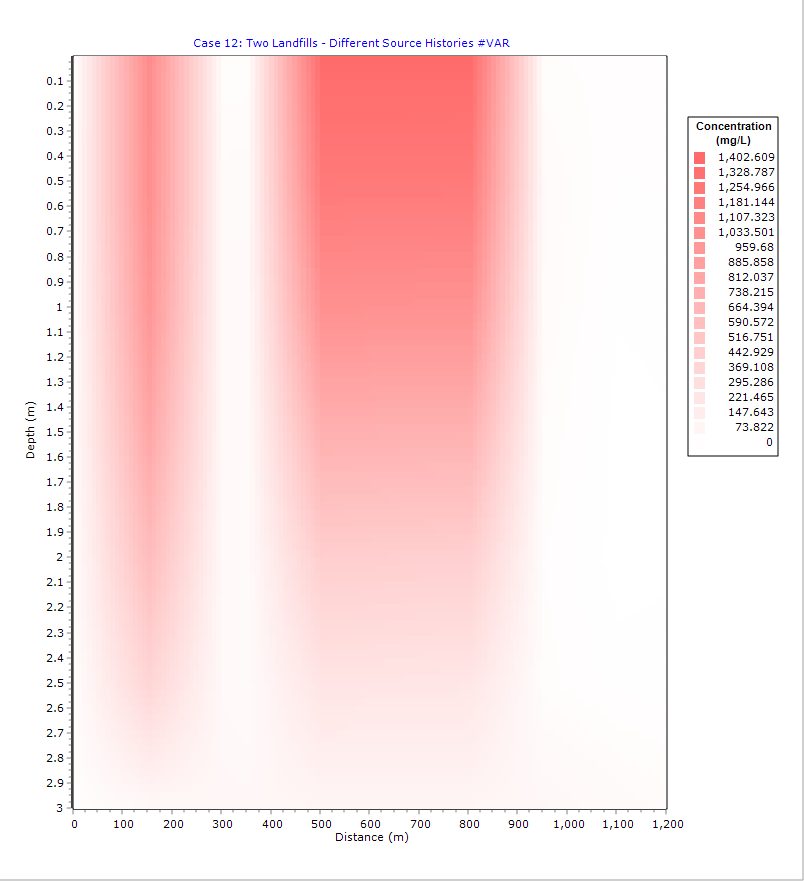
Graphical Output: Depth vs Distance
PDF Report
 Loading…

 Reload document
  Open in new tab
 Interpretation of Results
1. Early-Time Behavior (0–20 years)
- Dominated by Landfill Cell 1
- Rising then declining concentrations
2. Mid-Time Behavior (20–50 years)
- Transition period
- Landfill Cell 1 impact decreases
- Landfill Cell 2 begins contributing
3. Late-Time Behavior (50+ years)
- Dominated by Landfill Cell 2
- Higher peak concentrations due to:
- Larger size
- Higher peak value (2500 mg/L)
Key Insights
1. Timing Controls Impact
- Even a large landfill cell may have delayed influence
- Early impacts may come from smaller sources
2. Overlapping Plumes
- Plumes may:
- Overlap
- Reinforce each other
- Resulting in complex concentration patterns
3. Long-Term Risk
- Delayed sources can extend contamination over long timeframes
- Important for:
- Monitoring
- Risk assessment
Practical Applications
This type of modeling is critical for:
- Phased landfill development
- Long-term environmental planning
- Regulatory compliance over decades
- Forecasting future contamination scenarios
Key Takeaways
- Source history significantly affects contaminant transport
- Time-dependent modeling is essential for realism
- Delayed sources can dominate long-term impacts
- MIGRATEv10 can simulate complex temporal behavior effectively
Final Thoughts
MIGRATEv10 Example 12 highlights that contaminant transport is not just a function of space—but also time. By incorporating realistic source histories, this example provides a more accurate representation of how landfills impact groundwater over decades.
This example is especially important for:
- Long-term environmental assessments
- Multi-phase landfill operations
- Predictive modeling for future site conditions
Learn more about our Contaminant Transport Modeling Solutions
MIGRATE Examples
- MIGRATEv10 Example 1: Modeling a RCRA Subtitle D Landfill with a Composite Liner
- MIGRATEv10 Example 2: Composite Liner System with Primary & Secondary Leachate Collection
- MIGRATEv10 Example 3: Pure Diffusion of a Conservative Contaminant
- MIGRATEv10 Example 4: Finite Mass Source and Aquifer Mixing with Base Outflow
- MIGRATEv10 Example 5: Understanding Integration, Accuracy, and the Role of Engineering Judgment
- MIGRATEv10 Example 6: Eliminating Negative Concentrations Through Improved Integration
- MIGRATEv10 Example 7: Improving Accuracy with User-Selected Fourier Integration
- MIGRATEv10 Example 8: Evaluating Contaminant Migration at Multiple Lateral Positions
- MIGRATEv10 Example 9: Comparison with the TDAST Analytical Solution
- MIGRATEv10 Example 10: Contaminant Transport in Fractured Media with Sorption
- MIGRATEv10 Example 11: Contaminant Migration from Two Adjacent Landfill Cells
- MIGRATEv10 Example 13: Termination of Primary Leachate Collection System
Comparison between POLLUTE and MIGRATE
- MIGRATEv10 vs POLLUTEv10: Pure Diffusion Comparison
- MIGRATEv10 vs POLLUTEv10: Advective–Diffusive Transport Comparison
- MIGRATEv10 vs POLLUTEv10: Finite Mass Source Comparison
- MIGRATEv10 vs POLLUTEv10: Hydraulic Trap (Finite Mass Source) Comparison
- MIGRATEv10 vs POLLUTEv10: Fractured Layer with Sorption Comparison