

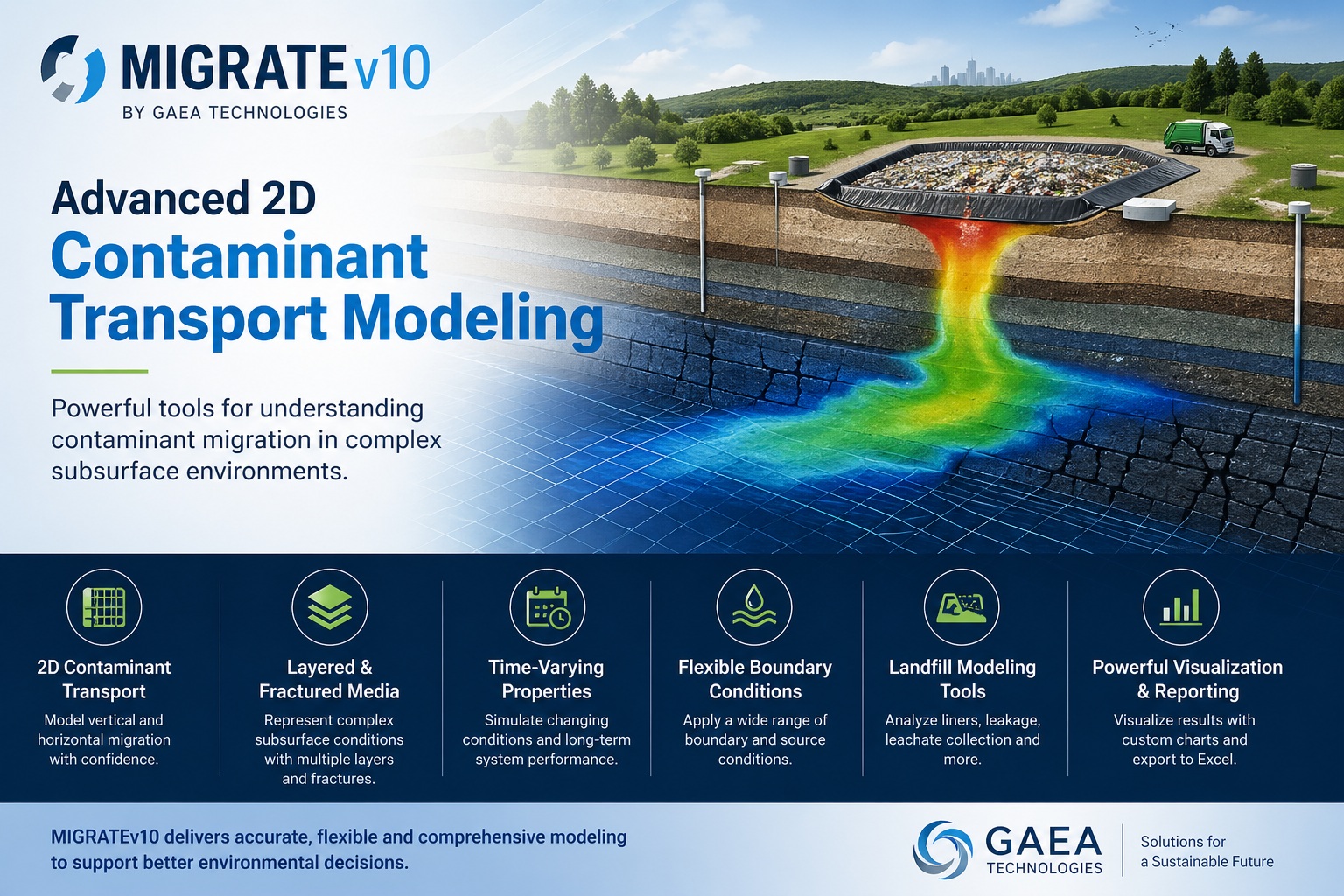
Understanding contaminant migration in complex subsurface environments requires tools that go beyond simplified assumptions. MIGRATEv10 is designed to meet this need by providing robust, two-dimensional modeling capabilities that capture the spatial and temporal dynamics of contaminant transport.
This post highlights the core features that make MIGRATEv10 a powerful solution for landfill and groundwater impact assessments.
Two-Dimensional Contaminant Transport
At its core, MIGRATEv10 simulates two-dimensional contaminant migration, allowing users to model both vertical and horizontal movement within the subsurface.
This enables:
- Accurate simulation of plume spreading
- Interaction between multiple landfill cells
- Realistic representation of site geometry
Unlike simplified one-dimensional approaches, MIGRATEv10 provides the spatial detail required for real-world environmental assessments.
Comprehensive Transport Processes
MIGRATEv10 incorporates all key physical and chemical transport mechanisms, including:
- Advection (movement with groundwater flow)
- Diffusion (movement due to concentration gradients)
- Dispersion (spreading due to heterogeneity)
- Coupled advective–diffusive transport
In addition, the model includes:
- Sorption (retardation effects)
- Radioactive and biological decay
These processes ensure that contaminant behavior is represented with a high degree of realism.
Flexible Boundary Conditions
A wide range of boundary conditions can be applied to simulate different environmental scenarios:
- Constant surface concentration
- Finite mass sources
- Buried contaminant sources
- Zero concentration or zero flux boundaries
- Aquifer boundary conditions
This flexibility allows MIGRATEv10 to adapt to a variety of site conditions and regulatory requirements.
Layered Subsurface Representation
MIGRATEv10 allows users to define multiple subsurface layers, each with unique hydraulic and transport properties.
This supports:
- Heterogeneous soil and rock conditions
- Engineered barrier systems
- Complex stratigraphy beneath landfills
The result is a more accurate representation of how contaminants move through layered environments.
Fractured Media Modeling
The model includes explicit support for fractured subsurface systems, which are critical in many geological settings.
With this capability, users can simulate:
- Preferential flow paths
- Rapid contaminant migration through fractures
- Transport in fractured rock aquifers
This feature is essential for sites where fractures dominate contaminant transport behavior.
Time-Varying Properties
MIGRATEv10 supports time-dependent changes in key model inputs, including:
- Source concentrations
- Hydraulic conditions
- Material properties
This enables simulation of:
- Changing landfill conditions over time
- Degradation of liner systems
- Long-term environmental performance
Time-varying inputs are critical for realistic lifecycle modeling.
Landfill-Specific Modeling Capabilities
MIGRATEv10 includes specialized tools for modeling landfill systems, such as:
- Primary landfill configurations
- Leakage rate models
- Composite liner systems (primary and secondary)
- Leachate collection systems
These features allow users to evaluate containment performance and potential environmental impacts with confidence.
Advanced Source Representation
The software supports a variety of contaminant source types, including:
- Surface sources
- Buried sources
- Multiple sources with different release histories
This flexibility makes it possible to model complex scenarios such as:
- Multiple landfill cells
- Staged waste placement
- Variable contaminant loading over time
Visualization and Output Tools
MIGRATEv10 provides a comprehensive suite of output visualization options, including:
- Concentration vs time
- Concentration vs depth
- Concentration vs distance
- Mass vs time
- Depth vs distance
Users can customize charts and export data for reporting or further analysis, making it easier to interpret results and communicate findings.
Data Export and Model Integration
To support workflows and reporting, MIGRATEv10 allows users to:
- Export results to Excel
- Transfer outputs between models (e.g., integration with POLLUTE)
- Import external datasets for comparison
This ensures compatibility with existing analysis tools and enhances productivity.
Conclusion
MIGRATEv10 delivers a powerful combination of 2D spatial modeling, process-based transport simulation, and flexible system representation. It is particularly well-suited for:
- Landfill impact assessments
- Groundwater contamination studies
- Complex, multi-source environments
- Long-term performance evaluations
By combining physical realism with practical usability, MIGRATEv10 provides engineers and environmental professionals with the tools needed to make informed, defensible decisions.