

Introduction
Contaminant transport modeling is widely used in environmental engineering and hydrogeology to predict how pollutants migrate through soil, groundwater, and engineered containment systems. When contaminants are released into the subsurface—through landfill leachate, industrial spills, mining operations, or nuclear waste disposal—their movement is governed by several physical, chemical, and biological processes.
These processes include:
- groundwater advection
- mechanical dispersion
- molecular diffusion
- sorption to soil particles
- chemical reactions
- biological degradation
- radioactive decay
Among these mechanisms, biological decay and radioactive decay are particularly important because they reduce contaminant concentrations over time. These decay processes can significantly influence contaminant plume migration, long-term environmental risks, and the effectiveness of remediation strategies.
Biological decay involves the breakdown of contaminants by microorganisms through metabolic processes. Radioactive decay, on the other hand, involves the transformation of unstable atomic nuclei into more stable forms through nuclear reactions.
Both types of decay are commonly incorporated into contaminant transport models to simulate how pollutant concentrations change over time.
Understanding how these decay processes work—and how they are represented mathematically—is essential for accurate prediction of contaminant fate and transport in environmental systems.
Overview of Contaminant Transport Processes
Before examining biological and radioactive decay, it is helpful to understand the broader processes controlling contaminant transport.
When contaminants enter groundwater systems, their migration is influenced by several mechanisms:
Advection
Advection describes the movement of dissolved contaminants with flowing groundwater. Contaminants are transported along hydraulic gradients within aquifers.
Dispersion
Dispersion causes contaminant plumes to spread as groundwater moves through porous media. Variations in pore structure and flow velocity produce this spreading effect.
Diffusion
Diffusion occurs when contaminants move from areas of higher concentration to lower concentration due to molecular motion.
Sorption
Sorption transfers contaminants from groundwater to soil or mineral surfaces, slowing contaminant movement.
Decay Processes
Decay mechanisms reduce contaminant mass through chemical transformation or radioactive processes.
Biological and radioactive decay are therefore important because they can reduce contaminant concentrations even without physical removal.
Biological Decay in Contaminant Transport
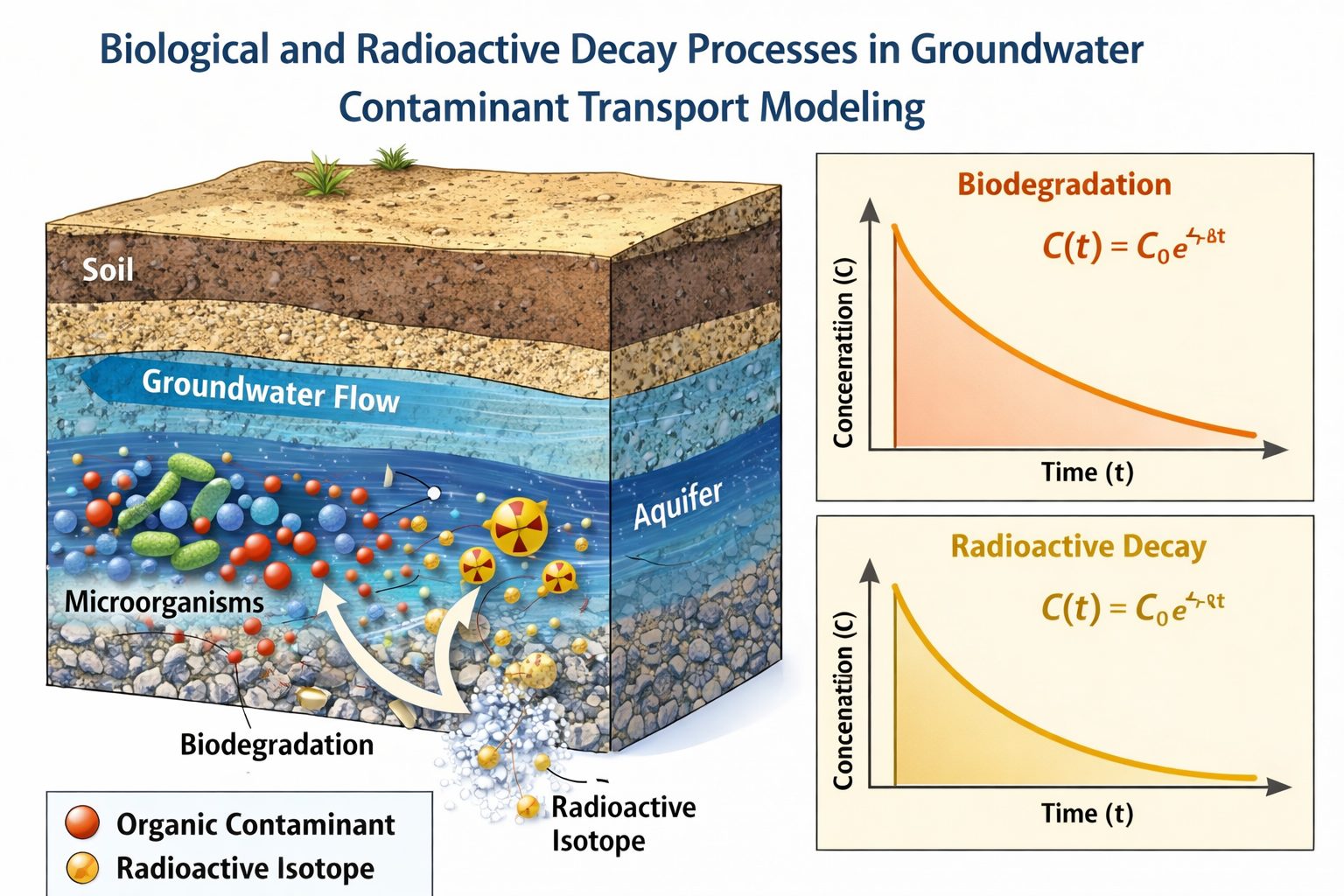
Biological decay refers to the degradation of contaminants through the activity of microorganisms. Bacteria, fungi, and other microbes present in soil and groundwater can metabolize certain contaminants and convert them into less harmful substances.
Microorganisms use contaminants as energy sources or electron donors during metabolic processes.
Biological degradation plays a key role in natural attenuation of many contaminants, including:
- petroleum hydrocarbons
- chlorinated solvents
- pesticides
- organic waste compounds
These processes often occur naturally in aquifers, sediments, and landfill environments.
Microbial Processes in Groundwater
Microbial degradation occurs through several biochemical pathways.
Aerobic Degradation
In oxygen-rich environments, microorganisms use oxygen to break down organic contaminants.
For example, hydrocarbons can be oxidized to carbon dioxide and water through aerobic metabolism.
Aerobic degradation typically occurs near the surface where oxygen is present.
Anaerobic Degradation
In deeper groundwater environments where oxygen is limited, microorganisms may use alternative electron acceptors.
These may include:
- nitrate
- sulfate
- iron
- carbon dioxide
Anaerobic degradation processes are common in landfill environments and contaminated aquifers.
Methanogenesis
In highly reducing environments such as landfill waste, microorganisms may produce methane through anaerobic decomposition of organic matter.
Methanogenesis represents the final stage of biological degradation in many landfill systems.
Modeling Biological Decay
In contaminant transport models, biological decay is commonly represented using first-order decay kinetics.
\frac{dC}{dt} = -\lambda C
Where:
- C = contaminant concentration
- t = time
- λ = decay constant
This equation assumes that the rate of contaminant degradation is proportional to the contaminant concentration.
The solution to this equation is:
C=C0e−λt
A
k
y=Ae−kt≈6e−0.6tyt
Where:
- C0 = initial concentration
- λ = decay constant
This relationship shows that contaminant concentrations decrease exponentially over time.
Half-Life of Contaminants
The half-life of a contaminant is the time required for half of the contaminant mass to degrade.
The half-life can be calculated using:
t_{1/2} = \frac{\ln 2}{\lambda}
Where:
- t₁/₂ = half-life
- λ = decay constant
Half-life values vary widely depending on environmental conditions and contaminant type.
For example:
- petroleum hydrocarbons may degrade within months or years
- chlorinated solvents may persist for decades
Accurate half-life estimates are critical for environmental modeling.
Radioactive Decay in Environmental Systems
Radioactive decay occurs when unstable atomic nuclei transform into more stable forms by emitting radiation.
This process is important in environmental systems involving:
- nuclear waste disposal
- uranium mining
- radioactive contamination
- medical isotope releases
Radioactive contaminants behave differently from chemical contaminants because they undergo nuclear transformation rather than biochemical degradation.
Common radioactive contaminants include:
- uranium isotopes
- radium
- cesium-137
- strontium-90
- plutonium
These isotopes may persist in the environment for extremely long periods depending on their half-lives.
Types of Radioactive Decay
Radioactive decay can occur through several mechanisms.
Alpha Decay
Alpha decay occurs when an unstable nucleus emits an alpha particle consisting of two protons and two neutrons.
This process reduces the atomic number of the element.
Beta Decay
Beta decay occurs when a neutron transforms into a proton while emitting an electron.
Beta decay is common in many radioactive isotopes found in environmental contamination.
Gamma Radiation
Gamma radiation involves the emission of high-energy electromagnetic radiation as the nucleus transitions to a lower energy state.
Gamma radiation often accompanies other decay processes.
Radioactive Decay Modeling
Radioactive decay follows the same mathematical form as first-order biological decay.
N=N0e−λt
A
k
y=Ae−kt≈6e−0.6tyt
Where:
- N = number of radioactive atoms remaining
- N0 = initial number of atoms
- λ = decay constant
This equation describes exponential reduction in radioactive material over time.
Because radioactive decay rates are intrinsic properties of isotopes, the decay constant remains fixed regardless of environmental conditions.
Decay Chains
Some radioactive isotopes decay into other radioactive isotopes rather than stable elements.
This sequence of transformations is known as a decay chain.
For example:
Uranium-238 decays through a series of intermediate isotopes before eventually becoming stable lead.
Decay chain modeling can be complex because each isotope in the chain may have its own half-life and environmental behavior.
Environmental models must sometimes track multiple isotopes simultaneously.
Combining Transport and Decay Processes
In contaminant transport models, decay processes are combined with other transport mechanisms.
The general contaminant transport equation may include:
- advection
- dispersion
- diffusion
- sorption
- decay
Decay processes reduce contaminant concentrations as they move through groundwater systems.
This means contaminant plumes may shrink or diminish over time even if contaminants continue to move through the aquifer.
Applications in Environmental Engineering
Biological and radioactive decay modeling is used in many environmental applications.
Groundwater Contamination Studies
Models incorporating biological decay help predict the natural attenuation of contaminants in aquifers.
Landfill Environmental Assessments
Biological decay plays a major role in landfill gas production and degradation of organic waste.
Nuclear Waste Management
Radioactive decay modeling is essential for evaluating long-term risks associated with nuclear waste disposal.
Environmental Risk Assessment
Decay models help estimate contaminant persistence and long-term environmental impacts.
Challenges in Modeling Decay Processes
Although decay processes are often represented using simple mathematical relationships, several challenges exist.
Environmental Variability
Biological decay rates depend on environmental conditions such as temperature, oxygen levels, and microbial populations.
Multiple Degradation Pathways
Some contaminants degrade through multiple chemical or biological pathways.
Coupled Reactions
Decay processes may interact with other reactions such as sorption or precipitation.
Uncertainty in Parameter Values
Accurate decay constants are sometimes difficult to determine from field data.
Because of these uncertainties, environmental models often include sensitivity analyses to evaluate the influence of decay parameters.
Advances in Reactive Transport Modeling
Recent advances in environmental modeling have improved the representation of biological and radioactive decay processes.
Modern reactive transport models can simulate complex interactions between chemical reactions, microbial activity, and groundwater flow.
These models allow scientists to simulate:
- biodegradation pathways
- microbial growth dynamics
- radionuclide decay chains
- coupled geochemical reactions
These advanced tools provide more realistic predictions of contaminant behavior in environmental systems.
Conclusion
Biological and radioactive decay processes play a crucial role in contaminant transport modeling. By reducing contaminant mass over time, these processes influence the long-term behavior of pollutant plumes in groundwater and soil systems.
Biological decay involves microbial degradation of contaminants, while radioactive decay involves nuclear transformation of unstable isotopes. Both processes are typically represented using first-order decay equations that describe exponential reductions in contaminant concentration.
Incorporating decay processes into contaminant transport models allows environmental engineers and hydrogeologists to better predict contaminant persistence, evaluate remediation strategies, and assess long-term environmental risks.
As environmental modeling techniques continue to evolve, improved understanding of decay processes will enhance our ability to simulate contaminant transport and protect groundwater resources.
Learn more about our Contaminant Transport Modeling Solutions
Related Articles
- Contaminant Transport Modelling and Landfill Design: A Complete Guide for Environmental Engineers
- How Contaminant Transport Models Predict Groundwater Pollution
- Designing Landfill Liner Systems to Prevent Groundwater Contamination
- Understanding Leachate Generation and Transport in Landfills
- Advection–Dispersion Modelling in Groundwater Systems
- Hydrogeological Data Required for Contaminant Transport Models
- Regulatory Requirements for Landfill Design and Groundwater Protection
- Unlock Global Expertise: Free Research Viewer for POLLUTE and MIGRATE
- Mastering the Plume: POLLUTEv8 vs. MODFLOW vs. FEFLOW vs. PATH3D
- Core Features of POLLUTEv8
- Mastering Contaminant Transport: Special Features of POLLUTEv8
- Navigating Contaminant Migration with POLLUTE: A Modern Approach to Landfill Design
- Beyond The MCL: Building Audit-Proof Contaminant Fate Models For 2026 Regulatory Submissions
- Using Predictive Models to Meet 2026 Primary Drinking Water Regulations
- Driving Environmental Research: How GAEA Technologies POLLUTE Software is Used in Academic and Industry Reports
- Modeling Your Way to ‘No Further Action’: How Predictive Simulation Shaves Years Off Remediation Timelines
- Meeting The New 2026 EPA Reporting Standards For PFAS: Why Traditional Spreadsheet Modeling No Longer Suffices
- Unlocking Sustainable Solutions: The Role of POLLUTE Software in Landfill Design and Contaminant Transport Modelling
- Contaminant Transport Modelling and Landfill Design Insights
- Geomembrane Degradation in Landfill Liners: Causes, Modeling, and Long-Term Performance
- Clogging of Landfill Leachate Collection Systems: Causes, Impacts, and Prevention
- Determining Diffusion Coefficients for Contaminant Transport Modeling
- Use and Determination of Distribution Coefficients for Contaminant Transport Modeling
- Non-Linear Sorption in Contaminant Transport Modeling
- Phase Change in Collection Systems in Contaminant Transport Modeling for Landfills
External References
- Effect of Non-Linear Sorption on Contaminant Plumes
- Non-Linear Sorption in Soil Systems
- Reactive transport modeling in porous media
- Henry’s Law and Gas–Liquid Partitioning in Landfills
- Modeling the Fate of Organic Chemicals in Landfills
- Models of Biodegradation During Contaminant Transport
- Modeling Decay Chains of Radioactive Contaminants