

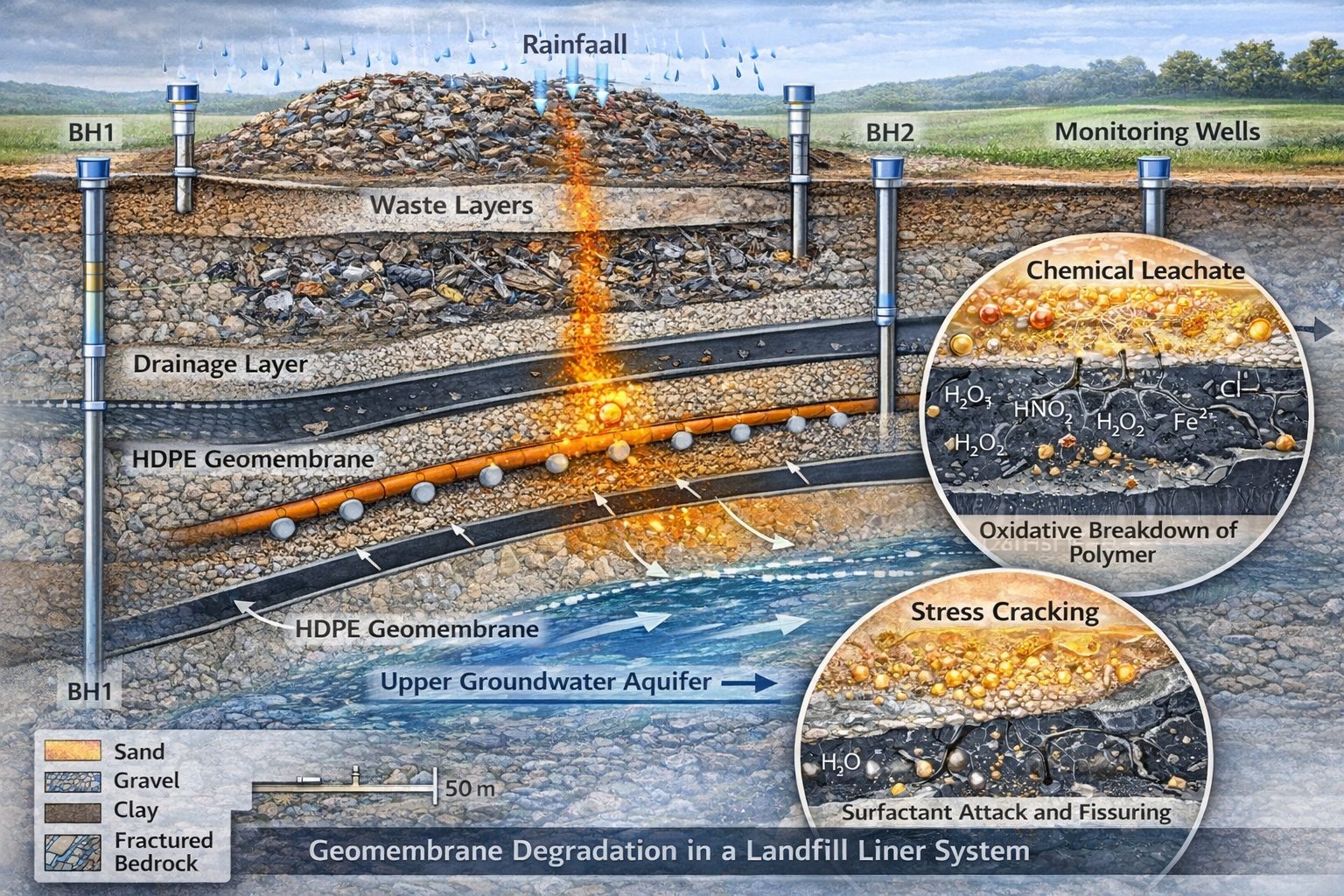
Introduction
Modern landfills are engineered containment systems designed to isolate waste from the surrounding environment and prevent contamination of soil, surface water, and groundwater. One of the most critical components of these containment systems is the geomembrane liner, a synthetic barrier that provides extremely low permeability and protects groundwater resources from leachate migration.
Geomembranes are widely used in landfill liner systems because they provide exceptional resistance to fluid flow and chemical attack. In most modern landfill designs, geomembranes are installed as part of a composite liner system, typically combined with compacted clay liners or geosynthetic clay liners. Together, these layers create multiple barriers that significantly reduce the risk of contaminant leakage.
However, like all engineered materials, geomembranes are subject to long-term degradation processes. Over time, chemical reactions, mechanical stresses, environmental exposure, and biological activity can gradually affect geomembrane performance. Understanding these degradation mechanisms is essential for predicting the long-term effectiveness of landfill liner systems.
Environmental engineers, geotechnical specialists, and hydrogeologists use laboratory testing, field monitoring, and numerical modeling to evaluate geomembrane degradation and estimate liner service life. These studies help ensure that landfill containment systems remain effective for decades or even centuries.
This article explores the causes of geomembrane degradation in landfill liners, the modeling techniques used to predict long-term performance, and the engineering strategies used to extend geomembrane lifespan and protect groundwater resources.
What Are Geomembranes?
Geomembranes are synthetic polymeric membranes used as fluid barriers in environmental containment systems. They are commonly used in:
- Landfill liner systems
- Mining waste containment facilities
- Wastewater treatment ponds
- Water reservoirs
- Secondary containment systems
The most commonly used geomembrane material in landfill applications is high-density polyethylene (HDPE). Other materials sometimes used include:
- Linear low-density polyethylene (LLDPE)
- Polyvinyl chloride (PVC)
- Polypropylene (PP)
- Ethylene propylene diene monomer (EPDM)
Among these materials, HDPE geomembranes are widely favored due to their:
- High chemical resistance
- Low permeability
- Excellent durability
- Strong mechanical properties
- Cost effectiveness
Typical landfill geomembranes are between 1.5 mm and 2.5 mm thick, depending on design requirements and regulatory standards.
The Role of Geomembranes in Landfill Liner Systems
Geomembranes serve as the primary hydraulic barrier in landfill containment systems. Their extremely low permeability prevents leachate from escaping the landfill and contaminating surrounding groundwater.
A typical landfill liner system may include the following components:
- Compacted clay liner
- Geomembrane liner
- Geosynthetic clay liner (optional)
- Drainage layer
- Leachate collection system
The geomembrane layer provides the most effective barrier to fluid flow. However, its long-term performance depends on maintaining material integrity over the lifespan of the landfill.
Because landfills may generate leachate for several decades or longer, geomembranes must remain functional for extended periods.
Causes of Geomembrane Degradation
Geomembrane degradation occurs when physical, chemical, or environmental processes alter the properties of the polymer material over time. Several degradation mechanisms can affect geomembrane performance.
Oxidative Degradation
Oxidation is one of the most important degradation mechanisms affecting HDPE geomembranes.
Polyethylene polymers contain antioxidant additives that protect the material from oxidation. Over time, these antioxidants are gradually consumed through chemical reactions with oxygen.
Once antioxidant protection is depleted, the polymer structure may begin to break down, causing:
- Reduced tensile strength
- Increased brittleness
- Surface cracking
Oxidation rates depend on temperature, oxygen availability, and chemical exposure.
Thermal Aging
Elevated temperatures can accelerate polymer degradation processes. Landfills generate heat due to microbial decomposition of organic waste.
Temperatures within landfill waste can sometimes exceed 50–70°C, which may accelerate geomembrane aging.
Thermal aging can lead to:
- Polymer chain scission
- Loss of mechanical strength
- Increased material brittleness
Long-term temperature exposure is therefore an important factor in predicting geomembrane service life.
Chemical Degradation
Landfill leachate contains a wide range of chemical compounds, including organic acids, heavy metals, salts, and industrial contaminants.
Although HDPE geomembranes have excellent chemical resistance, prolonged exposure to aggressive chemicals may affect polymer stability.
Chemical degradation can occur through:
- Solvent interactions
- Polymer swelling
- Extraction of additives
The chemical composition of landfill leachate plays an important role in evaluating long-term geomembrane performance.
Stress Cracking
Stress cracking occurs when mechanical stresses combine with chemical exposure to create cracks in the geomembrane material.
Factors that contribute to stress cracking include:
- Tensile stress from installation
- Differential settlement of landfill waste
- Sharp objects or protrusions beneath the liner
- Chemical exposure
Environmental stress cracking is one of the most common failure mechanisms in polyethylene geomembranes.
Ultraviolet (UV) Radiation
Exposure to ultraviolet radiation can degrade polymer materials through photochemical reactions.
However, most landfill geomembranes are buried beneath waste and are therefore not exposed to significant UV radiation during normal operation.
UV degradation is primarily a concern during:
- Storage prior to installation
- Construction phases before waste placement
Manufacturers often include UV stabilizers to protect geomembranes from temporary exposure.
Mechanical Damage and Installation Issues
Geomembrane degradation is not always caused by chemical or environmental processes. Mechanical damage during installation or operation can also compromise liner performance.
Potential sources of mechanical damage include:
- Punctures from sharp objects
- Improper welding of seams
- Wrinkling during installation
- Differential settlement of landfill waste
- Heavy equipment traffic during construction
Quality assurance and quality control procedures during installation are essential for minimizing mechanical damage.
Modeling Geomembrane Degradation
Predicting geomembrane lifespan requires understanding how degradation processes occur over time. Engineers use various modeling approaches to estimate long-term geomembrane performance.
Laboratory Aging Tests
Laboratory experiments are commonly used to study geomembrane degradation under controlled conditions.
Common tests include:
- Oven aging tests
- Immersion tests in chemical solutions
- Accelerated oxidative aging tests
These experiments simulate long-term exposure conditions and help estimate degradation rates.
Antioxidant Depletion Modeling
Because antioxidants protect HDPE geomembranes from oxidation, predicting antioxidant depletion is an important part of geomembrane lifespan modeling.
The degradation process is often divided into three stages:
- Antioxidant depletion phase
- Induction period (slow oxidation begins)
- Polymer degradation phase
Mathematical models estimate how long each stage lasts based on temperature and chemical exposure.
Arrhenius Modeling
The Arrhenius equation is commonly used to estimate degradation rates based on temperature.
k = A e^{-\frac{E_a}{RT}}
Where:
- k = reaction rate constant
- A = pre-exponential factor
- Eₐ = activation energy
- R = universal gas constant
- T = absolute temperature
This relationship allows engineers to extrapolate laboratory aging results to long-term field conditions.
Diffusion Modeling
Diffusion models simulate how oxygen and chemicals move through the geomembrane material.
These models help estimate:
- Oxygen transport through the polymer
- Antioxidant depletion rates
- Chemical exposure within the geomembrane
Diffusion modeling is particularly important for evaluating oxidative degradation processes.
Long-Term Performance of Geomembrane Liners
Numerous studies have evaluated the expected lifespan of geomembrane liners in landfill environments.
Research suggests that well-installed HDPE geomembranes may remain functional for several hundred years under favorable conditions.
Factors influencing long-term performance include:
- Temperature within the landfill
- Leachate chemistry
- Geomembrane thickness
- Quality of installation
- Mechanical stresses on the liner
Field studies of older landfill liners have shown that geomembranes often perform well for extended periods when properly protected.
Engineering Strategies to Extend Geomembrane Lifespan
Engineers use several strategies to maximize geomembrane durability and long-term performance.
Composite Liner Systems
Combining geomembranes with clay liners or geosynthetic clay liners provides redundancy and reduces leakage risks.
Protective Soil Layers
Protective soil or geotextile layers are often placed above and below geomembranes to prevent puncture damage.
Quality Assurance During Installation
Construction quality assurance programs ensure that geomembranes are properly installed and welded.
Typical quality control measures include:
- Seam testing
- Leak detection surveys
- Visual inspection during installation
Temperature Management
Landfill design strategies can help limit heat buildup and reduce thermal degradation.
Monitoring Geomembrane Performance
Although geomembranes are buried beneath landfill waste, their performance can still be monitored indirectly.
Monitoring systems may include:
- Leak detection layers
- Groundwater monitoring wells
- Electrical leak location surveys
- Leachate monitoring systems
These monitoring methods help detect potential liner failures before significant environmental impacts occur.
Future Developments in Geomembrane Technology
Advances in materials science are leading to improved geomembrane designs with enhanced durability and chemical resistance.
Emerging developments include:
- Improved antioxidant stabilization systems
- Multi-layer geomembrane structures
- Smart geomembranes with embedded sensors
- Advanced leak detection technologies
These innovations aim to improve long-term containment performance and environmental protection.
Conclusion
Geomembranes are essential components of modern landfill containment systems, providing highly effective barriers that prevent leachate from contaminating groundwater. However, long-term performance depends on understanding and managing the degradation processes that can affect polymer materials over time.
Oxidation, thermal aging, chemical exposure, and mechanical stresses all play roles in geomembrane degradation. Through laboratory testing, numerical modeling, and field monitoring, engineers can evaluate these processes and estimate geomembrane service life.
Modern engineering practices—including composite liner systems, protective layers, and rigorous installation standards—help ensure that geomembrane liners perform effectively for many decades.
As landfill design continues to evolve, advances in geomembrane materials and monitoring technologies will further enhance the long-term protection of groundwater resources and support sustainable waste management practices.
Learn more about our Contaminant Transport Modeling Solutions
Related Articles
- Contaminant Transport Modelling and Landfill Design: A Complete Guide for Environmental Engineers
- How Contaminant Transport Models Predict Groundwater Pollution
- Designing Landfill Liner Systems to Prevent Groundwater Contamination
- Understanding Leachate Generation and Transport in Landfills
- Advection–Dispersion Modelling in Groundwater Systems
- Hydrogeological Data Required for Contaminant Transport Models
- Regulatory Requirements for Landfill Design and Groundwater Protection
- Unlock Global Expertise: Free Research Viewer for POLLUTE and MIGRATE
- Mastering the Plume: POLLUTEv8 vs. MODFLOW vs. FEFLOW vs. PATH3D
- Core Features of POLLUTEv8
- Mastering Contaminant Transport: Special Features of POLLUTEv8
- Navigating Contaminant Migration with POLLUTE: A Modern Approach to Landfill Design
- Beyond The MCL: Building Audit-Proof Contaminant Fate Models For 2026 Regulatory Submissions
- Using Predictive Models to Meet 2026 Primary Drinking Water Regulations
- Driving Environmental Research: How GAEA Technologies POLLUTE Software is Used in Academic and Industry Reports
- Modeling Your Way to ‘No Further Action’: How Predictive Simulation Shaves Years Off Remediation Timelines
- Meeting The New 2026 EPA Reporting Standards For PFAS: Why Traditional Spreadsheet Modeling No Longer Suffices
- Unlocking Sustainable Solutions: The Role of POLLUTE Software in Landfill Design and Contaminant Transport Modelling
- Contaminant Transport Modelling and Landfill Design Insights
- Clogging of Landfill Leachate Collection Systems: Causes, Impacts, and Prevention
- Determining Diffusion Coefficients for Contaminant Transport Modeling
- Use and Determination of Distribution Coefficients for Contaminant Transport Modeling
- Non-Linear Sorption in Contaminant Transport Modeling
- Phase Change in Collection Systems in Contaminant Transport Modeling for Landfills
- Biological and Radioactive Decay in Contaminant Transport Modeling
External References
- Technical guidance on geomembrane landfill liners
- Geosynthetics used in landfill liner systems
- Hydrogeology and groundwater contamination research
- Service life of HDPE geomembranes in landfill environments
- Geomembrane lifetime prediction methods
- Service life of polyethylene geomembrane barriers
- HDPE geomembrane service life prediction
- Effect of temperature on geomembrane lifespan
- Antioxidant depletion in HDPE geomembranes
- Geomembrane liner degradation and failure mechanisms
- Modeling Decay Chains of Radioactive Contaminants