

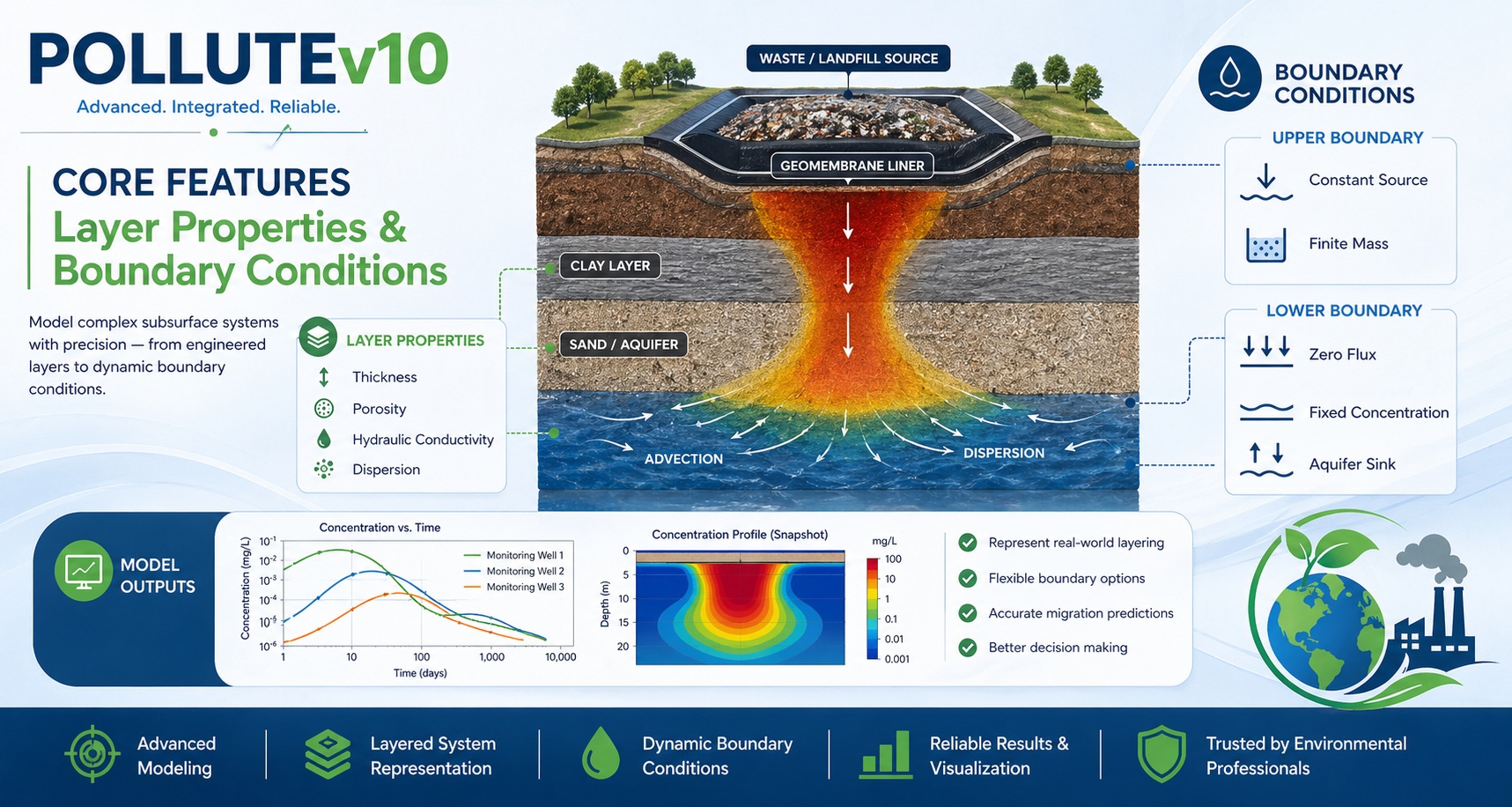
While the “Special Features” often steal the spotlight, the true strength of POLLUTEv10 lies in its robust core features. Designed for real-world environmental engineering, its primary features allow for the meticulous definition of subsurface environments and the clear communication of contaminant risks.
Comprehensive Layer Properties
The foundation of any POLLUTE model is its layering system. You can define an unlimited number of layers to represent:
- Engineered Barriers: From HDPE geomembranes to compacted clay liners.
- Natural Strata: Complex geological formations including silts, sands, and bedrock.
- Hydraulic Parameters: For each layer, you precisely define thickness, dispersion, porosity, and hydraulic conductivity, allowing for a true-to-life 1D or 1.5D advection-dispersion simulation.
Versatile Boundary Conditions
Modeling the source and the receptor requires flexibility. POLLUTEv10 provides several standard boundary conditions:
- Upper Boundaries: Model a constant source concentration or a finite mass (decaying) source, representing a landfill cell that eventually “washes out.”
- Lower Boundaries: Define a fixed concentration, zero flux, or a passive sink (aquifer) to accurately reflect how contaminants interact with the groundwater system at depth.
Landfill Type Templates
To jumpstart your design process, POLLUTEv10 includes pre-configured templates for various landfill types. Whether you are modeling a modern composite liner, a municipal solid waste facility, or a hazardous waste cell, these templates provide a standard starting point for layers and expected concentrations, saving hours of manual setup.
Professional Result Displays
Interpreting data is as important as calculating it. POLLUTEv10 offers:
- Concentration vs. Time: Track how the plume evolves over decades or centuries.
- Depth Profiles: As seen on the dashboard in the featured image, you can view the concentration gradient through the entire soil column at any specific point in time.
- Flux and Mass Analysis: Beyond concentration, track the actual mass of pollutants passing through your barrier system.
Seamless Excel Integration
Final reports often require further manipulation or custom graphing. POLLUTEv10 allows you to export all results directly to Excel. This ensures that your raw data is ready for inclusion in engineering reports, regulatory submissions, or more advanced internal spreadsheets.
In Summary
POLLUTEv8 provides an essential toolkit for any environmental professional tasked with predicting the fate of subsurface contaminants. By combining a robust core engine for defining layers and boundary conditions with advanced “special features” like Monte Carlo simulations and non-linear sorption, it bridges the gap between theoretical modeling and real-world engineering solutions.
Whether you are designing a high-performance landfill liner or managing a complex brownfield remediation project, POLLUTEv10’s ability to handle initial concentration profiles and time-varying properties ensures your predictions are as accurate as possible. Its professional result displays and seamless Excel integration further streamline the reporting process, making it the definitive choice for clear, defensible, and reliable contaminant transport analysis.
Additional Resources
Learn more about our Contaminant Transport Modeling Solutions
Related Articles
- Contaminant Transport Modelling and Landfill Design: A Complete Guide for Environmental Engineers
- How Contaminant Transport Models Predict Groundwater Pollution
- Designing Landfill Liner Systems to Prevent Groundwater Contamination
- Understanding Leachate Generation and Transport in Landfills
- Advection–Dispersion Modelling in Groundwater Systems
- Hydrogeological Data Required for Contaminant Transport Models
- Regulatory Requirements for Landfill Design and Groundwater Protection
- Unlock Global Expertise: Free Research Viewer for POLLUTE and MIGRATE
- Mastering the Plume: POLLUTEv8 vs. MODFLOW vs. FEFLOW vs. PATH3D
- Mastering Contaminant Transport: Special Features of POLLUTEv8
- Navigating Contaminant Migration with POLLUTE: A Modern Approach to Landfill Design
- Beyond The MCL: Building Audit-Proof Contaminant Fate Models For 2026 Regulatory Submissions
- Using Predictive Models to Meet 2026 Primary Drinking Water Regulations
- Driving Environmental Research: How GAEA Technologies POLLUTE Software is Used in Academic and Industry Reports
- Modeling Your Way to ‘No Further Action’: How Predictive Simulation Shaves Years Off Remediation Timelines
- Meeting The New 2026 EPA Reporting Standards For PFAS: Why Traditional Spreadsheet Modeling No Longer Suffices
- Using Predictive Models to Meet 2026 Primary Drinking Water Regulations
- Unlocking Sustainable Solutions: The Role of POLLUTE Software in Landfill Design and Contaminant Transport Modelling
- Contaminant Transport Modelling and Landfill Design Insights
- Geomembrane Degradation in Landfill Liners: Causes, Modeling, and Long-Term Performance
- Clogging of Landfill Leachate Collection Systems: Causes, Impacts, and Prevention
- Determining Diffusion Coefficients for Contaminant Transport Modeling
- Use and Determination of Distribution Coefficients for Contaminant Transport Modeling
- Non-Linear Sorption in Contaminant Transport Modeling
- Phase Change in Collection Systems in Contaminant Transport Modeling for Landfills
- Biological and Radioactive Decay in Contaminant Transport Modeling