

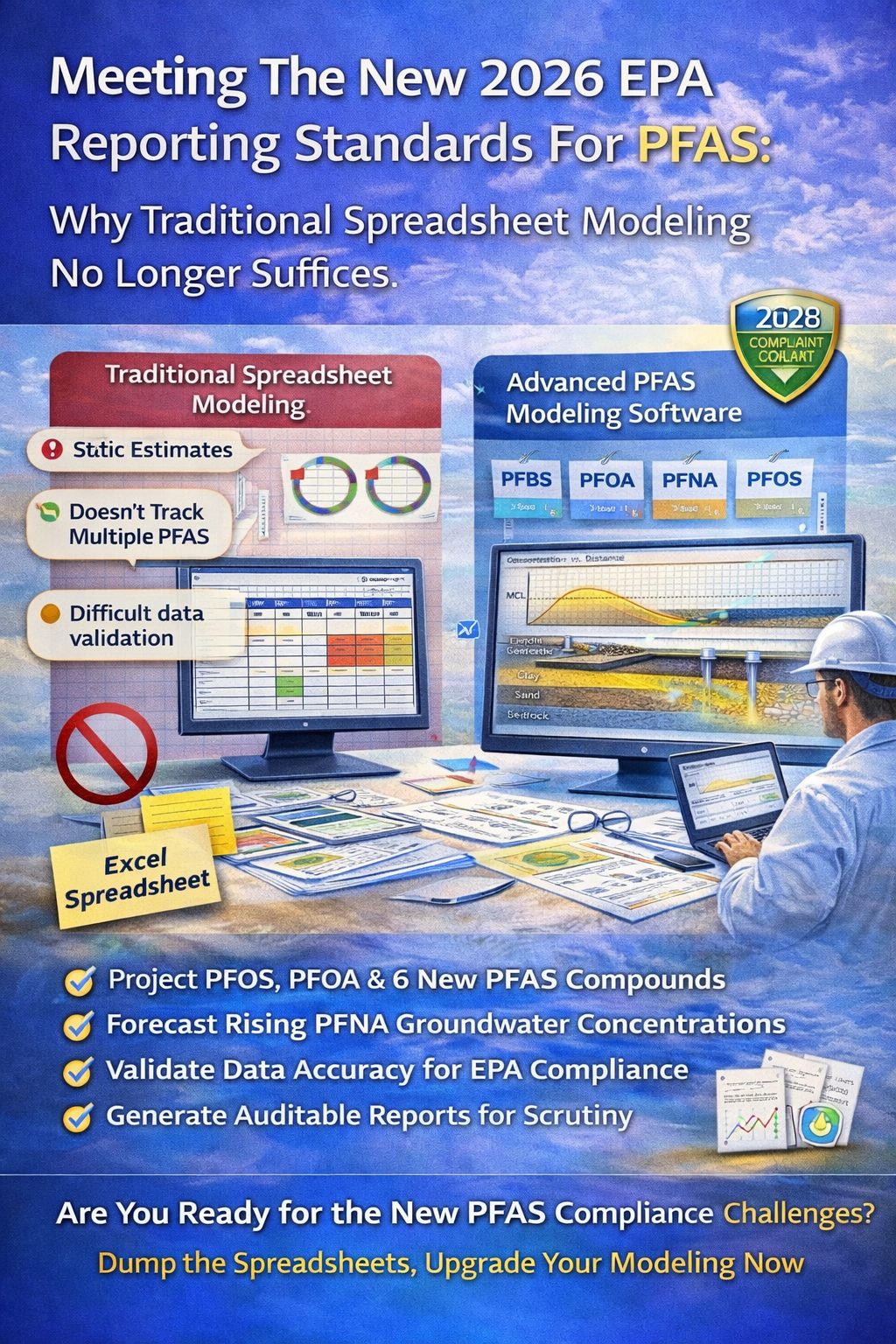
Did you know that by 2026, the Environmental Protection Agency (EPA) will implement stricter reporting standards for per- and polyfluoroalkyl substances (PFAS)? If you’re involved in the environmental, construction, or waste management industries, this new regulation could impact your work significantly. As organizations scramble to comply, it’s crucial to understand the limitations of traditional spreadsheet modeling in managing PFAS data. In this blog post, we’ll explore why outdated methodologies fall short, what these new standards entail, and how leveraging advanced modeling software can simplify compliance processes and enhance your operations.
Understanding PFAS and Their Regulatory Importance
PFAS, often dubbed “forever chemicals,” are synthetic compounds resistant to degradation in the environment and human bodies. Their widespread use in products like non-stick cookware, waterproof fabrics, and food packaging has led to contamination concerns at landfills, industrial sites, and even in drinking water supplies. As more research points to their adverse health effects, regulatory measures have begun tightening around PFAS.
The 2026 EPA Reporting Standards: What You Need to Know
In 2021, the EPA announced its intention to take action on PFAS, leading to the establishment of new reporting requirements slated for 2026. These standards aim to improve transparency about how PFAS are used and disposed of, making it imperative for companies to maintain accurate records of PFAS sources, transport, and disposal practices.
Implications for Businesses
Companies that fail to comply with stricter regulations could face substantial penalties, reputations can suffer, and risk liability increases. Moreover, businesses may encounter difficulties when applying for environmental permits or engaging in business ventures if their track record concerning PFAS is not clean.
The Limitations of Traditional Spreadsheet Modeling
For many years, organizations relied on spreadsheet tools to track and manage their PFAS data discretely. While spreadsheets have their advantages, they exhibit notable deficiencies:
- Error-Prone Manual Input: Data entry errors can lead to significant inaccuracies in reporting.
- Difficulty in Scale: As the amount of data grows, spreadsheets become cumbersome, leading to slower processing times.
- Version Control Issues: Collaborating on spreadsheets often creates confusion over which version contains the most accurate information.
- Limited Analytical Capabilities: Custom formulas and pivot tables only go so far in analyzing trends and drawing actionable insights.
- Inadequate Visualization: Spreadsheets provide limited options for data visualization, which is essential for interpreting complex datasets and regulatory reporting.
With these challenges in mind, organizations must seek solutions that effectively manage their compliance needs for PFAS and other regulatory requirements.
Transitioning to Advanced Modeling Software
Transitioning away from traditional spreadsheets towards modern contaminant modeling tools represents a critical step for organizations aiming to comply with the EPA’s new standards. Here’s why:
Benefits of Incorporating Modeling Software
- Enhanced Data Management: Advanced modeling tools enable centralized data storage, ensuring every team member accesses consistent and accurate information.
- Robust Analytical Features: These platforms come equipped with powerful analytical tools designed to evaluate data trends, track compliance, and make predictions about PFAS behavior in different environments.
- Automated Reporting: This software simplifies the generation of compliance reports, eliminating the cumbersome process of manual data compilation.
- Improved Collaboration: Many modern modeling tools feature cloud capabilities, allowing teams to collaborate seamlessly without worrying about version control.
- Real-Time Updates: Changes in regulations or internal business processes can be reflected in real-time, ensuring organizations always operate under the latest guidelines.
Implementing Change: Steps to Consider
As your organization considers the transition to advanced modeling software, here are steps to guide you:
- Assessment of Current Practices: Evaluate your current PFAS data management practices to identify gaps and challenges.
- Research Available Tools: Explore various modeling software options. Understand their features, flexibility, and ease of use.
- Training and Integration: Invest in proper training for your team to ease the transition to the new software and integrate data from previous systems.
- Pilot Testing: Implement a pilot test involving selected teams to ensure the software meets your organization’s needs before a full rollout.
- Feedback Loop: Create a system for collecting feedback from users regarding their experiences with the new tool, enabling continuous improvement.
Evaluating Long-Term Impacts
Investing in advanced modeling software is more than just compliance; it is about fostering a culture of accountability and environmental stewardship within your organization. As PFAS regulations become stricter, organizations that adopt proactive measures will gain a competitive edge, ensuring responsible practices while avoiding hefty penalties associated with non-compliance.
Where Do We Go From Here?
As we stand on the brink of new regulatory changes impacting the management of PFAS, organizations have a unique opportunity to reevaluate their data handling practices. Efficient data modeling is critical not just to meet compliance but to cultivate an organizational ethos of sustainability and environmental responsibility.
What Changes Can You Make at Home?
Focus on streamlining your data management processes today. By embracing advanced technology solutions tailored for PFAS compliance, you ensure that your organization is not just ready for the 2026 EPA reporting standards but positioned as a leader in environmental accountability.
Learn more about our Contaminant Transport Modeling Solutions
Related Articles
- Contaminant Transport Modelling and Landfill Design: A Complete Guide for Environmental Engineers
- How Contaminant Transport Models Predict Groundwater Pollution
- Designing Landfill Liner Systems to Prevent Groundwater Contamination
- Understanding Leachate Generation and Transport in Landfills
- Advection–Dispersion Modelling in Groundwater Systems
- Hydrogeological Data Required for Contaminant Transport Models
- Regulatory Requirements for Landfill Design and Groundwater Protection
- Unlock Global Expertise: Free Research Viewer for POLLUTE and MIGRATE
- Mastering the Plume: POLLUTEv8 vs. MODFLOW vs. FEFLOW vs. PATH3D
- Core Features of POLLUTEv8
- Mastering Contaminant Transport: Special Features of POLLUTEv8
- Navigating Contaminant Migration with POLLUTE: A Modern Approach to Landfill Design
- Beyond The MCL: Building Audit-Proof Contaminant Fate Models For 2026 Regulatory Submissions
- Using Predictive Models to Meet 2026 Primary Drinking Water Regulations
- Driving Environmental Research: How GAEA Technologies POLLUTE Software is Used in Academic and Industry Reports
- Modeling Your Way to ‘No Further Action’: How Predictive Simulation Shaves Years Off Remediation Timelines
- Using Predictive Models to Meet 2026 Primary Drinking Water Regulations
- Unlocking Sustainable Solutions: The Role of POLLUTE Software in Landfill Design and Contaminant Transport Modelling
- Contaminant Transport Modelling and Landfill Design Insights
- Geomembrane Degradation in Landfill Liners: Causes, Modeling, and Long-Term Performance
- Clogging of Landfill Leachate Collection Systems: Causes, Impacts, and Prevention
- Determining Diffusion Coefficients for Contaminant Transport Modeling
- Use and Determination of Distribution Coefficients for Contaminant Transport Modeling
- Non-Linear Sorption in Contaminant Transport Modeling
- Phase Change in Collection Systems in Contaminant Transport Modeling for Landfills
- Biological and Radioactive Decay in Contaminant Transport Modeling