

Introduction
Modern waste management systems must balance the need for safe disposal of solid waste with the protection of environmental resources, particularly groundwater. Landfills remain one of the most widely used waste disposal methods worldwide, but poorly designed or managed landfills can lead to serious environmental problems. Contaminants released from landfill waste may migrate into soil and groundwater, posing risks to drinking water supplies, ecosystems, and human health.
To address these risks, governments and environmental agencies have established strict regulatory frameworks that govern landfill design, construction, operation, and closure. These regulations require landfill operators to implement engineered containment systems, environmental monitoring programs, and long-term management strategies that protect groundwater resources.
Regulatory requirements for landfill design are based on decades of scientific research, engineering advancements, and lessons learned from historical contamination incidents. Modern regulations emphasize preventive design strategies, such as composite liner systems, leachate collection infrastructure, and groundwater monitoring networks.
This article explores the regulatory requirements that guide landfill design and groundwater protection, the engineering standards used to prevent contamination, and the environmental monitoring systems required to ensure compliance with environmental regulations.
Why Landfill Regulations Are Necessary
Landfills contain a wide range of waste materials that can generate contaminated liquids and gases during decomposition. As rainwater infiltrates landfill waste, it produces leachate, a liquid that may contain dissolved organic compounds, heavy metals, salts, and other pollutants.
If leachate escapes from a landfill and enters the surrounding subsurface environment, it can contaminate groundwater aquifers. Because groundwater often serves as a primary source of drinking water, preventing contamination is a critical environmental priority.
Historically, older landfills lacked proper containment systems, allowing leachate to migrate freely through soil and rock formations. These uncontrolled waste disposal sites caused widespread groundwater contamination in many regions.
Modern landfill regulations aim to prevent these environmental problems by requiring engineered systems that isolate waste from surrounding environments and manage landfill-generated liquids and gases safely.
The primary goals of landfill regulations include:
- Protecting groundwater resources
- Preventing soil and surface water contamination
- Ensuring safe waste containment
- Monitoring environmental conditions
- Providing long-term environmental protection after landfill closure
These regulatory frameworks establish minimum engineering standards and monitoring requirements that landfill operators must follow.
Regulatory Agencies and Environmental Standards
Landfill regulations are typically developed and enforced by national, regional, or provincial environmental agencies. While regulatory frameworks vary by country, many share similar principles and design requirements.
In the United States, landfill regulations are primarily governed by the Resource Conservation and Recovery Act (RCRA) administered by the U.S. Environmental Protection Agency. These regulations establish detailed standards for municipal solid waste landfills, including requirements for liner systems, leachate management, and groundwater monitoring.
In Canada, landfill regulations are managed by provincial governments and supported by federal environmental policies administered by Environment and Climate Change Canada.
International waste management practices are also guided by research and technical guidelines from organizations such as the International Solid Waste Association.
Although specific regulatory details may differ across jurisdictions, most landfill regulations follow similar engineering principles designed to protect groundwater and environmental quality.
Site Selection Requirements
One of the first regulatory considerations in landfill development is selecting an appropriate location. Site selection plays a critical role in minimizing environmental risks and ensuring long-term containment effectiveness.
Regulatory agencies typically require detailed site investigations before approving landfill construction.
Key site selection criteria often include:
Geological Conditions
The geological characteristics of a site influence how contaminants may migrate through the subsurface. Landfills are typically located in areas with low-permeability soils such as clay, which provide natural barriers to contaminant movement.
Groundwater Depth
Many regulations require a minimum vertical separation between the landfill base and the groundwater table. This separation provides additional protection against groundwater contamination.
Distance from Water Bodies
Landfills are typically required to maintain minimum distances from rivers, lakes, wetlands, and coastal areas to reduce contamination risks.
Seismic and Geotechnical Stability
Sites must also be evaluated for stability, including slope stability, seismic activity, and soil strength.
Comprehensive geological and hydrogeological investigations are often required before regulatory approval is granted.
Landfill Liner System Requirements
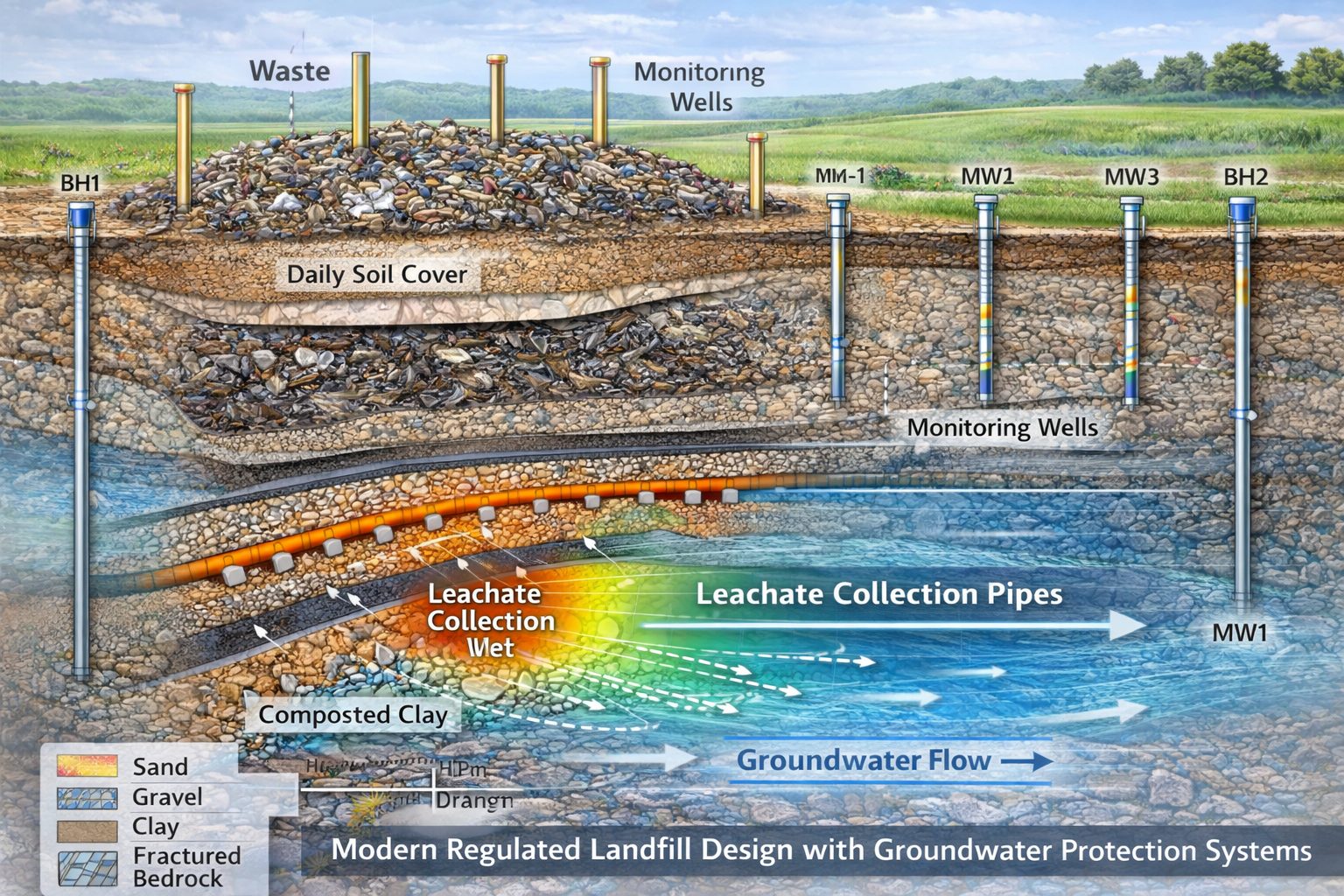
One of the most important regulatory requirements for landfill design is the installation of engineered liner systems. These liners act as barriers that prevent leachate from escaping into the surrounding soil and groundwater.
Modern landfill regulations typically require composite liner systems, which combine natural and synthetic materials to provide multiple containment layers.
Compacted Clay Liners
Many regulatory frameworks require a compacted clay layer beneath landfill waste. Clay soils have very low permeability, which limits the movement of water and contaminants.
Typical regulatory standards require hydraulic conductivity values of approximately:
- 1 × 10⁻⁷ cm/s or lower
Proper compaction and quality control during construction are essential to ensure the effectiveness of clay liners.
Geomembrane Liners
Synthetic geomembranes, typically made from high-density polyethylene (HDPE), are often installed above the clay liner. These materials provide extremely low permeability and excellent chemical resistance.
Geomembrane liners serve as the primary barrier preventing leachate from escaping the landfill.
Composite Liner Systems
A typical composite liner system may include:
- Compacted clay liner
- HDPE geomembrane liner
- Geosynthetic clay liner
- Drainage layer
This multi-layer approach provides redundancy and improves long-term containment performance.
Leachate Collection and Management Requirements
Landfill regulations also require systems that collect and manage leachate produced within the landfill.
Leachate Collection Systems
These systems typically consist of drainage layers and perforated pipes installed above the liner system. The drainage layer allows leachate to flow toward collection pipes, preventing liquid from accumulating above the liner.
Regulations often specify:
- Maximum allowable leachate head above the liner
- Minimum drainage layer permeability
- Pipe spacing and capacity requirements
Collected leachate is typically transported to treatment facilities or wastewater treatment plants.
Leachate Treatment
Some landfill facilities operate on-site treatment systems to remove contaminants from leachate before discharge.
Treatment technologies may include:
- Biological treatment
- Membrane filtration
- Chemical treatment processes
Regulatory permits typically specify allowable discharge limits for treated leachate.
Landfill Gas Management
Decomposing waste materials generate landfill gas, which consists primarily of methane and carbon dioxide. Methane is a potent greenhouse gas and can also pose explosion risks if it accumulates in confined spaces.
Many landfill regulations require gas management systems that capture and control landfill gas emissions.
Typical gas management infrastructure includes:
- Gas collection wells
- Gas extraction piping
- Flaring systems or energy recovery systems
Some landfill facilities capture methane and convert it into electricity or renewable natural gas.
Groundwater Monitoring Requirements
Groundwater monitoring is a critical component of landfill environmental protection programs. Regulations typically require landfill operators to install monitoring wells around landfill sites.
Monitoring wells allow environmental scientists to collect groundwater samples and detect potential contamination.
Groundwater monitoring programs often include:
- Upgradient wells to measure background water quality
- Downgradient wells to detect potential contamination
- Regular sampling and laboratory analysis
Contaminants commonly monitored include:
- Heavy metals
- Organic compounds
- Ammonia
- Chloride
- Volatile organic compounds
Monitoring results must be reported to regulatory agencies and may trigger additional investigations if contamination is detected.
Stormwater and Surface Water Controls
Landfill regulations also require systems that manage stormwater and prevent surface water contamination.
Surface water management infrastructure typically includes:
- Stormwater diversion channels
- Drainage ditches
- Sedimentation ponds
These systems prevent rainwater from entering landfill waste and reduce the generation of leachate.
Proper surface water management also prevents erosion and protects surrounding ecosystems.
Operational and Waste Management Controls
Regulations governing landfill operations include strict procedures for waste acceptance, daily operations, and environmental management.
Key operational requirements include:
Waste Screening
Landfill operators must inspect incoming waste to ensure that prohibited materials, such as hazardous waste, are not disposed of in municipal landfills.
Daily Cover Requirements
Waste must typically be covered with soil or alternative cover materials at the end of each operating day. This reduces odors, litter, and pest activity.
Environmental Monitoring
Landfill operators must monitor various environmental parameters, including:
- Groundwater quality
- Landfill gas emissions
- Leachate volumes
- Surface water quality
Operational records must be maintained and reported to regulatory authorities.
Closure and Post-Closure Care
Landfill regulations extend beyond the active operational life of a landfill. Once a landfill reaches capacity, it must be properly closed and monitored for many years.
Closure activities typically include:
- Installing a final cover system
- Stabilizing landfill slopes
- Establishing vegetation cover
The final cover system typically includes:
- Soil layers
- Geomembrane barriers
- Drainage layers
These systems prevent water infiltration and reduce leachate generation.
Post-closure care may continue for 30 years or more and includes ongoing groundwater monitoring and maintenance of containment systems.
Advances in Regulatory Practices
Environmental regulations continue to evolve as new scientific knowledge and technologies emerge.
Recent trends in landfill regulation include:
- Improved liner and geosynthetic materials
- Enhanced groundwater monitoring techniques
- Integrated environmental data management systems
- Increased focus on landfill gas capture and climate impacts
These advances help ensure that landfill facilities operate safely while minimizing environmental risks.
Conclusion
Regulatory requirements for landfill design and groundwater protection are essential for preventing environmental contamination and protecting public health. Modern landfill regulations require engineered containment systems, environmental monitoring programs, and long-term management strategies that isolate waste from surrounding ecosystems.
Through careful site selection, advanced liner systems, leachate collection infrastructure, and groundwater monitoring networks, modern landfill facilities can safely manage waste while minimizing environmental impacts.
Although landfill technology and regulations continue to evolve, the fundamental goal remains the same: protecting groundwater resources and ensuring that waste disposal practices do not compromise environmental sustainability.
Learn more about our Contaminant Transport Modeling Solutions
Related Articles
- Contaminant Transport Modelling and Landfill Design: A Complete Guide for Environmental Engineers
- How Contaminant Transport Models Predict Groundwater Pollution
- Designing Landfill Liner Systems to Prevent Groundwater Contamination
- Understanding Leachate Generation and Transport in Landfills
- Advection–Dispersion Modelling in Groundwater Systems
- Hydrogeological Data Required for Contaminant Transport Models
- Unlock Global Expertise: Free Research Viewer for POLLUTE and MIGRATE
- Mastering the Plume: POLLUTEv8 vs. MODFLOW vs. FEFLOW vs. PATH3D
- Core Features of POLLUTEv8
- Mastering Contaminant Transport: Special Features of POLLUTEv8
- Navigating Contaminant Migration with POLLUTE: A Modern Approach to Landfill Design
- Beyond The MCL: Building Audit-Proof Contaminant Fate Models For 2026 Regulatory Submissions
- Using Predictive Models to Meet 2026 Primary Drinking Water Regulations
- Driving Environmental Research: How GAEA Technologies POLLUTE Software is Used in Academic and Industry Reports
- Modeling Your Way to ‘No Further Action’: How Predictive Simulation Shaves Years Off Remediation Timelines
- Meeting The New 2026 EPA Reporting Standards For PFAS: Why Traditional Spreadsheet Modeling No Longer Suffices
- Using Predictive Models to Meet 2026 Primary Drinking Water Regulations
- Unlocking Sustainable Solutions: The Role of POLLUTE Software in Landfill Design and Contaminant Transport Modelling
- Contaminant Transport Modelling and Landfill Design Insights
- Geomembrane Degradation in Landfill Liners: Causes, Modeling, and Long-Term Performance
- Clogging of Landfill Leachate Collection Systems: Causes, Impacts, and Prevention
- Determining Diffusion Coefficients for Contaminant Transport Modeling
- Use and Determination of Distribution Coefficients for Contaminant Transport Modeling
- Non-Linear Sorption in Contaminant Transport Modeling
- Phase Change in Collection Systems in Contaminant Transport Modeling for Landfills
- Biological and Radioactive Decay in Contaminant Transport Modeling
External References
- EPA guidance on landfill design and leachate management
- EPA landfill liner and leachate collection regulations
- USGS groundwater contamination resources
- USGS groundwater flow and transport processes
- International Solid Waste Association landfill guidelines
- Canadian landfill environmental regulations
- Technical guidance on geomembrane landfill liners
- Geosynthetics used in landfill liner systems
- Hydrogeology and groundwater contamination research