

Introduction
Groundwater is one of the most important natural resources supporting drinking water supplies, agriculture, and industrial processes around the world. Because groundwater exists beneath the surface and moves slowly through soil and rock formations, contamination can go unnoticed for long periods of time. When pollutants enter the subsurface environment, they can migrate through aquifers and potentially impact wells, ecosystems, and municipal water systems.
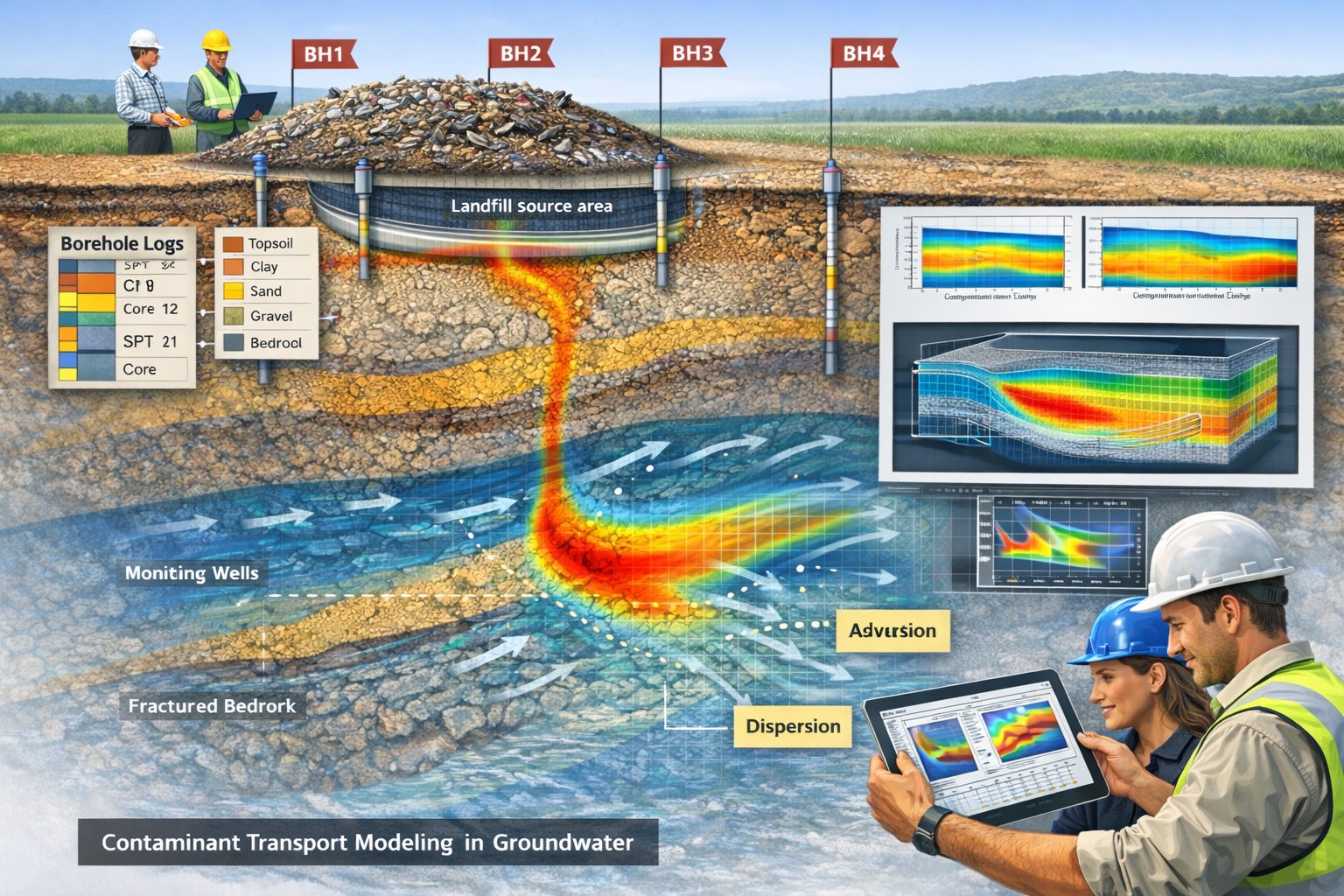
Understanding how contaminants move underground is therefore a critical task for environmental engineers, hydrogeologists, and regulators. One of the most powerful tools used to analyze and predict subsurface contamination is contaminant transport modeling. These models simulate how pollutants travel through soil and groundwater over time, allowing scientists to estimate the future spread of contamination and evaluate remediation strategies.
Contaminant transport models combine geological data, groundwater flow conditions, chemical properties, and mathematical equations to represent the complex physical and chemical processes that control contaminant migration. By integrating field measurements, borehole data, hydrogeologic interpretations, and computational simulation, these models provide a predictive framework for understanding groundwater pollution.
This article explores how contaminant transport models work, the scientific principles behind them, and how they are used to predict groundwater pollution and support environmental decision-making.
Why Predicting Groundwater Pollution Matters
Groundwater contamination poses serious environmental and public health risks. Unlike surface water pollution, which can often be observed directly, groundwater contamination occurs underground and may remain undetected until it reaches drinking water wells or surface water bodies.
Common sources of groundwater contamination include:
- Industrial chemical spills
- Landfill leachate
- Petroleum storage tank leaks
- Agricultural fertilizers and pesticides
- Mining activities
- Waste disposal sites
Once contaminants enter the subsurface, they can migrate long distances depending on groundwater flow patterns and geological conditions. Predicting how contamination will spread is essential for several reasons:
Protecting Drinking Water Supplies
Many municipalities and rural communities rely heavily on groundwater for drinking water. Modeling helps determine whether contamination may reach municipal wells or private groundwater sources.
Supporting Environmental Regulations
Environmental agencies require predictive modeling to evaluate the potential impacts of industrial facilities, waste disposal sites, and contaminated land remediation projects.
Designing Remediation Strategies
Models help engineers test different cleanup approaches, such as pump-and-treat systems, containment barriers, or natural attenuation strategies.
Assessing Long-Term Environmental Risk
Because groundwater can move slowly, contamination may persist for decades or centuries. Predictive models provide insight into long-term environmental impacts.
What Is Contaminant Transport Modeling?
Contaminant transport modeling is the process of using mathematical equations and computer simulations to predict how pollutants move through groundwater systems.
The models simulate several interacting processes that influence contaminant behavior, including:
- Groundwater flow
- Advection (movement with flowing water)
- Dispersion and diffusion
- Chemical reactions
- Sorption to soil and rock
- Biological degradation
By combining these processes into a numerical model, scientists can estimate how contamination will move through an aquifer over time.
Transport models are typically built using specialized hydrogeologic modeling software and rely on field data collected from boreholes, monitoring wells, and geological surveys.
The final model can simulate contaminant migration across years or even decades, helping stakeholders understand future environmental risks.
The Scientific Principles Behind Contaminant Transport
The movement of contaminants in groundwater is governed by several physical and chemical processes.
Groundwater Flow
Groundwater flow is the primary driver of contaminant movement. Water moves through porous materials such as sand, gravel, and fractured rock under the influence of hydraulic gradients.
Hydrogeologists use groundwater flow models to estimate:
- Flow direction
- Flow velocity
- Hydraulic gradients
- Recharge and discharge zones
Accurate groundwater flow modeling is essential because contaminant transport largely follows groundwater movement.
Advection
Advection describes the process by which contaminants are carried by flowing groundwater. If groundwater flows from one location to another, dissolved contaminants will move along with the water.
Advection often represents the dominant transport mechanism for dissolved pollutants.
Dispersion
Dispersion occurs when contaminants spread out as they move through porous materials. This spreading happens due to variations in pore structure and flow velocity within the aquifer.
Dispersion causes contaminant plumes to widen and spread over time.
Diffusion
Diffusion is the movement of contaminants from areas of high concentration to areas of lower concentration. Even in slow-moving groundwater systems, diffusion contributes to contaminant spreading.
Sorption
Many contaminants interact with soil and rock surfaces through chemical adsorption or absorption processes.
Sorption slows contaminant movement because some portion of the pollutant becomes temporarily attached to the subsurface materials.
Chemical Reactions and Degradation
Certain contaminants may break down over time due to:
- Chemical reactions
- Microbial activity
- Oxidation or reduction processes
These reactions can reduce contaminant concentrations and influence long-term plume behavior.
Building a Contaminant Transport Model
Developing a reliable contaminant transport model requires several steps that combine field data, geological interpretation, and numerical simulation.
1. Site Investigation and Data Collection
The first step involves collecting detailed site data, including:
- Borehole logs
- Soil and rock stratigraphy
- Hydraulic conductivity measurements
- Groundwater levels
- Monitoring well data
- Contaminant concentration measurements
These data provide the foundation for building a hydrogeologic model.
2. Geological and Hydrogeologic Modeling
The subsurface geology must be interpreted and represented in the model.
This includes defining:
- Geological layers
- Aquifers and aquitards
- Hydraulic properties
- Boundary conditions
Three-dimensional geological models are often used to represent complex subsurface conditions.
3. Groundwater Flow Simulation
Before simulating contaminant transport, engineers first develop a groundwater flow model to estimate how water moves through the aquifer.
Flow models simulate:
- Recharge
- Pumping wells
- Surface water interactions
- Hydraulic gradients
Accurate flow modeling is essential because contaminant movement depends on groundwater flow patterns.
4. Contaminant Source Definition
The model must represent the source of contamination, including:
- Source location
- Contaminant concentration
- Release duration
- Source geometry
Examples of sources include leaking storage tanks, landfill cells, or industrial discharge areas.
5. Transport Simulation
Once the flow model and contaminant source are defined, the transport model simulates contaminant migration over time.
The simulation calculates:
- Plume growth
- Concentration distribution
- Travel time
- Potential impacts on wells or receptors
Understanding Contaminant Plumes
One of the key outputs of contaminant transport models is the prediction of contaminant plumes.
A contaminant plume represents the spatial distribution of pollutants within groundwater.
Plumes typically have several defining characteristics:
- Source zone where contamination originates
- High concentration core near the source
- Diluted edges where dispersion occurs
- Down-gradient migration following groundwater flow
Models help visualize plume growth and predict how far contamination may travel over time.
These predictions are critical for protecting drinking water wells and planning remediation strategies.
Applications of Contaminant Transport Modeling
Contaminant transport models are used across a wide range of environmental engineering and hydrogeology applications.
Landfill Design and Leachate Management
Modern landfills are carefully engineered to prevent leachate from contaminating groundwater.
Transport models help evaluate:
- Liner system performance
- Potential leakage scenarios
- Long-term groundwater impacts
These models are often required for regulatory approval of landfill sites.
Industrial Site Assessment
Industrial facilities may release chemicals into soil and groundwater through accidental spills or long-term operational activities.
Transport modeling helps determine whether contamination could migrate beyond site boundaries.
Environmental Remediation Planning
When contamination is discovered, models are used to evaluate remediation options such as:
- Pump-and-treat systems
- Reactive barriers
- Bioremediation
- Natural attenuation
Simulation results help engineers select the most effective cleanup strategy.
Groundwater Protection Studies
Government agencies use modeling to evaluate potential contamination risks associated with industrial development, waste disposal, or agricultural activities.
Risk Assessment for Drinking Water Wells
Models can predict whether contamination may eventually reach drinking water wells or municipal groundwater supplies.
The Role of Numerical Modeling Software
Modern contaminant transport modeling relies heavily on advanced numerical modeling software.
These tools allow scientists to simulate complex hydrogeologic systems that would be impossible to analyze using analytical equations alone.
Key capabilities of modern modeling platforms include:
- Three-dimensional groundwater flow simulation
- Multi-species contaminant transport modeling
- Chemical reaction simulation
- Integration with geological models
- Visualization of contaminant plumes
Advanced visualization tools allow engineers to interpret model results through cross-sections, 3D subsurface models, and plume maps.
Model Calibration and Validation
For a contaminant transport model to be reliable, it must be calibrated and validated using observed field data.
Calibration
Calibration involves adjusting model parameters until the simulation results match observed groundwater levels and contaminant concentrations.
Common calibration parameters include:
- Hydraulic conductivity
- Porosity
- Dispersivity
- Recharge rates
Validation
Validation tests whether the calibrated model can accurately predict conditions at different times or locations.
Validation may involve comparing model predictions with:
- Monitoring well data
- Historical contamination trends
- Field measurements
Proper calibration and validation ensure that the model provides realistic predictions of contaminant migration.
Limitations and Uncertainty in Modeling
Although contaminant transport models are powerful tools, they are not perfect representations of reality.
Several factors introduce uncertainty into modeling results:
Limited Subsurface Data
Subsurface geology is complex and difficult to observe directly. Boreholes and monitoring wells provide only limited sampling of the subsurface.
Natural Variability
Hydrogeologic properties such as permeability and porosity may vary significantly across a site.
Model Simplifications
To make simulations computationally manageable, models must simplify certain processes or geological features.
Uncertain Contaminant Sources
In some cases, the timing or magnitude of contaminant releases may not be fully known.
To address these uncertainties, modelers often perform sensitivity analyses and scenario simulations to evaluate a range of possible outcomes.
The Future of Contaminant Transport Modeling
Advances in computational technology and subsurface data integration are transforming contaminant transport modeling.
Several emerging trends are shaping the future of groundwater pollution prediction.
Integrated Subsurface Data Platforms
Modern platforms combine borehole databases, geological models, and groundwater simulations within unified data environments.
These integrated systems allow engineers to update models dynamically as new site data becomes available.
High-Resolution Geological Modeling
Improved geological modeling techniques allow for more accurate representation of subsurface heterogeneity.
Better geological models lead to more realistic contaminant transport predictions.
Cloud-Based Simulation
Cloud computing enables faster simulations and collaboration between multidisciplinary teams working on complex environmental projects.
Real-Time Monitoring Integration
Sensor networks and automated monitoring systems may eventually feed real-time groundwater data into predictive models.
This integration could allow for continuous environmental risk monitoring.
Conclusion
Contaminant transport modeling plays a critical role in predicting and managing groundwater pollution. By simulating the complex processes that govern contaminant movement in soil and groundwater, these models allow scientists and engineers to forecast how contamination will spread through the subsurface.
Through the integration of geological data, groundwater flow simulations, and chemical transport equations, contaminant transport models provide valuable insights into environmental risk. They help protect drinking water resources, support regulatory decision-making, and guide the design of effective remediation strategies.
Although modeling involves uncertainties due to limited subsurface data and natural geological variability, ongoing advances in computational modeling, data integration, and environmental monitoring continue to improve the reliability of predictive groundwater simulations.
As environmental protection becomes increasingly important worldwide, contaminant transport modeling will remain an essential tool for safeguarding groundwater resources and ensuring sustainable management of the subsurface environment.
Learn more about our Contaminant Transport Modeling Solutions
Related Articles
- Contaminant Transport Modelling and Landfill Design: A Complete Guide for Environmental Engineers
- Designing Landfill Liner Systems to Prevent Groundwater Contamination
- Understanding Leachate Generation and Transport in Landfills
- Advection–Dispersion Modelling in Groundwater Systems
- Hydrogeological Data Required for Contaminant Transport Models
- Regulatory Requirements for Landfill Design and Groundwater Protection
- Unlock Global Expertise: Free Research Viewer for POLLUTE and MIGRATE
- Mastering the Plume: POLLUTEv8 vs. MODFLOW vs. FEFLOW vs. PATH3D
- Core Features of POLLUTEv8
- Mastering Contaminant Transport: Special Features of POLLUTEv8
- Navigating Contaminant Migration with POLLUTE: A Modern Approach to Landfill Design
- Beyond The MCL: Building Audit-Proof Contaminant Fate Models For 2026 Regulatory Submissions
- Using Predictive Models to Meet 2026 Primary Drinking Water Regulations
- Driving Environmental Research: How GAEA Technologies POLLUTE Software is Used in Academic and Industry Reports
- Modeling Your Way to ‘No Further Action’: How Predictive Simulation Shaves Years Off Remediation Timelines
- Meeting The New 2026 EPA Reporting Standards For PFAS: Why Traditional Spreadsheet Modeling No Longer Suffices
- Using Predictive Models to Meet 2026 Primary Drinking Water Regulations
- Unlocking Sustainable Solutions: The Role of POLLUTE Software in Landfill Design and Contaminant Transport Modelling
- Contaminant Transport Modelling and Landfill Design Insights
- Geomembrane Degradation in Landfill Liners: Causes, Modeling, and Long-Term Performance
- Clogging of Landfill Leachate Collection Systems: Causes, Impacts, and Prevention
- Determining Diffusion Coefficients for Contaminant Transport Modeling
- Use and Determination of Distribution Coefficients for Contaminant Transport Modeling
- Non-Linear Sorption in Contaminant Transport Modeling
- Phase Change in Collection Systems in Contaminant Transport Modeling for Landfills
- Biological and Radioactive Decay in Contaminant Transport Modeling
External References
- EPA guidance on landfill design and leachate management
- EPA landfill liner and leachate collection regulations
- USGS groundwater contamination resources
- USGS groundwater flow and transport processes
- International Solid Waste Association landfill guidelines
- Canadian landfill environmental regulations
- Technical guidance on geomembrane landfill liners
- Geosynthetics used in landfill liner systems