

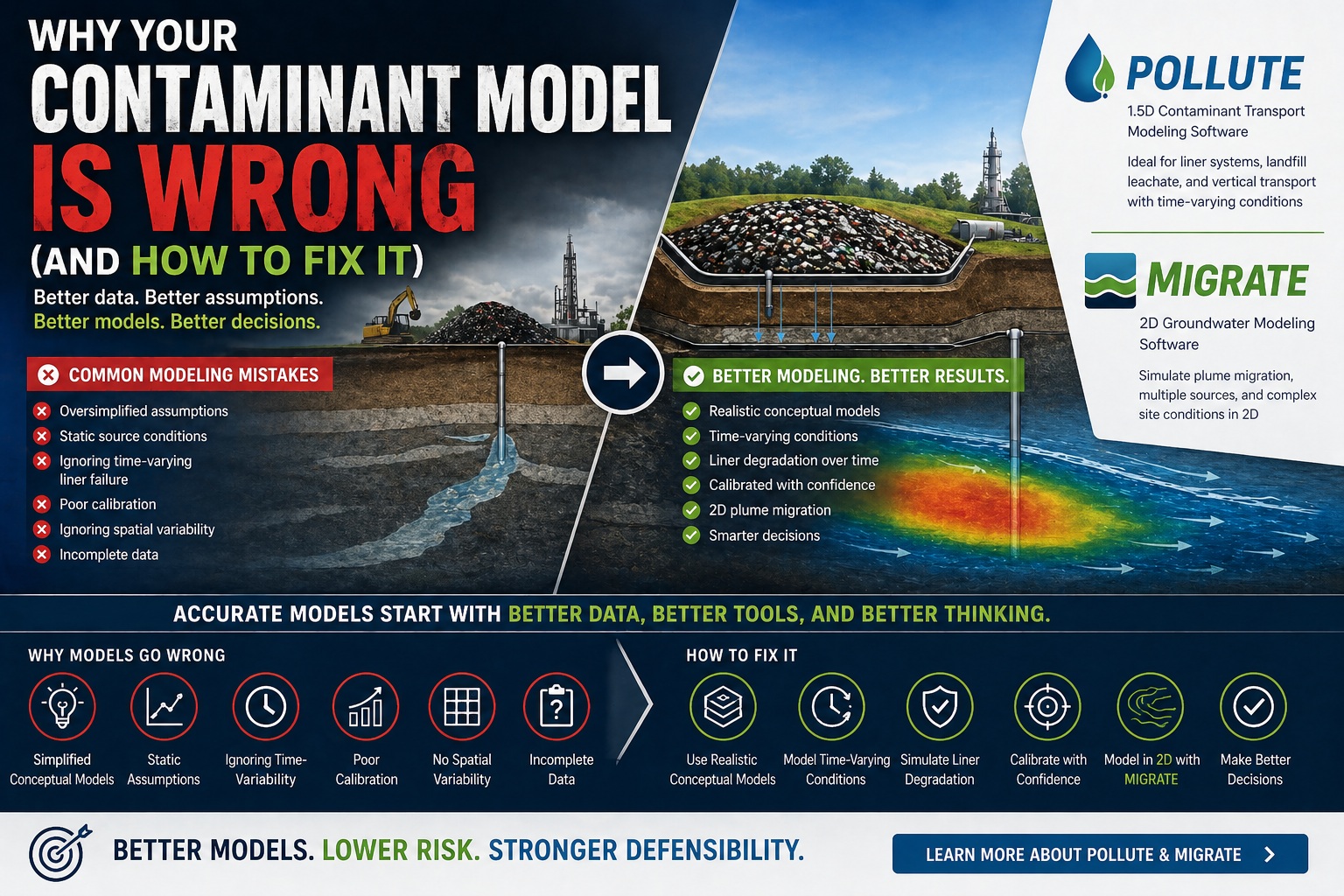
Contaminant transport models are supposed to bring clarity to complex subsurface systems. But in practice, many models—especially those used for groundwater contamination and landfill assessments—are fundamentally flawed.
They may look polished. They may produce clean breakthrough curves. They may even pass regulatory review.
And yet… they’re wrong.
Not because the software failed—but because the assumptions, inputs, and workflows behind the model are incomplete or unrealistic.
In this guide, we’ll break down the most common reasons contaminant models fail—and how to fix them using modern tools like POLLUTE and MIGRATE.
The Hard Truth About Contaminant Modeling
Most modeling errors don’t come from equations. They come from:
- Oversimplified assumptions
- Poor-quality input data
- Static system definitions
- Misaligned conceptual models
The result?
- Incorrect breakthrough timing
- Underestimated concentrations
- Misleading risk assessments
Problem #1: Your Conceptual Model Is Too Simple
Every contaminant model starts with a conceptual model. If that foundation is flawed, everything built on top of it will be too.
Common Mistakes
- Assuming uniform soil conditions
- Ignoring preferential pathways
- Treating sources as constant
- Overlooking layered systems
Why This Matters
Subsurface systems are inherently complex. A simplified conceptual model may:
- Miss critical transport pathways
- Underestimate plume spread
- Misrepresent travel times
How to Fix It
Use tools like POLLUTE and MIGRATE to:
- Represent spatial variability
- Model layered hydrogeology
- Simulate plume migration across a site
Key takeaway: If your conceptual model is wrong, your numerical model will be too—no matter how sophisticated the software.
Problem #2: You’re Assuming Constant Source Conditions
One of the most common—and damaging—mistakes is treating contaminant sources as constant.
Reality Check
Contaminant sources evolve over time:
- Landfill leachate concentrations rise and fall
- Industrial releases vary
- Remediation systems change source strength
What Happens If You Ignore This
- Incorrect breakthrough curves
- Misleading peak concentration predictions
- Poor long-term forecasts
How to Fix It
POLLUTE and MIGRATE allows you to model:
- Time-varying source concentrations
- Step changes and decay functions
- Realistic long-term source behavior
Result
More accurate predictions of:
- Arrival time
- Peak concentration
- Long-term tailing
Problem #3: You’re Treating Liner Systems as Static
If you’re modeling landfill systems and assuming liner properties don’t change—you’re almost certainly underestimating risk.
The Reality of Liner Systems
- Geomembranes degrade
- Defects increase over time
- Hydraulic conductivity changes
- Leachate head varies
The Consequence
Static models:
- Delay predicted breakthrough
- Underestimate contaminant flux
- Misrepresent long-term performance
How to Fix It
With POLLUTE and MIGRATE, you can simulate:
- Time-varying liner degradation
- Increasing defect density
- Changing hydraulic conductivity
- Leachate collection system (LCS) failure
This is one of the biggest upgrades you can make to your modeling workflow.
Problem #4: You’re Overfitting the Model
A model that perfectly matches observed data is not necessarily a good model.
The Trap
- Adjust parameters until the curve fits
- Ignore physical realism
- Prioritize fit over meaning
Why This Is Dangerous
You may end up with:
- Unrealistic hydraulic conductivities
- Incorrect dispersivity values
- Non-physical parameter combinations
How to Fix It
- Use physically realistic parameter ranges
- Validate against independent data
- Focus on process understanding, not just curve matching
Tools like MIGRATE help by:
- Providing spatial context
- Allowing multi-point calibration
- Preventing overfitting to a single location
Problem #5: You’re Ignoring Spatial Variability
Many models are still built as 1D systems—even when the site clearly isn’t.
The Problem
- Plumes spread laterally
- Sources are not uniform
- Hydrogeology varies across the site
The Result
- Misplaced monitoring predictions
- Underestimated plume width
- Incorrect receptor impacts
How to Fix It
Use MIGRATE to:
- Simulate 2D plume migration
- Model multiple sources
- Evaluate spatial variability
Key Advantage
You move from:
“When does contamination arrive?”
to
“Where does contamination go?”
Problem #6: You’re Using Poor or Incomplete Data
Even the best model can’t compensate for bad data.
Common Data Issues
- Sparse monitoring points
- Inconsistent sampling intervals
- Missing early-time data
- Laboratory uncertainty
Impact on Models
- Incorrect calibration
- Misleading trends
- Reduced confidence
How to Fix It
- Improve monitoring design
- Use consistent sampling intervals
- Combine field data with modeling
Both POLLUTE and MIGRATE allow you to:
- Test scenarios beyond available data
- Fill gaps with physically based simulations
- Improve interpretation
Problem #7: You’re Ignoring Long-Term Behavior
Many models focus on short-term results—but environmental systems evolve over decades.
What Gets Missed
- Long-term tailing
- Diffusion from low-permeability zones
- Delayed breakthrough
- Secondary contamination
Why It Matters
Regulatory decisions often depend on:
- 50–100+ year predictions
- Long-term groundwater protection
How to Fix It
POLLUTE is particularly strong for:
- Long-term simulations (100+ years)
- Diffusion-dominated transport
- Liner system evolution
Problem #8: You’re Not Linking Vertical and Horizontal Transport
Many workflows separate:
- Vertical transport (through liners)
- Horizontal transport (plume migration)
The Problem
These processes are connected.
The Solution
Use a combined workflow:
- Model vertical transport with POLLUTE
- Feed results into MIGRATE
- Simulate plume migration across the site
Result
A complete, defensible model of:
- Source → release → transport → impact
Problem #9: You’re Not Running Scenarios
A single model run is not enough.
Why Scenario Analysis Matters
Uncertainty is unavoidable in environmental systems.
What You Should Test
- Different source conditions
- Liner degradation rates
- Hydraulic conductivity ranges
- Climate or recharge changes
With POLLUTE and MIGRATE
You can:
- Run multiple scenarios quickly
- Compare outcomes
- Identify worst-case conditions
What a “Correct” Contaminant Model Looks Like
A strong model is not one that looks perfect—it’s one that is:
- Physically realistic
- Based on sound conceptual understanding
- Calibrated but not overfitted
- Tested across multiple scenarios
- Transparent and defensible
The Modern Modeling Workflow (2026)
Here’s what best practice looks like today:
Step 1: Build a strong conceptual model
Step 2: Use POLLUTE for vertical transport and liner systems
Step 3: Use MIGRATE for plume migration
Step 4: Incorporate time-varying conditions
Step 5: Calibrate using field data
Step 6: Run sensitivity and scenario analyses
Step 7: Validate and refine
Final Thoughts
If your contaminant model feels too clean, too simple, or too certain—it’s probably missing something.
The biggest improvements don’t come from tweaking parameters. They come from:
- Better conceptual models
- Time-dependent thinking
- Integrated workflows
- Using the right tools
With POLLUTE and MIGRATE, you can move beyond simplified assumptions and build models that actually reflect how contaminants behave in the real world.
Because in environmental consulting, the goal isn’t just to build a model.
It’s to build one you can trust.