

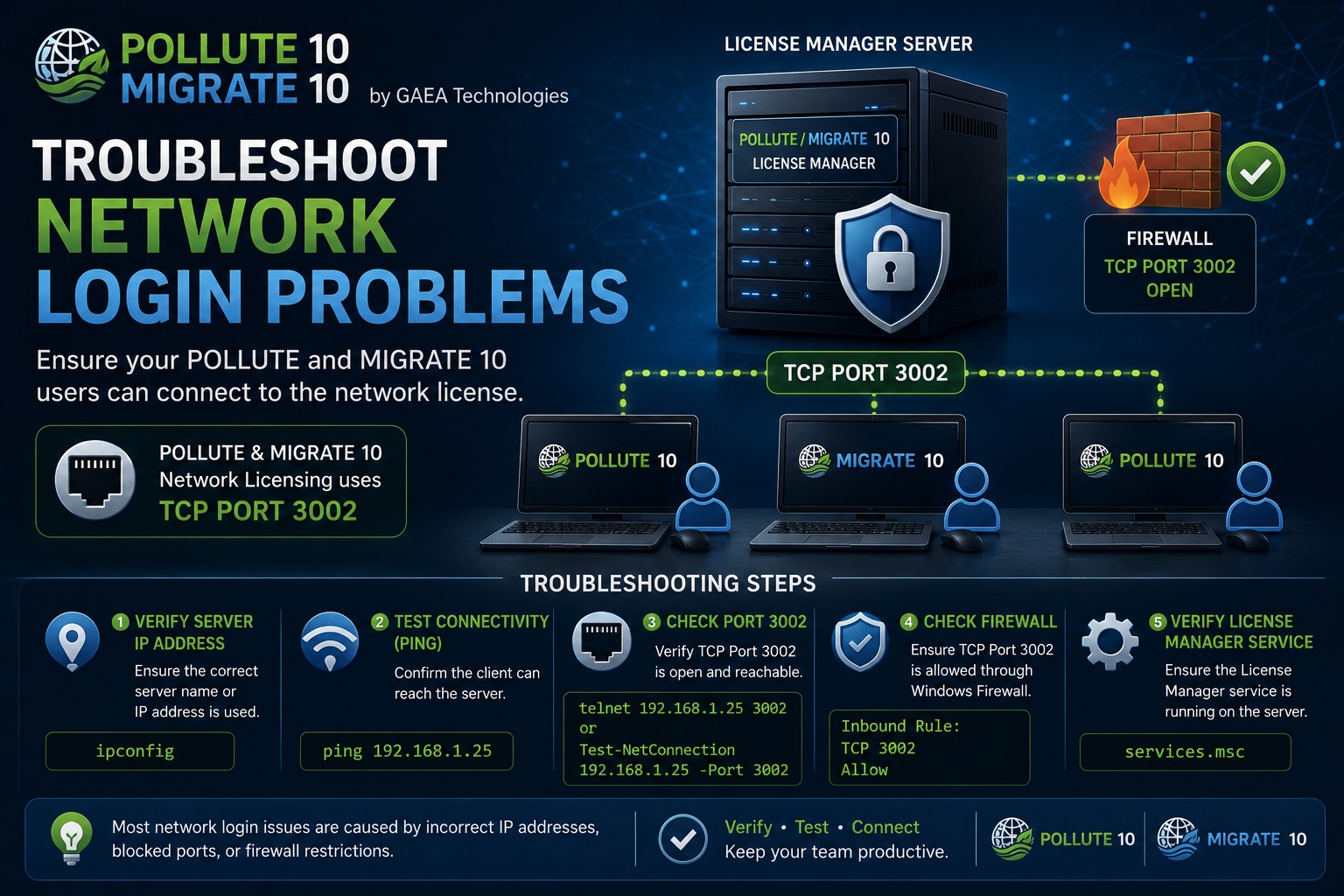
When users are unable to log into a POLLUTE 10 or MIGRATE 10 network installation, the issue is usually related to one of the following:
- Incorrect server name or IP address
- TCP Port 3002 blocked by a firewall
- The License Manager service not running
- Client computers unable to communicate with the server
- Incorrect network license settings on the client
This guide explains how to verify the server connection, test the IP address, confirm the network port is open, and troubleshoot common network login problems for POLLUTE and MIGRATE version 10.
Understanding How POLLUTE and MIGRATE 10 Network Licensing Works
POLLUTE and MIGRATE 10 use a centralized License Manager service running on the server. Client computers connect to the server over the network using:
- A server name or IP address
- TCP Port 3002
The client communicates with the License Manager service to:
- Authenticate users
- Request concurrent licenses
- Access network databases and projects
If the client cannot reach the server or the port is blocked, users will be unable to log in to the network license system.
Step 1 – Verify the License Manager Service is Running
Before troubleshooting the network connection, first confirm the POLLUTE/MIGRATE License Manager service is running on the server.
How to Check the Service
On the server computer:
- Open:
- Control Panel
- Administrative Tools
- Services
- Locate:
- PMLicenseManager
- Verify the service status is:
- Running
If the service is stopped:
- Right-click the service
- Select:
- Start
The service should normally be configured to start automatically with Windows.
Step 2 – Verify the Correct Server Name or IP Address
Client computers must point to the correct network server.
Where to Configure the Network Address
On the client computer:
- Open POLLUTE or MIGRATE
- Select:
- File > Preferences
- Open:
- Network License
- Verify:
- Networked = Yes
- Correct server name or IP address
- Port = 3002
If the server name is incorrect or misspelled, the client will not be able to connect.
Step 3 – Find the Correct Server IP Address
If users cannot connect using the server name, try using the server IP address instead.
How to Find the Server IP Address
On the server:
- Open Command Prompt
- Type:
ipconfig- Press Enter
Look for:
IPv4 AddressExample:
IPv4 Address . . . . . . . . . . : 192.168.1.25This is the IP address clients should use in the POLLUTE/MIGRATE Network License settings.
Step 4 – Test Network Connectivity Using Ping
After obtaining the server IP address, test whether the client can reach the server.
Test the Server Connection
On the client computer:
- Open Command Prompt
- Type:
ping 192.168.1.25(Replace the IP address with your actual server IP.)
If successful, you should receive replies such as:
Reply from 192.168.1.25: bytes=32 time<1ms TTL=128What If Ping Fails?
If you receive:
Request timed outor
Destination host unreachablethen:
- The server may be offline
- The client may be on the wrong network
- Windows Firewall may be blocking traffic
- VPN settings may be preventing communication
- The server name may not resolve correctly
Before proceeding, confirm:
- Both computers are on the same network
- VPN connections are functioning properly
- Firewalls allow internal communication
Step 5 – Verify Port 3002 is Open
Even if the client can ping the server, the required license port may still be blocked.
POLLUTE and MIGRATE 10 network licensing normally communicate using TCP Port 3002.
Method 1 – Test the Port Using Telnet
Enable Telnet (If Needed)
On Windows:
- Open:
- Control Panel
- Programs and Features
- Turn Windows Features On or Off
- Enable:
- Telnet Client
Test the Port
On the client computer:
telnet 192.168.1.25 3002If the connection succeeds:
- The screen will go blank
- This indicates the port is open
If you receive an error such as:
Could not open connectionthen Port 3002 is blocked or the License Manager service is not listening.
Method 2 – Test the Port Using PowerShell
Modern versions of Windows can test ports using PowerShell.
On the client:
Test-NetConnection 192.168.1.25 -Port 3002If successful, you should see:
TcpTestSucceeded : TrueIf it says:
TcpTestSucceeded : Falsethen the client cannot reach the License Manager service on Port 3002.
Step 6 – Open Port 3002 in Windows Firewall
If the port test fails, Windows Firewall may be blocking the connection.
Open Port 3002 on the Server
On the server:
- Open:
- Windows Defender Firewall
- Advanced Settings
- Select:
- Inbound Rules
- Click:
- New Rule
- Choose:
- Port
- Select:
- TCP
- Enter:
- 3002
- Select:
- Allow the connection
- Apply the rule to:
- Domain
- Private
- Name the rule:
- POLLUTE/MIGRATE License Manager
Repeat the same process for Outbound Rules if required by your IT security policies.
Step 7 – Verify the License Server is Listening on Port 3002
On the server computer:
- Open Command Prompt
- Run:
netstat -an | find "3002"You should see something similar to:
TCP 0.0.0.0:3002 LISTENINGIf nothing appears:
- The License Manager service may not be running
- Another application may already be using Port 3002
- Firewall or antivirus software may be interfering
Step 8 – Verify Client License Settings
Sometimes the connection succeeds but the client is configured incorrectly.
On the client computer verify:
- Networked = Yes
- Correct server name or IP address
- Port = 3002
- Required modules selected
After changing settings:
- Click OK
- Restart the application
Step 9 – Check Active Locks and Logs
The License Monitor includes tools to help diagnose login problems.
Active Locks
The Active Locks window displays:
- Current users
- Active licenses
- Computer locations
- Module usage
If all licenses are already in use, additional users may be denied access.
Review the Event Log
The Event Viewer records:
- Login attempts
- License requests
- Connection failures
- Authentication issues
- Network errors
Reviewing the logs can often identify the exact reason users cannot connect.
Common Causes of Network Login Problems
| Problem | Possible Cause |
|---|---|
| Cannot ping server | Network connectivity issue |
| Ping works but login fails | Port 3002 blocked |
| Port test fails | Firewall or service issue |
| Login window appears repeatedly | Incorrect IP or hostname |
| User denied access | No available concurrent licenses |
| Users disconnect randomly | VPN or unstable network |
| Server name fails but IP works | DNS resolution problem |
Best Practices for Reliable Network Licensing
To minimize network login problems:
- Use a static IP address for the server
- Keep Port 3002 open internally
- Avoid changing the server hostname
- Exclude the License Manager from antivirus scanning
- Monitor license usage regularly
- Ensure the License Manager service starts automatically
Final Thoughts
Most POLLUTE and MIGRATE 10 network login problems can be resolved by verifying:
- The License Manager service is running
- The server IP address is correct
- Port 3002 is open
- The client can reach the server
- The network license settings are configured properly
Using tools such as ping, telnet, Test-NetConnection, and netstat can quickly identify where communication is failing and help restore user access to the network license server.