

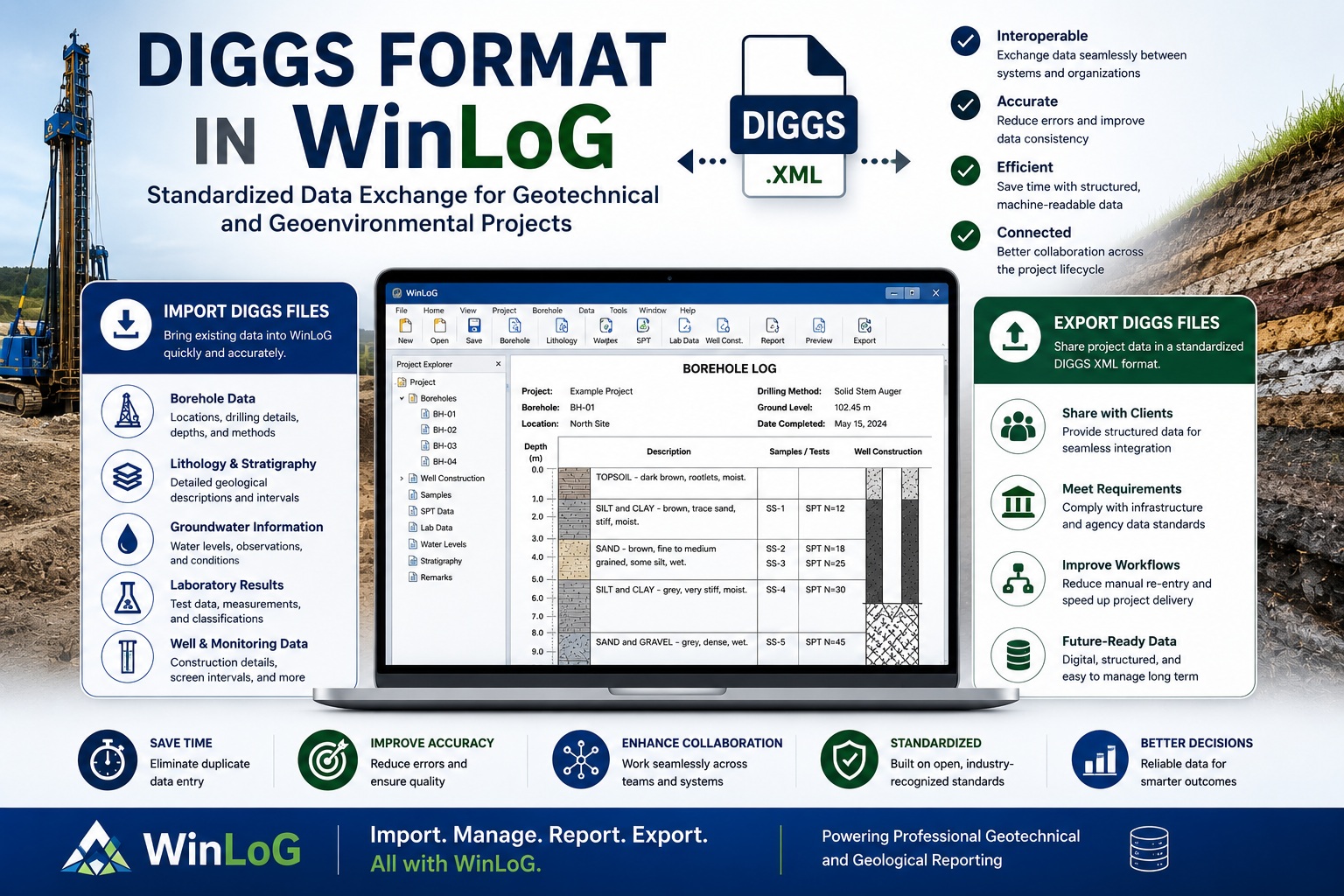
As geotechnical, environmental, and geological projects become increasingly data-driven, the ability to exchange information efficiently between software systems is more important than ever. Engineering consultants, drilling contractors, laboratories, government agencies, and infrastructure project teams often rely on multiple software platforms throughout the lifecycle of a project.
To improve interoperability and reduce manual data entry, standardized data exchange formats have become essential. One of the most important standards developed for geotechnical and geoenvironmental information exchange is DIGGS.
For organizations using WinLoG, DIGGS support can streamline workflows by enabling the importing and exporting of structured geotechnical and geological datasets.
This article explains what DIGGS format is, why it matters, and how DIGGS files can be imported and exported using WinLoG.
What Is DIGGS Format?
DIGGS stands for Data Interchange for Geotechnical and Geoenvironmental Specialists. It is a standardized XML-based data exchange format developed specifically for the geotechnical, geological, and environmental industries.
DIGGS was created to improve the transfer of subsurface investigation data between organizations and software systems. The format allows complex project data to be exchanged in a structured, machine-readable form while preserving consistency and organization.
DIGGS supports a broad range of geotechnical and geoenvironmental information, including:
- Borehole data
- Geological descriptions
- Sampling records
- Groundwater observations
- Laboratory test results
- Monitoring well information
- Geotechnical measurements
- Stratigraphy
- Drilling details
- Infrastructure investigation data
Because DIGGS uses XML technology, it is highly extensible and suitable for large-scale digital data management workflows.
Why DIGGS Format Was Developed
Before formats such as DIGGS and AGS became widely used, many organizations exchanged subsurface information using:
- Paper borehole logs
- PDFs
- Excel spreadsheets
- Proprietary software files
- Manual transcription
- Custom text files
These methods frequently caused problems including:
- Duplicate data entry
- Inconsistent formatting
- Typographical errors
- Lost information
- Reduced interoperability
- Delays in project delivery
DIGGS was developed to create a standardized method for exchanging geotechnical and geological information digitally across multiple systems and organizations.
DIGGS vs Traditional Data Exchange
Traditional reporting methods often focus on static deliverables such as PDFs or printed logs. While useful for viewing information, these formats are not ideal for digital data reuse.
DIGGS differs because it is designed for structured data exchange.
Instead of simply sharing reports, organizations can exchange:
- Actual borehole datasets
- Laboratory records
- Geotechnical measurements
- Stratigraphic intervals
- Monitoring information
- Metadata and project information
This makes it easier for receiving organizations to import data directly into their own systems.
Industries That Use DIGGS
DIGGS is commonly used in industries involving subsurface investigations and infrastructure projects.
Common applications include:
- Geotechnical engineering
- Environmental consulting
- Mining
- Transportation infrastructure
- Hydrogeology
- Construction engineering
- Government infrastructure projects
- Site investigations
- Monitoring programs
Large projects involving multiple stakeholders particularly benefit from standardized data exchange workflows.
How WinLoG Uses DIGGS Files
WinLoG supports modern geological and geotechnical workflows through integrated project management, professional reporting, and standardized data exchange capabilities.
Using DIGGS workflows with WinLoG can help organizations:
- Reduce manual data entry
- Improve collaboration
- Accelerate project setup
- Simplify reporting
- Improve data consistency
- Exchange information more efficiently
DIGGS support allows WinLoG to function as part of a broader digital geotechnical ecosystem.
Importing DIGGS Files into WinLoG
One of the major advantages of standardized formats is the ability to import existing project information directly into geological software systems.
Benefits of DIGGS Importing
Importing DIGGS files into WinLoG can help organizations:
- Eliminate duplicate data entry
- Reduce transcription errors
- Save time during project setup
- Standardize incoming datasets
- Improve collaboration with contractors and laboratories
- Accelerate borehole reporting workflows
Instead of manually entering borehole information, users can import structured DIGGS datasets directly into project databases.
Typical DIGGS Import Workflow
Although workflows may vary depending on project requirements and software configuration, a typical DIGGS import process may involve:
- Receiving a DIGGS XML file from a consultant, contractor, or laboratory
- Opening the DIGGS import function in WinLoG
- Selecting the DIGGS file
- Validating or mapping data fields
- Importing borehole and project data
- Reviewing imported records
- Generating geological or geotechnical reports
Once imported, the data can be edited, reviewed, and integrated into WinLoG reporting templates.
Types of Data Commonly Imported
DIGGS imports may include:
- Borehole coordinates
- Elevation data
- Lithology intervals
- Sampling records
- Groundwater observations
- SPT and CPT information
- Well construction details
- Laboratory test data
- Stratigraphy
- Monitoring well information
Importing this information directly into WinLoG significantly reduces manual processing time.
Exporting DIGGS Files from WinLoG
In addition to importing DIGGS files, WinLoG can export project information into DIGGS-compatible datasets for sharing with clients, consultants, and regulatory agencies.
This allows organizations to provide standardized digital deliverables that integrate more easily into downstream workflows.
Benefits of DIGGS Exporting
Standardized Deliverables
Many organizations require structured digital data submissions as part of infrastructure and environmental projects.
Exporting DIGGS files helps ensure deliverables meet modern data exchange standards.
Improved Collaboration
DIGGS exports allow multiple organizations to exchange data more efficiently across different software platforms.
Reduced Manual Conversion
Instead of manually recreating spreadsheets or reports, users can generate structured digital exports directly from project databases.
Better Long-Term Data Management
Structured XML-based datasets are often easier to archive, validate, and integrate into enterprise systems.
Typical DIGGS Export Workflow in WinLoG
A typical export workflow may include:
- Opening the project database in WinLoG
- Selecting boreholes or project datasets
- Choosing the DIGGS export option
- Selecting required data groups
- Validating project information
- Generating the DIGGS XML file
- Delivering the file to the client or consultant
Depending on project requirements, users may export:
- Entire project datasets
- Selected boreholes
- Laboratory results
- Monitoring data
- Geotechnical investigation records
- Stratigraphic information
DIGGS and Professional Reporting Workflows
One of the major advantages of combining DIGGS workflows with WinLoG is the ability to integrate structured data exchange with professional geological reporting.
After importing DIGGS data into WinLoG, users can generate:
- Geological borehole logs
- Geotechnical reports
- Monitoring well logs
- Environmental site investigation reports
- Stratigraphic sections
- Laboratory summary reports
- Infrastructure investigation deliverables
This creates a streamlined workflow from digital data exchange to final report production.
DIGGS and Infrastructure Projects
DIGGS is particularly valuable on large infrastructure and transportation projects where multiple organizations must collaborate using different software systems.
Common DIGGS Use Cases
DIGGS workflows are commonly used for:
- Highway investigations
- Bridge projects
- Rail infrastructure
- Environmental remediation
- Mining investigations
- Hydrogeological studies
- Geotechnical site investigations
- Municipal infrastructure projects
The ability to exchange structured data electronically improves coordination and reduces administrative overhead.
Advantages of Using DIGGS with WinLoG
Organizations using DIGGS workflows within WinLoG often benefit from:
- Faster project startup
- Reduced manual data entry
- Improved data quality
- Better interoperability
- Easier collaboration
- Standardized digital deliverables
- Improved reporting workflows
- Enhanced long-term data management
These advantages become increasingly important as projects become larger and more data-intensive.
DIGGS Validation and Compatibility Considerations
When exchanging DIGGS files, it is important to verify:
- DIGGS schema compatibility
- Required data fields
- Client-specific standards
- Coding conventions
- Validation procedures
- XML formatting requirements
Establishing clear project standards early helps minimize compatibility issues during data exchange.
The Future of Standardized Geotechnical Data
The geotechnical and geological industries are rapidly moving toward more integrated digital workflows.
Formats such as DIGGS help support:
- Digital engineering workflows
- Infrastructure asset management
- Improved interoperability
- Long-term data accessibility
- Reduced duplication of effort
- Better project coordination
Organizations adopting standardized data exchange methods today are often better prepared for future digital transformation initiatives.
Final Thoughts
DIGGS has become an important standard for geotechnical and geoenvironmental data exchange, helping organizations improve collaboration, reduce errors, and streamline project workflows.
For organizations using WinLoG, DIGGS importing and exporting capabilities can significantly improve the efficiency of geological and geotechnical reporting workflows.
Whether managing infrastructure investigations, environmental projects, mining exploration programs, or geotechnical drilling studies, integrating DIGGS workflows into WinLoG can help organizations build more scalable, standardized, and collaborative subsurface data management systems.