

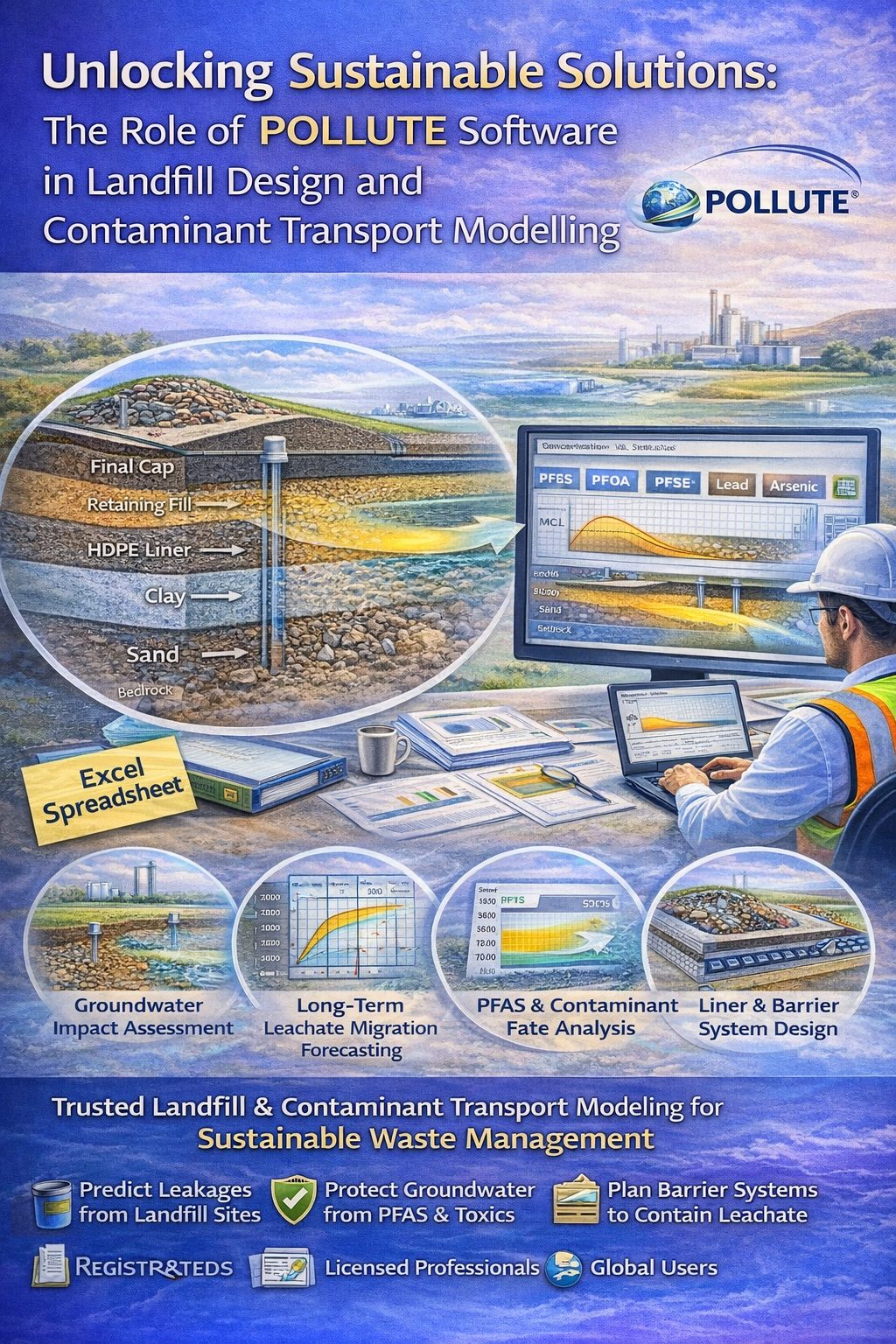
Did you know that improper landfill design can lead to serious environmental issues, including groundwater contamination and increased greenhouse gas emissions? The significance of using advanced software for landfill design and contaminant transport modelling cannot be overstated. As waste management becomes increasingly complex, utilizing cutting-edge tools like POLLUTE software from GAEA Technologies is essential. This blog post will explore how this software revolutionizes landfill design, enhances contaminant transport modelling, and contributes to more sustainable waste management strategies.
Understanding Landfill Design
Landfill design involves planning and executing a waste disposal site that minimizes environmental impact. Effective landfill design takes into account several crucial factors, including geological conditions, potential contaminant transport pathways, and leachate management techniques. A well-designed landfill can effectively contain waste while preventing harm to surrounding ecosystems.
Key Components of Landfill Design
- Site Selection: Choosing the right location is vital to ensure that landfills do not negatively affect nearby communities and ecosystems. Factors such as topography, geology, and hydrology are analyzed during the site selection process.
- Leachate Management: Leachate—a liquid formed when waste breaks down—can be hazardous if not properly managed. Effective leachate treatment systems must be integrated into landfill design to prevent contamination of groundwater.
- Cover Systems: A landfill cover helps to minimize odors and prevent rainwater from entering the waste. This reduces leachate production and offers environmental protection.
- Monitoring Systems: Continuous monitoring of groundwater and landfill conditions ensures that any potential issues are identified and addressed promptly.
The Importance of Contaminant Transport Modelling
Contaminant transport modelling is a way to predict the movement of pollutants in the environment. Understanding how contaminants migrate through soil and water systems is crucial for effective landfill management. By utilizing advanced modelling software, engineers and environmental scientists can simulate various scenarios and assess the potential risks associated with landfill operations.
POLLUTE Software: A Game Changer in Waste Management
POLLUTE from GAEA Technologies is an innovative software solution designed for both landfill design and contaminant transport modelling. This tool allows users to create detailed models of waste sites, simulate contamination scenarios, and strategize appropriate mitigation measures.
Features of POLLUTE Software
- Advanced Simulation Capabilities: POLLUTE uses robust algorithms to simulate contaminant transport through soil and groundwater, providing results that help in decision-making.
- User-Friendly Interface: The software is designed for ease of use, allowing users to quickly navigate through its extensive features without extensive training.
- Customizable Models: Users can tailor models to suit specific site conditions, ensuring more accurate predictions of potential environmental impacts.
- Regulatory Compliance Tools: POLLUTE helps users stay compliant with industry regulations by providing tools that simplify reporting and documentation processes.
Benefits of Using POLLUTE Software
- Enhanced Decision-Making: With accurate data and predictive modelling, waste management professionals can make informed decisions that reduce risks to the environment.
- Cost Efficiency: By preventing costly environmental breaches and optimizing landfill design, POLLUTE can ultimately save organizations money in the long run.
- Improved Community Relations: Proper landfill management fosters community trust by demonstrating a commitment to environmental protection and sustainability.
- Future-Proofing Infrastructure: By incorporating advanced technology into landfill design, organizations can build resilient waste management systems that are adaptable to future challenges.
Best Practices for Implementing POLLUTE Software
If you’re interested in leveraging POLLUTE software for your landfill design or contaminant transport modelling projects, here are some best practices:
- Engage Stakeholders Early: Involve stakeholders, including local communities and regulatory bodies, in the planning process.
- Regular Training: Ensure team members are well-versed in using POLLUTE to maximize its potential.
- Iterative Modelling: Use POLLUTE to regularly update models and monitor changes in landfill operations and environmental conditions.
- Data Integration: Integrate data from various sources to enhance model accuracy.
Conclusion: Towards Sustainable Waste Management with POLLUTE
As waste management challenges intensify due to population growth and environmental considerations, tools like POLLUTE software from GAEA Technologies will become indispensable in the field of landfill design and contaminant transport modelling. By leveraging advanced simulations and comprehensive data analysis, organizations can create efficient waste management solutions that protect public health and the environment. So where do we go from here? If you want to transform your approach to landfill design and contaminant modelling, learn more about POLLUTEv9 here: .
Embrace the future of sustainable waste management and ensure your projects contribute positively to the environment. Remember, every step you take towards responsible waste management is a step towards a cleaner, healthier planet. Embrace the challenge and let innovation guide your way!
Learn more about our Contaminant Transport Modeling Solutions
Related Articles
- Contaminant Transport Modelling and Landfill Design: A Complete Guide for Environmental Engineers
- How Contaminant Transport Models Predict Groundwater Pollution
- Designing Landfill Liner Systems to Prevent Groundwater Contamination
- Understanding Leachate Generation and Transport in Landfills
- Advection–Dispersion Modelling in Groundwater Systems
- Hydrogeological Data Required for Contaminant Transport Models
- Regulatory Requirements for Landfill Design and Groundwater Protection
- Unlock Global Expertise: Free Research Viewer for POLLUTE and MIGRATE
- Mastering the Plume: POLLUTEv8 vs. MODFLOW vs. FEFLOW vs. PATH3D
- Core Features of POLLUTEv8
- Mastering Contaminant Transport: Special Features of POLLUTEv8
- Navigating Contaminant Migration with POLLUTE: A Modern Approach to Landfill Design
- Beyond The MCL: Building Audit-Proof Contaminant Fate Models For 2026 Regulatory Submissions
- Using Predictive Models to Meet 2026 Primary Drinking Water Regulations
- Driving Environmental Research: How GAEA Technologies POLLUTE Software is Used in Academic and Industry Reports
- Modeling Your Way to ‘No Further Action’: How Predictive Simulation Shaves Years Off Remediation Timelines
- Meeting The New 2026 EPA Reporting Standards For PFAS: Why Traditional Spreadsheet Modeling No Longer Suffices
- Contaminant Transport Modelling and Landfill Design Insights
- Geomembrane Degradation in Landfill Liners: Causes, Modeling, and Long-Term Performance
- Clogging of Landfill Leachate Collection Systems: Causes, Impacts, and Prevention
- Determining Diffusion Coefficients for Contaminant Transport Modeling
- Use and Determination of Distribution Coefficients for Contaminant Transport Modeling
- Non-Linear Sorption in Contaminant Transport Modeling
- Phase Change in Collection Systems in Contaminant Transport Modeling for Landfills
- Biological and Radioactive Decay in Contaminant Transport Modeling