

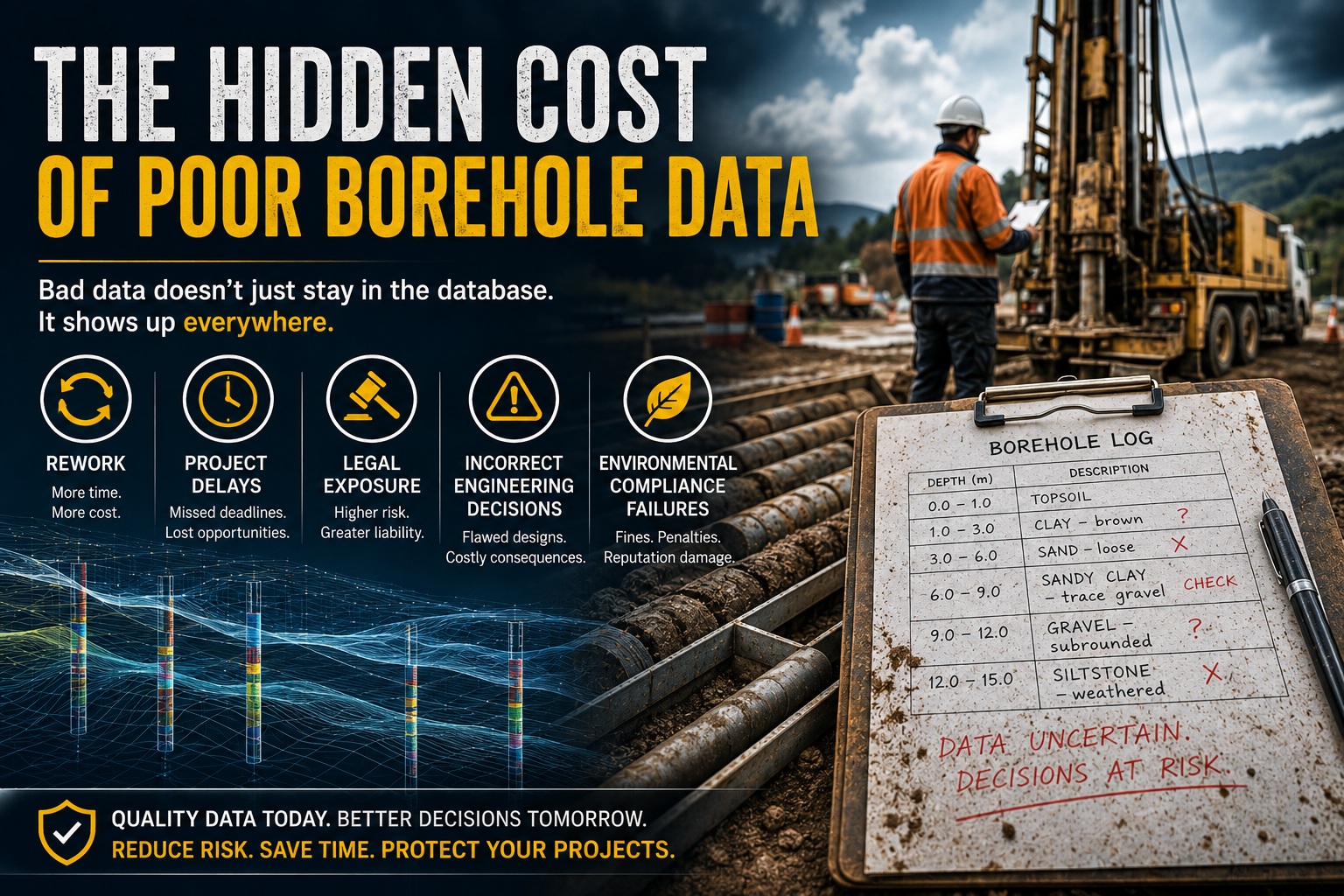
In geotechnical, environmental, mining, and infrastructure projects, borehole data forms the foundation for critical engineering and regulatory decisions. Every sample description, groundwater reading, lithology log, laboratory result, and field observation contributes to the overall understanding of subsurface conditions. When that data is incomplete, inconsistent, inaccurate, or poorly managed, the consequences can extend far beyond a simple correction in a report.
Poor borehole data creates hidden costs that can impact project schedules, engineering decisions, legal liability, environmental compliance, and long-term operational success. In many cases, the financial damage caused by bad data is not immediately visible during drilling or logging operations. Instead, the problems emerge later — during design, construction, permitting, audits, or litigation.
This article explores the true cost of poor borehole data and why strong QA/QC practices are essential for reducing risk and improving project outcomes.
Why Borehole Data Quality Matters
Borehole data is used throughout the entire lifecycle of a project:
- Site investigations
- Environmental assessments
- Geotechnical design
- Resource estimation
- Construction planning
- Regulatory reporting
- Long-term monitoring
- Asset management
Engineers, geologists, hydrogeologists, regulators, and contractors all rely on this information to make decisions. If the underlying data is flawed, every downstream activity becomes vulnerable.
Even small errors can have major consequences:
- Incorrect sample depths
- Missing groundwater elevations
- Wrong coordinate systems
- Invalid laboratory associations
- Inconsistent lithology coding
- Transcription mistakes
- Missing QA records
- Unverified field measurements
These problems often accumulate over time, especially when projects rely on spreadsheets, disconnected databases, handwritten notes, or inconsistent workflows.
Rework: The Most Immediate Hidden Cost
One of the most common consequences of poor borehole data is rework.
Rework occurs when teams must revisit, correct, validate, or recreate information that should have been accurate the first time. In drilling and investigation projects, rework can be extremely expensive because field activities are difficult and costly to repeat.
Examples of rework include:
- Re-entering field logs
- Correcting depth intervals
- Reprocessing laboratory imports
- Revising geological interpretations
- Recreating missing chain-of-custody information
- Reissuing reports
- Updating drawings and cross-sections
- Re-drilling boreholes due to missing or invalid data
The financial impact grows quickly when multiple disciplines depend on the same data.
For example, if an incorrect borehole elevation is discovered after geotechnical modeling has been completed, engineers may need to:
- Rebuild subsurface models
- Recalculate settlement estimates
- Revise foundation recommendations
- Update construction drawings
- Reissue reports to stakeholders
This creates additional consulting costs and delays downstream work.
In environmental projects, missing sample identifiers or invalid laboratory mappings may require re-sampling programs that involve:
- Mobilizing drilling crews again
- Additional laboratory testing
- Regulatory notifications
- Revised risk assessments
These costs can easily exceed the original savings gained by using weak data management practices.
Project Delays and Schedule Impacts
Poor borehole data often causes project delays that affect multiple stakeholders.
Many infrastructure and environmental projects operate on strict timelines involving:
- Permit approvals
- Construction windows
- Contractor schedules
- Seasonal access limitations
- Regulatory deadlines
- Financing milestones
When borehole data problems are discovered late in the process, schedules can rapidly collapse.
Common Delay Scenarios
Incomplete Field Records
If field crews fail to capture required data:
- Additional verification may be needed
- Reports cannot be finalized
- Regulators may reject submissions
- Engineering teams may pause design work
Data Validation Failures
Poor QA/QC procedures may allow invalid information into the database, such as:
- Overlapping sample intervals
- Impossible groundwater elevations
- Incorrect coordinate systems
- Duplicate borehole IDs
Correcting these issues can require extensive manual review.
Delayed Laboratory Integration
Improper sample tracking or inconsistent naming conventions can delay laboratory imports and validation. Environmental reporting deadlines may then be missed.
Regulatory Review Delays
Government agencies increasingly expect standardized, traceable, and validated digital submissions. Poor-quality borehole data often triggers requests for clarification or resubmission.
In large infrastructure projects, even minor delays can create significant financial penalties due to idle equipment, contractor downtime, and schedule overruns.
Incorrect Engineering Decisions
Perhaps the most dangerous consequence of poor borehole data is the risk of incorrect engineering decisions.
Engineering models are only as reliable as the data used to create them. If borehole information is inaccurate, incomplete, or inconsistent, the resulting designs may be fundamentally flawed.
Examples of Engineering Risks
Foundation Design Errors
Incorrect soil descriptions or strength parameters can lead to:
- Underdesigned foundations
- Excessive settlement
- Structural instability
- Increased maintenance costs
Groundwater Misinterpretation
Improper groundwater measurements may result in:
- Dewatering failures
- Flooding risks
- Slope instability
- Incorrect contaminant migration models
Rock Quality Misclassification
Errors in RQD, SCR, or lithology logging can affect:
- Tunnel support design
- Blasting plans
- Excavation methods
- Rock slope stability assessments
Environmental Risk Misjudgment
Missing or incorrect contaminant data may cause:
- Underestimated cleanup costs
- Human health risks
- Regulatory violations
- Incomplete remediation systems
These engineering mistakes may remain hidden for months or years before becoming visible during construction or operation.
By that point, correction costs are dramatically higher.
Legal Exposure and Liability
Poor borehole data can also create serious legal and contractual exposure.
When projects encounter failures, disputes, or environmental incidents, borehole records often become critical evidence.
If data cannot be verified, organizations may face:
- Professional liability claims
- Contract disputes
- Regulatory enforcement
- Insurance complications
- Litigation costs
Common Legal Problems
Missing Audit Trails
Without proper QA/QC systems, organizations may be unable to prove:
- Who entered the data
- When changes were made
- Whether validation occurred
- Which version of the data was used
This weakens legal defensibility.
Inconsistent Reporting
If different reports contain conflicting borehole information, opposing parties may question the reliability of the entire investigation.
Regulatory Non-Compliance
Many jurisdictions require environmental and geotechnical records to meet traceability and retention standards. Missing documentation may violate permit or reporting obligations.
Contractor Disputes
Construction claims often rely on subsurface conditions. If borehole data is inaccurate, disputes over differing site conditions can become costly and difficult to resolve.
In some cases, poor documentation alone can significantly weaken a company’s legal position — even if the technical work itself was acceptable.
Environmental Compliance Failures
Environmental projects are especially vulnerable to poor data quality because regulators require precise, defensible, and traceable information.
Errors in borehole and monitoring well data can result in compliance failures involving:
- Groundwater monitoring
- Soil contamination assessments
- Landfill monitoring
- Brownfield redevelopment
- Mining closure programs
- Remediation projects
Typical Compliance Problems
Incorrect Sampling Information
Improper sample depths, dates, or coordinates may invalidate regulatory submissions.
Missing Chain-of-Custody Records
If sample handling cannot be verified, regulators may reject analytical results.
Inconsistent Laboratory Data
Improper imports or unit conversions can produce false exceedances or hide real contamination.
Invalid Monitoring Well Information
Incorrect screen intervals or elevations can compromise groundwater interpretations and regulatory reporting.
Environmental compliance failures often trigger:
- Mandatory re-sampling
- Fines or penalties
- Increased regulatory oversight
- Project delays
- Public scrutiny
The reputational damage can also affect future permitting and client trust.
The Compounding Effect of Poor Data
One of the most dangerous aspects of poor borehole data is that problems compound over time.
A single error may propagate into:
- Databases
- CAD drawings
- GIS systems
- 3D geological models
- Engineering calculations
- Regulatory submissions
- Construction documents
As more teams rely on the information, correcting errors becomes increasingly difficult and expensive.
This is why organizations often discover major data problems years after the original drilling program was completed.
How QA/QC Reduces Hidden Costs
Strong QA/QC systems help prevent these issues before they affect projects.
Effective borehole QA/QC includes:
Standardized Data Entry
Using controlled vocabularies, templates, and validation rules reduces inconsistency.
Automated Validation
Rules-based systems can detect:
- Invalid depth intervals
- Missing required fields
- Duplicate IDs
- Out-of-range values
- Coordinate problems
Workflow Management
Defined review and approval workflows improve accountability and traceability.
Audit Trails
Tracking changes helps support legal defensibility and regulatory compliance.
Integrated Data Systems
Centralized databases reduce duplication and synchronization errors between teams.
Digital Field Capture
Mobile and digital logging systems reduce transcription mistakes from handwritten records.
Organizations that invest in proper QA/QC processes often see substantial long-term savings through reduced rework, fewer disputes, and improved project efficiency.
The Business Value of High-Quality Borehole Data
High-quality borehole data is not just a technical requirement — it is a business asset.
Reliable data supports:
- Faster project delivery
- Better engineering decisions
- Improved regulatory confidence
- Reduced legal exposure
- Lower operational risk
- Stronger client trust
As projects become more data-driven, the value of accurate, validated, and traceable borehole information continues to increase.
Companies that treat data quality as a strategic priority gain a significant competitive advantage.
Final Thoughts
The hidden cost of poor borehole data extends far beyond simple data correction. Rework, delays, legal exposure, engineering failures, and environmental compliance problems can create major financial and operational risks for organizations of any size.
Many of these problems are preventable through strong QA/QC practices, standardized workflows, automated validation, and integrated data management systems.
In modern geotechnical and environmental projects, data quality is no longer optional. Accurate borehole data is the foundation for safe engineering, regulatory compliance, and successful project delivery.
Investing in borehole QA/QC today can prevent costly problems tomorrow.