

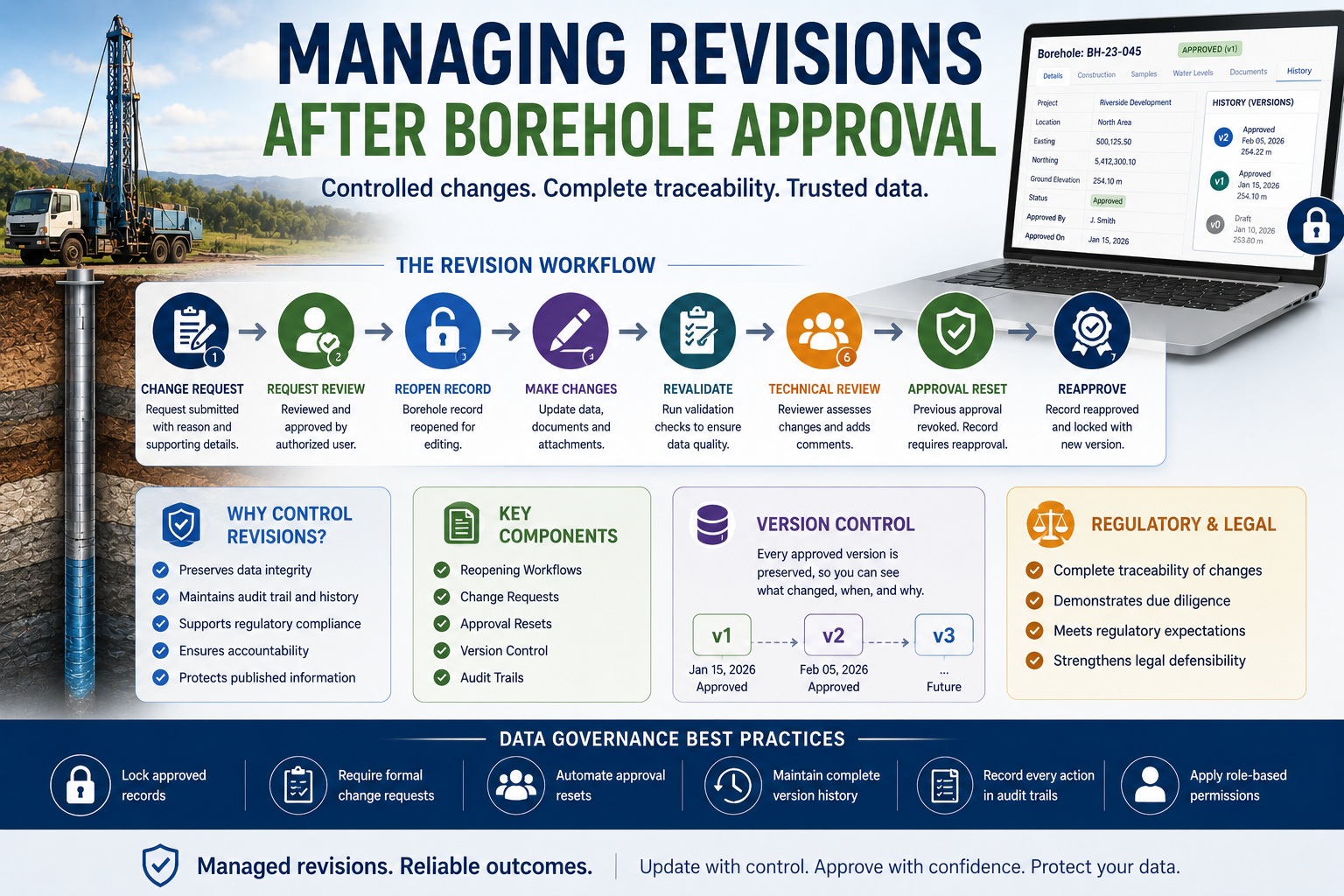
Approval is often viewed as the final step in the borehole data lifecycle. Once a borehole has passed validation, completed technical review, and received formal approval, it becomes an official project record that may be used for regulatory submissions, engineering design, environmental assessments, groundwater modeling, resource estimation, and client reporting.
However, approval does not necessarily mean the data will never change again.
New information may become available, data entry errors may be discovered, laboratory results may be corrected, or geological interpretations may evolve. Organizations must therefore establish a structured process for managing revisions after approval without compromising data integrity, accountability, or regulatory compliance.
The challenge is not whether approved boreholes should ever be revised. The challenge is ensuring that revisions occur through controlled workflows that preserve trust in the data. This is where reopening workflows, change requests, approval resets, and strong data governance practices become essential.
This article explores how organizations can effectively manage revisions after borehole approval while maintaining complete traceability and compliance throughout the data lifecycle.
Why Revisions Occur After Approval
Even the most rigorous QA/QC processes cannot eliminate every potential issue before approval.
Approved boreholes may require revision for several legitimate reasons:
Data Entry Corrections
Examples include:
- Incorrect coordinates
- Transposed values
- Unit conversion errors
- Mistyped elevations
- Incorrect borehole identifiers
Survey Updates
Survey corrections may improve the accuracy of:
- Easting and northing coordinates
- Ground elevations
- Collar locations
- Borehole trajectories
Laboratory Revisions
Laboratories occasionally revise results due to:
- Instrument recalibration
- Quality control investigations
- Sample identification corrections
- Reporting errors
Geological Reinterpretation
As additional boreholes are drilled, geological understanding may improve.
Examples include:
- Updated lithology classifications
- Revised stratigraphic boundaries
- Modified hydrogeological interpretations
- Improved structural interpretations
Regulatory Requests
Government agencies may request:
- Clarifications
- Additional documentation
- Data corrections
- Revised classifications
In all of these situations, organizations require a structured process for updating approved records.
The Risks of Uncontrolled Revisions
Allowing users to edit approved boreholes without oversight creates significant risks.
Loss of Trust
Stakeholders must be confident that approved data remains stable and reliable.
If approved records can be modified freely, questions arise regarding:
- Data authenticity
- Approval validity
- Historical accuracy
Compliance Issues
Many regulatory frameworks require organizations to maintain:
- Historical records
- Approval history
- Revision documentation
- Audit trails
Uncontrolled revisions can undermine compliance efforts.
Reporting Conflicts
Changes made after report publication may create inconsistencies between:
- Database records
- Regulatory submissions
- Engineering analyses
- Client reports
Without revision controls, determining which version is correct becomes difficult.
Legal Exposure
In legal proceedings, organizations may need to demonstrate:
- What data existed at a specific point in time
- Who approved it
- When changes occurred
- Why modifications were made
Unmanaged revisions can weaken legal defensibility.
Reopening Workflows
The most effective way to manage approved borehole revisions is through a controlled reopening workflow.
Rather than allowing direct edits to approved records, the system formally reopens the record for revision.
What Is a Reopening Workflow?
A reopening workflow is a structured process that transitions a record from an approved state back into an editable state while preserving the original approved version.
The workflow typically includes:
- Revision request submitted
- Request reviewed
- Record reopened
- Changes applied
- Validation performed
- Review completed
- Reapproval completed
This ensures that revisions receive the same level of scrutiny as the original data.
Benefits of Reopening Workflows
Reopening workflows provide:
- Controlled modifications
- Complete auditability
- Workflow consistency
- Improved accountability
- Regulatory traceability
Most modern geological data management systems should support configurable reopening procedures.
Managing Change Requests
Every revision should begin with a formal change request.
A change request documents the reason for modifying an approved record before changes occur.
Information to Capture
A change request should include:
- Requestor
- Date submitted
- Borehole identifier
- Reason for change
- Description of requested modifications
- Supporting documentation
- Priority level
Common Change Request Categories
Organizations often categorize requests such as:
Correction
Fixing an identified error.
Enhancement
Adding new information.
Regulatory Requirement
Responding to agency requests.
Geological Interpretation Update
Refining technical conclusions.
Laboratory Revision
Updating analytical results.
Categorizing requests improves reporting and helps identify recurring issues within workflows.
Approval of Change Requests
Not every request should automatically proceed.
Organizations may require authorization from:
- Project managers
- Technical leads
- Data managers
- Quality assurance personnel
This additional review helps prevent unnecessary or inappropriate modifications.
Approval Resets
One of the most important governance principles is that significant changes should invalidate previous approvals.
This concept is commonly known as an approval reset.
Why Approval Resets Matter
Approval represents confidence that a specific version of a borehole record meets quality standards.
Once the record changes, that approval may no longer be valid.
For example:
A geologist approves a borehole with:
- Groundwater elevation = 102.45 m
Later, the value is corrected to:
- Groundwater elevation = 102.95 m
Although the change appears minor, the approved record is no longer identical to the version originally reviewed.
The approval should therefore be reconsidered.
Automatic Approval Resets
Many systems automatically reset approval status when critical fields change.
Examples include:
- Coordinates
- Elevations
- Lithology intervals
- Laboratory results
- Groundwater measurements
- Borehole construction details
The record returns to a pending review state until reapproved.
Benefits of Approval Resets
Approval resets:
- Preserve quality standards
- Prevent unauthorized changes
- Maintain confidence in approved data
- Strengthen auditability
Without approval resets, organizations risk relying on data that was never formally reviewed.
Version Control
Version control is a critical component of post-approval revision management.
Instead of replacing approved records, the system creates a new version.
Example
Version 1:
- Approved January 15
- Ground elevation = 254.10 m
Version 2:
- Approved February 5
- Ground elevation = 254.22 m
Both versions remain accessible.
Users can identify:
- What changed
- Who changed it
- When it changed
- Why it changed
- Which version was used in reports
Benefits of Version Control
Version control provides:
Historical Preservation
No information is lost.
Audit Support
Every revision remains traceable.
Error Recovery
Previous versions can be restored if necessary.
Regulatory Compliance
Historical records remain available for inspection.
Version control is one of the most effective tools for maintaining trust in borehole databases.
Data Governance Considerations
Managing revisions effectively requires more than software functionality.
Organizations need clear governance policies that define how revisions are handled.
Define Revision Authority
Organizations should specify:
- Who can request changes
- Who can approve requests
- Who can perform edits
- Who can reapprove records
Clearly defined responsibilities improve accountability.
Establish Revision Policies
Policies should address:
- What types of changes require reopening
- Which changes trigger approval resets
- Documentation requirements
- Review procedures
Consistency is critical for maintaining governance standards.
Maintain Audit Trails
Every revision should be logged.
Audit records should capture:
- User identity
- Timestamp
- Previous value
- New value
- Change reason
- Workflow status
Comprehensive audit trails ensure complete traceability.
Protect Historical Versions
Historical versions should never be deleted or overwritten.
Preserving project history strengthens compliance and legal defensibility.
Apply Role-Based Permissions
Permissions should restrict revision activities to authorized users.
Typical roles include:
- Data Owner
- Reviewer
- Approver
- Project Manager
- Administrator
Role-based controls reduce risk and improve workflow management.
Recommended Revision Workflow
A robust post-approval revision workflow may follow this sequence:
- Approved
- Change Request Submitted
- Change Request Approved
- Record Reopened
- Revision In Progress
- Validation Pending
- Validation Passed
- Technical Review
- Approval Reset
- Reapproval
- New Version Approved
- Record Locked
This process ensures that revised data receives the same level of scrutiny as newly created records.
Best Practices for Managing Revisions
Organizations should consider the following best practices:
Lock Approved Records
Prevent direct modification of approved data.
Require Formal Change Requests
Document why revisions are needed.
Automate Approval Resets
Ensure modified records undergo reapproval.
Implement Version Control
Preserve historical records.
Maintain Comprehensive Audit Trails
Track every action and change.
Define Governance Policies
Document responsibilities and procedures.
Revalidate Modified Data
Ensure revised information meets quality standards.
Train Users
Help staff understand revision requirements and accountability expectations.
Conclusion
Managing revisions after borehole approval is a critical component of modern geological data governance. While approved records should generally remain protected from direct editing, organizations must also provide controlled mechanisms for incorporating corrections, new information, and regulatory updates.
Reopening workflows, formal change requests, approval resets, version control, and comprehensive audit trails work together to create a balanced approach that protects data integrity while supporting legitimate revisions. These processes ensure that approved borehole data remains trustworthy, traceable, and defensible throughout the project lifecycle.
Organizations that implement structured post-approval revision management not only improve QA/QC outcomes but also strengthen compliance, accountability, and confidence in the decisions that depend upon their geological data.