

Why Modern Digital Records Are Becoming Essential for Risk Management
Borehole logs have long been one of the most important records generated during geological, geotechnical, environmental, hydrogeological, and mining investigations. Traditionally, these records were created on paper forms, reviewed manually, and stored in filing cabinets or project archives. While paper records served the industry for decades, they often present challenges related to traceability, version control, record preservation, and legal defensibility.
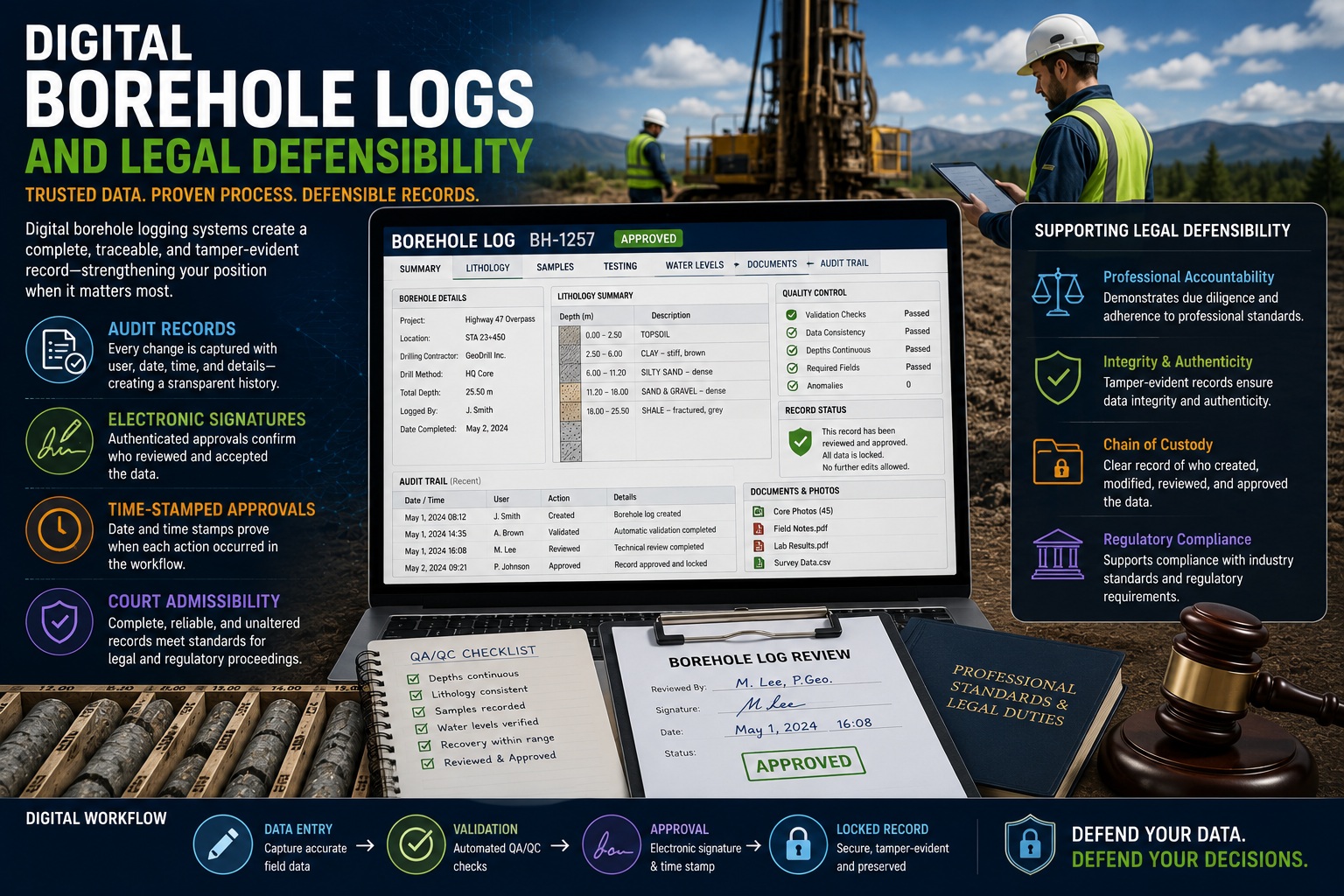
Today, organizations are increasingly adopting digital borehole logging systems that provide structured data management, automated workflows, audit trails, electronic approvals, and long-term record preservation. Beyond improving efficiency, these capabilities significantly strengthen the legal defensibility of geological records.
When disputes arise years after a project is completed, organizations may need to demonstrate who created a record, when it was modified, who approved it, and whether the information has remained unchanged. Digital borehole logging systems can provide this evidence in ways that traditional paper-based systems often cannot.
This article explores how digital borehole logs support legal defensibility through audit records, electronic signatures, time-stamped approvals, and court admissibility.
Why Legal Defensibility Matters
Many professionals view borehole logs primarily as technical documents.
In reality, they often become legal documents as well.
Borehole information may be used to support:
- Engineering designs
- Environmental assessments
- Groundwater studies
- Resource estimates
- Construction decisions
- Regulatory submissions
- Property transactions
- Litigation proceedings
Years after a project is completed, investigators, regulators, lawyers, insurance companies, and expert witnesses may review borehole records to determine what information was available when decisions were made.
The ability to demonstrate the integrity and authenticity of those records can become critically important.
The Limitations of Paper Records
Paper logs provide a permanent record, but they also create several challenges.
Common issues include:
- Handwriting interpretation problems
- Missing pages
- Photocopy degradation
- Uncontrolled revisions
- Lost records
- Unclear approval history
- Difficult retrieval
- Limited audit capability
Consider a dispute occurring ten years after a site investigation.
Questions may arise such as:
- Who created the log?
- Was it reviewed?
- Were corrections made?
- When was it approved?
- Which version was used in the report?
Paper systems often struggle to answer these questions conclusively.
Digital Borehole Logs as Evidence
Modern digital logging systems create a structured and traceable record of project activities.
Unlike static paper records, digital systems can automatically capture information about:
- User actions
- Data changes
- Review activities
- Approvals
- Workflow transitions
This additional information provides context that strengthens the evidentiary value of the data.
A digital borehole log is no longer simply a geological record.
It becomes a documented history of how the information was created, reviewed, approved, and maintained.
Audit Records
One of the most important features supporting legal defensibility is the audit trail.
An audit trail records significant events throughout the lifecycle of a borehole record.
Typical audit information includes:
- User identity
- Date and time
- Action performed
- Previous value
- New value
- Reason for change
Example of an Audit Record
Suppose a lithology interval is modified.
Original record:
| Depth | Lithology |
|---|---|
| 10–15 m | Clay |
Updated record:
| Depth | Lithology |
| 10–15 m | Silty Clay |
The audit system records:
| Field | Value |
| User | J. Smith |
| Date | May 12, 2026 |
| Time | 10:42 AM |
| Previous Value | Clay |
| New Value | Silty Clay |
| Reason | Core review completed |
The original information remains preserved.
This transparency can be invaluable during investigations or disputes.
Why Audit Trails Matter
Without an audit trail, questions may arise regarding:
- Data manipulation
- Unauthorized changes
- Record authenticity
- Documentation accuracy
Audit trails help demonstrate:
- Accountability
- Transparency
- Data integrity
- Quality control
These characteristics significantly improve legal defensibility.
Electronic Signatures
Electronic signatures have become increasingly common in professional and regulatory environments.
In modern borehole management systems, electronic signatures provide evidence that a qualified individual reviewed and approved a record.
What Is an Electronic Signature?
An electronic signature is a digital acknowledgment associated with a specific user and action.
Examples include:
- Reviewer approval
- Professional sign-off
- Validation acceptance
- Report authorization
The signature is typically linked to:
- User credentials
- Approval date
- Approval time
- Workflow status
Unlike handwritten signatures, electronic signatures can be automatically verified and traced.
Benefits of Electronic Signatures
Electronic signatures provide several advantages.
Accountability
The approving individual is clearly identified.
Security
Approval actions can require authenticated login credentials.
Traceability
The approval becomes part of the permanent audit history.
Efficiency
Approvals can occur remotely without paper circulation.
These benefits improve both operational efficiency and legal reliability.
Time-Stamped Approvals
Time-stamped approvals are another key component of defensible digital records.
Every significant workflow action should include:
- Date
- Time
- User
- Action performed
Why Time Stamps Are Important
In many disputes, timing matters.
Questions may include:
- Was the borehole reviewed before the report was issued?
- When was the correction made?
- Did the approval occur before construction began?
- Was the data modified after submission?
Time-stamped records provide objective answers.
Example Workflow
A digital system may record:
| Action | User | Date/Time |
| Borehole Created | Technician | May 10, 2026 09:15 |
| Validation Completed | System | May 10, 2026 09:18 |
| Technical Review | Geologist | May 11, 2026 14:32 |
| Approval | Senior Engineer | May 12, 2026 08:47 |
| Record Locked | System | May 12, 2026 08:48 |
This history demonstrates a clear chain of review and approval.
Version Control and Record Integrity
Another advantage of digital logging systems is version control.
Rather than overwriting data, advanced systems preserve historical versions.
Benefits of Version History
Version control allows organizations to:
- Recover previous records
- Compare revisions
- Investigate changes
- Demonstrate transparency
For example:
Version 1:
Initial logging.
Version 2:
Lithology revised following core review.
Version 3:
Groundwater observations added.
All versions remain accessible and traceable.
This capability is extremely valuable during legal proceedings.
Court Admissibility of Digital Records
One of the most important questions organizations ask is whether digital records are admissible in court.
In many jurisdictions, electronic records are widely accepted as evidence provided they meet certain reliability requirements.
Key Factors Affecting Admissibility
Courts generally evaluate whether records are:
Authentic
Can the record be shown to be genuine?
Reliable
Was the information created through normal business processes?
Complete
Are relevant records available?
Unaltered
Can modifications be identified and traced?
Digital borehole management systems often perform well in these areas because they automatically maintain supporting metadata.
Demonstrating Authenticity
Digital systems can provide evidence such as:
- User authentication logs
- Audit trails
- Electronic signatures
- Workflow histories
- Version records
These features help establish the authenticity of records.
Chain of Custody
The concept of chain of custody is often associated with forensic investigations but is equally relevant to technical records.
Organizations should be able to demonstrate:
- Who created the record
- Who modified it
- Who reviewed it
- Who approved it
- Where it has been stored
Digital systems can automatically preserve this information.
Regulatory and Professional Expectations
Regulators increasingly expect organizations to maintain comprehensive digital records.
Many industries now emphasize:
- Data traceability
- Record retention
- Electronic documentation
- Auditability
- Accountability
Digital logging systems align closely with these expectations.
In some cases, they may provide stronger evidence than traditional paper records.
Best Practices for Maximizing Legal Defensibility
Organizations seeking to improve legal defensibility should consider several best practices.
Maintain Comprehensive Audit Trails
Record:
- Data edits
- Workflow transitions
- Approvals
- Comments
- Validation activities
Use Electronic Signatures
Require authenticated approvals for:
- Reviews
- Technical sign-offs
- Final approvals
Implement Record Locking
Approved boreholes should be protected from unauthorized modifications.
If changes are required, a formal amendment process should be used.
Preserve Historical Versions
Never overwrite critical records without preserving prior versions.
Retain Supporting Evidence
Maintain:
- Core photographs
- Field notes
- Laboratory reports
- Survey data
- Validation reports
alongside the borehole record.
Establish Retention Policies
Ensure records remain accessible for the duration required by:
- Contracts
- Regulations
- Professional standards
- Corporate policies
The Future of Defensible Geological Records
As digital transformation continues, borehole databases are evolving from simple data repositories into comprehensive evidence management systems.
Emerging capabilities include:
- Digital signatures
- Workflow automation
- Blockchain verification
- Automated audit reporting
- AI-assisted review documentation
These technologies will further strengthen the reliability and defensibility of geological records.
Organizations that adopt robust digital record management practices today will be better prepared for future regulatory, technical, and legal challenges.
Conclusion
Digital borehole logs provide far more than operational efficiency. Through audit records, electronic signatures, time-stamped approvals, version control, and structured workflows, they create a transparent and traceable history of how geological information was collected, reviewed, approved, and maintained. These capabilities significantly improve legal defensibility by helping organizations demonstrate authenticity, accountability, and data integrity. In an environment where borehole records may eventually be scrutinized by regulators, lawyers, insurers, or courts, a well-designed digital logging system can become one of the strongest tools available for protecting both technical quality and legal interests.