

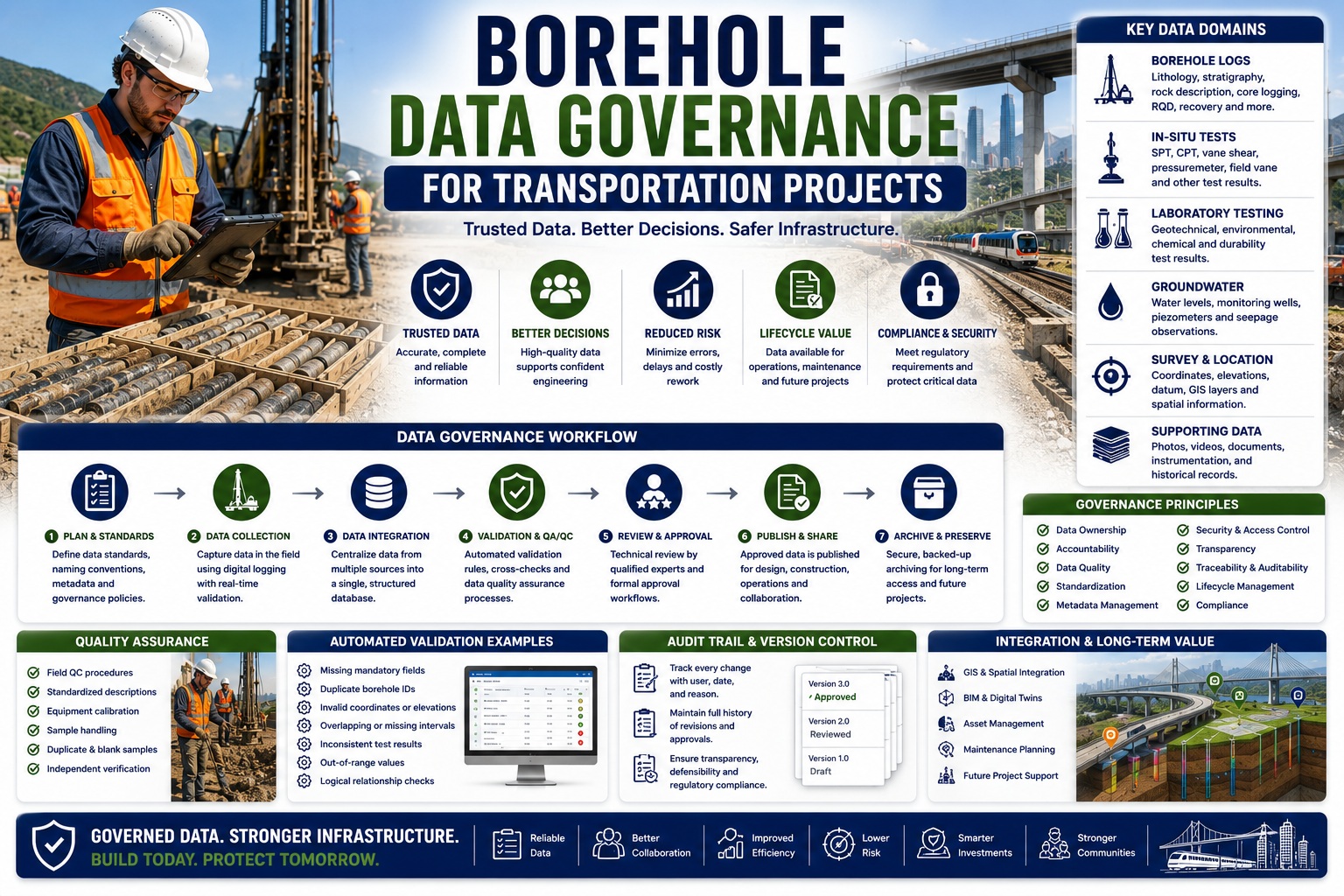
Ensuring Trusted, Secure, and Reusable Geotechnical Data Throughout the Infrastructure Lifecycle
Modern transportation infrastructure projects generate an extraordinary volume of geotechnical information. Highway expansions, bridge replacements, rail corridors, airports, tunnels, ports, and rapid transit systems all depend on accurate borehole investigations to characterize subsurface conditions before construction begins. Over the lifetime of a transportation asset, these investigations may span decades and involve multiple engineering firms, contractors, laboratories, government agencies, and asset managers.
Each borehole log contains valuable engineering knowledge—soil classifications, rock descriptions, groundwater observations, Standard Penetration Test (SPT) results, laboratory testing, geotechnical instrumentation, core recovery measurements, and numerous field observations. Collectively, these records become one of the most valuable long-term assets owned by transportation agencies.
Unfortunately, many organizations continue to manage borehole information using disconnected spreadsheets, scanned PDFs, paper logs, and isolated databases. As projects grow larger and more complex, this fragmented approach creates duplicate information, inconsistent terminology, missing records, uncontrolled revisions, and significant project risk.
Data governance provides the framework needed to ensure that borehole information remains accurate, complete, secure, traceable, and reusable throughout the entire infrastructure lifecycle. Effective governance combines standardized data collection, digital workflows, automated quality assurance (QA), quality control (QC), role-based permissions, validation engines, audit trails, version control, and long-term archival into a single integrated strategy.
This article examines best practices for borehole data governance in transportation projects and explains why structured geotechnical data has become essential for modern infrastructure delivery.
Why Borehole Data Governance Matters
Transportation agencies invest substantial resources in geotechnical investigations.
A major highway project may include:
- Hundreds of boreholes
- Thousands of laboratory tests
- Groundwater monitoring wells
- Geophysical investigations
- Cone Penetration Tests (CPT)
- Standard Penetration Tests (SPT)
- Rock core logging
- Environmental sampling
These investigations often represent millions of dollars in engineering work.
Without proper governance, organizations face risks such as:
- Duplicate drilling programs
- Lost historical information
- Conflicting borehole logs
- Design errors
- Construction claims
- Regulatory issues
- Increased lifecycle costs
Good governance transforms borehole records from temporary project documents into permanent engineering assets.
Borehole Data Supports the Entire Asset Lifecycle
Unlike construction drawings, borehole data often remains valuable long after a project is completed.
Historical investigations may be reused during:
- Highway widening
- Bridge rehabilitation
- Utility relocations
- Slope stabilization
- Tunnel maintenance
- Rail upgrades
- Emergency repairs
- Future environmental investigations
When historical information is well-governed, agencies can reduce investigation costs while improving engineering confidence.
Establish Standardized Data Standards
Governance begins with consistency.
Organizations should establish standards covering:
- Borehole numbering conventions
- Coordinate systems
- Vertical datums
- Soil classification systems
- Rock classification standards
- Lithology codes
- Sampling procedures
- Laboratory methods
- Metadata requirements
- Digital deliverable formats
When every consultant follows the same standards, data from multiple projects can be integrated without extensive rework.
Digital Data Capture Improves Governance
Paper borehole logs have served the industry for decades but introduce unnecessary risks.
Common problems include:
- Handwriting interpretation
- Manual transcription
- Calculation errors
- Lost field books
- Delayed reporting
- Duplicate data entry
Modern digital borehole logging systems provide significant advantages.
Benefits include:
- Real-time validation
- Controlled vocabularies
- Automated calculations
- GPS integration
- Immediate synchronization
- Photo attachments
- Laboratory integration
- Reduced transcription errors
Capturing information digitally at the source dramatically improves data quality.
Metadata Is as Important as Engineering Data
A borehole record should contain far more than lithology and sample data.
Comprehensive metadata may include:
- Project name
- Client
- Borehole ID
- Drilling contractor
- Logger
- Reviewer
- Drilling method
- Equipment used
- Coordinate system
- Survey method
- Elevation datum
- Logging date
- Revision history
Rich metadata allows future engineers to understand not only what data was collected but also how and when it was collected.
Define Data Ownership
Transportation projects typically involve multiple organizations.
Governance should clearly define responsibilities for:
- Data owner
- Project manager
- Data steward
- Database administrator
- Reviewer
- Approver
- Archive manager
Clearly assigned ownership improves accountability throughout the project.
Role-Based Security
Not everyone should have unrestricted access to engineering information.
Typical permissions include:
Field Staff
- Create borehole logs
- Edit draft records
- Upload photographs
Laboratory Personnel
- Upload laboratory results
- Review analytical data
Project Geologists
- Review geological interpretations
- Approve lithology
Geotechnical Engineers
- Review engineering data
- Approve borehole records
Project Managers
- View project status
- Monitor QA/QC metrics
- Generate reports
Administrators
- Configure validation rules
- Manage users
- Control workflows
Role-based security protects data integrity while allowing efficient collaboration.
Automated Validation
Governance depends upon trustworthy data.
Modern borehole databases automatically validate:
- Missing mandatory fields
- Duplicate borehole IDs
- Invalid coordinates
- Incorrect elevations
- Missing groundwater observations
- Duplicate sample IDs
- Overlapping intervals
- Invalid lithology codes
- Missing laboratory results
Automated validation dramatically reduces manual QA effort.
Cross-Dataset Validation
Many data quality issues only become apparent when related datasets are compared.
Examples include:
| Dataset Comparison | Validation |
|---|---|
| Borehole vs samples | Sample depths within borehole limits |
| SPT vs lithology | Soil description consistent with N-value |
| Monitoring wells vs groundwater | Observation depths valid |
| Laboratory results vs sample IDs | Correct sample linkage |
| Core recovery vs RQD | Logical relationships verified |
| Coordinates vs GIS | Borehole within project limits |
Cross-dataset validation significantly improves confidence in engineering data.
Workflow Governance
Transportation agencies benefit from structured digital workflows.
A typical workflow includes:
1. Field Collection
Initial borehole logging and sampling.
↓
2. Automated Validation
System checks completeness and consistency.
↓
3. Exception Review
Validation issues investigated.
↓
4. Technical Review
Senior geologist or engineer reviews interpretation.
↓
5. Approval
Authorized reviewer approves the borehole.
↓
6. Issue for Design
Approved records become available for engineering.
↓
7. Archive
Permanent storage with audit history.
Workflow management improves consistency while reducing unauthorized changes.
Change Management
Infrastructure projects evolve continuously.
Ground conditions may require reinterpretation as construction progresses.
Governance policies should define:
- How revisions are requested
- Who approves changes
- Required documentation
- Validation after modification
- Notification procedures
Controlled change management prevents confusion while preserving engineering integrity.
Version Control
Rather than overwriting existing information, governance should preserve previous versions.
Examples include:
- Original borehole logs
- Revised lithology
- Updated groundwater levels
- Corrected coordinates
- Additional laboratory results
Version control provides transparency and allows organizations to reconstruct historical decisions if necessary.
Audit Trails
Every modification should be permanently recorded.
Audit records typically include:
- User
- Date
- Time
- Modified field
- Previous value
- New value
- Reason for change
Comprehensive audit trails strengthen:
- Quality assurance
- Contract administration
- Regulatory compliance
- Legal defensibility
Integration with GIS
Transportation agencies increasingly manage infrastructure spatially.
Governed borehole data integrates naturally with GIS systems.
Benefits include:
- Corridor mapping
- Utility coordination
- Geological modelling
- Environmental assessments
- Asset management
- Future investigation planning
GIS integration allows engineers to visualize subsurface conditions across entire transportation corridors.
Laboratory Data Governance
Laboratory results should remain permanently linked to field samples.
Governance should verify:
- Sample identifiers
- Chain of custody
- Test methods
- Reporting units
- QA/QC samples
- Detection limits
- Laboratory revisions
Maintaining these relationships improves traceability and reporting accuracy.
Cybersecurity and Data Protection
Transportation infrastructure is increasingly considered critical infrastructure.
Governance should include:
- Strong authentication
- Role-based access control
- Multi-factor authentication
- Encryption
- Secure backups
- Disaster recovery
- Cloud security
- Network monitoring
Protecting geotechnical databases is now an important component of overall infrastructure security.
Long-Term Data Retention
Transportation infrastructure frequently remains in service for 75 years or more.
Retention strategies should include:
- Active project databases
- Long-term archives
- Backup schedules
- Migration planning
- Open data formats
- Regular integrity verification
Well-managed archives reduce the need for costly future investigations.
Supporting Digital Twins
Many transportation agencies are implementing digital twins to manage infrastructure assets.
Governed borehole information provides the subsurface component of these digital models.
Applications include:
- Foundation monitoring
- Pavement performance
- Slope management
- Bridge rehabilitation
- Tunnel maintenance
- Utility planning
- Climate resilience studies
High-quality borehole data significantly improves digital twin accuracy.
Artificial Intelligence Requires Governed Data
Artificial intelligence is becoming increasingly valuable for transportation engineering.
Emerging applications include:
- Automated borehole correlation
- Geological interpretation
- Anomaly detection
- Ground condition prediction
- QA/QC recommendations
- Engineering confidence scoring
However, AI is only as reliable as the data it learns from.
Well-governed, standardized borehole databases are essential for successful AI implementation.
Common Governance Challenges
Transportation agencies frequently encounter:
- Duplicate borehole numbers
- Inconsistent soil descriptions
- Multiple coordinate systems
- Missing metadata
- Uncontrolled revisions
- Spreadsheet silos
- Missing approvals
- Weak security controls
- Poor archival practices
Most of these issues can be resolved through structured governance policies and integrated digital systems.
Best Practices Checklist
Organizations should:
✓ Standardize borehole logging procedures.
✓ Adopt digital field data collection.
✓ Use controlled vocabularies and standardized coding.
✓ Validate data automatically during entry.
✓ Cross-check related datasets.
✓ Implement role-based permissions.
✓ Maintain complete audit trails.
✓ Preserve version history.
✓ Integrate GIS and laboratory data.
✓ Secure databases with modern cybersecurity controls.
✓ Archive records for long-term reuse.
✓ Require formal review and approval before data is issued.
The Future of Transportation Geotechnical Data
Transportation infrastructure is becoming increasingly digital, connected, and data-driven. Agencies are moving beyond static reports toward enterprise geotechnical databases that support digital twins, Building Information Modeling (BIM), GIS platforms, AI-assisted engineering, and predictive asset management.
Organizations that invest in robust data governance today will be better positioned to deliver safer infrastructure, reduce project risk, improve collaboration, and maximize the long-term value of their geotechnical investigations.
Conclusion
Borehole data governance is fundamental to the successful planning, design, construction, and maintenance of transportation infrastructure. By treating borehole records as strategic engineering assets rather than temporary project files, transportation agencies and engineering consultants can significantly improve data quality, consistency, traceability, and long-term usability. Standardized procedures, digital field logging, automated validation, structured workflows, role-based security, audit trails, version control, GIS integration, and comprehensive archival strategies all contribute to a trusted geotechnical data environment. As transportation projects continue to embrace digital transformation, effective borehole data governance will become an increasingly important competitive advantage, enabling better engineering decisions, lower lifecycle costs, and more resilient infrastructure for future generations.
Ensuring Trusted, Secure, and Reusable Geotechnical Data Throughout the Infrastructure Lifecycle
Modern transportation infrastructure projects generate an extraordinary volume of geotechnical information. Highway expansions, bridge replacements, rail corridors, airports, tunnels, ports, and rapid transit systems all depend on accurate borehole investigations to characterize subsurface conditions before construction begins. Over the lifetime of a transportation asset, these investigations may span decades and involve multiple engineering firms, contractors, laboratories, government agencies, and asset managers.
Each borehole log contains valuable engineering knowledge—soil classifications, rock descriptions, groundwater observations, Standard Penetration Test (SPT) results, laboratory testing, geotechnical instrumentation, core recovery measurements, and numerous field observations. Collectively, these records become one of the most valuable long-term assets owned by transportation agencies.
Unfortunately, many organizations continue to manage borehole information using disconnected spreadsheets, scanned PDFs, paper logs, and isolated databases. As projects grow larger and more complex, this fragmented approach creates duplicate information, inconsistent terminology, missing records, uncontrolled revisions, and significant project risk.
Data governance provides the framework needed to ensure that borehole information remains accurate, complete, secure, traceable, and reusable throughout the entire infrastructure lifecycle. Effective governance combines standardized data collection, digital workflows, automated quality assurance (QA), quality control (QC), role-based permissions, validation engines, audit trails, version control, and long-term archival into a single integrated strategy.
This article examines best practices for borehole data governance in transportation projects and explains why structured geotechnical data has become essential for modern infrastructure delivery.
Why Borehole Data Governance Matters
Transportation agencies invest substantial resources in geotechnical investigations.
A major highway project may include:
- Hundreds of boreholes
- Thousands of laboratory tests
- Groundwater monitoring wells
- Geophysical investigations
- Cone Penetration Tests (CPT)
- Standard Penetration Tests (SPT)
- Rock core logging
- Environmental sampling
These investigations often represent millions of dollars in engineering work.
Without proper governance, organizations face risks such as:
- Duplicate drilling programs
- Lost historical information
- Conflicting borehole logs
- Design errors
- Construction claims
- Regulatory issues
- Increased lifecycle costs
Good governance transforms borehole records from temporary project documents into permanent engineering assets.
Borehole Data Supports the Entire Asset Lifecycle
Unlike construction drawings, borehole data often remains valuable long after a project is completed.
Historical investigations may be reused during:
- Highway widening
- Bridge rehabilitation
- Utility relocations
- Slope stabilization
- Tunnel maintenance
- Rail upgrades
- Emergency repairs
- Future environmental investigations
When historical information is well-governed, agencies can reduce investigation costs while improving engineering confidence.
Establish Standardized Data Standards
Governance begins with consistency.
Organizations should establish standards covering:
- Borehole numbering conventions
- Coordinate systems
- Vertical datums
- Soil classification systems
- Rock classification standards
- Lithology codes
- Sampling procedures
- Laboratory methods
- Metadata requirements
- Digital deliverable formats
When every consultant follows the same standards, data from multiple projects can be integrated without extensive rework.
Digital Data Capture Improves Governance
Paper borehole logs have served the industry for decades but introduce unnecessary risks.
Common problems include:
- Handwriting interpretation
- Manual transcription
- Calculation errors
- Lost field books
- Delayed reporting
- Duplicate data entry
Modern digital borehole logging systems provide significant advantages.
Benefits include:
- Real-time validation
- Controlled vocabularies
- Automated calculations
- GPS integration
- Immediate synchronization
- Photo attachments
- Laboratory integration
- Reduced transcription errors
Capturing information digitally at the source dramatically improves data quality.
Metadata Is as Important as Engineering Data
A borehole record should contain far more than lithology and sample data.
Comprehensive metadata may include:
- Project name
- Client
- Borehole ID
- Drilling contractor
- Logger
- Reviewer
- Drilling method
- Equipment used
- Coordinate system
- Survey method
- Elevation datum
- Logging date
- Revision history
Rich metadata allows future engineers to understand not only what data was collected but also how and when it was collected.
Define Data Ownership
Transportation projects typically involve multiple organizations.
Governance should clearly define responsibilities for:
- Data owner
- Project manager
- Data steward
- Database administrator
- Reviewer
- Approver
- Archive manager
Clearly assigned ownership improves accountability throughout the project.
Role-Based Security
Not everyone should have unrestricted access to engineering information.
Typical permissions include:
Field Staff
- Create borehole logs
- Edit draft records
- Upload photographs
Laboratory Personnel
- Upload laboratory results
- Review analytical data
Project Geologists
- Review geological interpretations
- Approve lithology
Geotechnical Engineers
- Review engineering data
- Approve borehole records
Project Managers
- View project status
- Monitor QA/QC metrics
- Generate reports
Administrators
- Configure validation rules
- Manage users
- Control workflows
Role-based security protects data integrity while allowing efficient collaboration.
Automated Validation
Governance depends upon trustworthy data.
Modern borehole databases automatically validate:
- Missing mandatory fields
- Duplicate borehole IDs
- Invalid coordinates
- Incorrect elevations
- Missing groundwater observations
- Duplicate sample IDs
- Overlapping intervals
- Invalid lithology codes
- Missing laboratory results
Automated validation dramatically reduces manual QA effort.
Cross-Dataset Validation
Many data quality issues only become apparent when related datasets are compared.
Examples include:
| Dataset Comparison | Validation |
|---|---|
| Borehole vs samples | Sample depths within borehole limits |
| SPT vs lithology | Soil description consistent with N-value |
| Monitoring wells vs groundwater | Observation depths valid |
| Laboratory results vs sample IDs | Correct sample linkage |
| Core recovery vs RQD | Logical relationships verified |
| Coordinates vs GIS | Borehole within project limits |
Cross-dataset validation significantly improves confidence in engineering data.
Workflow Governance
Transportation agencies benefit from structured digital workflows.
A typical workflow includes:
1. Field Collection
Initial borehole logging and sampling.
↓
2. Automated Validation
System checks completeness and consistency.
↓
3. Exception Review
Validation issues investigated.
↓
4. Technical Review
Senior geologist or engineer reviews interpretation.
↓
5. Approval
Authorized reviewer approves the borehole.
↓
6. Issue for Design
Approved records become available for engineering.
↓
7. Archive
Permanent storage with audit history.
Workflow management improves consistency while reducing unauthorized changes.
Change Management
Infrastructure projects evolve continuously.
Ground conditions may require reinterpretation as construction progresses.
Governance policies should define:
- How revisions are requested
- Who approves changes
- Required documentation
- Validation after modification
- Notification procedures
Controlled change management prevents confusion while preserving engineering integrity.
Version Control
Rather than overwriting existing information, governance should preserve previous versions.
Examples include:
- Original borehole logs
- Revised lithology
- Updated groundwater levels
- Corrected coordinates
- Additional laboratory results
Version control provides transparency and allows organizations to reconstruct historical decisions if necessary.
Audit Trails
Every modification should be permanently recorded.
Audit records typically include:
- User
- Date
- Time
- Modified field
- Previous value
- New value
- Reason for change
Comprehensive audit trails strengthen:
- Quality assurance
- Contract administration
- Regulatory compliance
- Legal defensibility
Integration with GIS
Transportation agencies increasingly manage infrastructure spatially.
Governed borehole data integrates naturally with GIS systems.
Benefits include:
- Corridor mapping
- Utility coordination
- Geological modelling
- Environmental assessments
- Asset management
- Future investigation planning
GIS integration allows engineers to visualize subsurface conditions across entire transportation corridors.
Laboratory Data Governance
Laboratory results should remain permanently linked to field samples.
Governance should verify:
- Sample identifiers
- Chain of custody
- Test methods
- Reporting units
- QA/QC samples
- Detection limits
- Laboratory revisions
Maintaining these relationships improves traceability and reporting accuracy.
Cybersecurity and Data Protection
Transportation infrastructure is increasingly considered critical infrastructure.
Governance should include:
- Strong authentication
- Role-based access control
- Multi-factor authentication
- Encryption
- Secure backups
- Disaster recovery
- Cloud security
- Network monitoring
Protecting geotechnical databases is now an important component of overall infrastructure security.
Long-Term Data Retention
Transportation infrastructure frequently remains in service for 75 years or more.
Retention strategies should include:
- Active project databases
- Long-term archives
- Backup schedules
- Migration planning
- Open data formats
- Regular integrity verification
Well-managed archives reduce the need for costly future investigations.
Supporting Digital Twins
Many transportation agencies are implementing digital twins to manage infrastructure assets.
Governed borehole information provides the subsurface component of these digital models.
Applications include:
- Foundation monitoring
- Pavement performance
- Slope management
- Bridge rehabilitation
- Tunnel maintenance
- Utility planning
- Climate resilience studies
High-quality borehole data significantly improves digital twin accuracy.
Artificial Intelligence Requires Governed Data
Artificial intelligence is becoming increasingly valuable for transportation engineering.
Emerging applications include:
- Automated borehole correlation
- Geological interpretation
- Anomaly detection
- Ground condition prediction
- QA/QC recommendations
- Engineering confidence scoring
However, AI is only as reliable as the data it learns from.
Well-governed, standardized borehole databases are essential for successful AI implementation.
Common Governance Challenges
Transportation agencies frequently encounter:
- Duplicate borehole numbers
- Inconsistent soil descriptions
- Multiple coordinate systems
- Missing metadata
- Uncontrolled revisions
- Spreadsheet silos
- Missing approvals
- Weak security controls
- Poor archival practices
Most of these issues can be resolved through structured governance policies and integrated digital systems.
Best Practices Checklist
Organizations should:
✓ Standardize borehole logging procedures.
✓ Adopt digital field data collection.
✓ Use controlled vocabularies and standardized coding.
✓ Validate data automatically during entry.
✓ Cross-check related datasets.
✓ Implement role-based permissions.
✓ Maintain complete audit trails.
✓ Preserve version history.
✓ Integrate GIS and laboratory data.
✓ Secure databases with modern cybersecurity controls.
✓ Archive records for long-term reuse.
✓ Require formal review and approval before data is issued.
The Future of Transportation Geotechnical Data
Transportation infrastructure is becoming increasingly digital, connected, and data-driven. Agencies are moving beyond static reports toward enterprise geotechnical databases that support digital twins, Building Information Modeling (BIM), GIS platforms, AI-assisted engineering, and predictive asset management.
Organizations that invest in robust data governance today will be better positioned to deliver safer infrastructure, reduce project risk, improve collaboration, and maximize the long-term value of their geotechnical investigations.
Conclusion
Borehole data governance is fundamental to the successful planning, design, construction, and maintenance of transportation infrastructure. By treating borehole records as strategic engineering assets rather than temporary project files, transportation agencies and engineering consultants can significantly improve data quality, consistency, traceability, and long-term usability. Standardized procedures, digital field logging, automated validation, structured workflows, role-based security, audit trails, version control, GIS integration, and comprehensive archival strategies all contribute to a trusted geotechnical data environment. As transportation projects continue to embrace digital transformation, effective borehole data governance will become an increasingly important competitive advantage, enabling better engineering decisions, lower lifecycle costs, and more resilient infrastructure for future generations.