

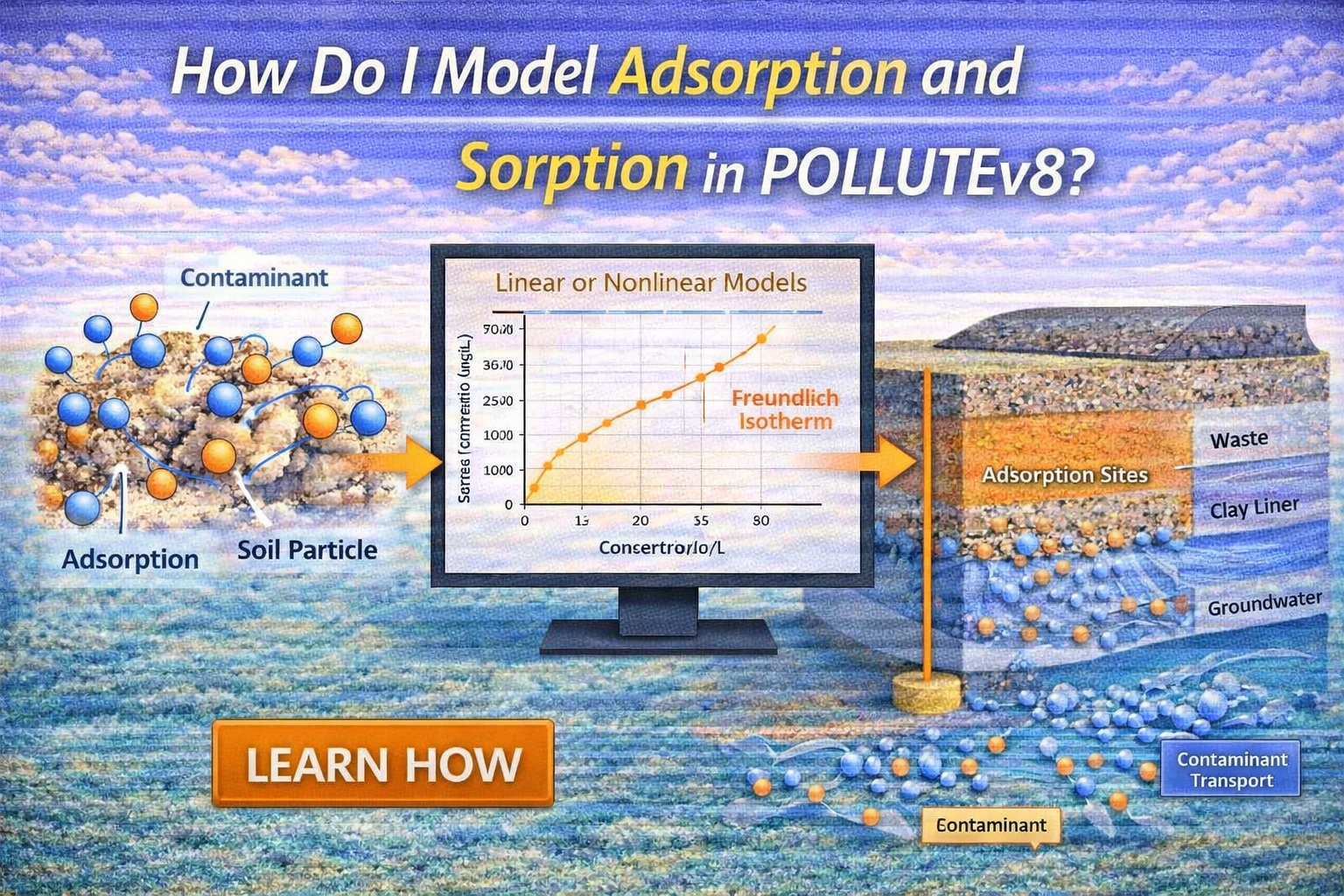
Understanding how contaminants interact with soil particles is critical for accurate environmental modeling. In POLLUTEv10, developed by GAEA Technologies, sorption is one of the most influential parameters affecting the transport and retardation of pollutants through a liner or soil layer.
If you are looking to refine your transport models, here is a step-by-step guide on how to implement sorption effectively.
Understanding the Mechanism: The Retardation Factor
In POLLUTEv10, sorption is typically accounted for using the Retardation Factor (R). This factor represents how much slower a contaminant moves compared to the actual velocity of the groundwater due to its adherence to soil particles.
The relationship is defined by the following linear isotherm equation:
Where:
- = Dry density of the soil
- Kd = Distribution coefficient
- n = Porosity of the medium
Choosing Your Sorption Model
Sorption is defined on a layer-by-layer basis, allowing you to model complex stratigraphy (e.g., a clay liner over a sandy aquifer). POLLUTEv10 allows for different types of sorption inputs depending on the complexity of your data:
Linear Sorption (Kd)
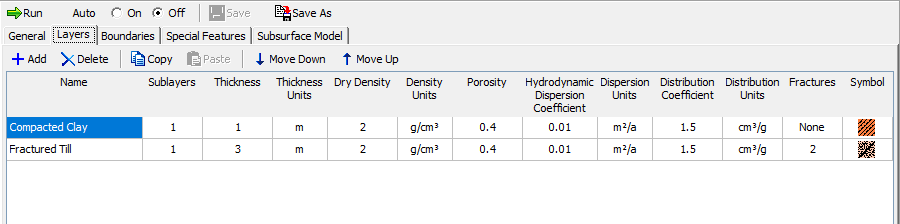
The most common method. You enter a constant distribution coefficient. Linear sorption is entered in the Layer Properties tab of the model as the Distribution Coefficient.
Freundlich and Langmuir Non-linear Sorption
Used for non-linear sorption where the capacity of the soil to “grab” the contaminant changes based on concentration. Non-linear sorption is entered on the Special Features tab.
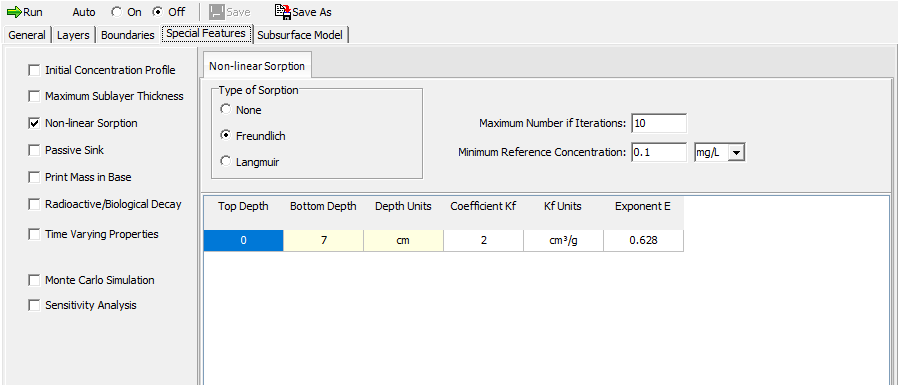
In contaminant transport modeling with POLLUTEv10, choosing between Langmuir and Freundlich models depends on the surface properties of your soil and how you expect the contaminant to behave at high concentrations.
Key Differences Between Models
| Feature | Langmuir Isotherm | Freundlich Isotherm |
|---|---|---|
| Surface Assumption | Homogeneous (all sites are identical). | Heterogeneous (sites have varying energies). |
| Layering | Monolayer only; once a site is occupied, no more can be added. | Multilayer adsorption; stacking of molecules is possible. |
| Saturation | Reaches a distinct plateau (maximum capacity | No theoretical saturation; capacity increases with concentration. |
| Nature | Theoretical/Mechanistic. | Empirical (based on observation). |
When to Use Each in POLLUTEv8
- Choose Langmuir if you are modeling specific chemical binding (chemisorption) or ion exchange, such as heavy metals on clay. It is ideal when you need to define a hard limit on how much a soil layer can hold (the “maximum adsorption capacity”).
- Choose Freundlich if you are modeling organic contaminants or complex, natural soils with many different types of particles. It is often a better fit for a wide range of concentrations because it accounts for “stronger” sites being filled first.
Pro-Tip: In the software, non-linear models are often more accurate than linear ones at very high or very low concentrations where the “constant Kd” assumption fails.
Pro-Tips for Accurate Modeling
- Conservative vs. Non-Conservative: If you are unsure of the sorption capacity, model the contaminant as “conservative” first to see the worst-case scenario.
- Sensitivity Analysis: Always run a sensitivity analysis on your values. Small changes in sorption can lead to massive differences in predicted “breakthrough times.”
- Refer to the Manual: For specific software navigation, consult the GAEA Technologies POLLUTEv10 Documentation.
Reference Table: Typical Kd Values and Sorption Potential
The following values are generalized. In POLLUTEv10, these should be adjusted based on site-specific soil tests.
| Contaminant | Typical | Sorption Potential | Retardation Behavior |
|---|---|---|---|
| Chloride | 0 | None (Conservative) | Moves at the same speed as water. |
| Benzene | 0.5 – 2.0 | Low to Moderate | Slight delay; highly mobile in low-carbon soils. |
| Toluene | 1.0 – 5.0 | Moderate | Noticeable lag in breakthrough time. |
| Cadmium | 1.5 – 25.0 | High | Strongly pH-dependent; often highly retarded. |
| Lead | 10.0 – 100+ | Very High | Highly immobile; moves very slowly through clay. |
| PFAS (PFOA) | 0.2 – 5.0 | Variable | Depends heavily on organic carbon content. |
Summary
Modeling sorption in POLLUTEv10 involves defining the Retardation Factor within the layer properties. By inputting the soil’s dry density, porosity, and the contaminant’s distribution coefficient (Kd), the software calculates how much the pollutant’s migration is delayed. This is essential for determining the long-term effectiveness of landfill liners and remediation barriers.