

Introduction
For decades, geoscience data has been treated primarily as something to store, organize, and retrieve. Borehole logs were archived, laboratory results filed, and maps generated as static outputs. While these practices supported project documentation, they rarely unlocked the full potential of the data itself.
Today, that paradigm is changing.
The geoscience industry is entering a new era—one where data is no longer just stored, but actively interpreted, connected, and transformed into intelligence. This shift is redefining how engineers, geologists, and environmental professionals approach their work.
At the center of this transformation is a simple but powerful idea:
Data should not just exist—it should think, connect, and inform.
This article explores how geoscience data is evolving from passive storage to intelligent systems, what technologies are driving this shift, and what it means for the future of the industry.
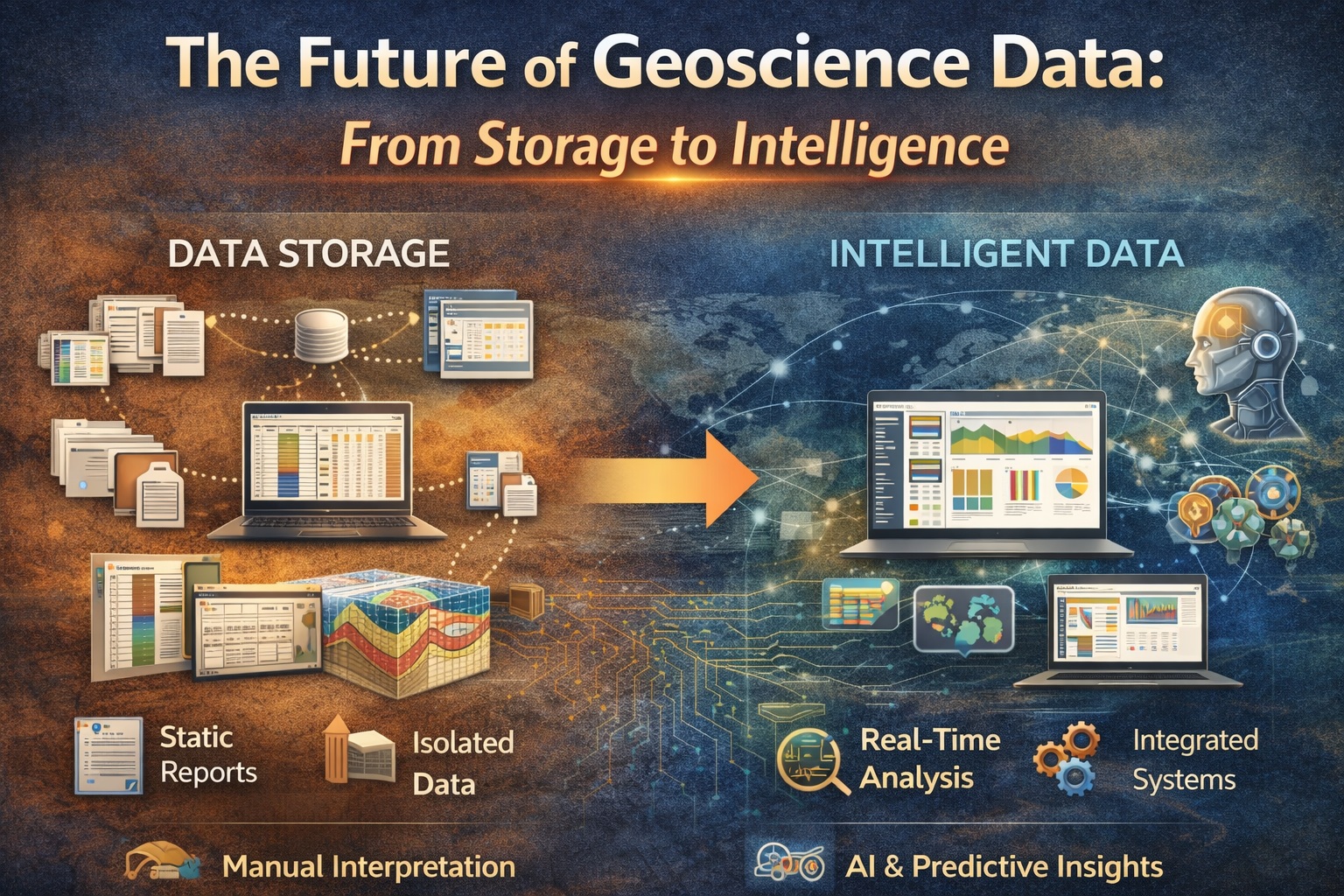
The Legacy Model: Data as Storage
Historically, geoscience workflows have been built around data storage.
What the Traditional Model Looks Like
- Borehole logs stored in spreadsheets or databases
- Laboratory results archived in separate systems
- Maps created as static outputs
- Reports compiled manually
Each dataset existed in isolation, serving a specific purpose.
Limitations of the Storage-First Approach
While effective for record-keeping, this model has significant limitations:
1. Static Information
Data is often frozen in time:
- Reports become outdated
- Visualizations do not update automatically
- Insights are limited to the moment of analysis
2. Fragmentation
Different data types are stored separately:
- Geological data
- Environmental data
- Spatial data
This prevents holistic analysis.
3. Manual Interpretation
Engineers and geoscientists must manually:
- Connect datasets
- Identify patterns
- Draw conclusions
This process is time-consuming and prone to error.
The Shift: Data as a Dynamic Asset
The future of geoscience is built on a new understanding:
Data is not just a record—it is a living asset.
What This Means
- Data updates in real time
- Systems connect different data types automatically
- Insights are generated continuously
Instead of asking:
“Where is the data?”
We now ask:
“What is the data telling us?”
Key Drivers of Transformation
Several technological advancements are enabling this shift from storage to intelligence.
1. Cloud Computing
Cloud platforms allow data to be:
- Stored centrally
- Accessed globally
- Updated in real time
Impact on Geoscience
- Teams can collaborate across locations
- Field data can be uploaded instantly
- Systems scale with project size
2. Big Data and Advanced Analytics
Modern projects generate massive volumes of data.
Advanced analytics tools can:
- Process large datasets بسرعة
- Identify patterns and anomalies
- Support predictive modeling
3. Artificial Intelligence and Machine Learning
AI is transforming how geoscience data is interpreted.
Applications Include:
- Automated classification of geological layers
- Predictive modeling of subsurface conditions
- Detection of trends in environmental data
4. Real-Time Data Integration
Sensors, IoT devices, and digital tools enable continuous data collection.
- Monitoring wells
- Environmental sensors
- Field data capture
This data feeds directly into integrated systems.
5. Visualization Technologies
From 2D maps to advanced 3D models:
- Visualization enhances understanding
- Complex datasets become intuitive
- Decision-making becomes faster
From Data to Intelligence: What Changes?
The transition from storage to intelligence fundamentally changes how data is used.
1. From Static Reports to Dynamic Dashboards
Instead of static documents:
- Dashboards update in real time
- Users access live data
- Reports become interactive
2. From Manual Analysis to Automated Insights
Systems can now:
- Highlight anomalies
- Suggest interpretations
- Generate predictive insights
3. From Isolated Data to Connected Systems
Integrated platforms bring together:
- Borehole data
- Sample results
- GIS mapping
- Cross-sections
Creating a unified view of projects.
4. From Reactive to Proactive Decision-Making
With intelligent systems:
- Risks can be identified early
- Trends can be predicted
- Decisions can be made proactively
The Role of Integrated Platforms
To fully realize data intelligence, integration is essential.
Why Integration Matters
Intelligence requires connection.
Without integration:
- Data remains fragmented
- Insights remain limited
Platforms Like GaeaSynergy
Modern platforms are designed to:
- Centralize data
- Connect workflows
- Enable real-time analysis
They provide the foundation for intelligent systems.
Real-World Applications
The shift to intelligent data is already transforming the industry.
Geotechnical Engineering
- Predictive modeling of soil behavior
- Real-time monitoring of site conditions
- Automated cross-section generation
Environmental Consulting
- Continuous monitoring of contaminants
- Data-driven risk assessments
- Faster regulatory reporting
Mining and Resource Exploration
- Improved resource estimation
- Advanced geological modeling
- Enhanced decision-making
Infrastructure Development
- Better site characterization
- Reduced project risk
- Optimized design decisions
Challenges on the Path to Intelligence
While the future is promising, the transition is not without challenges.
1. Data Quality
Intelligent systems depend on accurate data.
- Poor data quality leads to poor insights
- Standardization is critical
2. Integration Complexity
Connecting legacy systems can be difficult.
- Data formats vary
- Systems may not be compatible
3. Skill Gaps
Adopting new technologies requires:
- Training
- New skill sets
- Organizational change
4. Trust in Automation
Professionals must trust:
- AI-driven insights
- Automated processes
This takes time and validation.
Building Intelligent Workflows
To move from storage to intelligence, organizations must rethink their workflows.
Step 1: Centralize Data
Create a single source of truth.
Step 2: Integrate Systems
Connect all data types and tools.
Step 3: Enable Real-Time Updates
Ensure data is always current.
Step 4: Leverage Analytics and AI
Use technology to generate insights.
Step 5: Focus on User Experience
Design systems that support real workflows.
The Human Element
Despite technological advances, humans remain central.
Engineers and Geoscientists Still:
- Interpret results
- Validate insights
- Make final decisions
Technology enhances—not replaces—expertise.
The Next Frontier: Predictive and Autonomous Systems
Looking ahead, geoscience data will become even more intelligent.
Emerging Possibilities
- Digital twins of subsurface environments
- Fully automated data pipelines
- AI-driven design recommendations
- Autonomous monitoring systems
Why This Matters Now
The pressures facing the industry are increasing:
- Climate change
- Urbanization
- Resource demand
- Environmental regulation
These challenges require:
- Faster decisions
- Better insights
- More efficient workflows
Intelligent data systems are essential.
GaeaSynergy and the Intelligence Shift
Platforms like GaeaSynergy are already enabling this transition.
By providing:
- Integrated data environments
- Real-time updates
- Advanced visualization
They lay the groundwork for intelligent workflows.
Conclusion
The future of geoscience data is not about storing more information—it’s about understanding it better.
The shift from storage to intelligence represents a fundamental transformation:
- From static to dynamic
- From isolated to connected
- From reactive to proactive
As technology continues to evolve, organizations that embrace intelligent data systems will gain a significant advantage.
Because in the end:
Data alone is not enough.
Intelligence is what drives progress.