

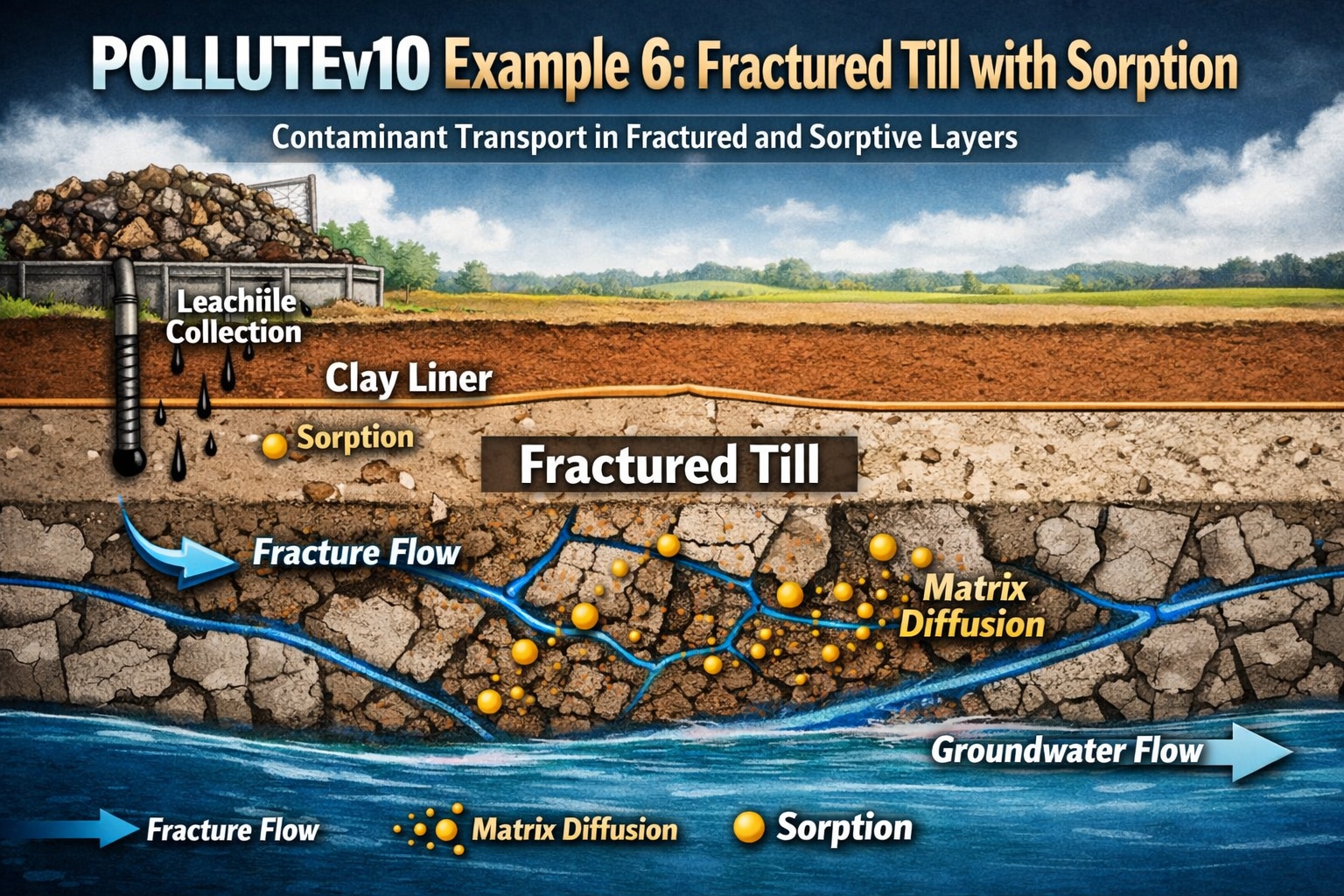
This example demonstrates the application of POLLUTEv10 for a more complex subsurface condition where fractured media and sorption processes both influence contaminant transport. It builds on previous cases by introducing a fractured till layer beneath a compacted clay liner and modeling a reactive contaminant species that sorbs to soil particles.
Conceptual Model Overview
The system consists of:
- A 1 m compacted clay liner (low permeability, sorptive)
- A 3 m fractured till layer (preferential flow pathways via fractures)
- An underlying aquifer with controlled inflow/outflow
- A finite contaminant source with a leachate collection system
Unlike homogeneous systems, this model accounts for:
- Dual-domain transport (fractures + matrix)
- Sorption in both clay liner and matrix
- Advection and dispersion in fractures
- Diffusion between fractures and matrix
Hydraulic Conditions and Flow Calculations
The governing hydraulic parameters are:
- Darcy velocity through the deposit:
va = 0.02 m/a - Infiltration through the cover:
qo = 0.3 m/a
Leachate Collection Rate
The volume of leachate collected (Qc) is calculated as:
This indicates that most infiltrating water is captured by the leachate collection system, limiting downward contaminant migration.
Aquifer Flow Conditions
- Upgradient inflow: 4 m/a
- Landfill length: 200 m
The downgradient outflow velocity (vb) is:
This reflects the cumulative contribution of vertical seepage across the landfill footprint.
Key Input Parameters
Soil and Transport Properties
| Property | Symbol | Value | Units |
|---|---|---|---|
| Darcy Velocity | va | 0.02 | m/a |
| Diffusion Coefficient | D | 0.01 | m²/a |
| Distribution Coefficient | Kd | 1.5 | cm³/g |
| Soil Porosity | n | 0.4 | – |
| Dry Density | ρd | 2 | g/cm³ |
Layer Configuration
| Layer | Thickness | Sub-layers |
|---|---|---|
| Clay Liner (HL) | 1 m | 1 |
| Fractured Till (HT) | 3 m | 1 |
Fracture Properties
| Property | Value |
|---|---|
| Fracture spacing (x, y) | 1 m |
| Fracture aperture | 10 μm |
| Dispersion in fractures (Df) | 0.06 m²/a |
| Fracture sorption (Kf) | 0 cm³/g |
Matrix Properties (Till)
| Property | Value |
|---|---|
| Diffusion coefficient (Dm) | 0.01 m²/a |
| Distribution coefficient (Km) | 1.5 cm³/g |
| Porosity (nm) | 0.4 |
| Dry density | 2 g/cm³ |
Source and Boundary Conditions
| Property | Value |
|---|---|
| Source concentration (co) | 1000 mg/L |
| Rate of increase (cr) | 0 mg/L/a |
| Leachate head (Hr) | 7.5 m |
| Leachate collection (Qc) | 0.28 m/a |
| Aquifer thickness (h) | 1 m |
| Aquifer porosity (nb) | 0.35 |
| Base outflow velocity (vb) | 8 m/a |
| Time range | 20–300 years |
Key Processes Simulated
1. Fracture Flow Dominance
The fractured till introduces preferential pathways, allowing faster contaminant migration compared to the clay liner. However, this is moderated by:
- Narrow fracture apertures (10 μm)
- Diffusion into the surrounding matrix
2. Sorption Effects
The contaminant is reactive, meaning:
- It sorbs onto clay liner material
- It also sorbs within the till matrix
- No sorption occurs within fractures (Kf = 0)
This leads to:
- Retardation of plume movement
- Reduced peak concentrations
- Increased long-term tailing
3. Matrix Diffusion
Contaminants move from fractures into the porous matrix via diffusion:
- Acts as a temporary storage mechanism
- Slows breakthrough in the aquifer
- Causes back-diffusion at later times
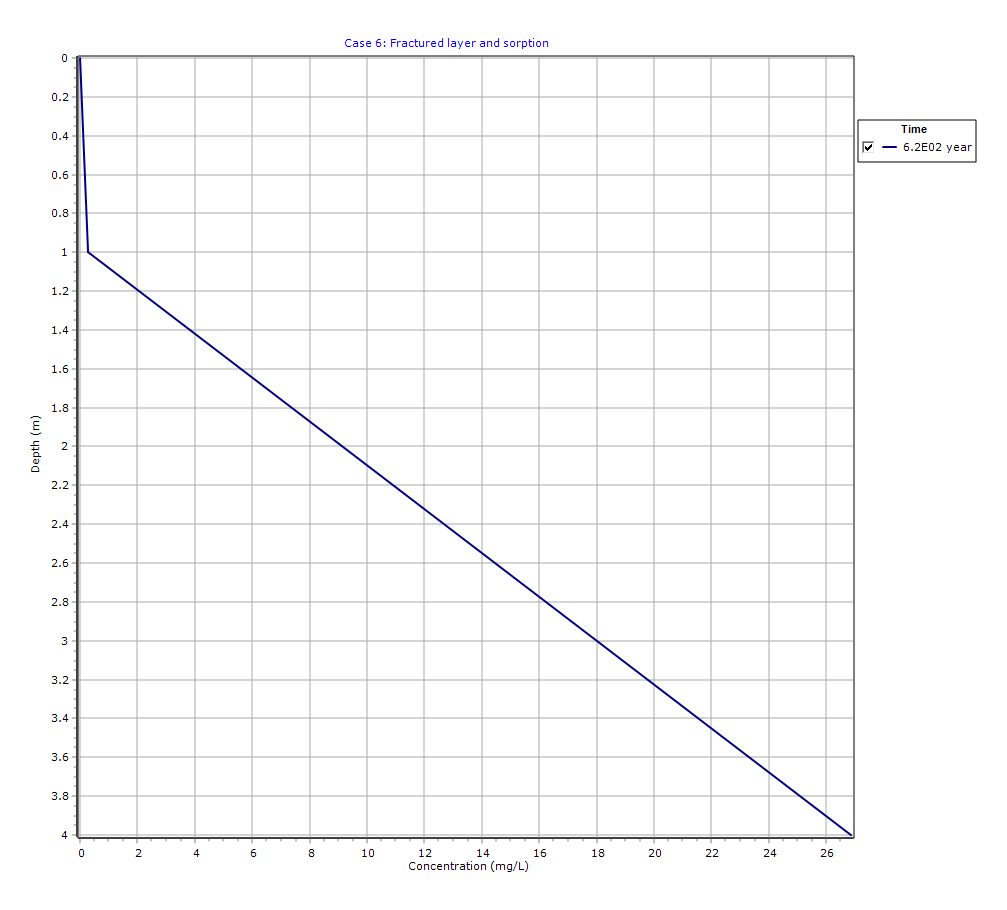
Graphical Output: Depth vs Concentration
PDF Report
 Loading…

 Reload document
  Open in new tab
 Interpretation of Results
This scenario typically produces:
- Delayed breakthrough compared to non-reactive cases
- Lower peak concentrations due to sorption
- Extended contaminant persistence due to matrix diffusion
The fractured till increases transport speed locally, but the combined effects of sorption and matrix diffusion significantly mitigate overall contaminant migration.
Engineering Insights
- Even with fractures, clay liners remain highly effective when sorption is significant.
- Leachate collection systems (Qc = 0.28 m/a) play a critical role in reducing contaminant flux.
- Ignoring matrix diffusion in fractured systems can underestimate long-term impacts.
- Reactive transport modeling is essential for realistic risk assessment.
Learn more about our Contaminant Transport Modeling Solutions
POLLUTE Examples
- POLLUTEv10 Example 1: Modeling a U.S. RCRA Subtitle D Landfill
- POLLUTEv10 Example 2: Pure Diffusion in a Soil Layer (No Sorption)
- POLLUTEv10 Example 3: Advection + Diffusion with Aquifer Mixing
- POLLUTEv10 Example 4: Finite Mass Source with Leachate Collection System
- POLLUTEv10 Example 5: Hydraulic Trap (Upward Flow into the Landfill)
- POLLUTEv10 Example 7: Lateral Migration of a Radioactive Contaminant in Fractured Rock
- POLLUTEv10 Example 8: Laboratory Diffusion of Potassium in Clay
- POLLUTEv10 Example 9: Diffusion with Freundlich Non-Linear Sorption (Phenol in Clay)
- POLLUTEv10 Example 10: Time-Varying Advective–Dispersive Transport from a Landfill
- POLLUTEv10 Example 11: Time-Varying Source Concentration with Diffusion (Chloride in Clay)
- POLLUTEv10 Example 12: Fractured Media Transport vs Analytical Solution (Tang et al., 1981)
- POLLUTEv10 Example 13: 2D Plane Dispersion vs Analytical Solution (TDAST)
- POLLUTEv10 Example 14: Modeling a Landfill with Primary and Secondary Leachate Collection Using Passive Sink
- POLLUTEv10 Example 15: Modeling Leachate Collection System Failure Using Variable Properties and Passive Sink
- POLLUTEv10 Example 16: Monte Carlo Simulation of Leachate Collection System Failure Timing
- POLLUTEv10 Example 17: Modeling a Landfill with Composite Liners and Dual Leachate Collection Systems
- POLLUTEv10 Example 18: Modeling Phase Change in a Secondary Leachate Collection System
- POLLUTEv10 Example 19: Multiphase Diffusion of Toluene Through a Geomembrane System
- POLLUTEv10 Example 20: Sensitivity Analysis of Primary Leachate Collection System Failure