

Modeling Transient Source Histories in Landfill Systems
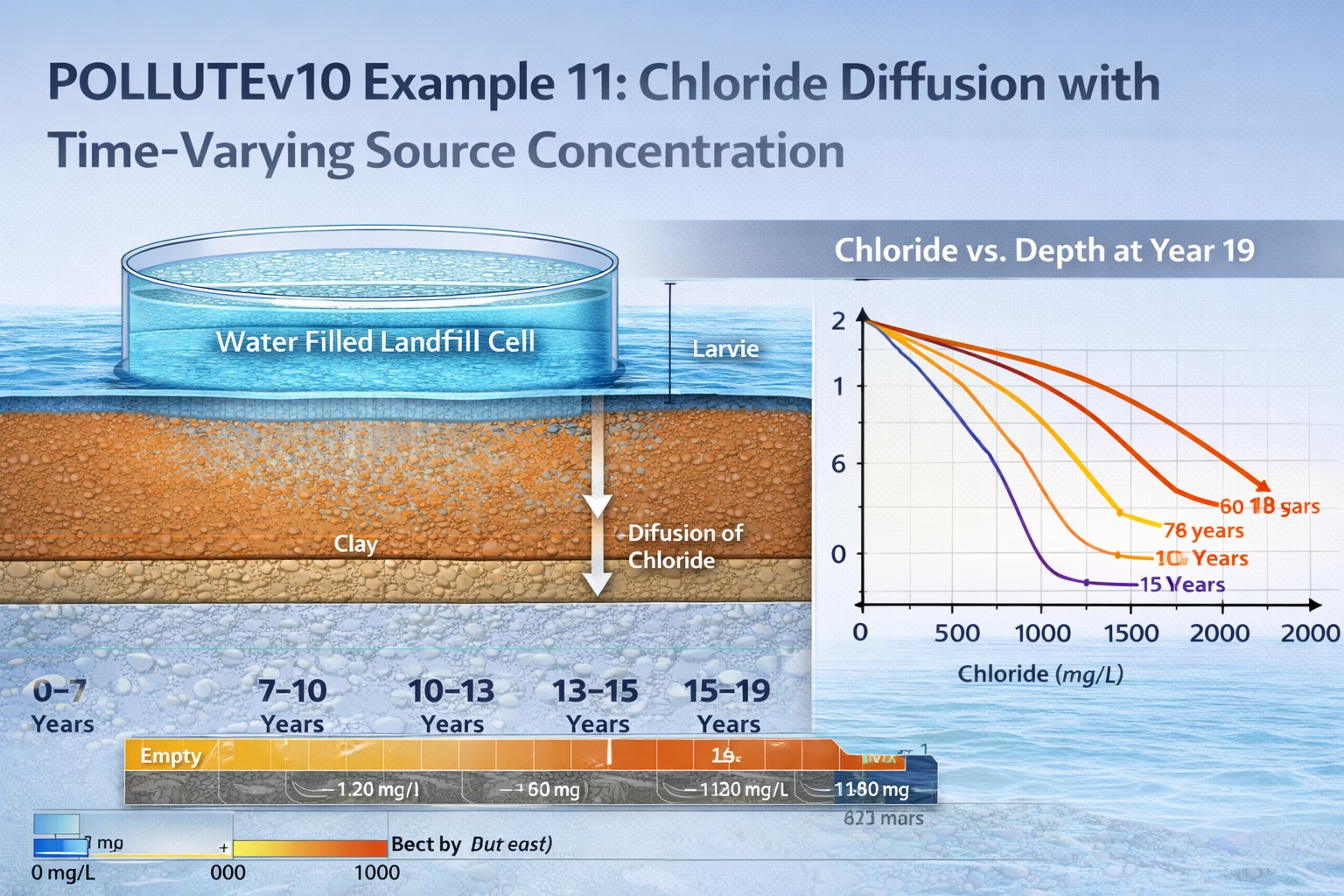
POLLUTEv10 Example 11 focuses on a critical real-world scenario: time-varying source concentration combined with diffusion-only transport in a clay medium.
Unlike previous examples, this case highlights how changing contaminant inputs over time influence subsurface concentration profiles—even in the absence of groundwater flow.
Problem Overview
This example simulates:
- A hypothetical landfill cell
- A conservative contaminant (chloride)
- No advection (Darcy velocity = 0)
- A time-dependent source concentration history
- A semi-infinite clay domain
Initial Conditions
- Clay pore water contains chloride at 120 mg/L
- Landfill cell is filled with water (6 m depth)
- No waste is present for the first 7 years
Conceptual Model
The system evolves through several stages:
Stage 1: 0–7 Years (Pre-Waste Phase)
- Clean water in landfill cell
- Chloride diffuses from clay → into water
- Gradient driven by initial clay concentration (120 mg/L)
Stage 2: 7–10 Years (Waste Placement)
- Chloride concentration increases linearly to 2100 mg/L
- Gradient reverses direction
Stage 3: 10–13 Years (Peak Phase)
- Source concentration remains constant at 2100 mg/L
Stage 4: 13–15 Years (Decline Phase)
- Concentration decreases to 1180 mg/L
Stage 5: 15–19 Years (Stabilization)
- Concentration remains constant again
Key Modeling Objective
The goal is to:
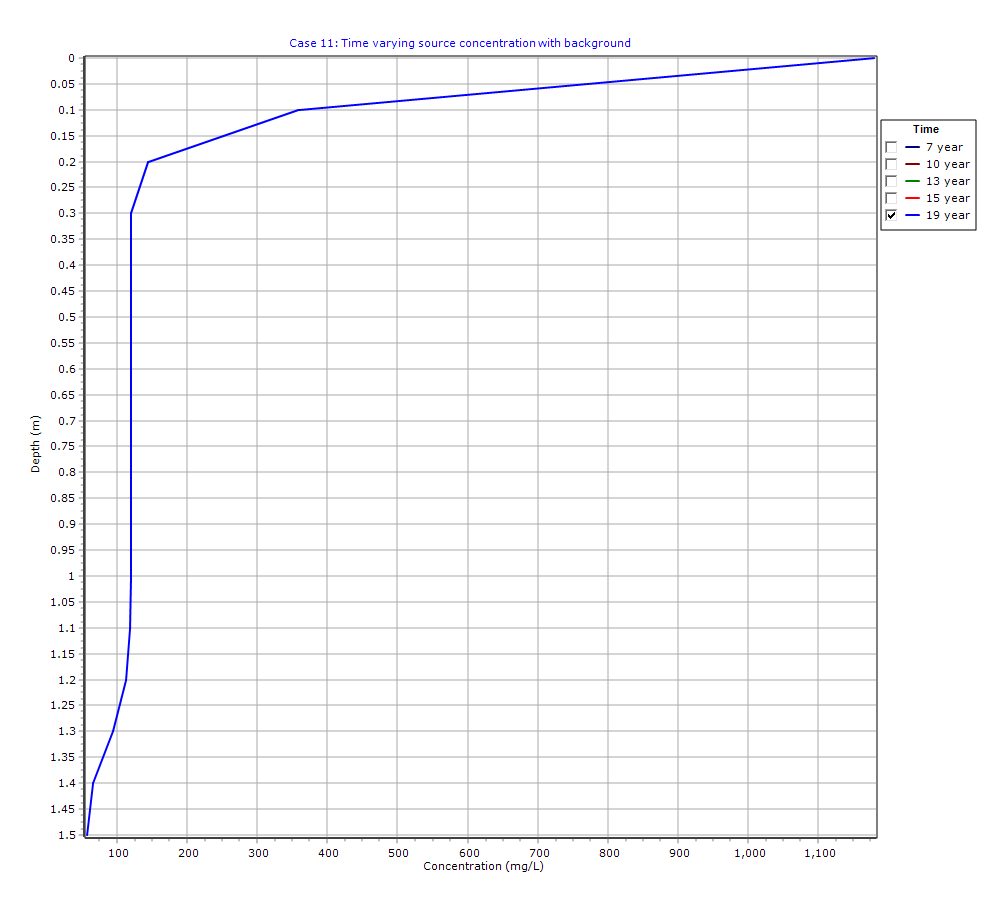
Predict chloride concentration distribution with depth at year 19
Input Parameters
| Property | Value | Units |
|---|---|---|
| Darcy Velocity (va) | 0.0 | m/a |
| Diffusion Coefficient (Dm) | 0.00663 | m²/a |
| Distribution Coefficient | 0.0 | cm³/g |
| Dispersivity | 0.0 | m |
| Soil Porosity (n) | 0.37 | – |
| Dry Density | 1.6 | g/cm³ |
| Thickness of Interest (H) | 1.5 | m |
| Sub-layers | 15 | – |
| Source Concentration | Variable | mg/L |
| Leachate Height (Hr) | 6.0 | m |
Key Equation
Since there is no flow, transport is purely diffusive:
With:
- va=0
- α=0
➡️ Therefore:
- D = Dm
- Dispersion effects are negligible
Time-Varying Source Representation
A key modeling technique in this example:
- The Reference Height of Leachate (Hr) is set very large during intervals
- This ensures the source concentration remains constant within each time step
This allows POLLUTEv10 to simulate:
- Stepwise or linear changes in concentration
- Complex source histories
Transport Mechanisms
1. Diffusion Only
- Driven by concentration gradients
- No advective transport
- Symmetric spreading behavior
2. No Sorption
- Chloride is conservative
- Moves freely with no retardation
3. Infinite Domain Assumption
- Clay thickness is effectively infinite
- No boundary effects at depth
Graphical Output: Concentration vs Time
PDF Report
 Loading…

 Reload document
  Open in new tab
 Key Insights
- Time-varying sources can significantly alter transport behavior
- Even without flow, diffusion redistributes contaminants over time
- Early conditions can influence long-term profiles
- Conservative species respond directly to boundary condition changes
Importance of Sub-Layer Resolution
Accuracy depends on the number of sub-layers when using Variable Properties.
- Time-dependent inputs require fine discretization
- Recommended: ≥ 15 sub-layers
- Ensures accurate capture of transient gradients
Practical Applications
This example is useful for:
- Landfill design and performance assessment
- Chloride migration studies
- Time-dependent contaminant modeling
- Calibration against monitoring data
Important Disclaimer
This is a hypothetical example intended to demonstrate modeling techniques.
It is not a universal modeling approach for all landfill systems.
Proper application requires:
- Hydrogeologic expertise
- Site-specific parameter selection
- Engineering judgment
Conclusion
POLLUTEv10 Example 11 demonstrates how time-varying source concentrations influence contaminant transport in diffusion-dominated systems.
Key takeaways:
- Diffusion alone can produce complex concentration profiles
- Source history plays a critical role in long-term outcomes
- Variable Properties enables realistic simulation of changing conditions
This example is essential for understanding transient contaminant behavior in low-permeability soils.
Learn more about our Contaminant Transport Modeling Solutions
POLLUTE Examples
- POLLUTEv10 Example 1: Modeling a U.S. RCRA Subtitle D Landfill
- POLLUTEv10 Example 2: Pure Diffusion in a Soil Layer (No Sorption)
- POLLUTEv10 Example 3: Advection + Diffusion with Aquifer Mixing
- POLLUTEv10 Example 4: Finite Mass Source with Leachate Collection System
- POLLUTEv10 Example 5: Hydraulic Trap (Upward Flow into the Landfill)
- POLLUTEv10 Example 6: Fractured Layer with Sorption and Reactive Transport
- POLLUTEv10 Example 7: Lateral Migration of a Radioactive Contaminant in Fractured Rock
- POLLUTEv10 Example 8: Laboratory Diffusion of Potassium in Clay
- POLLUTEv10 Example 9: Diffusion with Freundlich Non-Linear Sorption (Phenol in Clay)
- POLLUTEv10 Example 10: Time-Varying Advective–Dispersive Transport from a Landfill
- POLLUTEv10 Example 12: Fractured Media Transport vs Analytical Solution (Tang et al., 1981)
- POLLUTEv10 Example 13: 2D Plane Dispersion vs Analytical Solution (TDAST)
- POLLUTEv10 Example 14: Modeling a Landfill with Primary and Secondary Leachate Collection Using Passive Sink
- POLLUTEv10 Example 15: Modeling Leachate Collection System Failure Using Variable Properties and Passive Sink
- POLLUTEv10 Example 16: Monte Carlo Simulation of Leachate Collection System Failure Timing
- POLLUTEv10 Example 17: Modeling a Landfill with Composite Liners and Dual Leachate Collection Systems
- POLLUTEv10 Example 18: Modeling Phase Change in a Secondary Leachate Collection System
- POLLUTEv10 Example 19: Multiphase Diffusion of Toluene Through a Geomembrane System
- POLLUTEv10 Example 20: Sensitivity Analysis of Primary Leachate Collection System Failure
Comparison between POLLUTE and MIGRATE
- MIGRATEv10 vs POLLUTEv10: Pure Diffusion Comparison
- MIGRATEv10 vs POLLUTEv10: Advective–Diffusive Transport Comparison
- MIGRATEv10 vs POLLUTEv10: Finite Mass Source Comparison
- MIGRATEv10 vs POLLUTEv10: Hydraulic Trap (Finite Mass Source) Comparison
- MIGRATEv10 vs POLLUTEv10: Fractured Layer with Sorption Comparison