

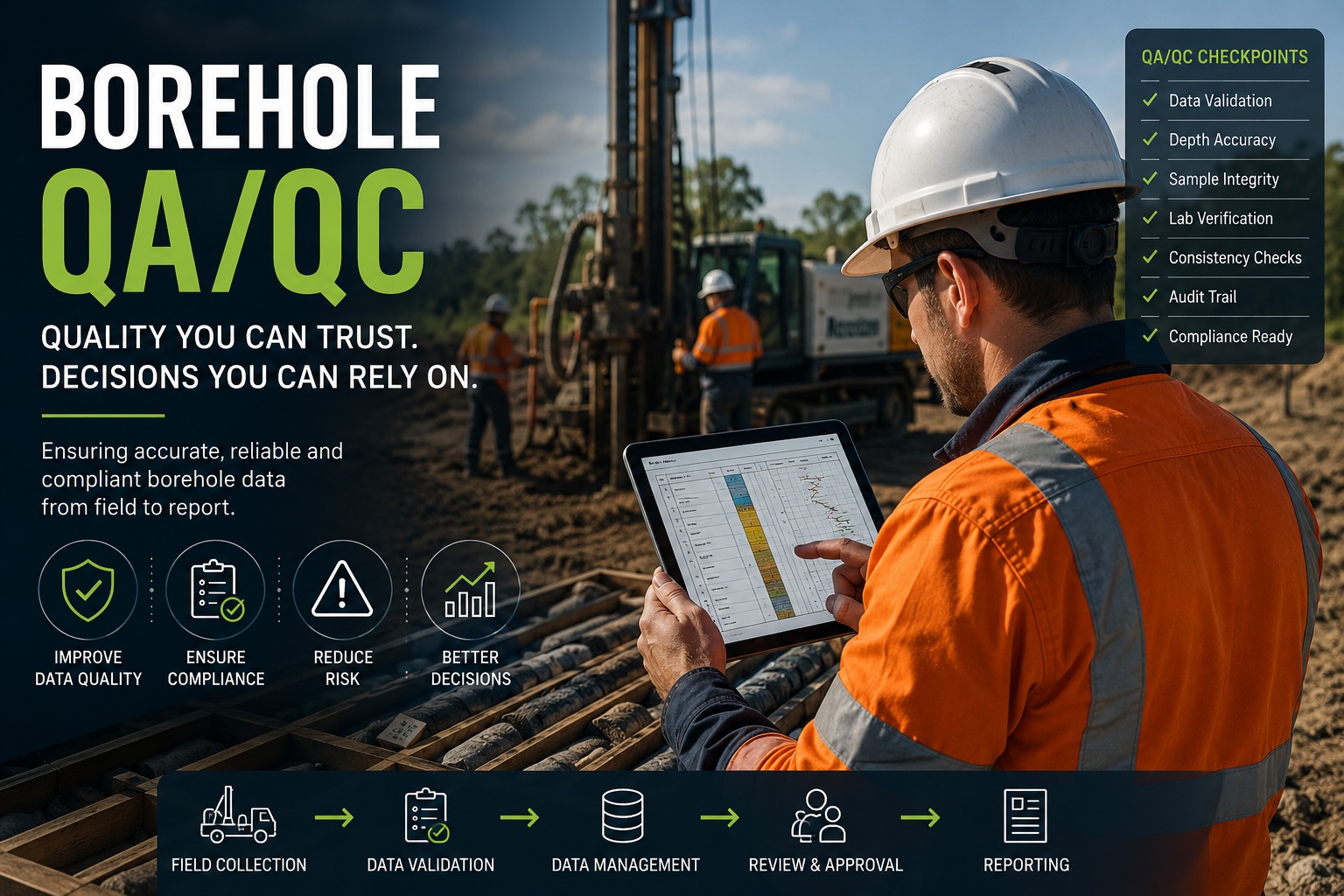
In the world of geotechnical, environmental, mining, and hydrogeological investigations, borehole data forms the foundation of critical decisions. Whether designing a building foundation, assessing environmental contamination, evaluating mineral resources, or managing groundwater systems, engineers and scientists rely heavily on the accuracy and reliability of borehole information.
This is where Borehole QA/QC becomes essential.
Quality Assurance (QA) and Quality Control (QC) are systematic processes used to ensure borehole data is accurate, consistent, traceable, and compliant with industry standards. Without proper QA/QC procedures, even small errors in drilling logs, sample records, laboratory results, or reports can lead to costly mistakes, regulatory issues, safety risks, and project delays.
In this article, we will explore what borehole QA/QC means, the difference between QA and QC, how QA/QC applies throughout the borehole data lifecycle, and why it plays such an important role in modern subsurface investigations.
What Is Borehole QA/QC?
Borehole QA/QC refers to the collection of procedures, standards, workflows, and validation methods used to maintain the integrity of borehole-related data and documentation.
The goal is simple:
- Ensure data is correct
- Detect and prevent errors
- Improve consistency
- Maintain regulatory compliance
- Reduce project risk
- Increase confidence in decision-making
QA/QC applies to every stage of a project, including:
- Drilling operations
- Field observations
- Sample collection
- Laboratory testing
- Data entry
- Data interpretation
- Reporting
- Archiving and long-term management
Because borehole data often passes through multiple people, systems, and revisions, maintaining quality control is not a one-time task. It is a continuous process throughout the project lifecycle.
Understanding the Difference Between QA and QC
Although the terms are often used together, Quality Assurance and Quality Control are not the same thing.
What Is Quality Assurance (QA)?
Quality Assurance focuses on preventing problems before they occur.
QA involves creating procedures, standards, workflows, and training systems designed to ensure work is performed correctly from the start.
Examples of QA activities include:
- Standardized logging procedures
- Controlled data entry forms
- Mandatory field requirements
- Staff training
- Workflow approvals
- Validation rules
- Version control systems
- Audit trails
- Standard operating procedures (SOPs)
QA is proactive.
It aims to reduce the likelihood of errors entering the system.
Example
A borehole logging software platform that prevents users from entering impossible SPT values or invalid sample depths is using QA principles.
What Is Quality Control (QC)?
Quality Control focuses on detecting and correcting errors after data has been collected or entered.
QC activities typically include:
- Reviewing borehole logs
- Comparing laboratory data against field records
- Checking for missing intervals
- Verifying coordinates and elevations
- Running validation reports
- Identifying outliers
- Reviewing final reports
QC is reactive.
It identifies problems that may have slipped through the QA process.
Example
A reviewer notices that a groundwater elevation is inconsistent with nearby monitoring wells and flags it for correction. This is QC.
QA and QC Work Together
Strong QA reduces the number of errors introduced into a project, while strong QC ensures remaining issues are identified before final deliverables are released.
Organizations that rely only on QC often spend significant time fixing preventable mistakes. Organizations with robust QA systems usually achieve faster project delivery, lower costs, and higher data reliability.
The Borehole Data Lifecycle
One of the most important concepts in borehole QA/QC is understanding the full data lifecycle.
Errors can occur at any stage, and issues introduced early in a project often propagate into later analyses and reports.
1. Project Planning
QA/QC begins before drilling starts.
At this stage, teams define:
- Data standards
- Logging procedures
- Sampling requirements
- Coordinate systems
- Naming conventions
- Approval workflows
- Regulatory requirements
- Deliverable formats
Good planning reduces inconsistencies later in the project.
2. Field Data Collection
Fieldwork is one of the highest-risk stages for data quality issues.
Common problems include:
- Incorrect sample depths
- Transcription errors
- Missing intervals
- Inconsistent lithology descriptions
- GPS inaccuracies
- Incorrect casing information
- Illegible notes
Field QA/QC practices may include:
- Digital logging systems
- Required field validation
- Real-time error checking
- Daily supervisor review
- Standardized classification systems
- Automated depth consistency checks
Modern software solutions increasingly perform validation during data entry rather than waiting until final review.
3. Laboratory Testing
Laboratory QA/QC is essential for ensuring test results remain accurate and traceable.
Important QC checks may include:
- Duplicate samples
- Calibration records
- Chain-of-custody verification
- Detection limit validation
- Outlier detection
- Cross-checking sample IDs
Incorrect laboratory data can significantly impact engineering designs or environmental assessments.
4. Data Entry and Management
Once field and laboratory data enters a central database, additional QA/QC procedures become critical.
Common database validation checks include:
- Overlapping intervals
- Missing depths
- Invalid coordinates
- Duplicate sample IDs
- Impossible values
- Inconsistent units
- Mismatched lithology codes
- Incorrect groundwater elevations
Modern borehole database systems often include automated rules engines to continuously validate data as it is entered or modified.
5. Interpretation and Modeling
Geological interpretations, cross-sections, contaminant models, and geotechnical analyses all depend on high-quality source data.
Poor QA/QC at earlier stages can lead to:
- Incorrect subsurface models
- Faulty groundwater interpretations
- Misleading contamination boundaries
- Unsafe engineering assumptions
- Overestimated or underestimated reserves
At this stage, QA/QC often involves peer review and interdisciplinary verification.
6. Reporting and Deliverables
The final report may be the most visible project output, but it is also one of the last opportunities to catch errors.
QC review during reporting may include:
- Verifying borehole logs
- Confirming figure consistency
- Checking units and elevations
- Ensuring regulatory compliance
- Reviewing calculations
- Validating tables and appendices
Automated report generation systems can significantly reduce manual transcription errors.
Field-to-Report Workflow
Borehole QA/QC works best when integrated into a structured field-to-report workflow.
A typical workflow may look like this:
- Field data collected digitally
- Validation rules applied during entry
- Daily review by field supervisor
- Data synchronized to central database
- Automated QC rules executed
- Reviewer performs technical validation
- Laboratory data imported and checked
- Borehole status updated through workflow stages
- Final approval completed
- Reports generated from validated data
This type of controlled workflow creates accountability, traceability, and consistency across projects.
Why Borehole QA/QC Matters
1. Regulatory Compliance
Many industries are subject to strict regulatory requirements regarding data quality and reporting.
Examples include:
- Environmental regulations
- Mining reporting standards
- Groundwater monitoring programs
- Geotechnical investigation requirements
- Infrastructure quality standards
Regulators increasingly expect:
- Traceable audit histories
- Validated datasets
- Electronic submission standards
- Consistent classification systems
- Documented QA/QC procedures
Failure to maintain proper QA/QC can result in:
- Rejected submissions
- Fines or penalties
- Delayed approvals
- Legal disputes
- Loss of professional credibility
2. Risk Reduction
Poor borehole data introduces substantial project risk.
Examples include:
- Foundation failures
- Incorrect contaminant delineation
- Unsafe slope designs
- Drilling into unknown hazards
- Cost overruns
- Construction delays
Even small data entry mistakes can produce major downstream consequences.
For example:
- A misplaced decimal point in groundwater elevation
- Incorrect sample depths
- Reversed coordinates
- Missing contamination results
Strong QA/QC procedures reduce the likelihood of these issues affecting final decisions.
3. Better Decision-Making
High-quality borehole data improves confidence in:
- Geological interpretations
- Engineering designs
- Environmental remediation plans
- Resource estimates
- Groundwater models
- Construction planning
Reliable data allows teams to make faster and more defensible decisions.
4. Improved Efficiency
Organizations often assume QA/QC slows projects down, but the opposite is usually true.
Projects with weak QA/QC spend enormous time:
- Fixing errors
- Reissuing reports
- Reconciling datasets
- Handling client complaints
- Responding to regulatory comments
Automated QA/QC systems reduce rework and improve project turnaround times.
5. Long-Term Data Value
Borehole data often remains valuable for decades.
Old borehole records may later support:
- New construction projects
- Regional geological studies
- Environmental investigations
- Infrastructure upgrades
- Groundwater assessments
If historical data lacks QA/QC, its reliability becomes questionable.
Well-managed data systems preserve long-term value and usability.
The Growing Role of Automation in Borehole QA/QC
As projects become larger and datasets more complex, manual QA/QC methods are no longer sufficient.
Modern borehole software platforms increasingly use:
- Automated validation rules
- Workflow approvals
- Statistical anomaly detection
- Real-time field validation
- AI-assisted review systems
- Version tracking
- Audit logging
- Role-based permissions
Automation helps organizations standardize quality processes while reducing human error.
However, automated systems should support—not replace—professional judgment and technical review.
Final Thoughts
Borehole QA/QC is far more than a simple review process. It is a comprehensive framework that protects data integrity throughout the entire project lifecycle.
By combining proactive Quality Assurance with reactive Quality Control, organizations can:
- Improve data reliability
- Reduce project risk
- Meet regulatory requirements
- Increase operational efficiency
- Deliver higher-quality reports
- Preserve long-term data value
As the industry moves toward increasingly digital and automated workflows, robust QA/QC systems are becoming essential rather than optional.
In subsurface investigations, decisions are only as good as the data behind them. Strong borehole QA/QC ensures that data can be trusted.