

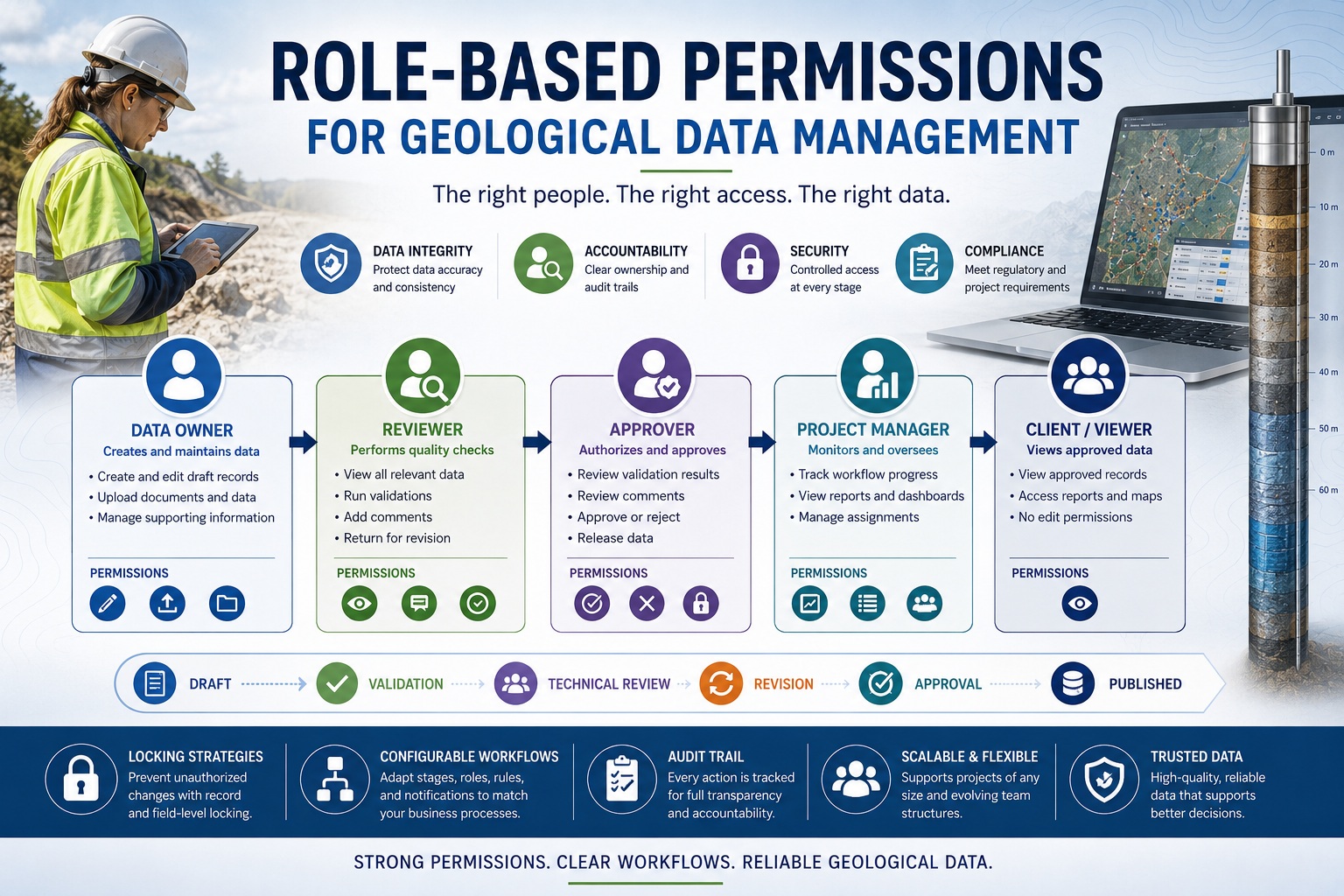
Geological data is one of the most valuable assets within environmental, geotechnical, hydrogeological, mining, and infrastructure projects. Borehole logs, laboratory results, groundwater measurements, geological interpretations, and spatial datasets often influence critical decisions worth millions of dollars. Ensuring the integrity, security, and traceability of this information requires more than simply storing data in a database. It requires a well-designed permission model that controls who can view, edit, review, approve, and publish information throughout the data lifecycle.
Role-based permissions provide the foundation for effective geological data governance. By assigning responsibilities and access rights based on job functions rather than individual users, organizations can improve data quality, strengthen accountability, support regulatory compliance, and streamline project workflows.
This article explores the importance of role-based permissions in geological data management and examines key concepts including data ownership, reviewer permissions, approver permissions, locking strategies, and customer-configurable workflows.
Why Role-Based Permissions Matter
In many organizations, geological data passes through multiple hands before it becomes part of the official project record.
A single borehole may involve:
- Field technicians collecting data
- Geologists logging lithology
- Laboratory personnel generating analytical results
- Data managers importing information
- Reviewers performing quality control
- Project managers approving deliverables
- Clients accessing final reports
Without clearly defined permissions, organizations risk:
- Unauthorized data modifications
- Accidental data loss
- Inconsistent review processes
- Compliance violations
- Lack of accountability
- Conflicting versions of the same dataset
Role-based permissions ensure that users only perform actions appropriate to their responsibilities while maintaining complete visibility into who made changes and when.
Understanding Role-Based Access Control
Role-Based Access Control (RBAC) is a security and governance model that assigns permissions to roles rather than individual users.
For example:
| Role | Typical Permissions |
|---|---|
| Data Entry Technician | Create and edit draft records |
| Reviewer | Review and comment on records |
| Approver | Approve and release records |
| Project Manager | Monitor workflow progress |
| Administrator | Configure permissions and workflows |
| Client User | View approved data only |
Users inherit permissions from their assigned roles, simplifying administration and ensuring consistent access controls across projects.
Data Ownership
One of the most important concepts in geological data management is data ownership.
Ownership establishes responsibility for the accuracy, completeness, and maintenance of data records.
What Is a Data Owner?
A data owner is typically the individual or group responsible for creating and maintaining a specific dataset.
Examples include:
- A geologist responsible for lithology logs
- A hydrogeologist responsible for groundwater measurements
- A laboratory coordinator responsible for analytical results
- A project manager responsible for final project deliverables
Ownership does not necessarily mean unrestricted access. Instead, ownership identifies accountability.
Benefits of Data Ownership
Clear ownership provides several advantages:
Accountability
Every record has a responsible party.
Faster Issue Resolution
Review comments can be directed to the correct individual.
Improved Data Quality
Owners are more likely to maintain high-quality records when responsibility is clearly defined.
Audit Support
Regulatory agencies often require organizations to demonstrate who created or modified data.
Ownership Throughout the Lifecycle
Ownership may change as data progresses through workflow stages.
For example:
- Data Entry Technician creates draft record.
- Geologist becomes responsible for technical content.
- Reviewer validates data quality.
- Approver authorizes release.
- Data Manager archives final version.
Tracking ownership transitions creates transparency and supports governance requirements.
Reviewer Permissions
Reviewers serve as the primary quality control checkpoint within geological workflows.
They provide independent assessment of data before approval.
Typical Reviewer Responsibilities
Reviewers may:
- Examine borehole logs
- Verify laboratory imports
- Check coordinate accuracy
- Assess completeness
- Evaluate geological interpretations
- Review groundwater measurements
- Confirm compliance with standards
Permissions Reviewers Should Have
A reviewer typically requires the ability to:
- View all relevant project data
- Access supporting documents
- Run validation checks
- Add comments and recommendations
- Assign corrective actions
- Return records for revision
However, reviewers often should not have authority to approve records or modify approved data directly.
Maintaining separation between review and approval functions strengthens quality assurance and reduces conflicts of interest.
Read-Only Versus Editable Review
Organizations frequently choose between two review models.
Read-Only Review
Reviewers cannot modify records.
Advantages include:
- Strong auditability
- Clear accountability
- Controlled change management
Editable Review
Reviewers can correct minor issues directly.
Advantages include:
- Faster workflow completion
- Reduced administrative effort
Many organizations adopt a hybrid approach where reviewers can make minor corrections while significant changes require reassignment to the original owner.
Approver Permissions
Approval represents formal acceptance of geological data.
Approvers play a critical governance role because their decisions determine whether information becomes part of the official project record.
Who Should Be an Approver?
Approvers are typically:
- Senior geologists
- Project managers
- Technical leads
- Hydrogeologists
- Quality managers
- Regulatory coordinators
Approvers should possess sufficient technical expertise and authority to evaluate data quality and project requirements.
Typical Approval Permissions
Approvers commonly receive authority to:
- Review validation history
- Examine reviewer comments
- Approve records
- Reject submissions
- Request additional revisions
- Release data for reporting
- Lock approved records
Because approval carries significant responsibility, approval rights should be granted sparingly.
Separation of Duties
A best practice in geological data governance is separating the roles of creator, reviewer, and approver.
For example:
| Function | User |
| Data Entry | Technician |
| Review | Geologist |
| Approval | Senior Project Manager |
This separation reduces the likelihood of errors being overlooked and improves confidence in the final dataset.
Locking Strategies
One of the most effective methods for protecting data integrity is implementing record locking.
Locking prevents unauthorized or accidental modifications at critical workflow stages.
Why Locking Matters
Without locking mechanisms, approved records may be altered without review or authorization.
This can result in:
- Version conflicts
- Audit failures
- Regulatory non-compliance
- Loss of trust in project data
Draft Locking
During active editing, a record may be locked to a specific user.
Benefits include:
- Preventing simultaneous edits
- Reducing conflicting changes
- Improving workflow consistency
Review Locking
When records enter review status:
- Editing permissions may be removed from general users.
- Reviewers gain comment privileges.
- Workflow integrity is preserved.
This ensures the reviewer evaluates a stable version of the record.
Approval Locking
After approval, records should typically become read-only.
Changes should require:
- Formal reopening.
- Revision authorization.
- Re-validation.
- Re-review.
- Re-approval.
This approach ensures that approved data remains trustworthy and traceable.
Partial Locking
Some organizations implement field-level locking.
Examples include:
- Approved laboratory results cannot be edited.
- Administrative fields remain editable.
- Attachments can still be added.
Partial locking offers flexibility while protecting critical data.
Customer-Configurable Workflows
No two organizations manage geological data in exactly the same way.
Environmental consultants, mining companies, engineering firms, government agencies, and hydrogeological specialists often have unique requirements.
A modern geological data management system should therefore support customer-configurable workflows.
Why Configuration Matters
Rigid workflows frequently force organizations to adapt their processes to software limitations.
Configurable workflows allow software to support existing business practices.
Configurable Workflow Components
Organizations may customize:
Workflow Stages
Examples:
- Draft
- Validation
- Technical Review
- Peer Review
- Client Review
- Approval
- Archive
Role Assignments
Different organizations may assign responsibilities differently.
For example:
- Small firms may combine review and approval.
- Large enterprises may require multiple approval levels.
Validation Rules
Organizations can configure:
- Required fields
- Compliance requirements
- Cross-dataset checks
- Industry-specific validations
Notification Rules
Automated alerts may notify users when:
- Validation fails
- Review is required
- Revisions are requested
- Approval is completed
Supporting Scalability
Configurable workflows allow organizations to scale from small projects with a handful of users to enterprise-level systems managing thousands of boreholes and multiple departments.
This flexibility ensures that governance standards remain consistent regardless of project size.
Best Practices for Geological Permission Models
When designing a role-based permission system, consider the following best practices:
Apply Least-Privilege Principles
Users should receive only the permissions necessary to perform their work.
Separate Critical Responsibilities
Avoid allowing a single user to create, review, and approve the same data.
Maintain Comprehensive Audit Trails
Track:
- User actions
- Workflow changes
- Approval decisions
- Revision history
Lock Approved Data
Protect approved records from unauthorized modifications.
Support Workflow Flexibility
Allow organizations to configure workflows that align with their operational requirements.
Review Permissions Regularly
Periodic audits ensure permissions remain appropriate as roles and responsibilities evolve.
Conclusion
Role-based permissions are essential for maintaining the integrity, security, and quality of geological data. By establishing clear ownership, defining reviewer and approver responsibilities, implementing effective locking strategies, and supporting customer-configurable workflows, organizations can build a governance framework that promotes accountability and trust.
As geological datasets continue to grow in complexity and importance, role-based access control becomes more than a security feature—it becomes a cornerstone of modern geological data management. Organizations that invest in well-designed permission models are better positioned to ensure compliance, improve data quality, and deliver reliable information that supports confident technical and business decisions.