

Understanding Regulatory Expectations for Documentation, Retention, and Compliance
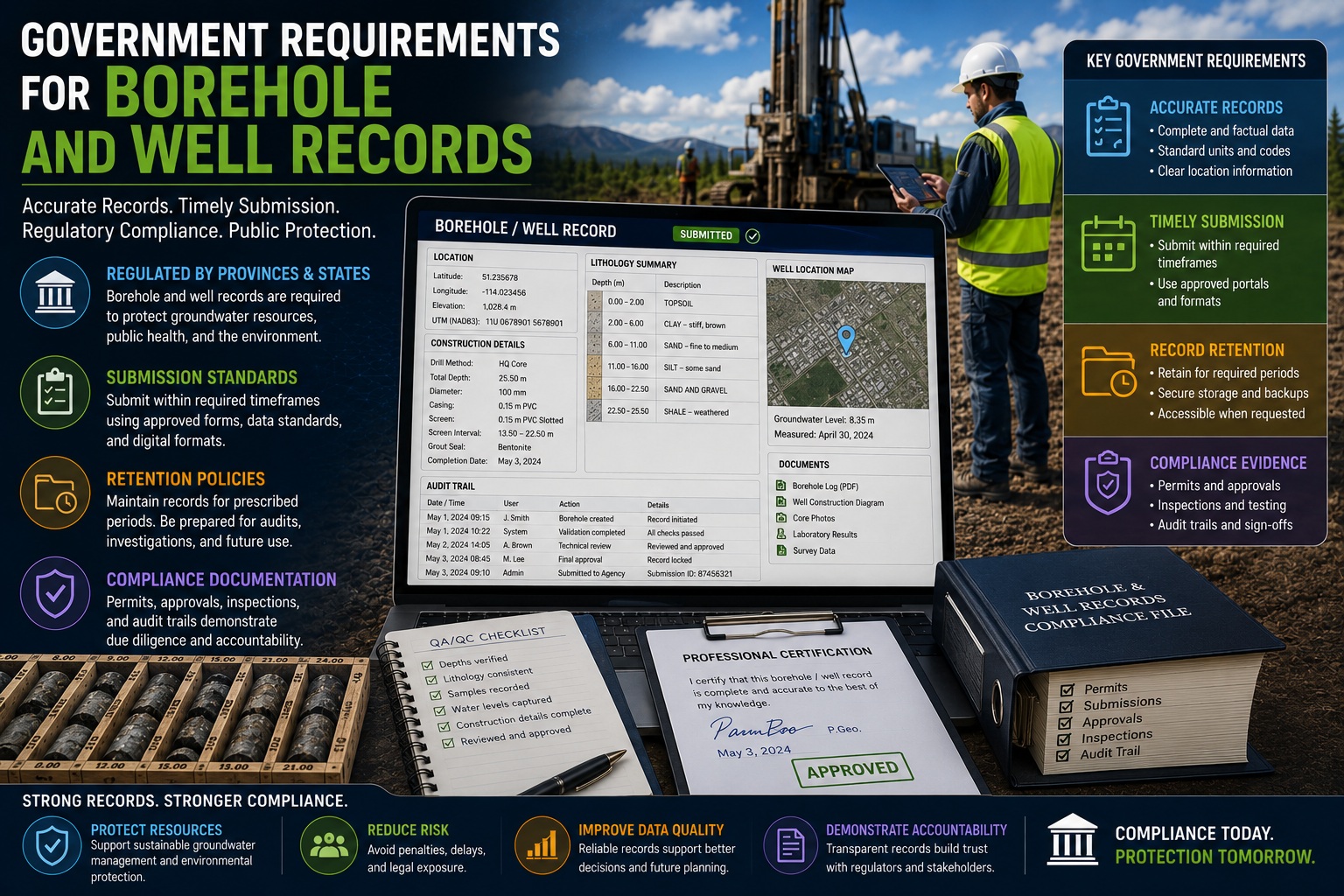
Borehole and well records are far more than technical project documents. In many jurisdictions, they are regulated records that must be collected, maintained, and submitted according to government requirements. Provincial, state, and federal agencies rely on these records to monitor groundwater resources, protect public health, assess environmental conditions, support infrastructure development, and ensure compliance with applicable legislation.
Whether the project involves geotechnical investigations, environmental assessments, groundwater monitoring, water supply wells, mining exploration, or infrastructure construction, organizations are often required to maintain accurate and complete borehole documentation. Failure to meet regulatory requirements can result in project delays, compliance violations, permit issues, financial penalties, and increased legal exposure.
As governments continue to modernize reporting requirements and transition toward digital record management, understanding regulatory expectations has become an essential part of borehole data management.
This article examines government requirements for borehole and well records, including provincial and state regulations, retention policies, submission standards, and compliance documentation.
Why Governments Regulate Borehole Records
Subsurface investigations generate information that extends beyond individual projects.
Borehole and well records often contribute to:
- Groundwater resource management
- Environmental protection
- Public safety
- Infrastructure planning
- Geological mapping
- Contamination assessment
- Water supply monitoring
- Land-use planning
Government agencies use this information to better understand subsurface conditions and to support long-term decision-making.
Accurate records benefit not only the project owner but also regulators, municipalities, consultants, researchers, and future property owners.
Types of Regulated Borehole Records
Government requirements vary by jurisdiction, but commonly regulated records include:
Borehole Logs
Documentation of:
- Lithology
- Stratigraphy
- Drilling methods
- Sampling intervals
- Groundwater observations
Water Well Records
Information regarding:
- Well construction
- Screen intervals
- Pump installation
- Well yield
- Water levels
Monitoring Well Records
Environmental monitoring wells often require:
- Installation details
- Construction diagrams
- Sampling records
- Groundwater monitoring results
Geotechnical Investigation Records
Projects involving infrastructure or development may require:
- Borehole logs
- Laboratory testing
- Field testing records
- Engineering documentation
Abandonment and Decommissioning Records
Many jurisdictions require documentation when wells are:
- Removed
- Sealed
- Abandoned
- Decommissioned
Proper closure records help prevent groundwater contamination and future liability.
Provincial and State Regulations
Requirements vary significantly depending on location.
Most jurisdictions regulate some combination of:
- Drilling activities
- Well construction
- Record submission
- Data retention
- Groundwater protection
Common Regulatory Objectives
Despite differences between provinces and states, regulatory programs generally aim to:
- Protect groundwater resources
- Ensure public safety
- Maintain reliable records
- Support environmental compliance
- Improve data accessibility
Regulators frequently require specific information to be reported in standardized formats.
Examples of Regulated Information
Government agencies may require:
| Category | Examples |
|---|---|
| Location | Coordinates, elevations |
| Construction | Diameter, casing, screen |
| Geology | Lithology descriptions |
| Groundwater | Water levels, flow conditions |
| Drilling | Methods and equipment |
| Ownership | Property and well owner information |
| Dates | Drilling and completion dates |
Missing or inaccurate information can result in rejected submissions or compliance issues.
Submission Standards
One of the most important regulatory requirements involves record submission.
Many agencies require borehole and well information to be submitted within specified timeframes.
Submission Deadlines
Depending on the jurisdiction, records may need to be submitted:
- Immediately after drilling
- Within a specified number of days
- Before permit closure
- Prior to project completion
Organizations should establish workflows that ensure submissions occur on time.
Late submissions can create unnecessary compliance risks.
Standardized Reporting Formats
Many government agencies prescribe:
- Required forms
- Digital templates
- Data structures
- Coordinate systems
- Coding standards
Examples include:
- Standard lithology codes
- Approved coordinate reference systems
- Required well construction fields
- Specific groundwater reporting formats
Using non-standard formats may result in rejected submissions.
Digital Submission Requirements
Increasingly, regulators are moving away from paper records.
Modern requirements often include:
- Electronic submissions
- Structured digital files
- GIS-compatible data
- Online reporting portals
Organizations relying solely on paper workflows may find compliance more challenging as digital reporting requirements expand.
Retention Policies
Submitting records is only part of the compliance process.
Organizations must also maintain records for prescribed retention periods.
Why Retention Matters
Government agencies may request historical records years after a project is completed.
Records may be needed for:
- Regulatory audits
- Environmental investigations
- Property transactions
- Legal disputes
- Future development projects
Without proper retention procedures, critical information may be unavailable when needed.
Typical Records to Retain
Retention policies often apply to:
- Borehole logs
- Well records
- Laboratory reports
- Field notes
- Core photographs
- Survey data
- Approval documentation
- Monitoring records
Supporting documentation can be just as important as the final borehole log itself.
Long-Term Record Management
Organizations should consider:
- Digital archiving
- Backup procedures
- Version control
- Secure storage
- Disaster recovery planning
A well-designed digital database can significantly simplify long-term retention.
Compliance Documentation
Maintaining records is not enough.
Organizations must often demonstrate compliance with regulatory requirements.
This requires supporting documentation.
What Is Compliance Documentation?
Compliance documentation provides evidence that required procedures were followed.
Examples include:
- Permits
- Approvals
- Inspection records
- Submission confirmations
- Validation reports
- Review records
- Audit logs
These documents may become important during audits or investigations.
Demonstrating Due Diligence
When regulators review a project, they may ask:
- Were records submitted on time?
- Were approved procedures followed?
- Were required inspections completed?
- Were deficiencies corrected?
Comprehensive documentation helps answer these questions.
Audit Trails and Regulatory Compliance
Modern borehole databases increasingly include audit trail functionality.
Audit trails automatically record:
- Data changes
- User activity
- Review actions
- Approval events
This information supports compliance efforts by providing transparency and accountability.
Example
An audit record may show:
| Action | User | Date |
| Borehole Created | Technician | May 1 |
| Validation Completed | System | May 2 |
| Review Approved | Geologist | May 3 |
| Submitted to Agency | Administrator | May 4 |
This type of documentation can demonstrate that required processes were completed.
Electronic Signatures and Approvals
Many organizations now use electronic workflows to support regulatory compliance.
Electronic approvals can document:
- Technical review
- Professional sign-off
- Submission authorization
Benefits include:
- Improved traceability
- Reduced paperwork
- Stronger auditability
- Better accountability
Electronic workflows often provide more reliable documentation than traditional paper systems.
Common Compliance Risks
Several recurring issues frequently create regulatory challenges.
Incomplete Records
Missing:
- Coordinates
- Groundwater observations
- Construction details
- Sample information
can result in rejected submissions.
Inconsistent Data
Conflicts between:
- Borehole logs
- Well construction records
- Survey information
may trigger additional review.
Late Submissions
Failure to meet reporting deadlines remains one of the most common compliance problems.
Poor Record Retention
Lost records can create significant difficulties during audits and investigations.
Lack of Documentation
Organizations may have complied with requirements but lack sufficient evidence to demonstrate compliance.
This can become problematic during regulatory reviews.
Best Practices for Maintaining Compliance
Organizations can reduce compliance risk through several practical measures.
Standardize Data Collection
Use consistent templates and controlled data entry procedures.
Implement Automated Validation
Validation rules help identify missing or inconsistent information before submission.
Use Review and Approval Workflows
Require technical review before records are finalized.
Maintain Audit Trails
Record all significant actions and changes.
Digitize Record Management
Digital systems simplify:
- Submission preparation
- Retention
- Retrieval
- Reporting
- Audit support
Monitor Regulatory Changes
Regulatory requirements evolve over time.
Organizations should periodically review:
- Submission requirements
- Reporting standards
- Retention obligations
- Technical guidance documents
to ensure continued compliance.
The Growing Importance of Digital Compliance
Regulatory agencies increasingly expect digital records that are:
- Searchable
- Traceable
- Secure
- Accessible
- Auditable
Future compliance programs will likely place even greater emphasis on:
- Electronic submissions
- Structured databases
- Automated reporting
- Digital signatures
- Audit-ready documentation
Organizations that invest in modern borehole data management systems today will be better positioned to meet these expectations.
Conclusion
Government requirements for borehole and well records play a critical role in protecting groundwater resources, supporting environmental stewardship, and ensuring public safety. Regulatory compliance involves much more than drilling and logging; it requires accurate documentation, timely submissions, long-term record retention, and comprehensive compliance evidence. By implementing standardized workflows, automated validation, digital record management, audit trails, and structured approval processes, organizations can improve data quality while reducing regulatory risk. As governments continue to modernize reporting requirements, maintaining complete, traceable, and compliant borehole records will become increasingly important for geological, geotechnical, environmental, and hydrogeological projects.