

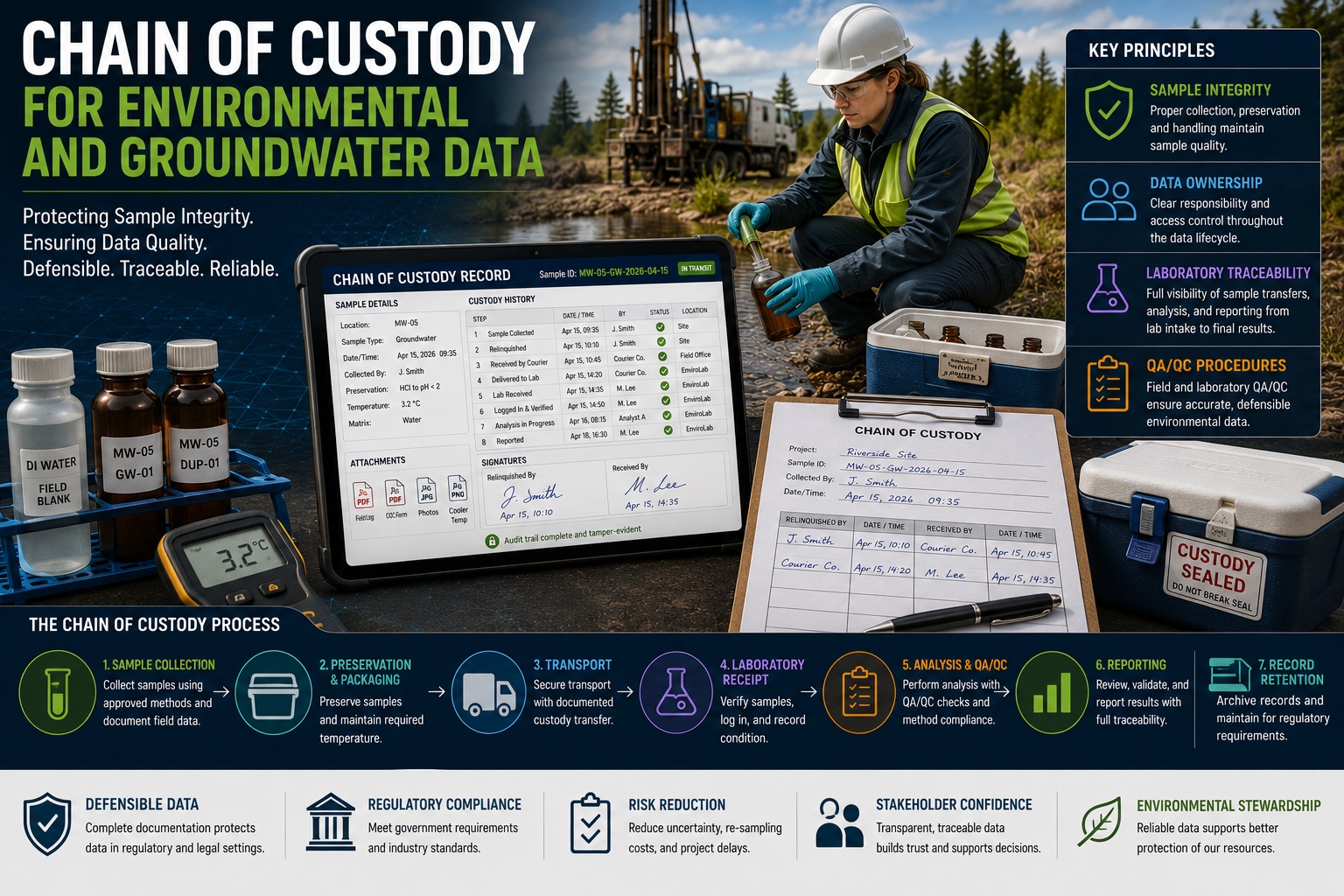
Protecting Sample Integrity from Field Collection to Final Reporting
Environmental and groundwater investigations often involve decisions with significant financial, regulatory, environmental, and legal consequences. Contaminated site assessments, groundwater monitoring programs, remediation projects, landfill investigations, industrial compliance monitoring, and environmental due diligence studies all depend on the accuracy and reliability of collected samples and associated data.
In these projects, the quality of laboratory results is only as strong as the processes used to collect, transport, track, analyze, and document samples. Even the most sophisticated laboratory analysis can be questioned if there is uncertainty regarding sample handling, ownership, storage conditions, or documentation.
This is where chain of custody becomes critical.
Chain of custody provides a documented record of who collected a sample, who handled it, where it was stored, when it was transferred, and how it was analyzed. It establishes confidence that environmental and groundwater samples remain representative of field conditions and that analytical results can be trusted.
This article explores the importance of chain of custody for environmental and groundwater data, including sample integrity, data ownership, laboratory traceability, and QA/QC procedures.
What Is Chain of Custody?
Chain of custody is the documented process used to track environmental samples and associated data throughout their entire lifecycle.
The process begins when a sample is collected and continues until:
- Laboratory analysis is completed
- Results are reported
- Records are archived
- Regulatory requirements are satisfied
The objective is to create a complete and traceable history of every sample.
A proper chain of custody record answers critical questions:
- Who collected the sample?
- When was it collected?
- Where was it collected?
- How was it preserved?
- Who transported it?
- Who received it?
- Which laboratory analyzed it?
- Who reviewed the results?
Without this information, the reliability of analytical data may be challenged.
Why Chain of Custody Matters
Environmental decisions are often based on analytical results.
Examples include:
- Contamination assessments
- Groundwater monitoring programs
- Site remediation plans
- Regulatory compliance reporting
- Property transactions
- Environmental litigation
If sample integrity cannot be demonstrated, the resulting data may be questioned.
Consequences can include:
- Regulatory rejection
- Project delays
- Re-sampling costs
- Legal disputes
- Increased liability
Maintaining a defensible chain of custody helps ensure that environmental data remains credible and legally defensible.
Sample Integrity
One of the primary purposes of chain of custody is protecting sample integrity.
Sample integrity means that the sample arriving at the laboratory accurately represents the conditions that existed at the time of collection.
Threats to Sample Integrity
Several factors can compromise environmental samples.
Examples include:
- Improper labeling
- Sample contamination
- Temperature excursions
- Incorrect preservation methods
- Container damage
- Lost samples
- Mix-ups during transport
Even minor errors can affect analytical results.
For example, a mislabeled groundwater sample could result in contamination being assigned to the wrong monitoring well.
Proper Sample Identification
Every sample should have a unique identifier.
Typical information includes:
- Project number
- Borehole or well ID
- Sample depth
- Sample date
- Sample time
Example:
MW-05-GW-2026-04-15Unique identifiers reduce the risk of confusion and improve traceability.
Preservation Requirements
Certain contaminants require specific preservation methods.
Examples include:
- Cooling samples to required temperatures
- Chemical preservatives
- Light-protected containers
- Specialized storage requirements
Chain of custody documentation should record preservation methods and conditions.
Data Ownership
Environmental data often passes through multiple organizations before final reporting.
Parties may include:
- Site owners
- Environmental consultants
- Drilling contractors
- Field technicians
- Laboratories
- Regulatory agencies
Maintaining clear data ownership is essential.
Why Ownership Matters
Questions frequently arise regarding:
- Who owns the data?
- Who can modify records?
- Who authorizes release?
- Who approves final reports?
Without clearly defined ownership, disputes can occur regarding data use and interpretation.
Managing Ownership Through Documentation
Good data management practices include documenting:
- Data creators
- Responsible organizations
- Review authorities
- Approval authorities
Modern environmental databases often use permissions and workflow controls to support accountability.
Auditability
Ownership is closely tied to auditability.
Organizations should be able to determine:
- Who entered data
- Who reviewed it
- Who approved it
- When changes occurred
This information strengthens confidence in the final dataset.
Laboratory Traceability
Once samples leave the field, laboratory traceability becomes critical.
Traceability ensures that samples can be tracked throughout the analytical process.
Sample Transfers
Every transfer should be documented.
Examples include:
| Transfer | Example |
|---|---|
| Field to Courier | Sample shipment |
| Courier to Laboratory | Laboratory receipt |
| Laboratory Intake | Sample registration |
| Analyst Assignment | Testing allocation |
| Reporting | Results generation |
Each transfer should be recorded and acknowledged.
Laboratory Receipt Verification
When samples arrive at the laboratory, personnel typically verify:
- Sample count
- Container condition
- Labels
- Preservation
- Temperature
Any discrepancies should be documented immediately.
Examples include:
- Missing samples
- Broken containers
- Incorrect labels
- Improper temperatures
These observations become part of the permanent record.
Analytical Traceability
Laboratories should maintain records showing:
- Analytical methods used
- Instrument calibration
- Quality control results
- Analyst information
- Testing dates
This information supports confidence in reported results.
QA/QC Procedures
Chain of custody is closely connected to environmental QA/QC programs.
Together they help ensure reliable and defensible data.
Field QA/QC Samples
Environmental projects frequently include quality control samples such as:
Field Duplicates
Collected to assess sampling precision.
Equipment Blanks
Used to evaluate decontamination effectiveness.
Trip Blanks
Used to identify contamination during transport.
Field Blanks
Used to evaluate contamination introduced during sampling.
These samples help verify that sampling procedures are functioning correctly.
Documentation Requirements
QA/QC procedures should document:
- Sampling methods
- Equipment used
- Calibration records
- Preservation methods
- Weather conditions
- Field observations
The more complete the documentation, the easier it becomes to defend the resulting data.
Data Validation
After laboratory results are received, data validation often occurs.
Reviewers evaluate:
- Holding times
- Detection limits
- QA/QC sample results
- Analytical qualifiers
- Method compliance
Validation helps ensure results are suitable for decision-making.
Digital Chain of Custody Systems
Many organizations are replacing paper chain of custody forms with digital systems.
Digital solutions provide several advantages.
Improved Accuracy
Electronic forms reduce:
- Handwriting issues
- Missing fields
- Transcription errors
Real-Time Tracking
Users can monitor:
- Sample location
- Transfer status
- Laboratory receipt
- Analysis progress
in real time.
Audit Trails
Digital systems automatically record:
- User actions
- Data changes
- Approval activities
- Workflow transitions
This improves transparency and accountability.
Integration with Environmental Databases
Modern systems can link chain of custody information directly to:
- Borehole logs
- Monitoring wells
- Laboratory results
- Compliance reports
This creates a complete and searchable project record.
Regulatory and Legal Considerations
Chain of custody is particularly important when environmental data may be scrutinized by regulators or courts.
Examples include:
- Contamination disputes
- Environmental litigation
- Regulatory investigations
- Enforcement actions
In these situations, parties may question:
- Sample authenticity
- Handling procedures
- Data reliability
A documented chain of custody helps establish credibility.
Evidence Preservation
Environmental data often becomes evidence.
Organizations should preserve:
- Chain of custody forms
- Sample logs
- Field notes
- Laboratory reports
- QA/QC records
- Validation reports
These records help support the integrity of environmental conclusions.
Common Chain of Custody Errors
Several recurring problems can weaken data defensibility.
Examples include:
- Missing signatures
- Incomplete forms
- Incorrect sample IDs
- Undocumented transfers
- Missing preservation records
- Unclear ownership
- Lost documentation
Even small documentation gaps can create significant questions regarding data reliability.
Best Practices
Organizations can strengthen chain of custody procedures through several best practices.
Use Unique Sample Identifiers
Prevent confusion and improve traceability.
Standardize Documentation
Use consistent forms and workflows.
Digitize Records
Improve accessibility and reduce errors.
Maintain Audit Trails
Track all sample transfers and approvals.
Train Personnel
Ensure field and laboratory staff understand custody requirements.
Retain Records
Preserve custody documentation for the duration required by regulations and project policies.
Conclusion
Chain of custody is one of the most important components of environmental and groundwater data management. By documenting every stage of sample collection, handling, transport, analysis, and reporting, organizations can protect sample integrity, establish data ownership, ensure laboratory traceability, and support robust QA/QC programs. Strong chain of custody procedures not only improve data quality but also strengthen regulatory compliance, legal defensibility, and stakeholder confidence. As environmental investigations increasingly rely on digital workflows and long-term data management, maintaining a complete and auditable chain of custody will remain essential for producing reliable and trustworthy environmental information.