

Understanding How Geological and Geotechnical Records Are Evaluated
Geological, geotechnical, environmental, hydrogeological, and mining projects generate vast amounts of data throughout their lifecycle. Borehole logs, laboratory results, groundwater measurements, well construction records, sampling data, and geospatial information all contribute to decisions that affect public safety, environmental protection, infrastructure development, and resource management.
Because these records often support regulatory submissions, permits, environmental assessments, engineering reports, and compliance programs, government agencies and regulatory authorities periodically conduct audits to verify that organizations are maintaining accurate and reliable information.
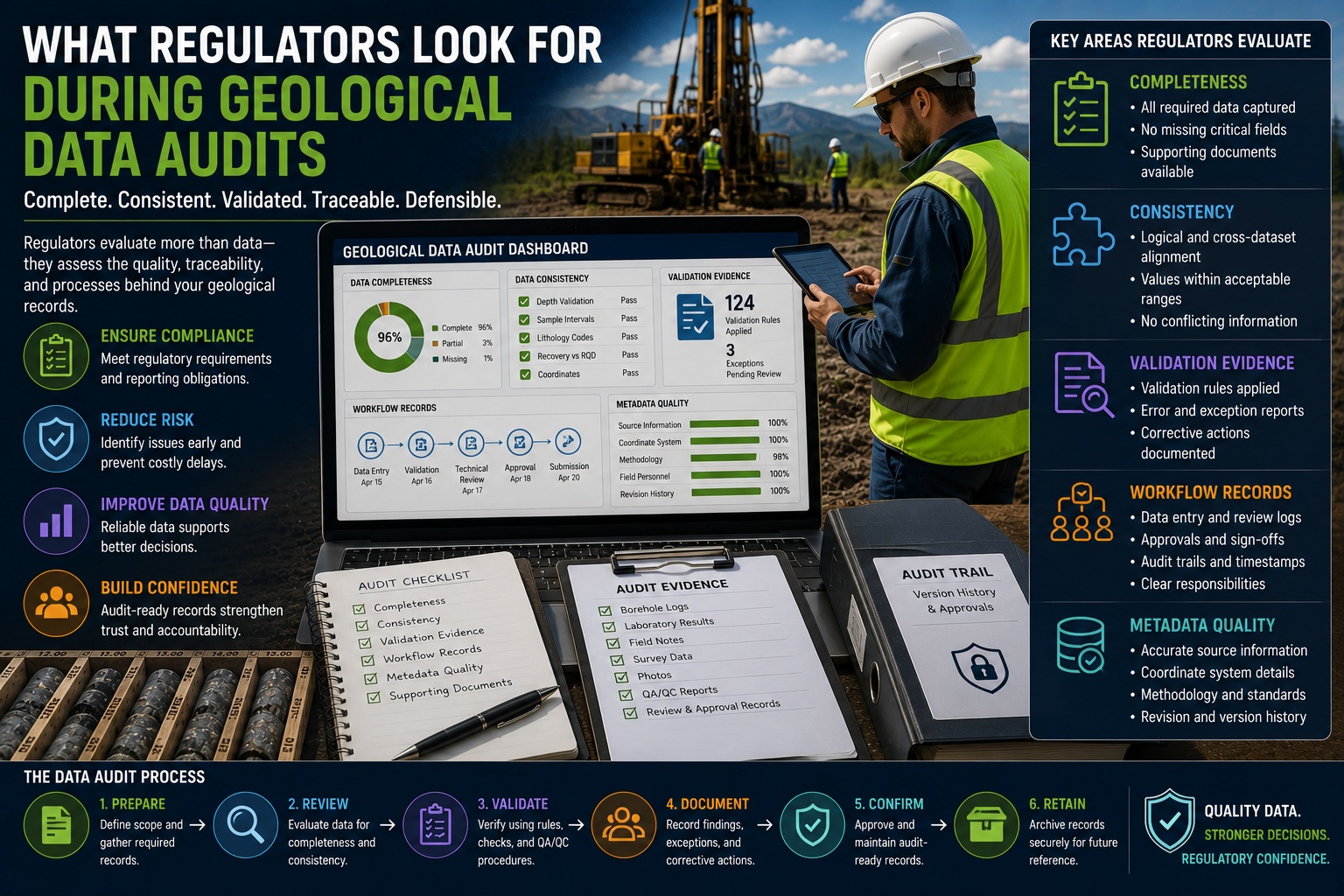
A geological data audit is not simply a review of borehole logs. Regulators evaluate how data is collected, managed, validated, reviewed, approved, and preserved. They want assurance that reported information is complete, consistent, traceable, and supported by documented quality control procedures.
Organizations that understand what regulators expect are better positioned to maintain compliance, reduce risk, and demonstrate professional accountability.
This article explores five key areas regulators commonly examine during geological data audits: completeness, consistency, validation evidence, workflow records, and metadata quality.
Why Geological Data Audits Matter
Regulatory audits serve several important purposes.
They help ensure:
- Public safety
- Environmental protection
- Groundwater resource management
- Regulatory compliance
- Data reliability
- Professional accountability
Audits also provide confidence that decisions are based on accurate and defensible information.
Whether the project involves environmental monitoring, groundwater investigations, geotechnical assessments, mining exploration, or infrastructure development, regulators rely heavily on the quality of the underlying data.
Poor record management can raise concerns about the validity of conclusions and recommendations.
Completeness
One of the first areas regulators examine is completeness.
Simply put, regulators want to know whether all required information has been collected and documented.
Missing information is one of the most common deficiencies identified during audits.
Required Borehole Information
A complete borehole record typically includes:
- Borehole identification
- Coordinates
- Elevation
- Drilling method
- Start and completion dates
- Lithology descriptions
- Sample intervals
- Groundwater observations
- Final depth
Depending on project type, additional information may also be required.
Missing Data Concerns
Regulators often identify issues such as:
- Missing lithology intervals
- Incomplete well construction records
- Missing groundwater measurements
- Unrecorded sample depths
- Missing laboratory results
- Incomplete coordinate information
Even if only a small portion of information is missing, questions may arise regarding overall data quality.
Completeness Metrics
Many organizations now track completeness using automated systems.
Examples include:
| Dataset | Completeness |
|---|---|
| Collar Data | 100% |
| Lithology | 98% |
| Recovery | 96% |
| Groundwater | 94% |
Such metrics can demonstrate proactive quality management during audits.
Consistency
After completeness, regulators typically evaluate consistency.
Consistency refers to whether information remains logically aligned throughout the database.
Internal Consistency
Auditors often compare related datasets.
Examples include:
Recovery vs RQD
RQD should not exceed recovery.
Borehole Depth vs Sample Depth
Samples should not extend beyond borehole depth.
Well Construction vs Borehole Geometry
Screens and casings should fit within the completed borehole.
Coordinates vs Site Boundaries
Locations should fall within expected project areas.
Consistency Across Documents
Regulators may compare:
- Borehole logs
- Reports
- Laboratory data
- Monitoring records
- Regulatory submissions
Discrepancies between documents often trigger additional review.
Why Consistency Matters
Inconsistent records can indicate:
- Data entry errors
- Inadequate review procedures
- Version control problems
- Poor quality assurance
Regulators expect organizations to identify and resolve such issues before submission.
Validation Evidence
Regulators increasingly expect organizations to demonstrate that data quality controls are actively used.
This is where validation evidence becomes important.
What Is Validation Evidence?
Validation evidence shows that data was checked for errors before being used or submitted.
Examples include:
- Validation reports
- Error summaries
- QA/QC records
- Exception reports
- Corrective action records
Rather than simply claiming that data was reviewed, organizations should be able to provide objective evidence.
Automated Validation
Modern geological databases often perform automated checks such as:
- Missing field detection
- Overlapping intervals
- Coordinate verification
- Duplicate records
- Recovery and RQD comparisons
Regulators may ask:
- Which validation rules are used?
- How often are validations run?
- How are issues resolved?
- Are validation results documented?
Organizations with structured validation programs generally perform better during audits.
Corrective Action Documentation
Finding errors is only part of the process.
Regulators also want evidence that issues were addressed.
Examples include:
| Issue | Resolution |
| Missing groundwater reading | Field records reviewed and updated |
| Duplicate sample number | Corrected following laboratory verification |
| Invalid coordinate | Survey data reprocessed |
Documenting corrective actions demonstrates effective quality management.
Workflow Records
Data quality is not determined solely by the final record.
Regulators increasingly evaluate the processes used to create and manage information.
This is where workflow documentation becomes important.
Why Workflow Records Matter
Workflow records demonstrate how data moves through the organization.
Typical stages include:
- Data Collection
- Data Entry
- Validation
- Technical Review
- Approval
- Submission
- Archiving
Auditors often examine whether these stages are documented and consistently followed.
Review Records
Technical reviews are particularly important.
Regulators may ask:
- Who reviewed the borehole?
- When was the review completed?
- What issues were identified?
- Were concerns resolved?
Review documentation helps demonstrate due diligence.
Approval Records
Organizations should maintain records showing:
- Approver identity
- Approval date
- Approval status
- Supporting comments
Formal approvals help establish accountability.
Audit Trails
Modern digital systems often include audit trails that record:
- Data changes
- User actions
- Workflow transitions
- Approval events
Audit trails provide valuable evidence during regulatory reviews.
Metadata Quality
Metadata is often overlooked, yet it is one of the most important components of a defensible geological database.
Metadata is information about the data itself.
Examples of Metadata
Common metadata includes:
- Record creation date
- Last modification date
- User information
- Coordinate reference system
- Data source
- Laboratory methods
- Instrument calibration information
Without metadata, it may be difficult to determine how records were created or maintained.
Why Regulators Examine Metadata
Metadata helps answer important questions.
Examples include:
- Who entered the data?
- When was it modified?
- Which coordinate system was used?
- Which laboratory method generated the result?
- Was the information updated after approval?
These details help establish transparency and traceability.
Spatial Metadata
For geotechnical and environmental projects, spatial metadata is especially important.
Regulators frequently verify:
- Datum information
- Projection information
- Coordinate system definitions
- Survey methods
Incorrect spatial metadata can compromise the accuracy of an entire project.
Common Audit Findings
Although every audit is unique, several issues appear repeatedly.
Common findings include:
Missing Documentation
Required records cannot be located.
Incomplete Metadata
Data sources or coordinate systems are unclear.
Lack of Validation Evidence
Organizations cannot demonstrate that quality checks occurred.
Uncontrolled Revisions
Changes were made without proper documentation.
Missing Approval Records
No evidence exists that qualified personnel reviewed the data.
Preparing for a Geological Data Audit
Organizations can significantly improve audit readiness through proactive data management.
Implement Automated Validation
Use validation rules to identify errors early.
Maintain Review Workflows
Document technical reviews and approvals.
Preserve Audit Trails
Track data changes and workflow activities.
Standardize Metadata
Ensure consistent capture of:
- Data sources
- Coordinate systems
- User information
- Dates
Monitor Completeness
Regularly evaluate datasets for missing information.
Archive Supporting Documentation
Retain:
- Field notes
- Core photographs
- Laboratory reports
- Validation records
- Approval documentation
These records often become critical during audits.
The Growing Role of Digital Geological Databases
As regulatory expectations evolve, digital geological databases are becoming increasingly important.
Modern systems provide:
- Automated validation
- Workflow management
- Audit trails
- Metadata tracking
- Electronic approvals
- Reporting tools
These capabilities make it easier to demonstrate compliance and respond to audit requests.
Organizations relying on manual or paper-based processes may face greater challenges as regulators increasingly expect traceable and auditable digital records.
Conclusion
Geological data audits focus on much more than individual borehole logs. Regulators evaluate whether records are complete, consistent, validated, properly reviewed, and supported by high-quality metadata. They want evidence that organizations maintain robust QA/QC procedures, document workflow activities, preserve audit trails, and manage data responsibly throughout its lifecycle. By implementing automated validation, structured review processes, comprehensive metadata management, and modern digital record systems, organizations can improve audit readiness, strengthen compliance, and build confidence in the quality and reliability of their geological data.