

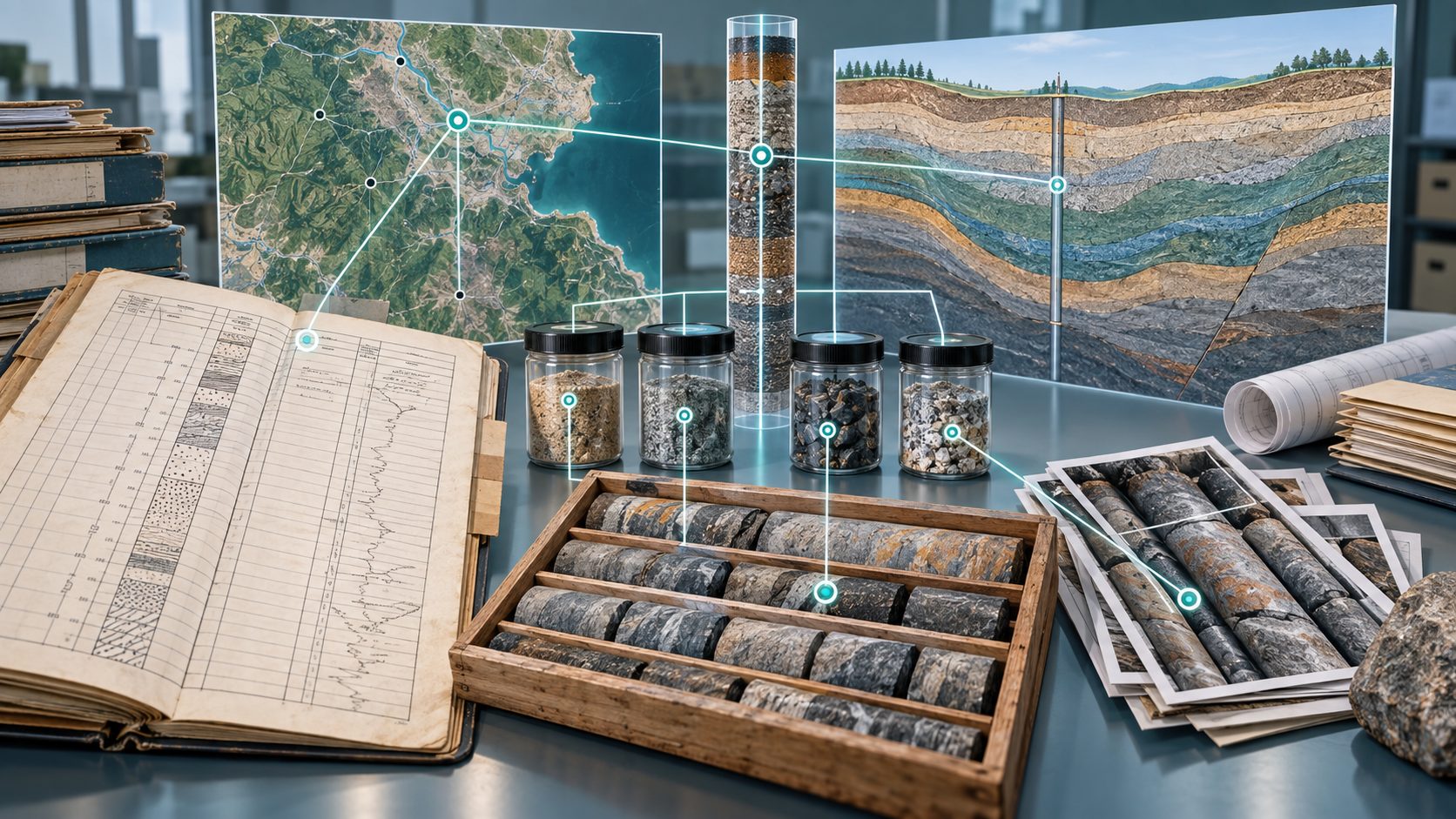
Historical borehole projects are valuable because they connect observations to a particular place, depth, investigation, and method. When those projects move into a new system, preserving a list of boreholes and their final logs is only the beginning. The relationships and context behind the records determine how confidently the information can be reused.
Migrating historical borehole projects should therefore start with a preservation checklist. That checklist helps teams distinguish essential source information, deliberate transformations, and unresolved uncertainty. It also provides a practical basis for reviewing the migrated archive.
Preserve project and borehole identity
Keep original project names, numbers, location identifiers, and relevant aliases. Borehole names such as BH-01 often repeat across projects, so a name alone is rarely sufficient to establish identity. Preserve the relationship between each location and its source project, and retain a cross-reference when the destination requires new identifiers.
Distinguish duplicated copies from genuinely separate investigations. Two records at similar coordinates may represent different drilling events or an intentional revisit. Do not merge them solely because their names or positions resemble one another. Document the evidence for any consolidation.
Preserve location and reference systems
Coordinates need their reference system, units, and any relevant description of how they were obtained. Elevations need a vertical reference. Historical local grids, assumed datums, approximate positions, and later survey corrections should remain identifiable. A number that looks precise does not prove that its location was surveyed accurately.
- Original coordinates and elevations, including source units and reference information.
- Survey or positioning method and date, where recorded.
- Local-grid definitions, transformation parameters, and supporting notes.
- Original and transformed values when coordinates are converted.
- Flags for unknown references, approximate locations, or unresolved conflicts.
Do not silently assign a modern reference system to an undocumented historical grid. Preserve uncertainty until there is enough evidence to resolve it, and make the review decision traceable.
Preserve depth relationships and interval meaning
Borehole information often describes intervals rather than isolated values. Retain top and bottom depths, the reference from which they were measured, and the type of interval represented. A lithological interval, a sample interval, and a test interval may overlap without representing the same thing.
Keep recorded termination depths, drilling progress notes, recovery information, and relevant reasons for gaps. Review inverted intervals, unexpected overlaps, and values beyond the recorded hole depth as exceptions. Some may be errors; others may reflect the way the investigation was documented. Corrections require evidence rather than automatic normalization.
Preserve observations separately from interpretations
Original descriptions, classification codes, interpreted units, and later interpretations can all be useful. Preserve their distinction wherever the source allows it. A standardized code can help with searching and comparison, but it should not replace descriptive wording that contains details the code cannot express.
If the team translates a historical classification into a current vocabulary, retain the original and record the mapping rule. A direct equivalence may be defensible for some codes and inappropriate for others. Unmapped or ambiguous descriptions should remain visible for review.
Preserve samples, methods, results, and qualifiers
A test result has meaning through its connection to a sample or measurement location, a method, a unit, and relevant conditions. Keep sample identifiers and the relationships between field records, laboratory submissions, and reported results. Preserve method references and dates where available.
Retain result qualifiers, detection or reporting limits where relevant, comments, and distinctions between measured, calculated, estimated, and unavailable values. Zero, blank, not tested, and below a reporting limit are different states. Converting them all to the same numeric value can make a dataset easier to load while making it less reliable.
Preserve groundwater observations as events
Water observations can change with time and measurement conditions. Keep observation dates and times where recorded, the measurement reference, and notes explaining whether a reading was taken during drilling, after completion, or during later monitoring. Preserve relevant installation details and the link to the correct borehole or monitoring point.
Do not collapse multiple readings into a single water-level field without retaining the underlying observations. If a summary value is useful for reporting, document how it was selected.
Preserve supporting documents and provenance
Collect scanned field sheets, core photographs, laboratory reports, completion records, and issued logs. Preserve document versions and links to the records they support. Moving an attachment is incomplete if users can no longer tell which location, sample, or revision it belongs to.
- Source file or database identity and the date of extraction.
- Original identifiers and any destination cross-reference.
- Mapping, conversion, and cleanup rules used during migration.
- Known omissions, unresolved questions, and approved exceptions.
- Reviewer, review date, and acceptance decision for each migration batch.
Define a preservation package for each project
A preservation package should make the archive understandable without requiring the original author to explain it. Include the source database or files, a document inventory, a field dictionary where available, and a short project note. The note should describe the investigation phases, the structure of the records, the source of location information, and any important limitations discovered during preparation.
Keep the package organized around stable project and location identities. Folder names can be helpful, but they should not be the only evidence connecting a photograph or report to a borehole. Record explicit references in an attachment register or supported database relationship. Where filenames are changed for consistency, retain the original filename and the reason for the change.
Treat conflicting records as a review task
Historical archives may contain several versions of a borehole log, a handwritten correction, and a database that does not reflect the final issued report. Decide which source is authoritative for each kind of information and record the basis for that decision. The latest file timestamp alone may not establish which record contains the approved interpretation.
For example, an issued log might show a corrected ground elevation while the database retains the earlier value. Preserve both pieces of evidence, identify the approved correction, and document how the destination value was selected. If authority cannot be established, retain the conflict as an unresolved issue rather than making a silent choice.
This does not mean displaying every historical revision in every routine report. It means maintaining enough provenance for a reviewer to trace the current representation to its supporting evidence. The operational view can remain clear while the underlying archive preserves the history needed to investigate questions.
Review a borehole as a connected record
A useful review exercise starts with one borehole and follows all of its relationships. Confirm its project and location, inspect its depth intervals, select a sample, follow that sample to a laboratory result, and open the supporting report. Then compare the destination log with the trusted source output. This sequence tests the archive as a working information system rather than as a collection of independent tables.
Include an example with repeated sample names or multiple investigations at one location. A transfer can preserve every visible value while linking a result to the wrong event. Checking relationships in context is therefore essential. A sample reference should resolve to the intended sample within the intended investigation, not merely to the first matching label.
Select review examples deliberately. Include deep and shallow holes, different drilling methods where present, records with several groundwater observations, and projects with later revisions. The aim is to cover the kinds of complexity in the archive. A large random sample of nearly identical records may provide less useful evidence than a smaller selection covering known variations.
Keep transformations reproducible
Where units or coordinates are converted, record the method and the inputs needed to reproduce the result. Avoid replacing original precision with a misleading number of decimal places. If a historical measurement was approximate, the destination should continue to communicate that limitation even when the converted value is stored with greater numerical precision.
For classification changes, keep a versioned mapping list with a brief explanation of any judgment involved. A material code used by one office may not mean exactly the same thing in another archive. Review ambiguous mappings with someone familiar with the source practice, and keep the original description available alongside the standardized value.
Set acceptance rules for incomplete projects
Some archives will remain incomplete after reasonable investigation. Define what is essential for the proposed use and what can remain unknown. A location suitable for identifying regional historical coverage may be insufficiently precise for a detailed site model. Acceptance should therefore be tied to intended use, not to a general declaration that the whole project is either good or bad.
Record limitations where future users will encounter them. A note buried in a migration report may not help someone exporting the data months later. Where the destination supports it, associate quality flags and explanatory remarks with the relevant project, borehole, or result, and confirm how those notes appear in downstream outputs.
Make the archive maintainable after migration
Assign responsibility for future corrections and attachment maintenance. If a broken link is repaired or an uncertain location is resolved, preserve a record of the change and its evidence. Establish a consistent process for importing additional historical projects so the archive does not return to a mixture of undocumented conventions.
The preservation checklist can then become a reusable project-closeout checklist. Collecting identifiers, reference information, source documents, and review decisions while a project is active is easier than reconstructing them years later. Migration provides an opportunity to improve that handover for the next generation of borehole records.
Validate a chain of evidence
Select several boreholes and follow them from the original archive through the migrated database to an output log. Include complex records as well as simple ones. Reconcile counts, compare representative values, open attachments, and review the links between intervals, samples, and tests. Record expected differences and investigate unexpected ones.
The planned GAEA Migration Center is intended to support future migration-related resources and workflows; unreleased capabilities remain upcoming. Preservation work can begin now, independently of future automation. Review GAEA’s data migration information or contact GAEA to discuss current options and requirements for your archive.
A successful migration leaves future users able to understand both the data and its limits. Preserving identity, relationships, original evidence, and uncertainty makes historical projects more useful without giving them a false appearance of completeness.