

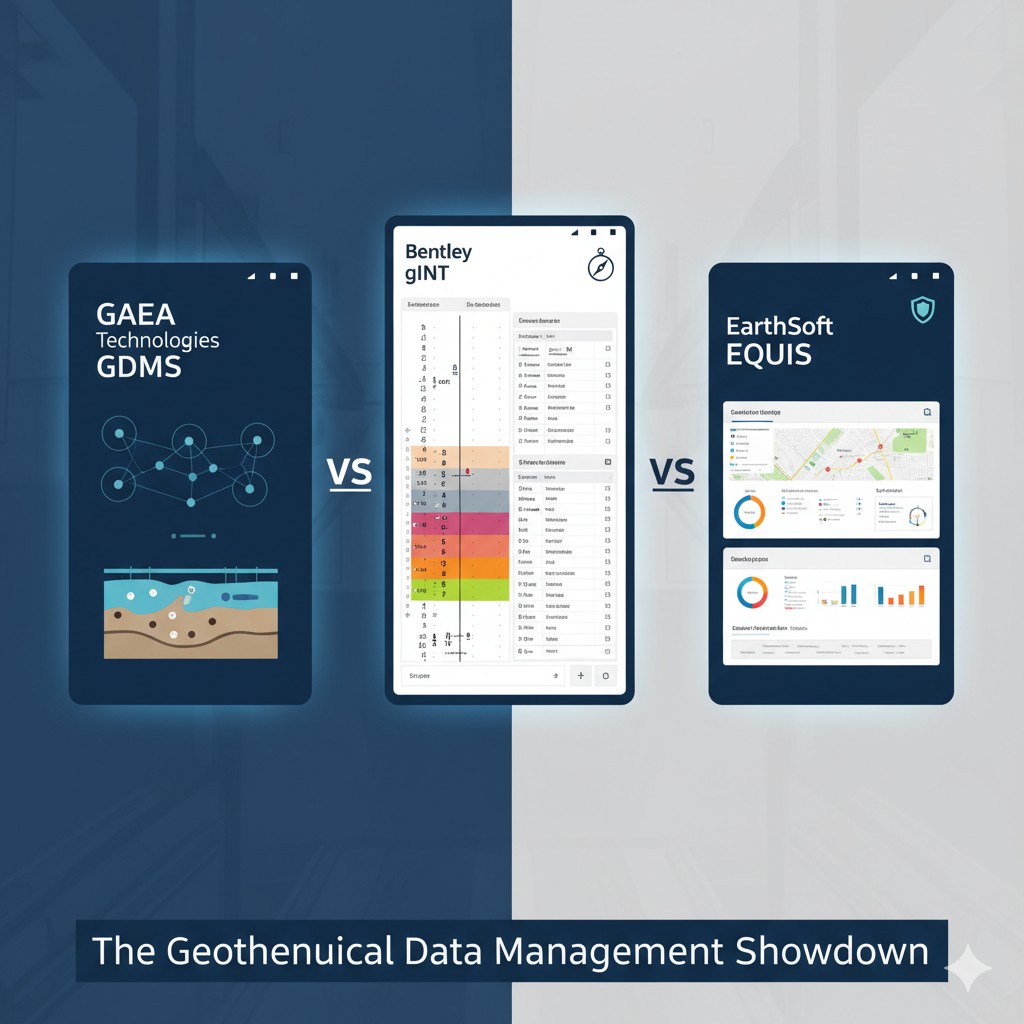
Choosing the right Geotechnical Data Management System (GDMS) is no longer just about printing boring logs; it’s about future-proofing your firm’s data. With the industry shifting away from legacy desktop tools toward integrated, cloud-ready solutions, the choice between GAEA Technologies GDMS, Bentley gINT, and EarthSoft EQuIS has never been more critical.
Each of these powerhouses offers a unique approach to managing subsurface data. Here is how they stack up for modern geotechnical and environmental firms.
Bentley gINT: The Legacy Giant
For decades, gINT has been the industry benchmark. It is famous for its high degree of customizability, allowing users to script almost any report format imaginable.
- The Reality in 2026: Bentley has shifted focus toward OpenGround, its cloud-based successor. This means gINT is effectively in a “sunset” phase with limited new feature development.
- Best For: Firms with deep, existing libraries of custom gINT scripts and reports who aren’t ready to migrate to the cloud just yet.
- The Verdict: While powerful, its desktop-first architecture is increasingly viewed as outdated compared to more agile alternatives.
GAEA Technologies GDMS: The Practical Powerhouse
GAEA’s GDMS is designed as a “Geotechnical Testing and Data Management” system that bridges the gap between field logging and laboratory information management (LIMS).
- Ease of Use: Unlike the steep learning curves of its competitors, GDMS is built for geoscientists who want to get up and running quickly without a dedicated IT department.
- Key Advantage: It shines in its integration of lab testing (concrete, asphalt, soil) directly with the project database, making it a “one-stop-shop” for Quality Control (QC) and geotechnical reporting.
- Best For: Small to mid-sized consulting firms and laboratories looking for an affordable, intuitive, and comprehensive lifecycle tool.
EarthSoft EQuIS: The Enterprise Leader
EQuIS Geotech is the “big engine” of the group. It is an enterprise-level solution that manages both environmental and geotechnical data in a single, massive ecosystem.
- Scale & Control: EQuIS is built for complexity. It offers unrivaled data validation and automated workflows that ensure compliance across multi-national project portfolios.
- Data Integration: It connects seamlessly with GIS, CAD, and internal ERP systems via a REST API, making it the most “connected” option for large-scale infrastructure projects.
- Best For: Large government agencies, global environmental firms, and mega-projects where data integrity and cross-departmental integration are the highest priority.
2026 Pricing Comparison Table
Pricing for geotechnical data management software in 2026 reflects a significant shift toward subscription-based models, with costs varying based on organizational scale and the depth of data integration required.
| Software Platform | Entry-Level Cost | Network | Pricing Model Details |
|---|---|---|---|
| GAEA GDMS | $695 perpetual | $1,295 perpetual | Single-user or network annual subscriptions or perpetual licences. Enterprise solutions focus on project ROI, reportedly increasing productivity by up to 300%. |
| Bentley gINT | $633 / year | $2,512 – $3,490 / year | Tiered annual practitioner licenses: gINT Logs ($633), Professional ($2,512), and Professional Plus ($3,490). |
| EarthSoft EQuIS | $420 – $580 / month | $25,000 – $100,000+ | Cloud subscriptions start at Level 1 ($420-$580/mo). On-premise enterprise environments start at $25,000 for Starter packages and $100,000 for Portfolios. |
GAEA Technologies GDMS
GAEA’s pricing is typically the most transparent and budget-friendly for smaller firms.
- GaeaSynergy/GDMS: A single-user annual subscription is $300 USD., a perpetual license is $695 USD.
- Target Audience: Ideal for mid-sized consulting firms that need an all-in-one tool for borehole logging and lab testing without the overhead of massive enterprise systems.
Bentley gINT
While Bentley is transitioning users toward the cloud-based OpenGround, gINT remains available for existing accounts via annual practitioner licenses.
- gINT Logs: The basic level starts at $633 USD annually.
- gINT Professional/Plus: More advanced versions range from $2,512 to $3,490 per year.
- Note: In 2026, gINT is largely sold only to companies that already hold existing licenses, as Bentley pushes new customers toward its newer cloud ecosystem.
EarthSoft EQuIS
EQuIS uses a highly complex, tiered pricing structure designed for large-scale enterprise deployments.
- SaaS/Cloud Levels: Small-scale cloud databases (Level 1) start around $210/month (~$2,520/year) for basic data storage.
- Enterprise Portfolio: Large-scale on-premise or dedicated cloud solutions can range from $24,000 to over $100,000 depending on the number of “Cores” licensed and “Active Client Access Licenses” (ACALs) required.
- Add-ons: Specialized modules like the Geotechnical Module can add an additional $18,000 per environment.
Implementation & Setup Costs
Beyond the initial software license, the “hidden” costs of implementation and training are what often determine the long-term success of a geotechnical data management system.
Implementation involves more than just installation; it includes data migration, template customization, and IT infrastructure setup.
- GAEA GDMS:
- Setup: Designed as an “off-the-shelf” solution, it has the lowest implementation overhead. Most firms can be operational within 1–3 days.
- Data Migration: Free tools are available for importing legacy data, reducing the need for expensive third-party consultants.
- Bentley gINT:
- Customization: Known for high complexity, full implementation often requires a specialist to build custom report templates. Professional services for gINT can range from $2,000 to $10,000+ depending on the complexity of your legacy scripts.
- Transition to OpenGround: If you are migrating from gINT to Bentley’s newer cloud system, be prepared for a multi-month project and significant onboarding costs.
- EarthSoft EQuIS:
- Enterprise Setup: This is a major IT undertaking. One-time database setup and configuration fees start at $500 per occurrence, while large-scale “Portfolio” configurations can have one-time service fees starting at $25,000.
- Timeframe: Full enterprise deployment typically takes 3–12 months.
Training Costs
Training ensures your staff can actually use the specialized features of the software without constant errors.
| Feature | GAEA GDMS | Bentley gINT | EarthSoft EQuIS |
|---|---|---|---|
| Self-Paced Training | Free (Included) | Included in “SELECT” | $99 – $100 per course |
| Live In-Person Training | Custom quotes | ~$1,500 – $2,000 | $1,800 – $2,750 per person |
| Training Credits | N/A | Included with Virtuosity | Custom Enterprise bundles |
| Learning Curve | Low | Medium – High | Very High |
- GAEA’s Advantage: GAEA provides free technical support and minor updates as part of its model, significantly lowering the total cost of ownership (TCO) for smaller teams.
- Bentley’s “Keys”: Bentley’s Virtuosity subscriptions include “Keys” (training credits) that can be redeemed for tailored coaching or specialized on-demand sessions.
- EQuIS Academy: EarthSoft offers the most structured training via its EQuIS Academy, which features a rigorous series of paid certifications that are highly valued for regulatory compliance roles.
Return on Investment
Evaluating the Return on Investment (ROI) for these systems requires balancing their high upfront costs against the long-term gains in billable efficiency, data accuracy, and reduced reporting cycles.
ROI Comparison Breakdown
| ROI Metric | GAEA GDMS | Bentley gINT | EarthSoft EQuIS |
|---|---|---|---|
| Time to Value | Immediate (1-2 weeks) | Moderate (1-3 months) | Slow (6-12 months) |
| Efficiency Gain | High for mid-sized firms | High for legacy users | Massive for global firms |
| Break-Even Point | 6 – 12 Months | 12 – 18 Months | 24 – 36 Months |
| Data Re-entry Reduction | Up to 70% | Up to 60% | Up to 95% (Automated) |
1. GAEA GDMS: The “Quick Win” ROI
For most consulting firms, GDMS offers the fastest path to profitability.
- The Math: By automating lab data entry and borehole logging, firms typically save 4–6 hours per project. At a billable rate of $150/hr, a firm doing 50 projects a year saves $30,000 to $45,000 annually in labor costs.
- Payback: With a software cost of ~$1,375, the system pays for itself within its first 3 projects.
2. Bentley gINT: The “Legacy Continuity” ROI
The ROI for gINT is often found in not changing established workflows.
- The Math: For firms with thousands of custom scripts, the cost of migrating to a new platform could exceed $50,000 in labor. Staying with gINT preserves that historical investment.
- The Risk: The ROI is diminishing as the industry moves to the cloud. Maintaining gINT in 2026 often incurs “technical debt” as it becomes harder to integrate with modern GIS and BIM tools.
3. EarthSoft EQuIS: The “Enterprise Scaling” ROI
EQuIS has a massive upfront cost but provides an exponential return for organizations managing thousands of sites.
- The Math: EQuIS eliminates the need for manual data validation, which can cost large agencies hundreds of thousands in internal audits. For a $100M infrastructure project, EQuIS can reduce data management overhead by 15–20%.
- Long-Term Value: Its primary ROI is risk mitigation—the cost of a single data error leading to a design failure far outweighs the $100,000+ software investment.
Summary
If you need a highly specialized, easy-to-implement tool that handles both lab and field data, GAEA GDMS is the clear winner for ROI. If you are tied to legacy scripts and complex historical reporting, gINT remains a functional (though aging) choice. However, if you are a large organization requiring a single “source of truth” for thousands of wells and boreholes, EQuIS is the gold standard.