

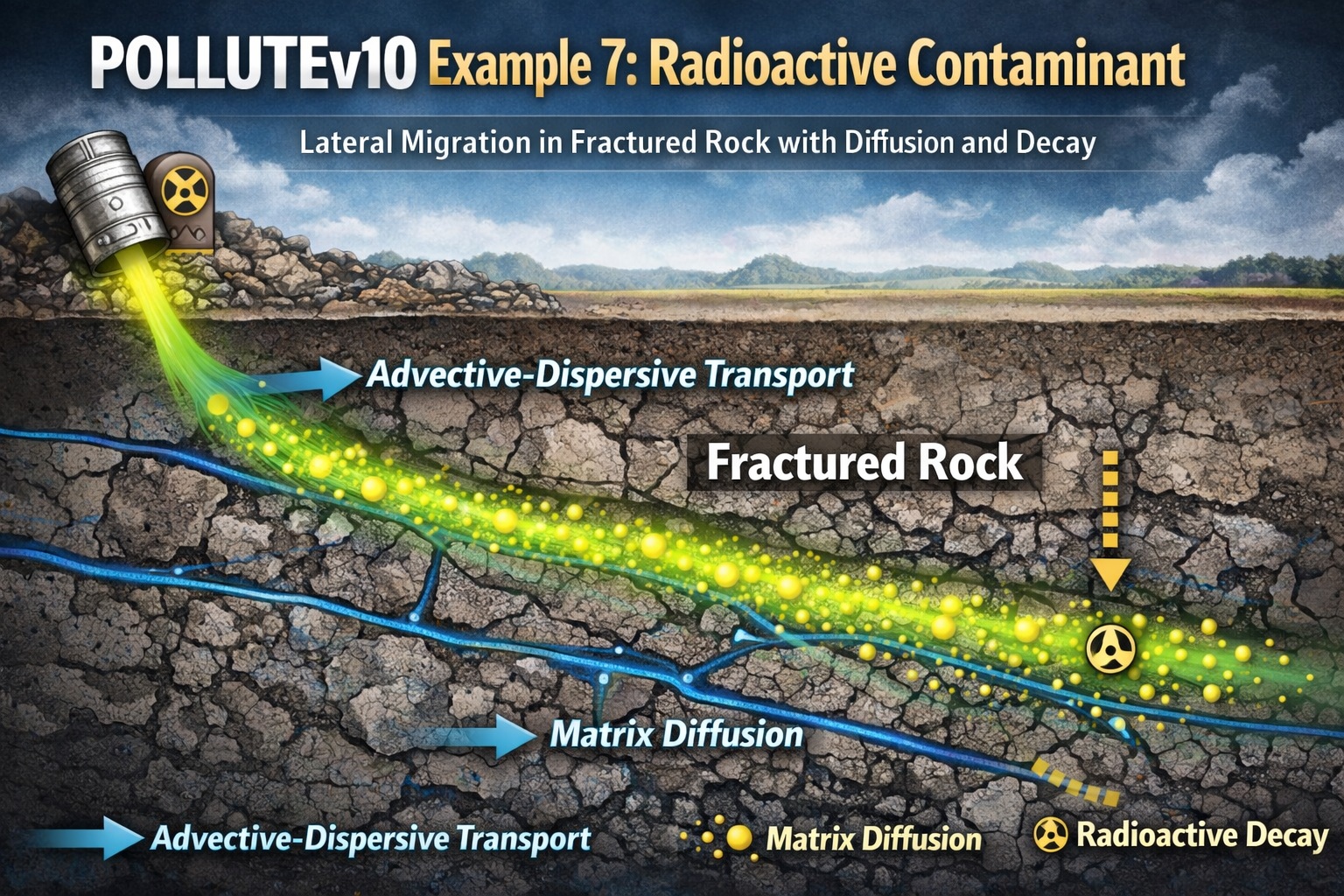
This example demonstrates how POLLUTEv10 can be used to simulate the lateral migration of a radioactive contaminant in a fractured porous rock system. It focuses on transport along a single set of parallel fractures, incorporating advection, dispersion, matrix diffusion, and radioactive decay.
The scenario is particularly relevant for nuclear waste disposal assessments, deep geological repositories, and long-term contaminant fate modeling.
Conceptual Model Overview
The model assumes:
- A fractured rock domain extending effectively infinitely from the source
- Transport occurring primarily along fractures (fast pathways)
- Diffusion into the surrounding rock matrix (slow storage zone)
- A radioactive contaminant that undergoes decay over time
The analysis focuses on:
- First 50 m of transport distance
- Time period of 30 years
Key Modeling Assumptions
- Initial source concentration: co = 1 (normalized unit)
- The source is constant (no depletion) due to large supply
- Radioactive decay occurs continuously
- No sorption in fractures or matrix (Kf = Km = 0)
- Transport is governed by:
- Advection
- Dispersion
- Matrix diffusion
- First-order radioactive decay
Governing Radioactive Decay
The decay of the contaminant follows first-order kinetics:
Where:
- = concentration at time t
- = initial concentration
- = decay constant
- = time (years)
The decay constant is related to half-life:
This means that over 30 years, only modest decay occurs, making transport processes dominant in plume evolution.
Input Parameters
Hydraulic and Transport Properties
| Property | Symbol | Value | Units |
|---|---|---|---|
| Darcy Velocity | va | 0.08 | m/a |
| Dispersion in fractures | Df | 6 | m²/a |
| Matrix diffusion coefficient | Dm | 0.0018 | m²/a |
Fracture Geometry
| Property | Value |
|---|---|
| Fracture spacing (2H1) | 0.05 m |
| Fracture aperture (2h1) | 10 μm |
These closely spaced fractures create highly efficient lateral pathways for contaminant migration.
Matrix Properties
| Property | Value |
|---|---|
| Matrix porosity (nm) | 0.05 |
| Distribution coefficient (Km) | 0 cm³/g |
| Dry density | 2 g/cm³ |
With no sorption, the matrix acts purely as a diffusive sink, not a reactive barrier.
Domain and Simulation Setup
| Property | Value |
|---|---|
| Fractured rock thickness (HT) | 50 m |
| Number of sub-layers | 5 |
| Source concentration (co) | 1 |
| Half-life | 100 years |
| Simulation time | 30 years |
| Distance of interest | 50 m |
Special Feature: Maximum Sublayer Thickness
This example highlights a POLLUTEv10 special feature:
- Ability to define sublayers thicker than the default 5 units
- Allows efficient modeling of large domains (50 m) with fewer layers
- Maintains numerical stability while improving computational efficiency
This is especially useful in regional-scale fractured rock simulations.
Transport Processes Explained
1. Advective–Dispersive Flow in Fractures
- Advection drives the contaminant forward along fractures
- Dispersion spreads the plume longitudinally
- Results in rapid lateral migration over tens of meters
2. Matrix Diffusion
- Contaminants diffuse from fractures into the rock matrix
- Acts as a temporary storage mechanism
- Slows peak concentrations in fractures
- Leads to long-term back-diffusion
3. Radioactive Decay
- Reduces total contaminant mass over time
- Less significant over 30 years due to long half-life (100 years)
- Becomes more important in long-term (>100 year) simulations
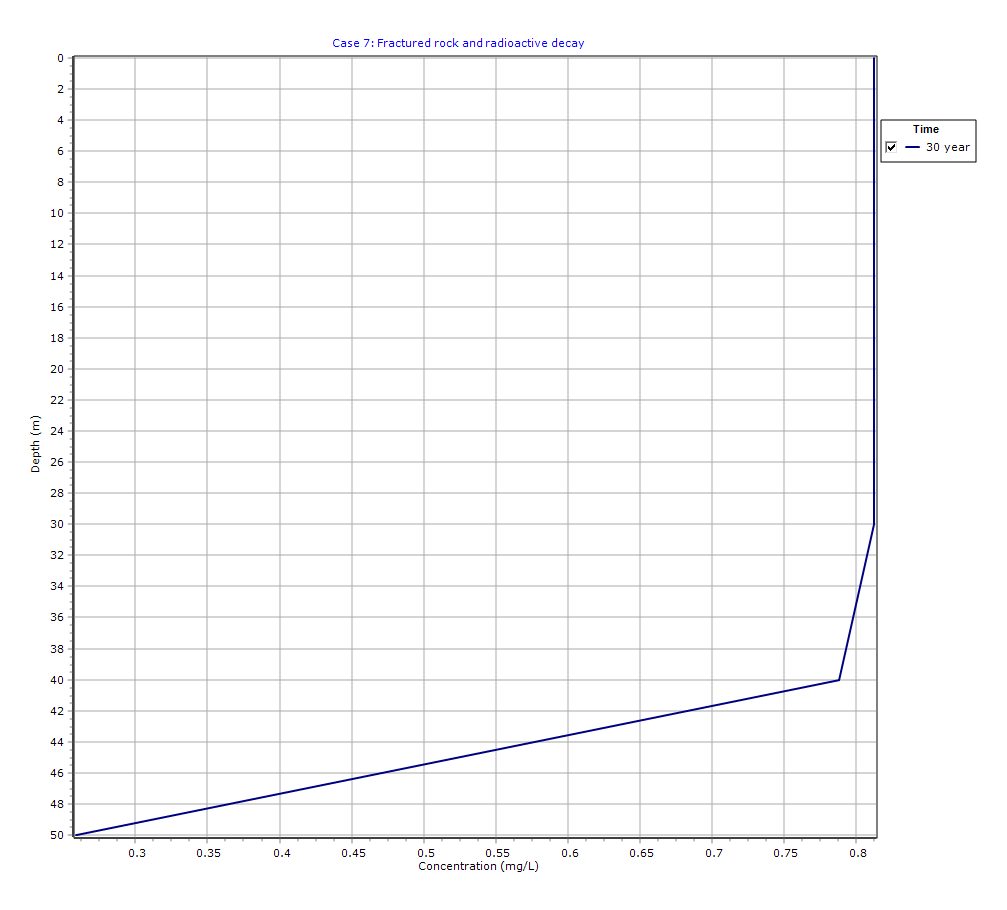
Graphical Output: Depth vs Concentration
PDF Report
 Loading…

 Reload document
  Open in new tab
 Engineering and Environmental Insights
- Fractured rock systems can enable fast contaminant migration, even with low matrix permeability
- Matrix diffusion is critical for realistic long-term predictions
- Radioactive decay alone is insufficient for short-term attenuation
- This type of modeling is essential for:
- Nuclear waste repository design
- Risk assessment of radioactive contaminants
- Long-term groundwater protection strategies