

Introduction
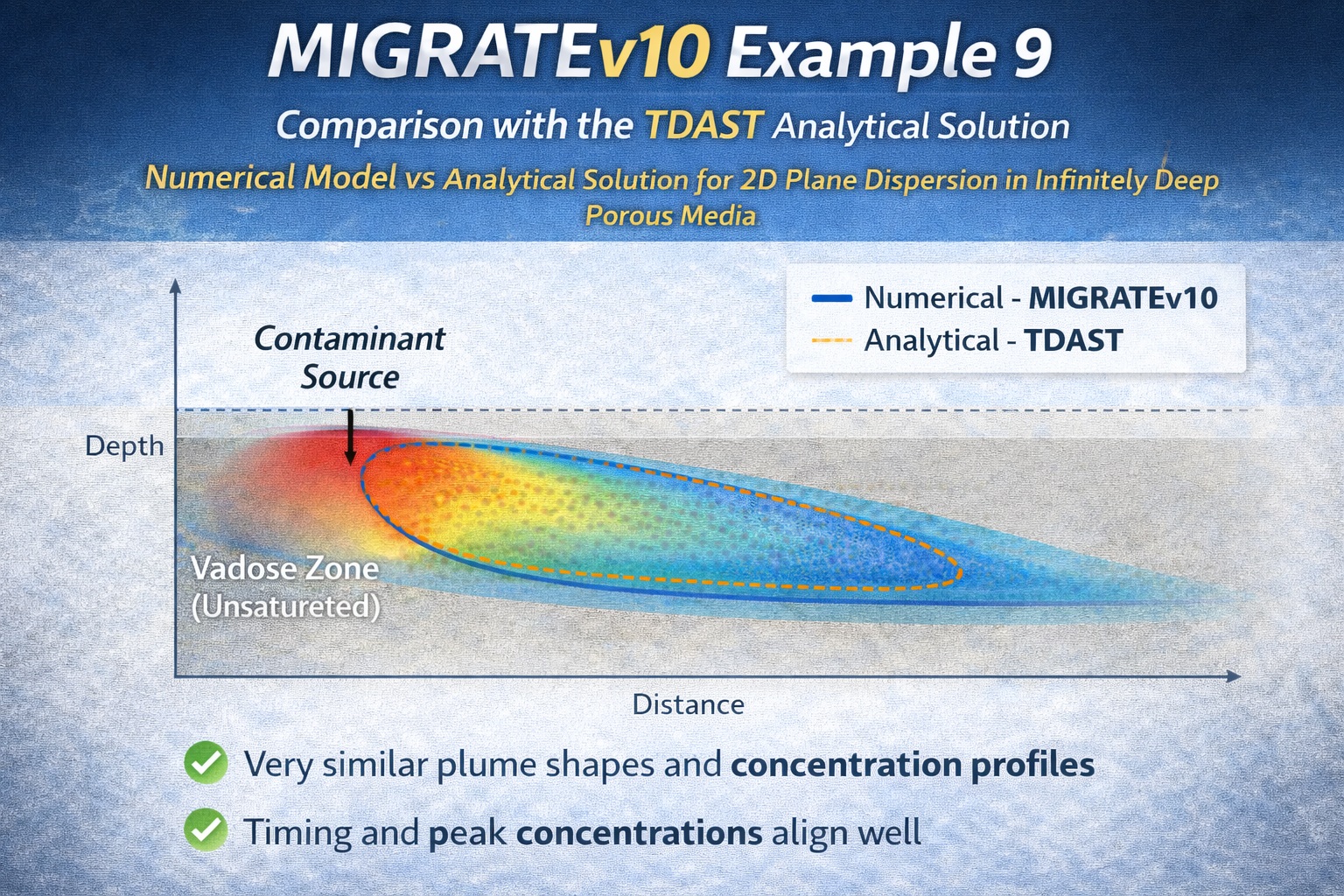
MIGRATEv10 Example 9 focuses on model validation by comparing numerical results from MIGRATEv10 with an established analytical solution.
The benchmark used is TDAST, a program developed by Javandel et al. (1984) for solving 2-D plane dispersion in infinitely deep porous media. This example demonstrates how closely MIGRATE can reproduce analytical solutions and provides confidence in its numerical approach.
Conceptual Model Overview
The modeled system represents:
- A 2-D contaminant plume
- Migration through an infinitely deep porous medium
- Transport governed by:
- Advection
- Dispersion
What is TDAST?
TDAST (Javandel et al., 1984) is a well-known analytical tool used for:
- Solving 2-D dispersion problems
- Modeling contaminant transport in idealized infinite domains
Key Characteristics
- Assumes infinite depth
- Provides analytical (exact) solutions
- Used as a benchmark for validating numerical models
Key Modeling Objective
The purpose of this example is to:
- Compare MIGRATEv10 results with analytical solutions
- Evaluate:
- Accuracy
- Consistency
- Numerical reliability
Modeling Assumptions
To ensure a valid comparison, the model is simplified:
- Infinite vertical domain (approximated in MIGRATE)
- Homogeneous porous medium
- Constant transport parameters
- No complex boundary effects
👉 These assumptions align MIGRATE with the analytical conditions used in TDAST.
Modeling Approach in MIGRATEv10
Step 1: Define Equivalent Geometry
- Approximate infinite depth using a sufficiently large domain
Step 2: Assign Transport Parameters
- Match dispersion and velocity values used in TDAST
Step 3: Configure Boundary Conditions
- Minimize boundary influence
- Simulate open or far-field conditions
Step 4: Run Simulation
- Generate concentration distributions
- Extract results for comparison
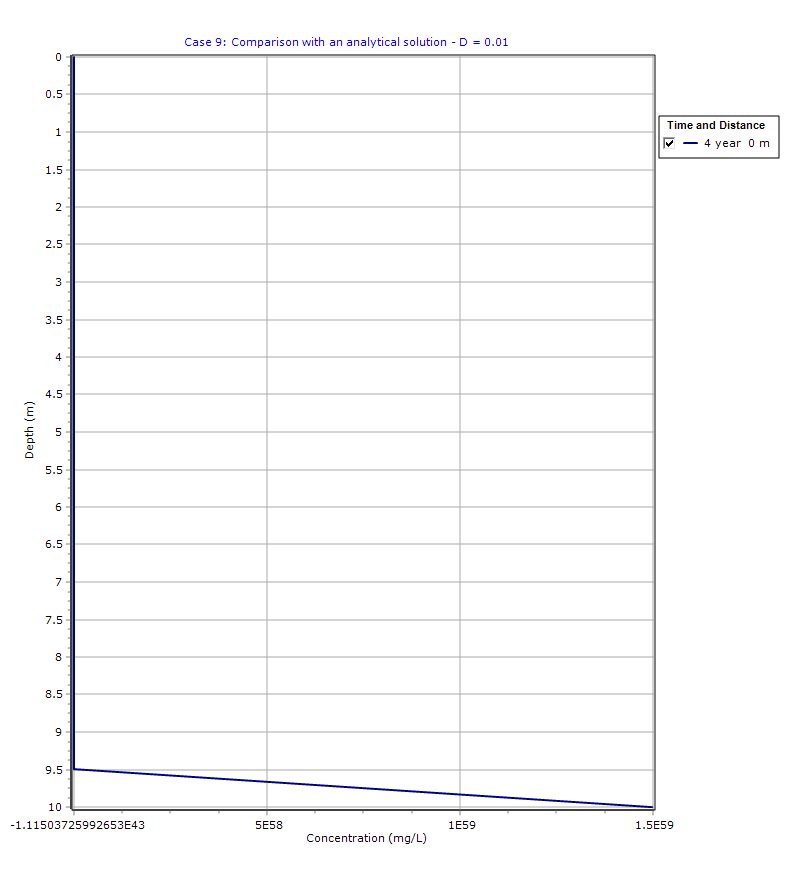
Graphical Output: Depth vs Concentration
PDF Report
 Loading…

 Reload document
  Open in new tab
 Comparison of Results
1. Concentration Profiles
- MIGRATEv10 results closely match TDAST predictions
- Plume shape and spread are nearly identical
2. Breakthrough Behavior
- Timing of concentration arrival is consistent
- Peak concentrations align well
3. Spatial Distribution
- Similar plume geometry across the domain
- Minor differences may occur due to:
- Numerical discretization
- Finite domain approximation
Interpretation of Differences
Small discrepancies between MIGRATE and TDAST may arise from:
- Finite vs infinite domain representation
- Numerical integration approximations
- Grid or resolution effects
👉 These differences are typically minor and acceptable
Why This Example Matters
1. Model Validation
This example confirms that MIGRATEv10 can:
- Accurately reproduce analytical solutions
- Be trusted for more complex simulations
2. Confidence in Numerical Methods
Agreement with TDAST demonstrates:
- Correct implementation of transport equations
- Reliable numerical integration techniques
3. Foundation for Advanced Modeling
Once validated, MIGRATE can be applied to:
- Real-world landfill scenarios
- Complex layered systems
- Non-ideal boundary conditions
Key Takeaways
- MIGRATEv10 closely matches TDAST analytical solutions
- Numerical models can achieve high accuracy when properly configured
- Analytical comparisons are essential for:
- Validation
- Quality assurance
- Small differences are expected due to modeling assumptions
Practical Insight
Always validate numerical models against analytical solutions when possible.
This ensures that:
- Model setup is correct
- Results are physically meaningful
- Predictions are defensible
Final Thoughts
MIGRATEv10 Example 9 highlights the importance of benchmarking and validation in environmental modeling. By demonstrating strong agreement with TDAST, this example reinforces confidence in MIGRATE’s ability to simulate contaminant transport accurately.
This validation step is especially important before applying the model to:
- Regulatory studies
- Risk assessments
- Design evaluations
Learn more about our Contaminant Transport Modeling Solutions
MIGRATE Examples
- MIGRATEv10 Example 1: Modeling a RCRA Subtitle D Landfill with a Composite Liner
- MIGRATEv10 Example 2: Composite Liner System with Primary & Secondary Leachate Collection
- MIGRATEv10 Example 3: Pure Diffusion of a Conservative Contaminant
- MIGRATEv10 Example 4: Finite Mass Source and Aquifer Mixing with Base Outflow
- MIGRATEv10 Example 5: Understanding Integration, Accuracy, and the Role of Engineering Judgment
- MIGRATEv10 Example 6: Eliminating Negative Concentrations Through Improved Integration
- MIGRATEv10 Example 7: Improving Accuracy with User-Selected Fourier Integration
- MIGRATEv10 Example 8: Evaluating Contaminant Migration at Multiple Lateral Positions
- MIGRATEv10 Example 10: Contaminant Transport in Fractured Media with Sorption
- MIGRATEv10 Example 11: Contaminant Migration from Two Adjacent Landfill Cells
- MIGRATEv10 Example 12: Modeling Time-Dependent Source Histories for Multiple Landfill Cells
- MIGRATEv10 Example 13: Termination of Primary Leachate Collection System
Comparison between POLLUTE and MIGRATE
- MIGRATEv10 vs POLLUTEv10: Pure Diffusion Comparison
- MIGRATEv10 vs POLLUTEv10: Advective–Diffusive Transport Comparison
- MIGRATEv10 vs POLLUTEv10: Finite Mass Source Comparison
- MIGRATEv10 vs POLLUTEv10: Hydraulic Trap (Finite Mass Source) Comparison
- MIGRATEv10 vs POLLUTEv10: Fractured Layer with Sorption Comparison