

Introduction
MIGRATEv10 Example 13 explores a critical long-term scenario in landfill performance:
👉 What happens when the primary leachate collection system (PLCS) stops operating?
This example builds directly on Example 1 by introducing time-dependent changes in hydraulic conditions following landfill closure. It highlights how reduced system performance can significantly impact leakage rates and contaminant migration.
Conceptual Model Overview
The modeled system includes:
- A RCRA Subtitle D landfill
- A composite liner system:
- 60 mil geomembrane
- 0.9 m compacted clay liner
- A primary leachate collection system (PLCS)
- Time-dependent changes in leachate head and Darcy velocity
Key Modeling Objective
This example aims to:
- Simulate the termination of leachate collection system performance
- Evaluate how increasing leachate head affects leakage rates
- Assess long-term impacts on contaminant transport
Landfill and Liner System
| Component | Description |
|---|---|
| Geomembrane | 60 mil (1.5 mm), good contact |
| Clay Liner | 0.9 m thick |
| System Type | Composite liner |
This configuration provides strong containment—while the PLCS is functioning.
Source Behavior
Early Operation Phase (0–10 years)
- Contaminant concentration increases linearly
- Peak concentration reached at 10 years
Leachate Collection System Performance
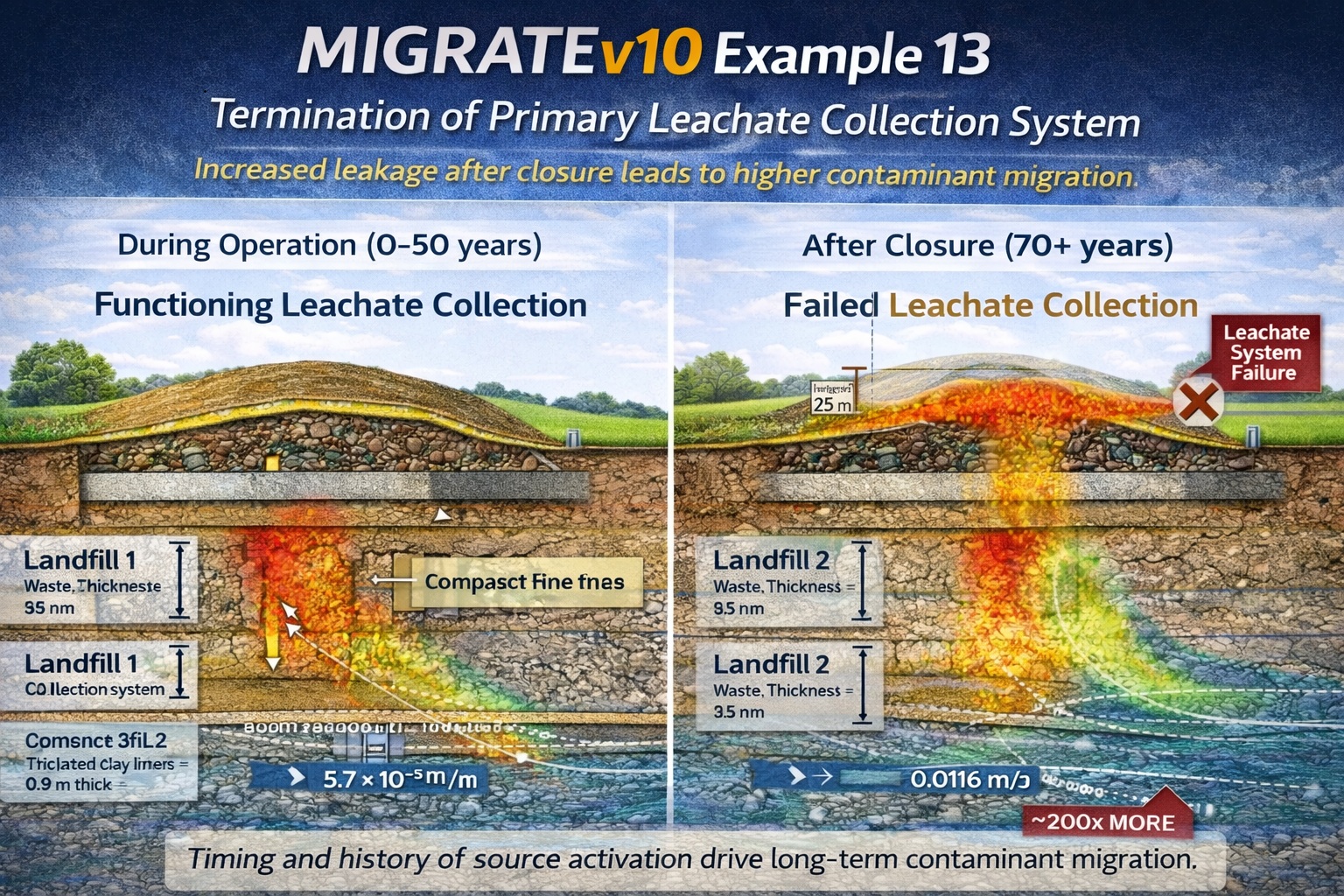
During Operation (0–50 years)
- PLCS is active Downward Darcy velocity:
va = 5.7 10-5 m/a
👉 This low velocity reflects effective leachate removal
Post-Closure Conditions
At 50 Years: System Termination
- PLCS stops functioning
- Cover system is no longer maintained
- Leachate begins to accumulate
50–70 Years: Transition Phase
- Leachate mound rises gradually
- Darcy velocity increases over time
👉 Modeled using linear interpolation divided into 5 steps
At 70 Years: Maximum Leachate Mound
- Leachate head reaches 25 m
- New Darcy velocity:
va = 0.0116 m/a
👉 This represents a ~200× increase in leakage potential
Modeling Approach in MIGRATEv10
Step 1: Start with Example 1 Model
- Same geometry and liner system
Step 2: Define Time-Dependent Source
- Linear increase in concentration (0–10 years)
Step 3: Apply Initial Flow Conditions
- Darcy velocity during PLCS operation
Step 4: Introduce System Termination (50 years)
- Modify boundary conditions
- Remove leachate collection effect
Step 5: Model Transition Phase (50–70 years)
- Divide into 5 time steps
- Gradually increase Darcy velocity
Step 6: Apply Final Conditions (70+ years)
- Use maximum Darcy velocity
- Continue simulation
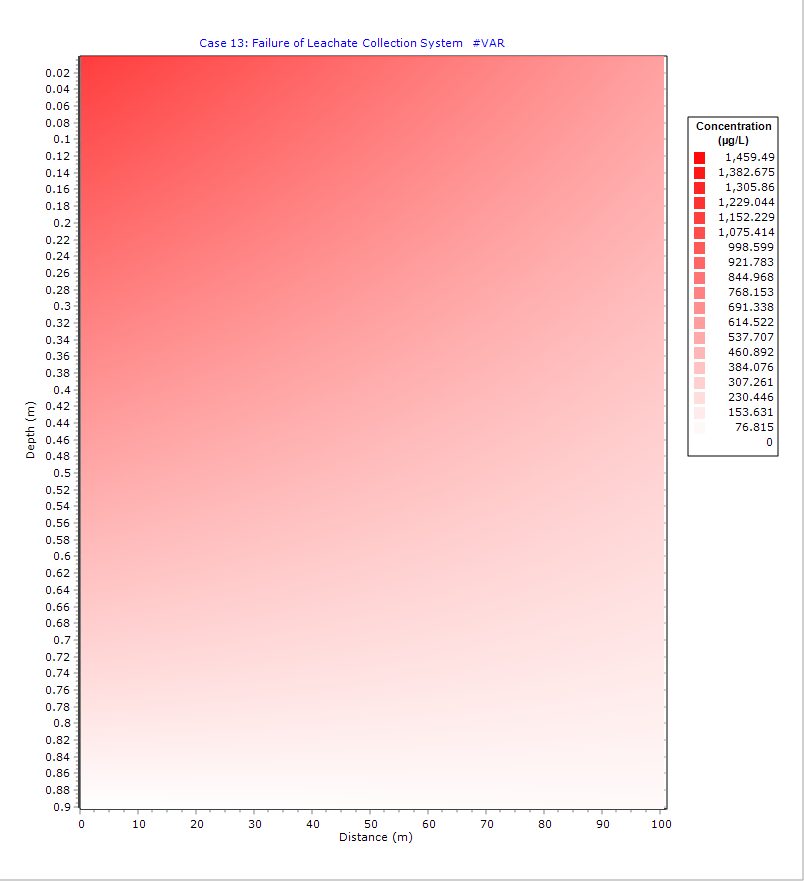
Graphical Output: Depth vs Distance
PDF Report
 Loading…

 Reload document
  Open in new tab
 Interpretation of Results
1. Early Period (0–50 years)
- Minimal leakage
- Effective containment
- Low contaminant migration
2. Transition Period (50–70 years)
- Increasing leakage rates
- Accelerated contaminant movement
3. Long-Term Behavior (70+ years)
- Significantly higher contaminant flux
- Greater impact on underlying aquifer
Key Insights
1. Importance of Leachate Collection Systems
- PLCS plays a critical role in limiting leakage
- System failure dramatically increases risk
2. Sensitivity to Leachate Head
- Leakage is highly dependent on:
- Hydraulic head
- System maintenance
3. Long-Term Risk
- Post-closure conditions may pose greater risk than active operation
Practical Implications
This example is highly relevant for:
- Long-term landfill performance assessment
- Closure planning and post-closure care
- Regulatory evaluation of containment systems
Key Takeaways
- Termination of PLCS leads to significant increases in leakage
- Time-dependent modeling is essential for realistic predictions
- Leachate mound height is a critical control parameter
- MIGRATEv10 can simulate changing system conditions over decades
Final Thoughts
MIGRATEv10 Example 13 highlights a crucial reality in landfill engineering:
Containment systems do not perform the same way over time
By modeling the failure of the leachate collection system, this example demonstrates how long-term conditions can dramatically alter contaminant migration behavior. It underscores the importance of:
- Proper closure design
- Long-term monitoring
- Conservative modeling assumptions
Learn more about our Contaminant Transport Modeling Solutions
MIGRATE Examples
- MIGRATEv10 Example 1: Modeling a RCRA Subtitle D Landfill with a Composite Liner
- MIGRATEv10 Example 2: Composite Liner System with Primary & Secondary Leachate Collection
- MIGRATEv10 Example 3: Pure Diffusion of a Conservative Contaminant
- MIGRATEv10 Example 4: Finite Mass Source and Aquifer Mixing with Base Outflow
- MIGRATEv10 Example 5: Understanding Integration, Accuracy, and the Role of Engineering Judgment
- MIGRATEv10 Example 6: Eliminating Negative Concentrations Through Improved Integration
- MIGRATEv10 Example 7: Improving Accuracy with User-Selected Fourier Integration
- MIGRATEv10 Example 8: Evaluating Contaminant Migration at Multiple Lateral Positions
- MIGRATEv10 Example 9: Comparison with the TDAST Analytical Solution
- MIGRATEv10 Example 10: Contaminant Transport in Fractured Media with Sorption
- MIGRATEv10 Example 11: Contaminant Migration from Two Adjacent Landfill Cells
- MIGRATEv10 Example 12: Modeling Time-Dependent Source Histories for Multiple Landfill Cells
Comparison between POLLUTE and MIGRATE
- MIGRATEv10 vs POLLUTEv10: Pure Diffusion Comparison
- MIGRATEv10 vs POLLUTEv10: Advective–Diffusive Transport Comparison
- MIGRATEv10 vs POLLUTEv10: Finite Mass Source Comparison
- MIGRATEv10 vs POLLUTEv10: Hydraulic Trap (Finite Mass Source) Comparison
- MIGRATEv10 vs POLLUTEv10: Fractured Layer with Sorption Comparison