

Overview
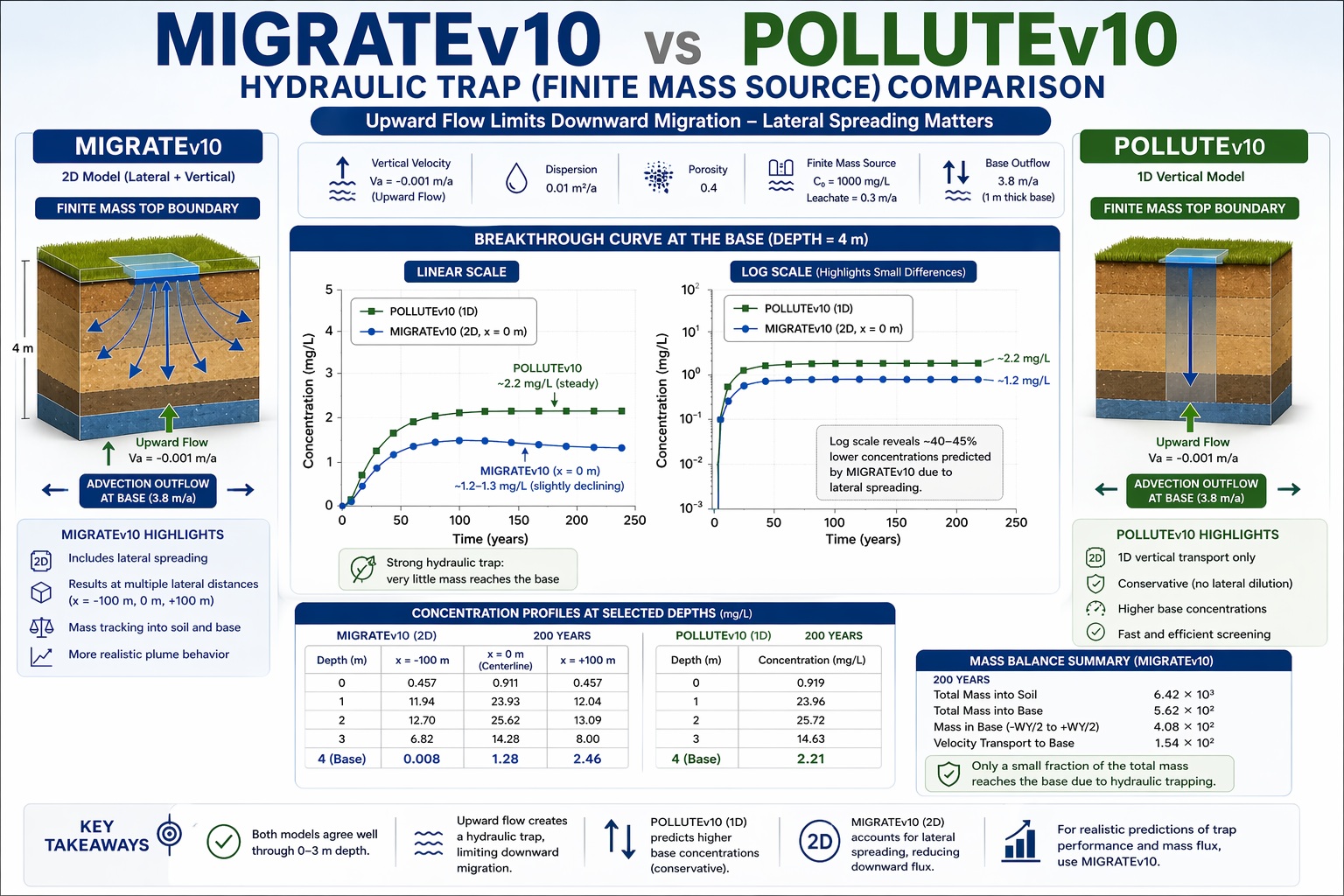
This example compares results from MIGRATEv10 and POLLUTEv10 for a hydraulic trap scenario with a finite mass source.
A hydraulic trap occurs when upward (negative) advective velocity counteracts downward contaminant migration. In this case:
- Vertical velocity = –0.001 m/a
- Finite contaminant mass at the top boundary
- Advective outflow at the base
This creates a system where contaminants are partially retained, significantly altering breakthrough behavior compared to standard downward flow cases.
Model Setup
Both models use consistent inputs:
- Layer thickness: 4 m
- Dispersion coefficient: 0.01 m²/a
- Porosity: 0.4
- Sorption: None (Kd = 0)
- Vertical velocity: –0.001 m/a (upward flow)
- Finite mass source:
- Initial concentration: 1000 mg/L
- Leachate collection: 0.3 m/a
- Reference head: 7.5 m
- Bottom boundary:
- Advective outflow (aquifer)
Results Comparison
Concentration Profiles at 200 Years
POLLUTEv10 (1D)
| Depth (m) | Concentration (mg/L) |
|---|---|
| 0 | 0.919 |
| 1 | 23.96 |
| 2 | 25.72 |
| 3 | 14.63 |
| 4 | 2.21 |
MIGRATEv10 (Centerline, x = 0 m)
| Depth (m) | Concentration (mg/L) |
| 0 | 0.911 |
| 1 | 23.93 |
| 2 | 25.62 |
| 3 | 14.28 |
| 4 | 1.28 |
Key Observations
1. Excellent Agreement Through Most of the Profile
At depths 0–3 m:
- Results are nearly identical between models
- Differences are negligible (<2–3%)
👉 Confirms both models solve the advection–dispersion equation with reversed flow consistently
2. Difference at the Base (Depth = 4 m)
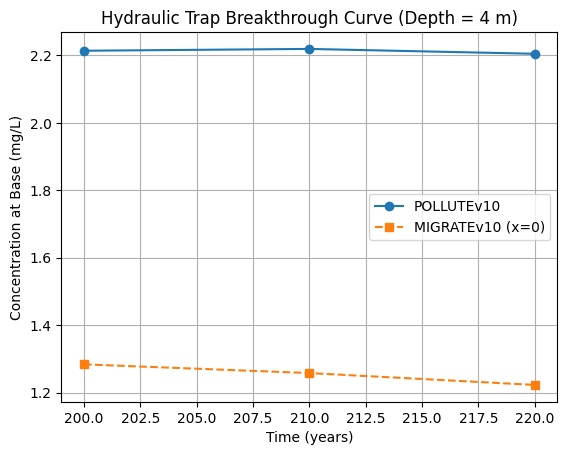
- POLLUTEv10: ~2.21 mg/L
- MIGRATEv10 (x = 0): ~1.28 mg/L
👉 MIGRATE predicts ~40–45% lower concentration
3. Why the Difference?
This is again due to dimensionality effects:
POLLUTEv10 (1D)
- All contaminant mass moves vertically
- No lateral spreading
- Produces higher base concentrations
MIGRATEv10 (2D)
- Includes lateral spreading
- Some contaminant mass is diverted sideways
- Results in reduced downward flux
4. Hydraulic Trap Behavior
This case highlights unique physics:
- Upward flow opposes contaminant migration
- Contaminants accumulate within the layer
- Peak concentrations occur within the soil, not at the base
At ~2 m depth:
- Concentrations exceed 25 mg/L
- Indicates a zone of accumulation (trap region)
5. Lateral Variability (MIGRATEv10)
At 200 years:
| Distance | Base Concentration (mg/L) |
| x = –100 m | ~0.008 |
| x = 0 m | ~1.28 |
| x = +100 m | ~2.46 |
This shows:
- Strong lateral gradients
- Edge effects can increase or decrease concentrations
- Behavior depends on plume geometry and flow field
6. Mass Transport Insights
MIGRATEv10 provides mass balance information:
- At 200 years:
- Mass into soil ≈ 6.42 × 10³
- Mass into base ≈ 5.62 × 10²
👉 Only a small fraction of mass reaches the base, confirming the trapping effect
Key Differences Summary
| Feature | MIGRATEv10 | POLLUTEv10 |
| Dimensionality | 2D (lateral + vertical) | 1D (vertical only) |
| Agreement (0–3 m) | Excellent | Benchmark |
| Base concentration | Lower (~1.3 mg/L) | Higher (~2.2 mg/L) |
| Lateral spreading | Included | Not included |
| Mass tracking | Yes | No |
| Trap representation | Realistic plume | Conservative |
Interpretation
- Both models correctly simulate hydraulic trapping behavior
- POLLUTEv10 provides a conservative estimate of base concentration
- MIGRATEv10 provides a more realistic distribution, accounting for lateral spreading and reduced vertical flux
This case demonstrates that:
In low or upward flow systems, lateral spreading becomes even more important, significantly reducing breakthrough.
Conclusion
The hydraulic trap scenario reinforces a consistent theme:
- Physics is consistent between models
- Differences arise from dimensionality
Key takeaway:
- Use POLLUTEv10 for conservative screening
- Use MIGRATEv10 when evaluating:
- Trap efficiency
- Plume distribution
- Mass flux to underlying aquifers
Learn more about our Contaminant Transport Modeling Solutions
POLLUTE and MIGRATE Contaminant Modeling and Landfill Design
Comparison between POLLUTE and MIGRATE
- MIGRATEv10 vs POLLUTEv10: Pure Diffusion Comparison
- MIGRATEv10 vs POLLUTEv10: Advective–Diffusive Transport Comparison
- MIGRATEv10 vs POLLUTEv10: Finite Mass Source Comparison
- MIGRATEv10 vs POLLUTEv10: Fractured Layer with Sorption Comparison